When to Replace Running Shoes: Miles, Wear Signs and More
When to replace running shoes depends on mileage, wear, and your stride. Check the warning signs and learn when to retire or repurpose a pair.

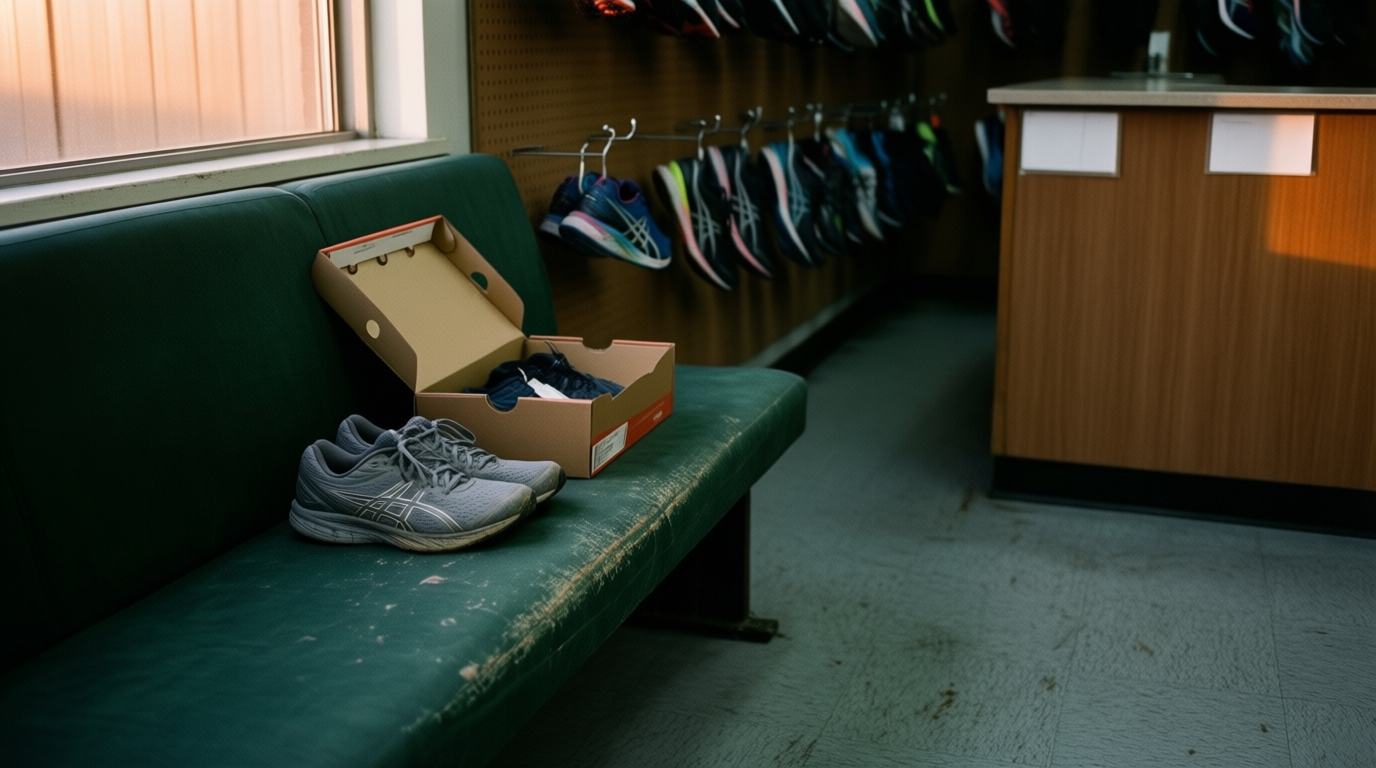
Think of your running shoes like a trusted pair of work boots. They carry you through every mile, and then one day the cushioning is flat and your knees start complaining. You still lace them up, but they’re no longer doing the job you paid for.
So how do you know when it’s time? In this post, we’ll cover how many miles a typical pair handles, the wear signs you can check yourself, and how your running style changes the timing.
We’ll also share practical shop-counter advice on retiring, repurposing, and brand-specific lifespans.
When to Replace Running Shoes by Mileage
The question is less about how old a pair is and more about how far it’s gone.
The usual 300 to 500 mile guideline
According to podiatrists featured by NBC News, the average pair lasts 300 to 500 miles. A Journal of Biomechanics study looked at how aging affects a shoe’s mechanics.
There’s no hard-and-fast rule, so treat these as a starting point. Is 300 miles okay? Yes, it’s on the cautious side of the range. How many miles do Hokas last? We don’t have a verified number, so use the 300 to 500 range.
Replacing sooner as weekly miles climb
A PLOS One study notes casual runners may take longer to hit replacement mileage than runners who train more often. Rough timing:
- Casual runners: 8 to 12 months
- 5K and 10K (5 and 10 kilometers): 5 to 8 months
- Half-marathon: 4 to 6 months
- Marathon: every 2 to 3 months
- Around 15 miles a week: 5 to 8 months
A weekend runner at 15 miles a week should swap shoes before race season, not mid-training.
Tracking months, miles and wear together
Lifespans run 3 to 12 months. How long do Asics shoes last? We don’t have a verified number, so use that range. Log miles in a fitness app.
A study on running shoe end-of-life says half-marathon runners should base replacement on mileage and wear, not a fixed number of months. End-of-life signs include:
- excessive outsole (the tread) or upper wear
- a significant tear
- unbonded parts
Combine all three, since a longitudinal study of plantar pressures notes your foot’s pressure pattern may shift as shoes wear. Frequent swaps add up fast, so let wear decide.
What Affects How Long Shoes Last
Running shoes don’t wear out on a calendar. Your body, your ground and the shoe’s build all set the pace.
How your body and running style matter
Your stride does much of the work. Pronation, the way your foot rolls inward on landing, changes how a shoe wears. Body weight and height add load with every step, foot type shapes where that load lands, and training volume and frequency set the clock.
Consider a parent who runs three mornings a week and a coworker training five days for a half-marathon, both in the same shoe. The coworker will be shopping for new pairs long before the parent is.
How running surfaces wear shoes down
Pavement is hard on foam, so road shoes lose cushioning faster than shoes used on softer ground. Trail shoes are built for dirt and loose rock, so running them mostly on pavement wears their lugs (the rubber bumps that grip the ground) down quickly.
Match the shoe to the surface you run on most, because the ground can matter as much as the miles.
How shoe design and cushioning hold up
Quality and materials set the baseline, so well-built shoes with durable rubber generally last longer, but a higher price isn’t a guarantee. Max-cushion foam feels plush out of the box, but its durability varies. Thick isn’t the same as tough.
The midsole, the foam layer under your foot, varies in compound from model to model. Low-profile midsoles, the thinner soles that sit closer to the ground, break down sooner because there’s less material absorbing each step.
Heavier runners should look for supportive models built to handle more load, not the lightest option on the shelf. Check how a shoe is built, not just what’s on the box.
Signs Your Running Shoes Are Worn Out
Most running shoes don’t announce when they’re finished. The clues show up in the foam, tread, upper and how your legs feel after a run.
Cushioning that feels flat or stiff
The midsole is the foam between your foot and the ground, and it does most of the cushioning. When it breaks down, the shoe feels different before it looks different. Watch for:
- Flat, stiff or dense feel. Your usual pair no longer feels soft underfoot.
- Creasing along the sidewalls. Deep creases mean the foam has packed down.
- Thumb-press rebound. Press your thumb into the midsole. Fresh foam springs back fast, while tired foam stays dented.
Reduced shock absorption and a harder foot strike go hand in hand. If each footfall jolts up your shins, the foam isn’t doing its job anymore.
The fastest check is comparing old against new. Think of a weekend 5K runner who alternates two pairs. She jogs the same loop in each and feels the worn pair’s stiffness right away, so she retires it before her shins start paying for it.
Tread that’s worn smooth or uneven
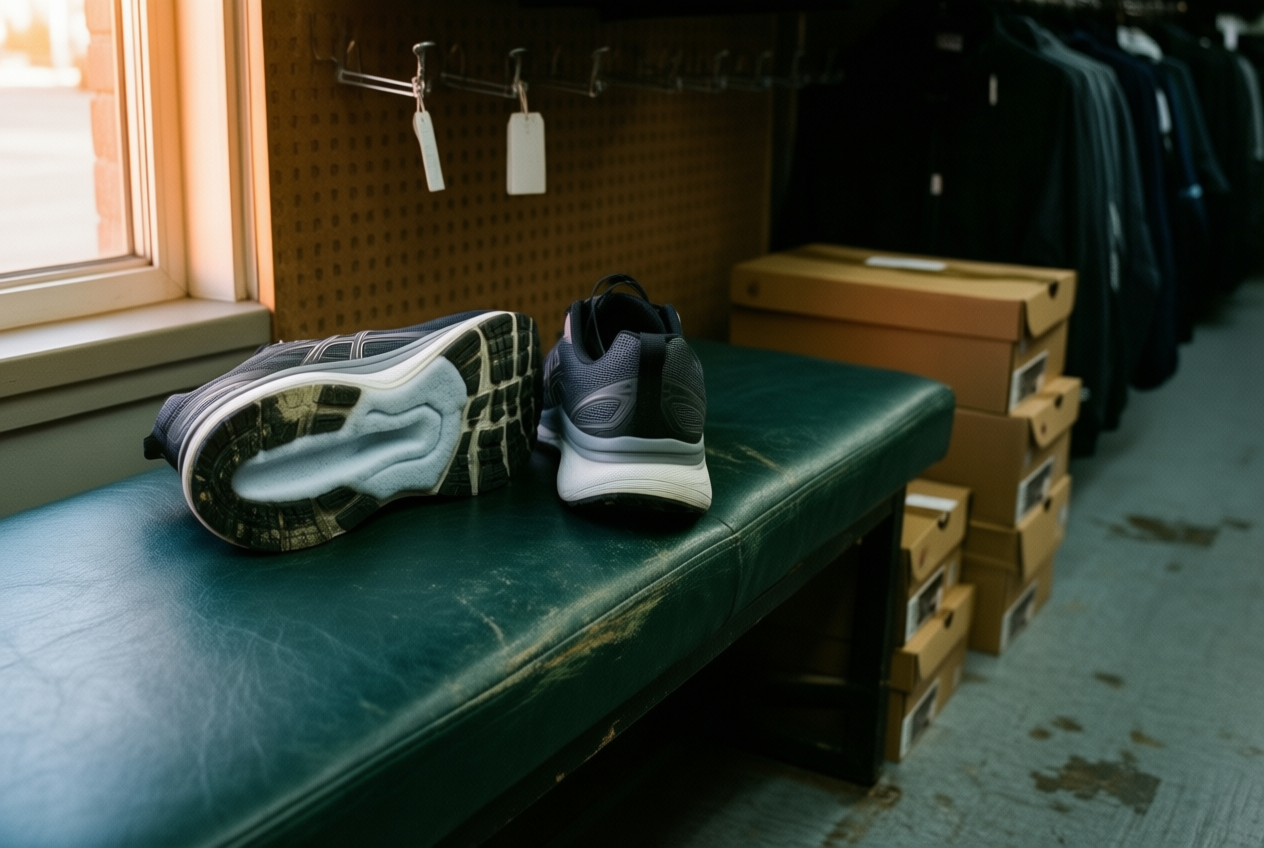
Check the outsole, the rubber on the bottom. Worn tread, especially where the midsole shows through, costs you grip, and smooth tread is risky on wet ground. If one shoe wears faster than its partner, pay attention.
Wear patterns can also reveal your foot strike. Finally, set both shoes on a flat table. If they don’t stand straight, one side has worn more than the other.
Tears and fraying in the upper
The upper, the fabric wrapping your foot, is where damage is easiest to see. Fraying or torn spots are obvious, but toes wearing through the toe-box, the front section that holds your toes, usually mean the shoe has lost its shape.
Fraying along the inner heel can rub your ankle on every stride, and a peeling outsole or foam means the structure is failing.
When your body and runs feel off
Your body often notices wear before your eyes do. New joint or foot pain, running that suddenly feels harder, fatigue on familiar routes and new blisters all deserve attention.
Mystery aches, like knee pain that shows up out of nowhere, are a good reason to check your shoes first. Don’t wait for it to get worse.
Check your shoes once a month
Make it routine: once a month, take two minutes to:
- press the midsole,
- glance at the tread,
- look over the upper and
- set the pair on a flat surface.
Regular checks catch problems before they become an injury risk. Judge them by how they feel today, not how far they’ve gone, and trust your body if it disagrees with a clean-looking pair.
So when do you throw them out? There’s no single cutoff for every runner. Retire a pair when several signs show up together, or when one serious problem, like a peeling sole or a torn upper, appears.
Replacing for reasons other than wear
Sales and redesigns tempt plenty of runners, but a pair that still feels right doesn’t need replacing because a newer model landed.
Mixing road and trail is different: if you’ve started running dirt trails in pavement shoes, a pair built for that terrain may serve you better. Colorway enthusiasm is fun, but a bright new color isn’t a reason to retire a working shoe.
Buy because you need a new pair, and treat the color as a bonus.
Why Worn Shoes Are Worth Retiring
The real question is less about how old a pair looks and more about how its cushioning and tread are wearing down. Cushioning fades quietly.
How worn shoes raise injury risk
When cushioning breaks down, the shoe stops doing its main job:
- Reduced impact absorption. Less cushioning means less shock absorbed with every step.
- Increased joint stress. A cohort study of amateur marathon runners cites prior research showing worn-out shoes raise stress on the lower limbs.
- Greater foot collapse or pronation. Worn shoes can allow more foot collapse or pronation (the inward roll of the foot).
- Higher fall risk with worn tread. A traction study of worn shoes found that tread wear increases slip risk.
- Footwear as one factor. Shoes are one contributing factor, not the only one.
Injuries that often come from worn shoes
Worn shoes are often part of the story behind plantar fasciitis, runner’s knee, and iliotibial (IT) band syndrome. Take a weekend runner who logs three easy runs a week in last spring’s pair.
When her shins ache, she checks the midsole and tread before blaming her training.
Yale Medicine ties shin splints to running in shoes with poor support, and shoes that rub can cause new blisters. A study on exercise-related foot blisters suggests that new or worsening blisters are a reason to reassess shoe fit and condition.
How worn shoes slow you down
Worn shoes can make running less efficient and hamper your physical performance. CNA Lifestyle reported on a study that compared how participants ran in new shoes versus after 200 miles, finding small changes in movement.
Dr Gruber said those changes could make running less comfortable.
Can you use old running shoes for walking? Our sources focus on running, so they don’t settle that question. If you’re tempted, press the midsole and check the tread, and if either looks flat or smooth, the wear signs above still apply.
Ways to Make Your Shoes Last Longer
A few simple habits make your shoes last longer.
What is the 3 shoe rule?
The 3 shoe rule means two running pairs you rotate, plus a third pair just for everyday wear. It’s about rotating your pairs instead of overusing one.
- Rotate two pairs. Alternate them from run to run.
- Wear only for running. Keep them off errands.
- Separate pair for casual wear. Your third pair handles everyday walking.
- Dry time between runs. Let each pair dry fully before its next outing.
Think of a weekend runner who wears one pair every Saturday and Sunday. Alternating two pairs lets each one recover, so both last the season.
Cleaning and storing shoes the right way
- Spot clean, no machine. Wipe off grime by hand.
- Store cool and dry. Find a shelf that stays cool and dry between runs.
- Avoid heat and sunlight. Keep them out of direct sun and away from heaters.
- Untie laces before removing. Loosen them so you don’t yank your heel out of a tight collar.
Consider a first-time runner who leaves sweaty shoes in a hot car after a race. Heat is the enemy. So bring them inside to air out.
Use each pair for its own terrain
Road and trail shoes are built for different ground, so match each pair to its surface, not to convenience.
- Road shoes for road. Keep them on pavement and tracks.
- Trail shoes for trail. Save them for dirt and rocky paths.
Think of a club runner who wears her trail shoes on pavement all week, then shows up to Sunday’s trail run with worn-out shoes. Keep each pair in its lane and both last longer.
When a pair is finally done, don’t just toss it. Consider recycling or donating it instead.
Replacing running shoes isn’t about chasing the newest colorway. It’s about keeping the support and cushioning your body depends on, whether you’re checking mileage, scanning for wear, or paying attention to how your legs feel after a long run.
Use mileage as your starting point, then let the signs on the midsole and outsole confirm the call. Know when to swap them out, and every mile after that feels a little lighter.
References
- Variation in prevalence of participation limitation, injury location, and training habits between young and master runners: A cross-sectional study — journals.plos.org (2026)
- End-of-life of running shoes: does cushioning matter? — doi.org (2025)
- Injury Incidence and Prevention Strategies Among Amateur Marathon Runners: A Prospective Cohort Study — icr-heart.com (2025)
- Automated traction analysis for worn shoes: combining novel imaging technology, convolutional neural networks, and hydrodynamic modelling to predict friction performance — doi.org (2025)
- Shin Splints | Fact Sheets — yalemedicine.org (2026)
- Aging of running shoes and its effect on mechanical and biomechanical variables: implications for runners — pubmed.ncbi.nlm.nih.gov (2014)
- Longitudinal Analysis of Plantar Pressures with Wear of a Running Shoe — mdpi.com (2020)
- Etiological Foundation for Practical Strategies to Prevent Exercise-Related Foot Blisters — doi.org (2016)
- How Often Should You Replace Running Shoes? Podiatrists Explain — nbcnews.com (2026)
- How often should I replace my running shoes? Cushioning loss signals change — cnalifestyle.channelnewsasia.com (2026)
- Experts Advise When You Should Replace Your Old Running Shoes : ScienceAlert — sciencealert.com
Questions
What is the 3 shoe rule?
The 3 shoe rule means keeping two pairs of running shoes to alternate between runs, plus a third pair for everyday wear. Rotating running pairs gives each time to dry and recover, while keeping them off errands limits extra wear.
How long do Asics shoes last?
Asics shoes have no single verified lifespan. Use the typical running-shoe guideline of 300 to 500 miles, then check for flattened cushioning, worn tread, damage, or changes in how they feel.
How many miles do Hokas last?
Hoka shoes have no single verified mileage lifespan. A typical running shoe lasts about 300 to 500 miles, but running style, surfaces, shoe construction, and visible wear can shift that range.
Can I use old running shoes for walking?
Yes, old running shoes can be used for walking if their cushioning, tread, and structure are still in good condition. If the midsole feels flat or stiff, the tread is smooth, or parts are damaged, replace them rather than relying on them for walks.
When to throw out sneakers?
Replace sneakers when several signs of wear appear together, or when there is a serious problem such as a peeling sole or torn upper. Check for flattened cushioning, smooth or uneven tread, fraying, new discomfort, or blisters; mileage alone is not a fixed cutoff.
Is it okay to change my running shoes every 300 miles?
Yes. Replacing running shoes at 300 miles is a cautious choice within the usual 300-to-500-mile guideline. Also check cushioning, tread, and other wear signs, since some shoes may need replacing sooner and others may remain comfortable longer.
Sources
- How Often Should You Replace Running Shoes? Podiatrists Explain, nbcnews.com,
- Aging of running shoes and its effect on mechanical and biomechanical variables: implications for runners, pubmed.ncbi.nlm.nih.gov,
- Variation in prevalence of participation limitation, injury location, and training habits between young and master runners: A cross-sectional study | PLOS One, journals.plos.org,
- End-of-life of running shoes: does cushioning matter?, doi.org,
- Longitudinal Analysis of Plantar Pressures with Wear of a Running Shoe, mdpi.com,
- Injury Incidence and Prevention Strategies Among Amateur Marathon Runners: A Prospective Cohort Study | Journal of Heart Valve Disease, icr-heart.com,
- Automated traction analysis for worn shoes: combining novel imaging technology, convolutional neural networks, and hydrodynamic modelling to predict friction, doi.org,
- Etiological Foundation for Practical Strategies to Prevent Exercise-Related Foot Blisters, doi.org,
- Shin Splints | Fact Sheets | Yale Medicine, yalemedicine.org,
- How often should I replace my running shoes? Cushioning loss signals change - CNA Lifestyle, cnalifestyle.channelnewsasia.com,
- Experts Advise When You Should Replace Your Old Running Shoes : ScienceAlert, sciencealert.com
Find your level
The Counter