How to Fit Running Shoes Properly
Measure both feet, try running shoes on late in the day and check length, width, heel and laces, so the pair that fits in the store still fits at mile five.
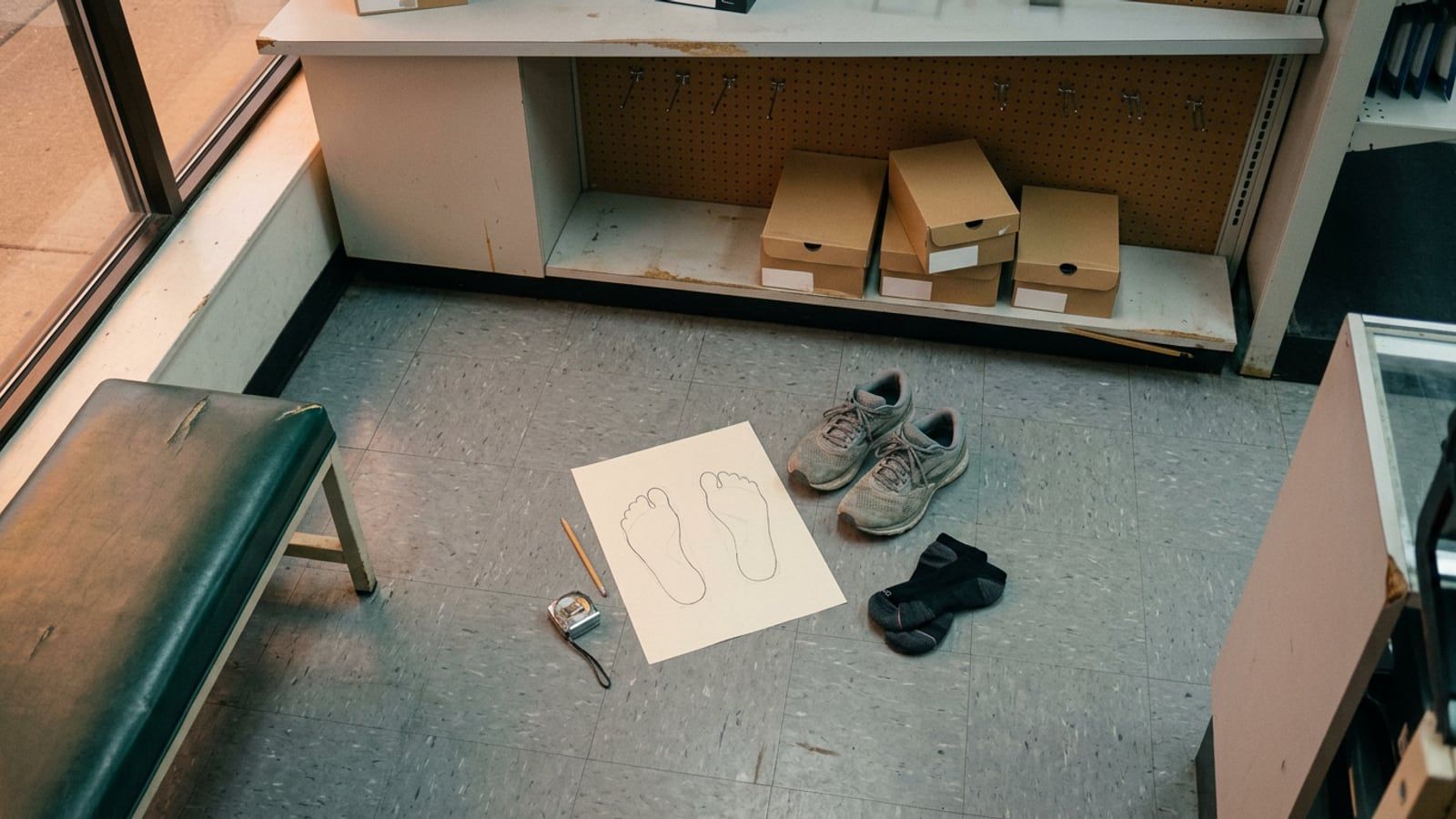
A running shoe that fits is one you stop noticing a mile in. One that does not shows up later as a bruised toenail or a heel blister, usually after the return window has closed. Fit comes down to length, width, how the heel holds and how the laces pull it together. All it takes is a tape measure, the socks you run in and ten honest minutes in the shoes before you pay.
Measure both feet before you shop
The size on your last pair is a starting point, not an answer. Sizing drifts between brands and even between models, so measure first.
- Put on the socks you run in. A thin sock and a cushioned one fit differently, and cotton holds sweat against the skin, so run in synthetic or merino socks; there is a pair we like on our Gear page.
- Stand on a sheet of paper with your weight even on both feet, and have someone trace around each foot with the pen held straight up.
- Measure each tracing from the back of the heel to the tip of the longest toe, then across the widest part of the forefoot.
- Fit the larger foot. Running Warehouse’s fit guide notes that your two feet can differ by as much as a full size.
- Look the length up on the brand’s size chart for running shoes rather than assuming your everyday size.
Expect the number to move. Running Warehouse notes that a running shoe usually fits about half a size larger than your casual shoes, and that men’s and women’s sizes sit roughly a size and a half apart, so a women’s 7 is close to a men’s 5.5. Measure again every year or so; feet change.
Try them on at the right time
Feet swell over the day and over a run. The American Academy of Orthopaedic Surgeons’ guide to athletic shoes suggests trying shoes on at the end of the day or after a workout, in the socks you wear for your sport. Bring your own pair rather than borrowing the thin try-on socks by the bench.
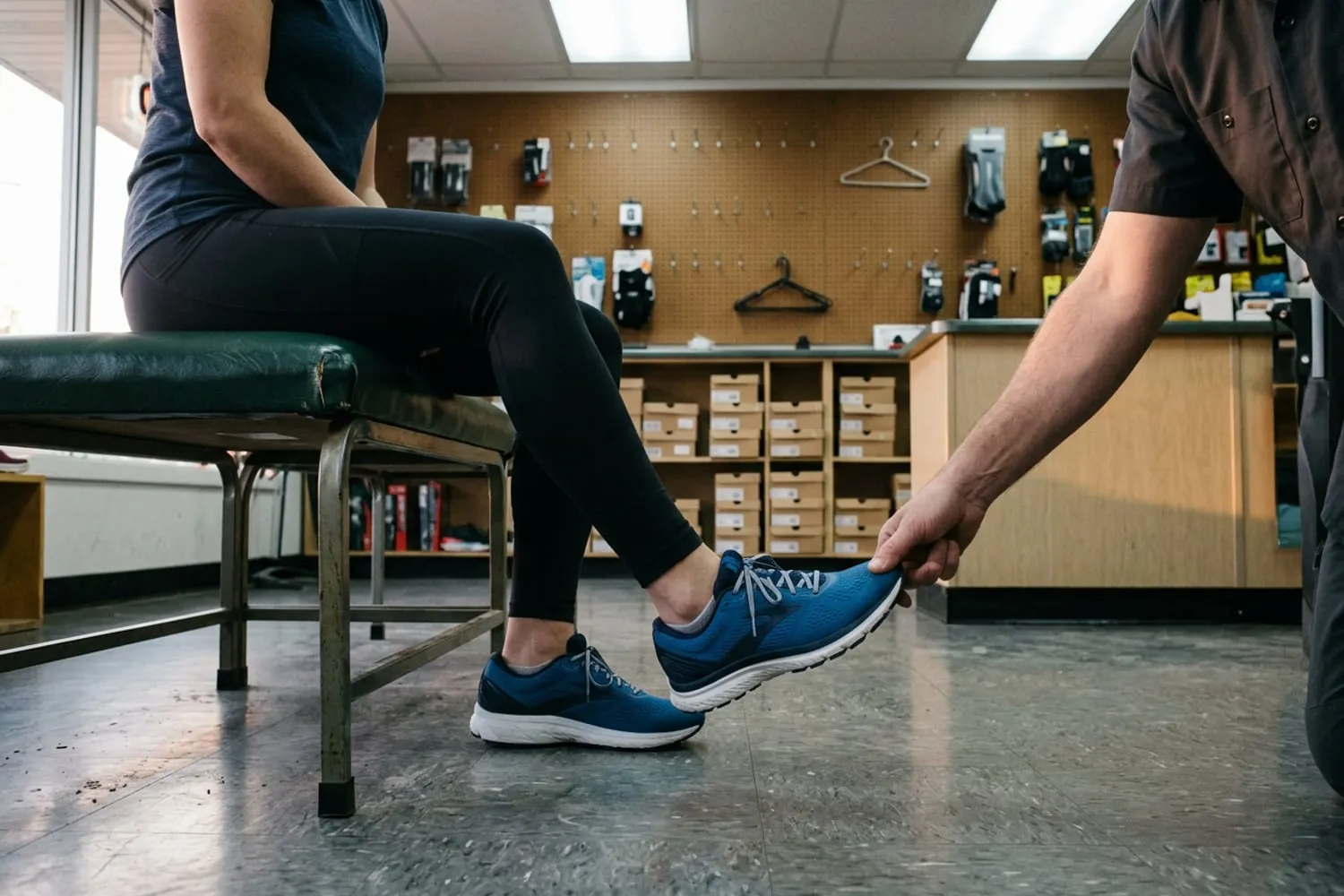
Put on both shoes, lace them as you would for a run and stand up. Then walk, jog a few steps and use the treadmill or ramp if the store has one. A shoe that feels fine sitting down can let your toes hit the front on the first downhill.
A specialist running store will measure your feet for you: Fleet Feet’s free fit id process scans each foot in 3D. With bargain pairs, the AAOS guide advises against shoes that have sat on a shelf for a long time, because the cushioning can break down unused.
Check the fit point by point
Laced and standing, go through the fit one point at a time. Most bad fits fail on one, and which one tells you whether you need another size, width or shoe.
| Fit point | What you want | Sign it is wrong |
|---|---|---|
| Length | About half an inch in front of your longest toe | Toes touch the front when you stand or jog |
| Width | The ball of the foot sits flat on the sole | The upper bulges over the sole or pinches |
| Toe box | Room to wiggle your toes | Toes pressed together or pushed down |
| Heel | Snug, with little or no lift | The heel slips even with the laces snug |
| Midfoot | Even, gentle pressure under the laces | A pressure point or numbness across the top |
Length and the toe box
Stand up and press your thumb down just beyond your longest toe, which is not always the big toe. The AAOS guide asks for at least half an inch of space; Running Warehouse puts it at half to a full thumb width. Less and your toes will meet the front on descents; much more and the shoe bends in the wrong place. Then wiggle your toes: they should move freely without the upper pressing down on them.
Width and the heel hold
Look down at the forefoot. The ball of your foot should sit on the platform of the shoe, not roll over its edge, and the upper should lie smooth rather than stretching tight over your little toe. Most runners do well in a standard width, but many models also come in narrow and wide versions: men’s widths run from B (narrow) to 4E (extra wide), women’s from 2A to 2E. Running Warehouse shows the widths each model comes in on its men’s running shoes and women’s running shoes listings.
Then check the heel. Hold the back of the shoe down and lift your heel: there should be little or no lift. If your heel still slips with the laces snug, the shoe is probably too big rather than too loosely laced.
Tip: take the insole out and stand on it. If your toes reach past the front or your foot spills over the sides, the shoe is too small for you before you have even laced it.
Lace for the foot you have
Laces fix more fit problems than you would expect, for nothing. Running Warehouse’s lacing guide covers the common ones:
- Heel slip: a runner’s loop, also called a heel lock, uses the top eyelet to pull the collar snug around your ankle.
- Pressure across the top of the foot: parallel, or ladder, lacing spreads the pull more evenly and suits wide feet.
- Sore or bruised toes: bruised-toe lacing, a diagonal pattern, gives the toe box more room.
- A hot spot on top of the foot: skip the eyelets over the sore area so the lace does not press there.
Try a new pattern on a short run before a long one.
Signs the size is wrong
Some problems only show up after a few runs. Toenails that bruise after long runs point to a shoe that is too short or too shallow. A blister at the back of the heel usually means the heel is slipping. Tingling or numbness across the top of the foot often comes from laces pulled tight over a high instep, which ladder lacing or a skipped eyelet can ease.
If a pair still hurts after you have changed the lacing, it is the wrong shoe, and breaking it in will not fix it. Pain that stays after you have changed shoes is one to take to a podiatrist or a doctor rather than a store.
When to fit yourself again
Your feet change, and so do the shoes: a new version of a model you liked can fit differently, so try it on before reordering your old size. Fit yourself again whenever you buy a new pair, and measure your feet again every year or so.
The foam wears out long before the upper looks finished. Our guide to how often to replace running shoes covers the mileage and the five checks that say a pair is done, and our Care & Repair section covers cleaning, drying and storing your shoes so the pair you fitted well lasts as long as it should.
When the time comes, start again from the tracing, not from the box. A first pair should be a neutral daily trainer, which is where the running list on The Counter starts, and the rest of our Running section covers what to add at each level.
Questions
Should running shoes be a half size bigger than my normal shoes?
Often, yes. Running Warehouse notes that a running shoe usually fits about half a size larger than a casual shoe, because you need room in front of your toes. Go by the fit checks rather than the number on the box.
How much room should be in the toe of a running shoe?
The American Academy of Orthopaedic Surgeons says at least half an inch between your longest toe and the end of the shoe; Running Warehouse puts it at half to a full thumb width. Check it while you stand, and make sure your toes can wiggle without the upper pressing on them.
How do I know if I need a wide running shoe?
If the ball of your foot rolls over the edge of the sole, or the upper stretches tight over your little toe in your correct length, try a wide version. Many models come in more than one width: Running Warehouse lists B (narrow) to 4E (extra wide) for men and 2A to 2E for women.
Sources
- Athletic Shoes, OrthoInfo, American Academy of Orthopaedic Surgeons
- The Ultimate Guide to Find Your Running Shoe Size & Fit, Running Warehouse,
- How to Tie Running Shoes: Lacing Techniques for a Better Fit, Running Warehouse
- The Fit Process, Fleet Feet
Find your level
The Counter