How Often to Replace Running Shoes, and the Signs
Most running shoes last 300 to 500 miles. Why some pairs wear out sooner, five two-minute checks at home, and how to track the miles you run in each pair.

Most running shoes need replacing somewhere between 300 and 500 miles. For someone running 15 miles a week, that is roughly every five to eight months. The number is a guide, not a deadline: a heavier runner who does every mile on pavement can finish a pair well before 300 miles, and a light runner who rotates two pairs on smooth roads can go past 500. The shoes themselves give the better answer, and five checks at home read it in about two minutes.
The short answer: 300 to 500 miles
The 300 to 500 mile range is what most makers and running stores give. ASICS’s replacement guide suggests considering a new pair every 400 to 500 miles, and adds that a pair showing none of the signs of wear may last longer.
The American Academy of Orthopaedic Surgeons’ guide to athletic shoes gives a rule of thumb that takes your weight into account: divide 75,000 by your body weight in pounds to get a rough mileage. That works out to about 500 miles at 150 pounds, 375 at 200 pounds and 600 at 125 pounds. The same guide says the common midsole foam, EVA, starts to show structural damage after about 120 miles, and that by 500 miles a shoe has lost 45% of its original shock absorption. Cushioning fades gradually, long before the shoe looks finished.
Neither figure is a lifespan for any particular model. Treat your number as the point to start checking the pair every few weeks.
Why some pairs last longer than others
Two runners can buy the same shoe on the same day and retire it months apart. The usual reasons:
| What changes it | Wears out sooner | Lasts longer |
|---|---|---|
| Body weight | Heavier or taller runners compress the foam more | Lighter runners |
| Surface | Every mile on pavement; trails in a road shoe | A mix of surfaces, each in the shoe built for it |
| Footstrike | Heavy heel striking wears the heel early | An even strike that spreads the wear |
| Type of shoe | Light race and tempo shoes with soft foam | Durable daily trainers with more rubber |
| How you use them | One pair for every run, and for walking around | Two pairs in rotation, kept for running only |
ASICS names weight, terrain and running style as the main factors: a podiatrist it quotes says running on the road all the time wears shoes out faster than running off-road, and heel strikers may need to replace their shoes more often. The shoe’s job matters as much: a daily trainer carries more outsole rubber and denser foam than a race shoe built to be light. Shoe type is the one you choose at the counter, so buy for the miles you will put in. A first pair should be a daily trainer, which is where the running list on The Counter starts.
Five checks that say a pair is done
Do these in good light with both shoes in front of you. ASICS’s guide lists the same signs, and any one of them is reason enough to start shopping.
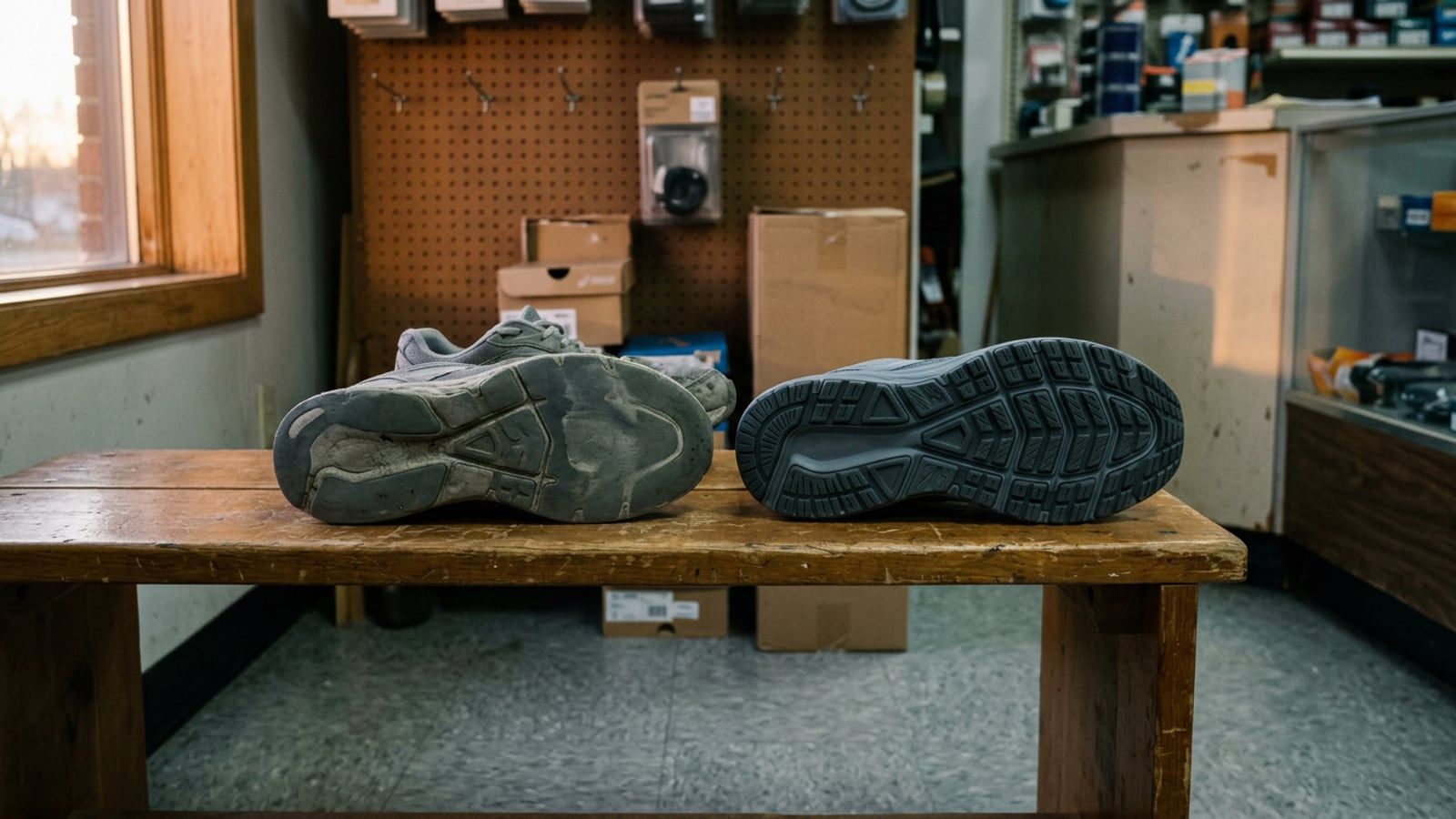
- Turn them over. Look at the outsole rubber under the heel and the ball of the foot. If the rubber has worn through and you can see the softer midsole foam underneath, the pair is done.
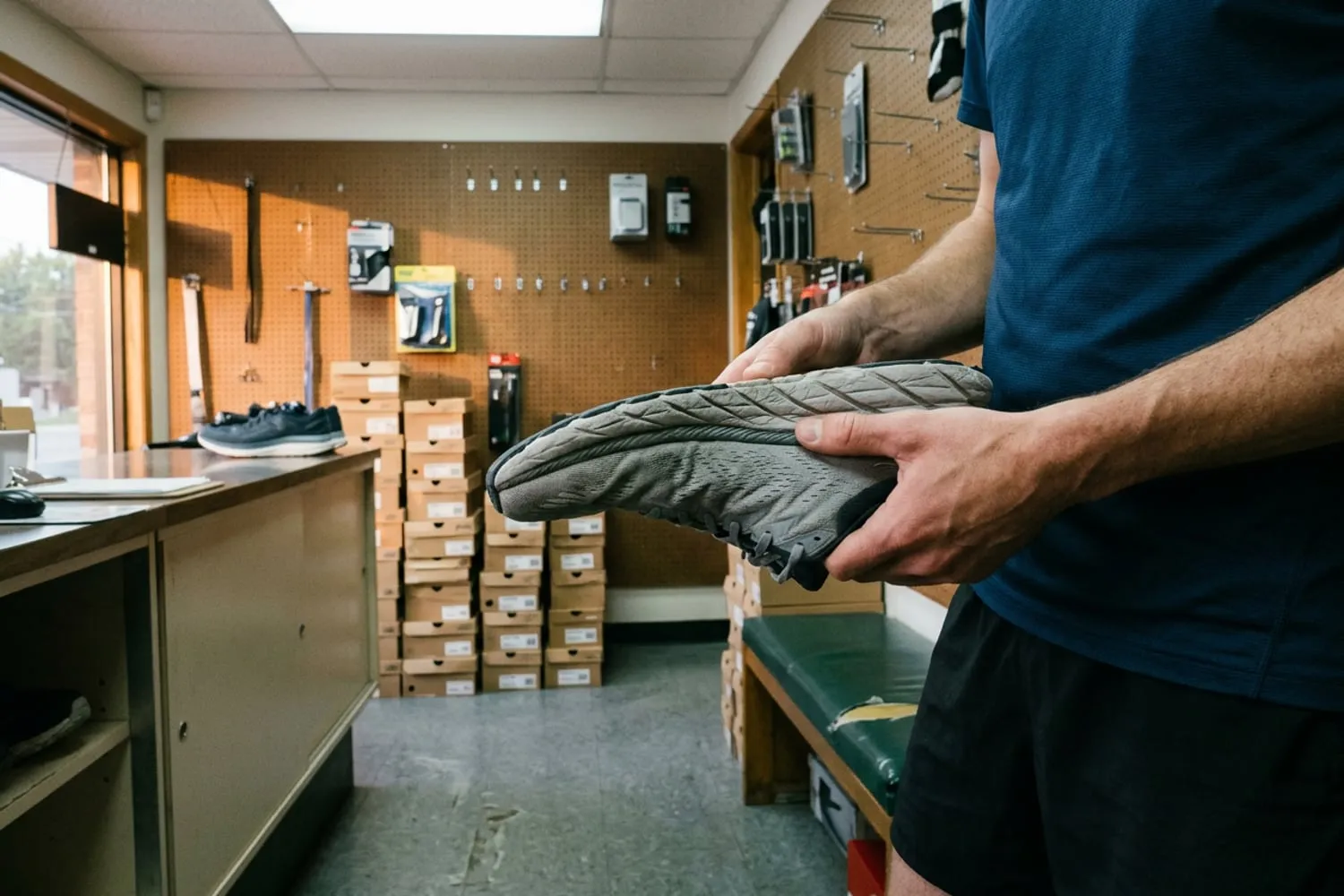
- Look at the midsole from the side. Deep creases running along the foam, or foam that squashes flat when you press it with your thumb, mean the cushioning has packed down.
- Squeeze the heel counter. Pinch the stiff cup at the back of the heel. If it folds easily or has gone soft and wobbly, it no longer holds your heel in place.
- Set them on a table. Put both shoes on a flat surface and look from behind. A shoe that leans to one side, or a pair where one sole is worn far more than the other, has worn unevenly.
- Check the upper. A toe poking through the mesh, a torn heel lining or eyelets pulling out will only get worse.
Then there is how they feel. A pair that feels flat underfoot, or runs that leave your legs more sore than they used to, is a reason to check the shoes; ASICS lists increased muscle soreness after running among its signs. It is not a diagnosis, though. If pain stays after you have changed into a fresh pair, take it to a doctor, podiatrist or physical therapist rather than a shoe store.
Tip: when you buy a new pair, write the date on the inside of the tongue with a marker. Months from now, it will save you guessing how old the shoes are.
How to keep track of the miles
The checks above tell you when a pair is worn; a running total tells you when to start looking. Most runners already log their runs in an app that can count miles per pair:
- Strava: add each pair under My Gear and pick the shoes on every run. Strava’s shoe mileage notifications email you when a pair passes a set distance: 250 miles by default, adjustable up to 800. The reminder is set on the Strava website, not in the app.
- Garmin Connect: add your shoes under Gear, set a maximum distance and choose which activity types they count toward, so your runs are added to the pair automatically.
- No app: a note on your phone or a line on a calendar each week does the same job. Add an estimate for the miles you walk in them, too.
Whichever you use, add a new pair on the day you start wearing it, and pick the right shoes each time if you rotate. A count is only as good as the runs it includes.
Make a pair last: rotation, drying and storage
You cannot make foam last forever, but you can stop wearing it out faster than you need to.
- Rotate two pairs. Alternating gives each pair a full day or two to dry out between runs, and spreads your miles over both. A second pair to rotate is where the regular runner’s list starts on The Counter.
- Keep them for running. Every errand, dog walk and day on your feet adds miles the app never sees. Older running shoes can take over those jobs.
- Dry them slowly. After a wet run, take the insoles out, loosen the laces, stuff the shoes with newspaper and leave them at room temperature. Keep them off radiators and out of the dryer: heat can weaken the glue and stiffen the foam.
- Unlace them. Kicking shoes off by the heel slowly breaks down the heel counter, which is one of the checks above.
- Store them cool and dry. A hot car trunk or a damp garage is hard on foam and glue.
When the shoes need cleaning, a soft brush, mild soap and cool water do the job; the Care and Repair list on our Gear page has a shoe-cleaning kit that works on mesh and knit. More on drying, storing and cleaning gear is in our Care & Repair section.
What to do with the old pair
A pair retired from running often has plenty of walking left in it. Many runners keep the last pair for yard work, travel or a rainy-day backup.
If they are still wearable, donate them. Soles4Souls accepts new or gently worn shoes in all styles and sizes, running shoes included, as long as they have no holes or mold. It has a drop-off finder, asks you to fill out a donation form before you visit, and also takes boxes shipped to its warehouses.
A pair worn through to the foam is not a donation. Ask your local running store whether it collects old shoes for recycling, or check your town’s rules for textile recycling before you put them in the trash.
Then start the next pair the way you started the last one: measure your feet again rather than reordering the size on the box, because feet change and so do the shoes. Our guide to fitting running shoes properly walks through it, and the rest of our Running section covers what to buy at each level.
Questions
How many miles do running shoes last?
Most makers and running stores put it at 300 to 500 miles, and ASICS suggests considering a new pair every 400 to 500 miles. The American Academy of Orthopaedic Surgeons gives a rule of thumb of 75,000 divided by your body weight in pounds, which comes to 500 miles for a 150-pound runner. Treat any figure as the point to start checking the shoes, not a deadline.
Do running shoes wear out if you don’t run in them?
Slowly, yes. The American Academy of Orthopaedic Surgeons notes that cushioning can become less effective over time even without use, and advises against shoes that have sat on a shelf for a long time. A pair kept cool and dry for a season is fine; a bargain pair from several years back is worth a close look at the foam before you run in it.
Do carbon-plated race shoes wear out faster than daily trainers?
Generally, yes. A biomechanics researcher quoted by Fleet Feet says the foam in these shoes loses its freshness faster, and that many would put their useful life at about 100 kilometers, or 62 miles, though others go further and models vary. Keep them for races and a few key sessions, and run your everyday miles in a daily trainer.
Can I keep old running shoes for walking or the gym?
For walking, errands and yard work, usually yes, as long as they still feel comfortable. For court games, gym classes and lifting they are the wrong shoe: the AAOS notes that a running tread can make a shoe hard to wear on a court, and that court shoes are built for stability in all directions. When they are too worn even for walking, donate or recycle them.
Sources
- Athletic Shoes, OrthoInfo, American Academy of Orthopaedic Surgeons
- When to Replace Your Running Shoes, ASICS
- How Do I Manage Shoe Mileage Notifications on Strava?, Strava
- Can You Run in Carbon-Plated Shoes Too Much?, Fleet Feet
Find your level
The Counter