Golf Driver Shaft Length: A Complete Guide
Golf driver shaft length affects distance and accuracy. Compare typical and tour lengths, check the 46- and 48-inch limits, and find your best fit.

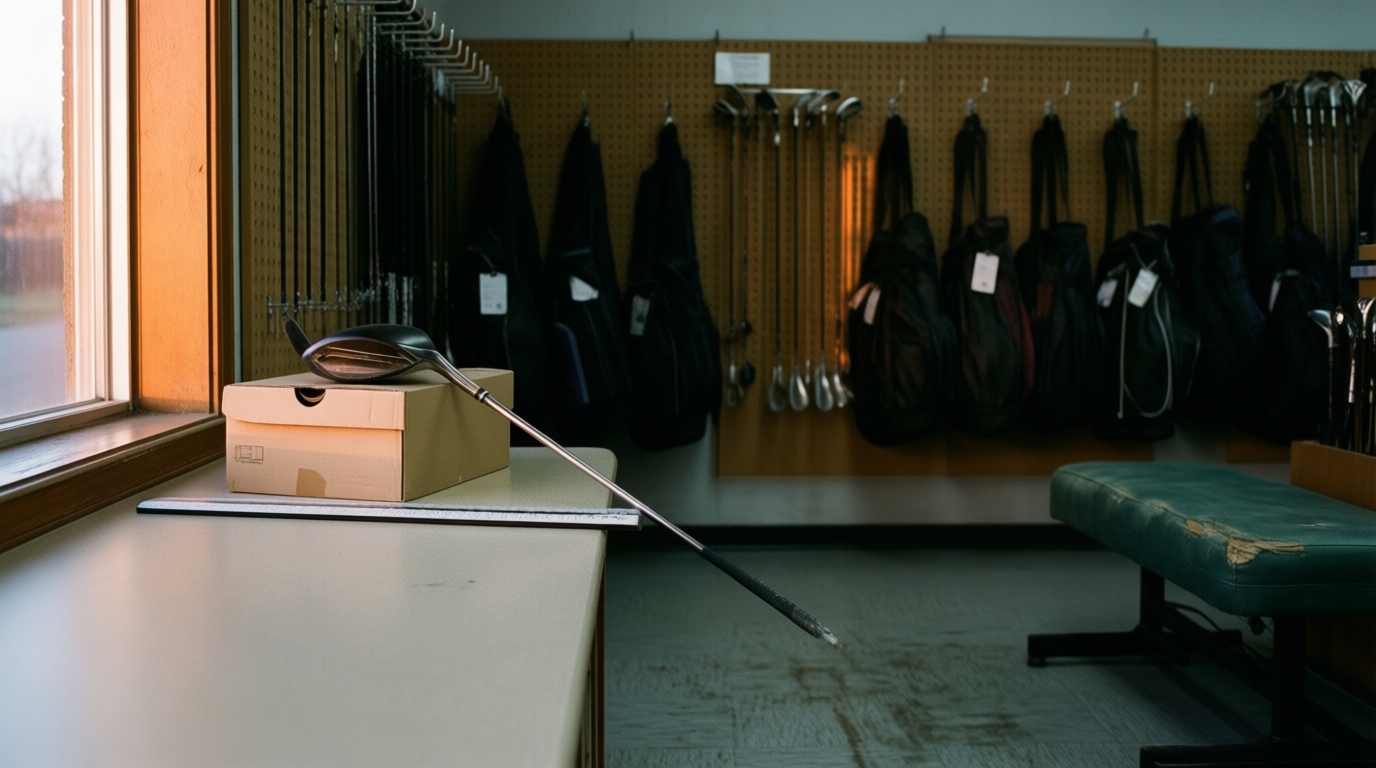
Think about buying running shoes. Too long and every stride feels sloppy, too short and your toes pay for it. A golf driver works the same way, and the mismatch shows up in your swing and where the ball lands.
Shaft length is the distance from the grip to the tip, and it’s one of the biggest levers on distance and accuracy.
We’ll cover typical and tour lengths, the 46 and 48 inch rules, and how length trades distance for strike quality, then help you find your own number.
Typical Golf Driver Shaft Length
Most drivers on store shelves sit close to 45 inches, but that number hides a wider range. Here’s how tour players, off-the-shelf models and the players who go longest compare.
How long tour pros’ drivers really are
According to Golf.com’s Jonathan Wall, the tour average driver length as of December 2019 was 44.75 inches. The range runs from 44.5 to 45.5 inches, and top finishers at the 2018 Masters played drivers at 44.5 inches.
Back in the 1990s, the tour average was about 43 inches.
Lengths you can buy off the shelf
Retail drivers are commonly offered at lengths around 45 inches, slightly longer than the tour average, and a Korean study on shaft length tested drivers at 44, 45 and 46 inches.
Think of a weekend golfer who grabs the 45-inch driver on the rack because it’s what’s in stock. If it swings comfortably and she can square the face, she’s already close to the tour average without a custom order.
Stock lengths vary by model, so check the listed length on the spec sheet before you buy. Some models also come in tour-length versions if you want the pros’ setup straight off the rack.
Women’s, senior and junior models have their own standard lengths, so read the label rather than assuming the adult default.
How driver lengths have changed over time
Driver lengths grew over the decades as golfers chased more ball speed. Lengths have since swung from about 43 inches up to 48 inches and, in some cases, back again.
Here’s the mechanism: a study on shaft length and club head speed found that a longer shaft raised head speed at impact for every subject tested. A longer shaft buys distance, but it can cost you strike quality. That’s the trade.
Players who swing the longest drivers
A few players and competitors push length furthest:
- Bryson DeChambeau and Phil Mickelson are known for swinging some of the longest drivers.
- Long drive competitors use 48-inch shafts.
- Justin Thomas has gone with a longer shaft too.
Their goal is maximum clubhead speed, even with the strike-quality cost.
How Long the Rules Let Drivers Be
Before you shop, it helps to know how long a driver is allowed to be. The rules have changed, and the newer limit only applies in certain competitions.
The old 48-inch cap
Under the United States Golf Association (USGA) rules, every club except the putter is capped at a maximum length of 48 inches. That 48-inch ceiling is still the general standard for most rounds, so a driver at or under it works for your weekend game.
The 46-inch limit starting January 2022
The USGA and the R&A (the Royal and Ancient Golf Club of St Andrews) proposed the change in February 2021, and it took effect in January 2022.
Golf Monthly reported the announcement, which let professional and elite amateur organizers cap driver shaft length at 46 inches, down from 48.
The rule is called Model Local Rule G-10, and Australian Golf Digest describes it as a 46-inch maximum that’s often applied in elite competitions.
The penalty applies when you use a longer driver, not when you carry one. Using a driver over the limit in a competition that enforces it means disqualification. Carrying one in your bag costs you nothing.

Who the optional local rule is for
The 46-inch limit is an optional local rule, so a competition has to choose to adopt it. It’s aimed at highly skilled players, not the typical weekend round. The PGA and LPGA, the major professional tours in men’s and women’s golf, have adopted the limit.
Recreational courses decide for themselves whether to use it. Think of a weekend player entering her club’s Saturday tournament.
If the event doesn’t adopt the local rule, her current 48-inch driver stays legal, so there’s no reason to replace it before tee time.
How Length Affects Distance and Contact
Length is a trade-off between distance and contact. A longer shaft can add speed, but only if the ball meets the face where you want it to.
How clubhead speed turns into ball speed
Distance is driven by speed factors, and the two that matter here are clubhead speed (how fast the head moves) and ball speed (how fast the ball leaves the face). A longer shaft adds swing arc, which can raise clubhead speed.
Where the ball meets the face changes how much ball speed you get. Smash factor is ball speed divided by clubhead speed, a simple score for how efficiently a strike converts speed into distance. Speed alone won’t do it.
Hitting the middle of the face
Off-center hits lose distance, and they hurt direction too. Many everyday golfers struggle to find the middle of the face. Picture a weekend golfer on a narrow hole who’d rather give up a few yards for a fairway they can actually find.
A shorter driver improves those odds. According to a swing article from the golf coaching group TPI, it is “easier to hit the center of the clubface with a shorter club than a longer club.”
Real examples of shorter drivers at work
Tony Finau went half an inch shorter, and his ball speed rose from 180 to 183 miles per hour. The payoff shows up in accuracy, too.
In a Golf Digest story, Walker saw his fairways hit go up 17 percent, and Fowler’s accuracy improved by nine percent with no noticeable loss of distance. Tour professionals may use drivers shorter than retail models.
A simulation study of optimal golf drives found that five of the most recent driving distance leaders on the PGA Tour, the main professional circuit in the United States, used drivers under 1.17 m, about 46 inches.
Reading your misses to spot length problems
Your misses are clues. Watch where the ball meets the face:
- Too long: a shaft that’s too long causes heel hits, and heel hits raise spin.
- Toe hits: a pattern of them suggests the shaft may be too short for you.
- The ideal spot: slightly toward the toe and a little high on the face.
Picture a parent who squeezes in nine holes on Sunday mornings, whose drives keep finding the heel. That pattern is worth checking against shaft length before you rebuild the swing. Read the miss first, then the shaft.
Find the Right Driver Length for You
Driver length is personal, so it’s worth getting right. Here’s how to measure yours, test it, and spot when it’s time to change.
How do you measure driver shaft length?
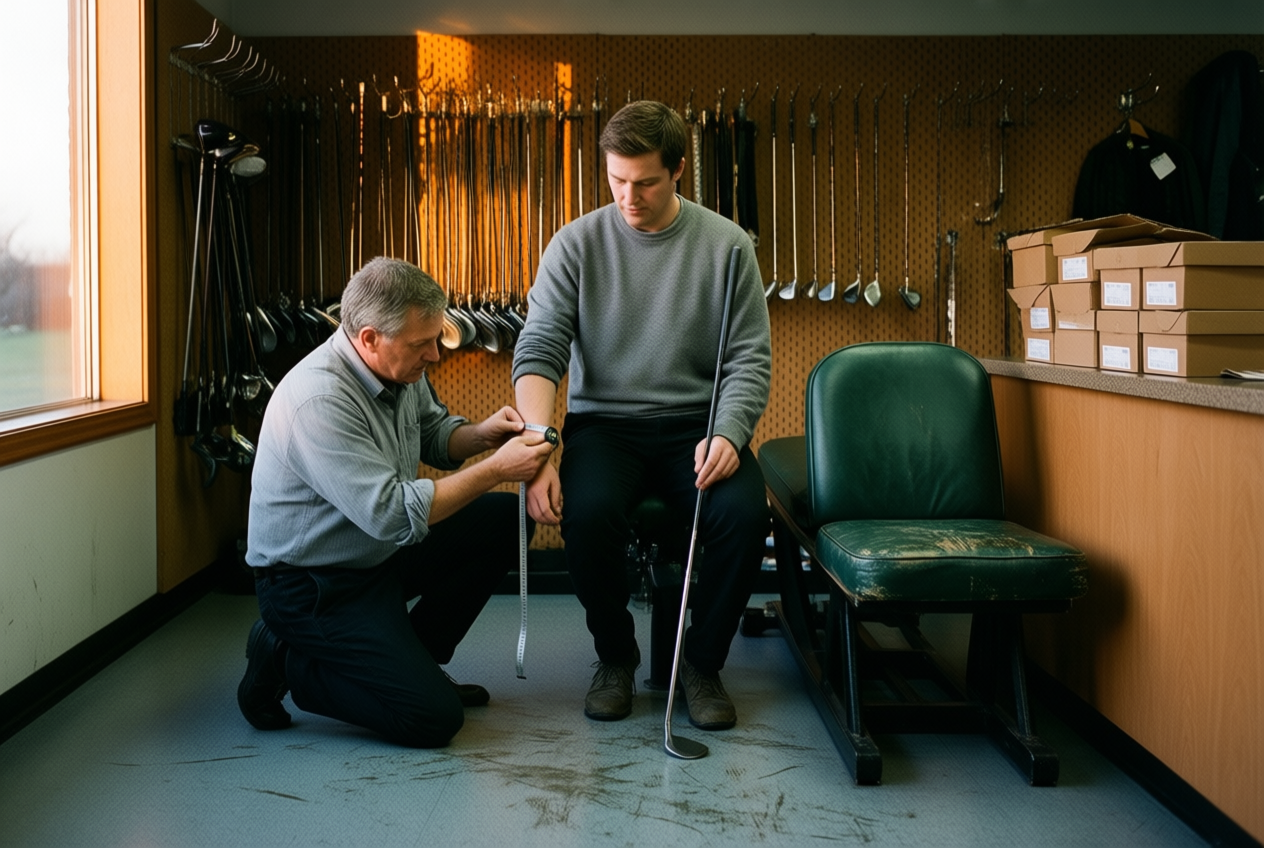
Start with the wrist-crease-to-floor measurement. Stand in your normal address posture and measure from your wrist crease down to the floor.
For more precision, lean on one of these:
- Fitting systems and software: computer tools that track your swing and compare lengths.
- Professional driver fitting: a trained fitter adjusts length while you hit.
- Lessons and fitting bookings: a teaching pro can point you to a fitting session.
Bring your current driver so the fitter can compare it against new lengths.
Test your strikes at home
A good length is less about how far you hit it and more about where you connect with the face.
- Face tape or stickers: stick them on the face, hit a few balls, and read the marks to check impact location.
- Foot powder or dry shampoo: dust the face so the impact mark shows clearly.
- Choke down on the grip: slide your hands down to test a shorter effective length, the length you actually swing.
Think of a weekend golfer whose face tape shows strikes scattered toward the heel. Choking down an inch tightens her pattern, so she books a fitting before buying anything new.
Your height, arm length and posture
Height, arm length and posture are personal factors, and a Korean study on driver shaft length and body conditions found that shaft length and height can affect head speed, distance and direction. Your body, not a pro’s, sets the target.
- Arm length: it shapes how you reach the ball.
- Posture at address: your setup changes which length feels natural.
- Tall stance and steep swing: these can point to a club longer than your body wants.
- Height of player: a starting point, not a verdict.
- Average Tour player height: the PGA (Professional Golfers’ Association) Tour average makes a poor target.
Signs it’s time to change length
Your ball flight and confidence will flag when a length stops working:
- Fairways hit under 50%: if fewer than half your tee shots find the fairway, the driver may be working against you.
- Out-of-bounds tee shots: repeated misses cost strokes, not just distance.
- Confidence dropping with your longest club: doubting the driver before you swing is worth acting on.
Those signs point to fit, not just the club.
Changing Length and Matching Your Gear
You have more options than buying a new driver. Here’s how to change the length and what to adjust when you do.
Ways to shorten your driver
There are three main routes:
- Cutting an existing driver. A shop trims the shaft to your target length.
- Shorter shafts in fitting kits. Fitters use these to test a shorter length before you commit.
- Shorter standard lengths. Some shaft makers offer them, so you can buy one off the shelf.
Cutting is the most permanent option. You pay for the work, and you can’t add length back, so a wrong cut stays wrong. That’s why you’ll want to demo a shorter driver first. Hit one on the range before you change anything.
Think of a weekend golfer who finds her driver a touch long for her swing. She demos a shorter model, finds her strikes more consistent, and then asks her fitter for a heavier shaft so the swing still feels familiar.
Keeping the feel right with a heavier shaft
A shorter driver needs a heavier shaft to feel right. Plan on roughly 10 grams heavier than your current shaft. If the feel still isn’t there, add head weight to restore it. Match the feel, not just the number.
How length shifts the right shaft flex
Length changes more than feel, too: it also shifts the flex you need. Going shorter suggests a softer flex, while going longer suggests a stiffer one. Fitting tools account for this shift, so trust them over the label on the box. Test, don’t guess.
Shaft length can look like a small spec, but it shapes how your driver feels at address and how the face meets the ball. The best length is the one you can swing with control, not the longest one on the rack.
Extra length can buy distance, but only if you still find the center of the face.
Test a few options with a fitter if you can, and watch how your contact changes. The right length won’t win the round for you, but it’ll stop your driver from working against you.
References
- Kinematics Analysis of Golf club`s Length and Strength — doi.org (2007)
- 드라이버 샤프트 길이와 신체적 조건이 헤드스피드, 비거리 및 방향성에 미치는 영향 — db.koreascholar.com (2019)
- The Effect of Club Length, Face Bulge Radius, and Center of Gravity Depth on Optimal Golf Drives — A Simulation Study — doi.org (2022)
- Effect of Shaft Length on the Club Head Speed in Golf — doi.org (2005)
- USGA, R&A propose reducing maximum driver length, hint at bifurcation — thescore.com (2025)
- When is a driver that’s breaking the rules not actually breaking the rules? — australiangolfdigest.com.au
- Can a shorter driver shaft bring more fairways and more yards? You bet | Golf Equipment: Clubs, Balls, Bags — golfdigest.com (2025)
- “Extremely Disappointing” - Mickelson Reacts To Driver Length Rule Change — golfmonthly.com
- Will a Shorter Driver Give You More Distance ? | Article — mytpi.com
Questions
What is the average height of PGA Tour players?
The average PGA Tour player is about 5 feet 10 inches tall, though player heights vary. Height alone is not a good guide to choosing driver length because arm length and setup matter too.
What are the benefits of a shorter driver shaft?
A shorter driver is often easier to control and hit near the center of the clubface. More centered contact can improve accuracy and may preserve distance, even if the shorter shaft produces less clubhead speed.
How do you measure shaft length on a driver?
For a standard measurement, place the club in its playing position on a flat surface and measure from the ground at the heel of the club to the end of the grip. Golfers often measure only the shaft itself differently, so specify whether you mean playing length or the bare shaft when comparing measurements.
How long can a driver be?
The general USGA maximum for clubs other than putters is 48 inches. In competitions that adopt Model Local Rule G-10, the driver limit is 46 inches; check the event rules before playing.
How do you know what length your putter should be?
Your putter length should let you stand comfortably with your eyes over or just inside the ball and your arms hanging naturally, without hunching or reaching. A fitting can confirm the length by checking your posture, aim and stroke; common adult putters are around 33 to 35 inches, but the right length varies by golfer.
Sources
- USGA, R&A propose reducing maximum driver length, hint at bifurcation, thescore.com,
- Kinematics Analysis of Golf club`s Length and Strength, doi.org,
- 드라이버 샤프트 길이와 신체적 조건이 헤드스피드, 비거리 및 방향성에 미치는 영향, db.koreascholar.com,
- Effect of Shaft Length on the Club Head Speed in Golf, doi.org,
- When is a driver that's breaking the rules not actually breaking the rules? – Australian Golf Digest, australiangolfdigest.com.au
- "Extremely Disappointing" - Mickelson Reacts To Driver Length Rule Change | Golf Monthly, golfmonthly.com
- The Effect of Club Length, Face Bulge Radius, and Center of Gravity Depth on Optimal Golf Drives -- A Simulation Study, doi.org,
- Will a Shorter Driver Give You More Distance ? | Article | TPI, mytpi.com
- Can a shorter driver shaft bring more fairways and more yards? You bet | Golf Equipment: Clubs, Balls, Bags | Golf Digest, golfdigest.com,
- Biomechanical and modelling analysis of shaft length effects on golf driving performance, doi.org,
Find your level
The Counter