Dumbbell Exercises Explained: Moves, Sets and Gear
Dumbbell exercises help you build a routine by muscle group, match sets, reps, and weights to your level, and choose moves and gear for your space.
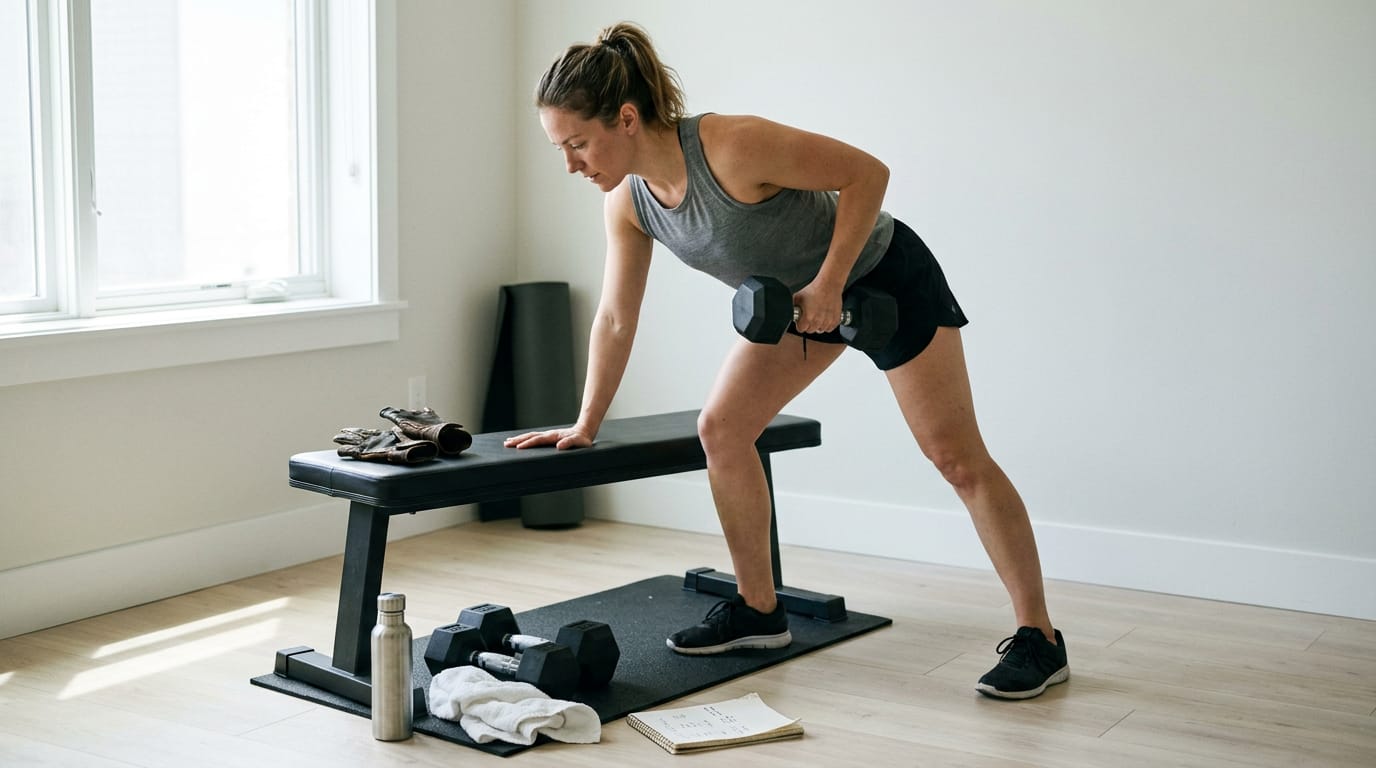
Think of a pair of dumbbells as the kitchen knife of your home gym: one simple tool that handles a surprising number of jobs. Presses, rows, squats and lunges all work with the same idea, holding a weight and moving it with control.
A dumbbell exercise is any move where you hold weight in your hands or at your sides and move it through a controlled range of motion.
In this guide, we’ll cover moves by muscle group, explain how sets, reps and weight selection work together, and help you choose dumbbells that fit your level and your space.
Plan Your Dumbbell Exercises from the Start
Before you pick up a pair, know what each exercise works, how heavy to go and how often to train.
Can I build muscle with just free weights?
Yes, dumbbells alone can build muscle if the weight challenges you.
- Free weights vs. machines. Machines guide the movement. Dumbbells make you steer the path yourself, which makes it less about how much you lift and more about how well you control it.
- Stabilizer muscles. Holding a weight in each hand works the smaller muscles that keep your joints steady.
- Greater range of motion. Each arm or leg moves on its own path, often allowing a fuller range than a fixed machine.
- Calorie burn and toning. A Frontiers study of college women with overweight and obesity explains that resistance training burns significant calories during a session and keeps metabolism elevated afterward as muscle grows. Dumbbell work is resistance training too, so it can help you burn calories and tone your muscles.
Choosing weights that match your goals
Your goal sets the weight, so ask whether you want strength or endurance. Take a weekend soccer player who wants a stronger kick. Heavier dumbbells for fewer reps build that power, and when the load feels easy, she moves up so her kick keeps improving.
- Heavy weight, low reps. This builds strength, so pick a load that’s tough to finish.
- Light weight, high reps. This suits endurance, letting you keep going longer.
- Last rep should be challenging. It should feel hard but still controlled.
- Progressive overload over time. Once a weight feels easy, add a little load or a few reps so your plan keeps working.
Scheduling, exercise order and rest days
Aim to train four or five days a week, with rest days in between.
- Avoid same muscles back-to-back. Alternate upper-body and lower-body days.
- Big lifts before small. Start with moves like a squat or row that work several muscles at once, then finish with curls.
- Workout length flexibility. Short on time? A shorter session still counts.
- Training when sore. Is it okay to exercise when you’re sore? Usually yes, if the soreness is mild. Train a different muscle group, and rest any area with sharp or worsening pain.
Keep good form and avoid injury
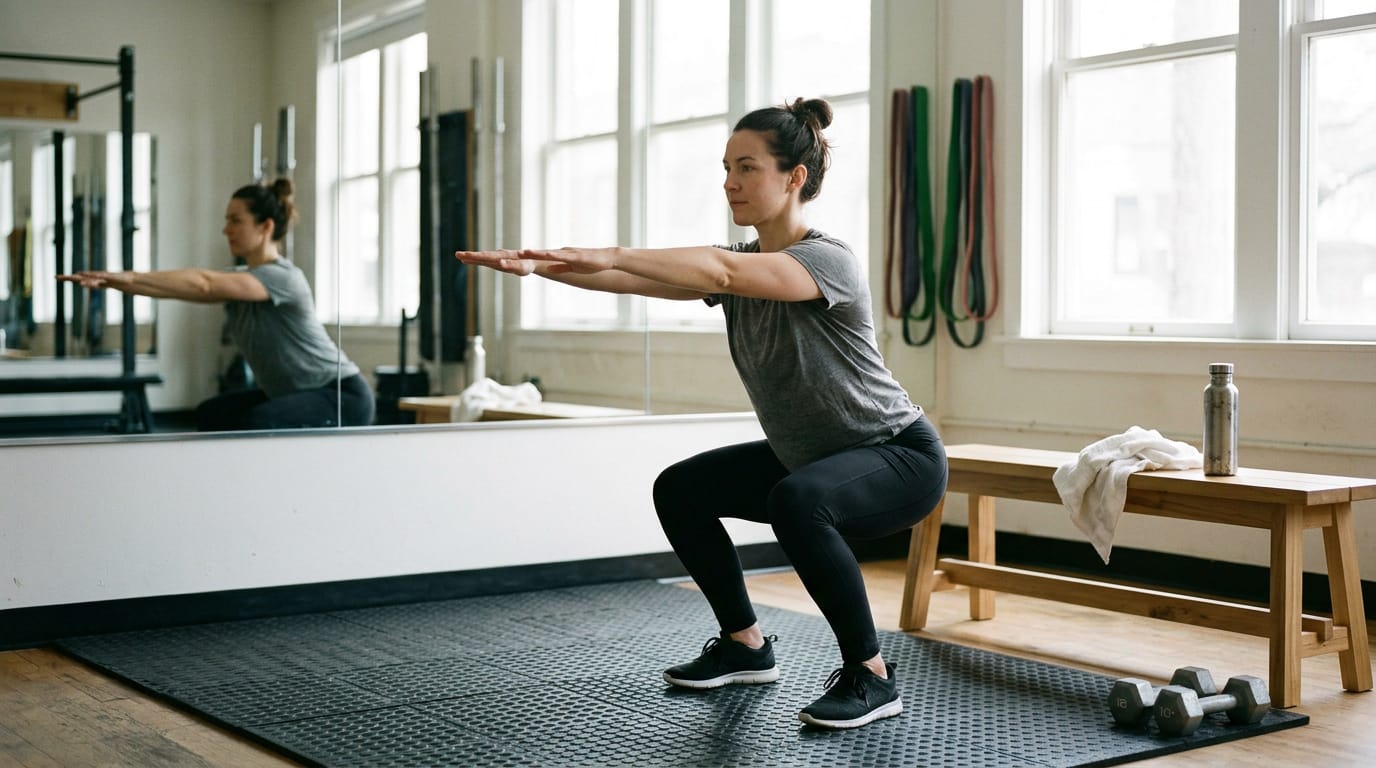
- Practice with bodyweight first. Try squats or push-ups without weights until the movement feels smooth.
- Control the lowering phase. Lower the weight slowly on the way down. Control beats speed.
- Rest between sets. Rest long enough that your next set starts with good form.
- Reduce injury risk. Good form, controlled reps and enough rest keep you training instead of sidelined.
How many sets, reps and rest to use
- Starting point. 2 to 3 sets of 8 to 12 reps.
- Steady option. 3 sets of 10 to 12 reps.
- Beginner rest. About 1 minute between sets.
- Intermediate and advanced. Work up to 3 or 4 sets per exercise.
You may hear about the 3-3-3 rule in the gym, too. We can’t confirm its exact numbers from our research, so rather than guess, use the ranges above.
Upper Body Moves with Dumbbells
Dumbbells can work your chest, back, shoulders and arms with one pair. Here’s what to know about each core move and the cues that keep your form honest.
Chest moves to try
- The flat bench press is the classic: press the dumbbells up over your chest from a bench, lowering them under control.
- The floor press does the same from the ground, with your upper arms resting on the floor at the bottom. For a weekend tennis player with a grumbling shoulder, that shorter range keeps strength work on track.
- For the floor chest fly, lie flat with your arms out and a slight elbow bend, then bring the dumbbells together over your chest.
Rows and moves for your back
- Bent-over row: Hinge at the hips with a flat back and pull the dumbbells toward your ribs.
- Single-arm row: Brace one hand and knee on a bench, then row one side at a time.
- Renegade row: From a push-up position, row one dumbbell at a time without letting your hips rock.
- Upright row and shrugs: Pull the dumbbells up close to your body, keeping your elbows below shoulder height, then shrug toward your ears.
- Good mornings: Hold the dumbbells at your shoulders, hinge forward with a soft knee bend, and stand tall again. It targets your lower back, so you’ll want to keep it controlled.
Ways to work your shoulders
Choose a weight you can press with clean form, not one that forces a swing. Clean reps beat heavy ones.
- Overhead press: Press the dumbbells from shoulder height straight overhead.
- Arnold press: Start with palms facing you, then rotate them outward so they face forward at the top.
- Lateral raises: Raise your arms out to the sides until they reach about shoulder height.
- Rear delt flyes: Hinge forward and raise your arms wide to hit the back of your shoulders.
- Neutral grip push press: Keep your palms facing each other and use a small knee dip to drive the weights overhead.
Curls and extensions for your arms
- Bicep curls: Curl with palms facing up and elbows pinned at your sides.
- Hammer curls: Curl with palms facing in, which also works your forearms.
- Overhead triceps extension: Hold one dumbbell in both hands behind your head and press it up until your arms straighten.
- Skull crushers: Lie on a bench, lower the dumbbells toward your forehead, then extend your elbows.
- Seated variations: Do curls or overhead extensions seated on a bench to support your back.
Leg and Hip Moves with Dumbbells
These moves cover squats, lunges, hinges and calf raises. Pick the ones that fit your level and your space.
Different squat styles to try
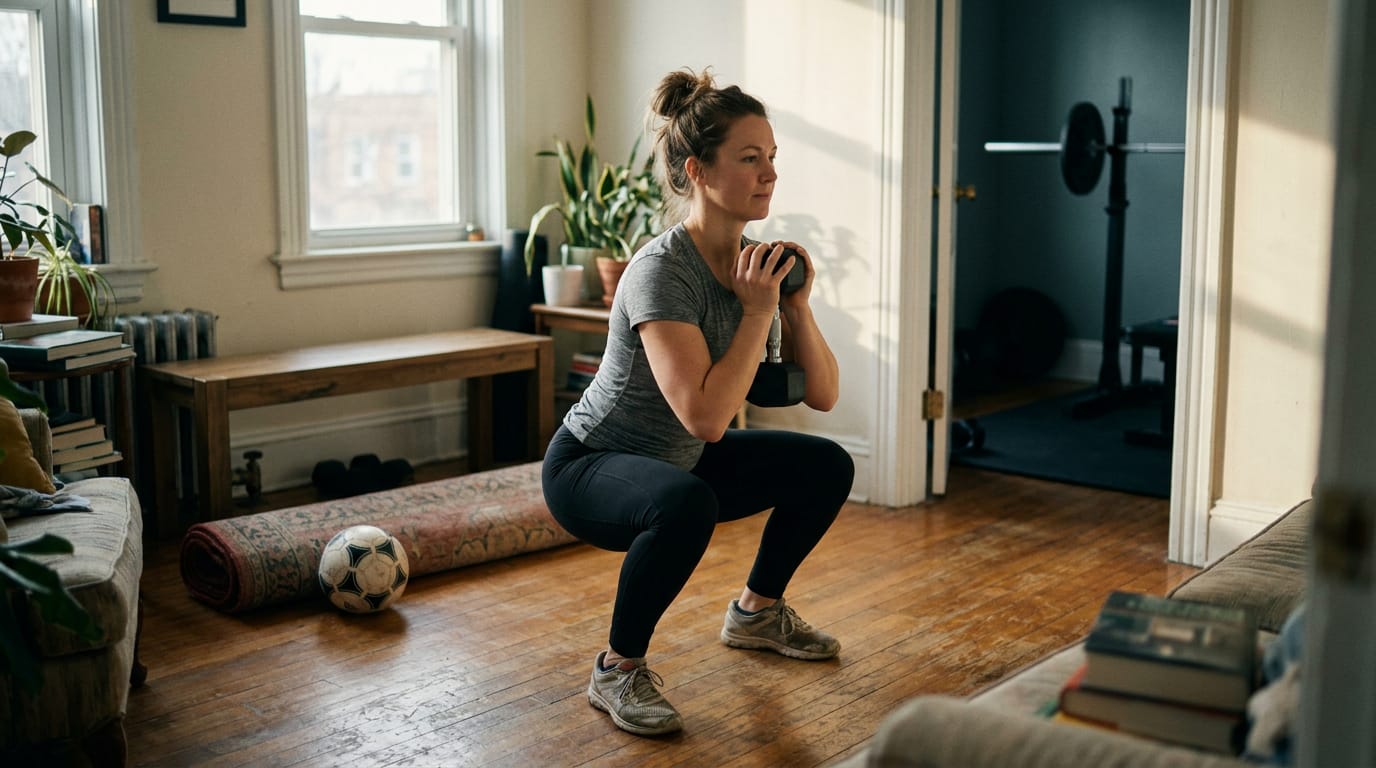
The goblet squat is the easiest start: hold one dumbbell at your chest and sit straight down. The dumbbell front squat holds the weights at your shoulders for more upper-body and core work.
The Bulgarian split squat rests one foot on a bench behind you and is demanding, so start light. The barbell back squat needs a rack and a spotter, so it’s a gym-only move.
A weekend soccer player who wants steady legs late in a match can start with a goblet squat at home.
Lunges and one-leg moves for balance
A lunge steps one leg forward and lowers the back knee toward the floor, with dumbbells at your sides. Balance and side-to-side imbalances are easy to miss, so train both sides evenly.
A runner whose knee wobbles downhill can use lunges on each side to find the weaker leg. The single-leg deadlift combines balance and hinging: stand on one leg, hinge at the hips, and reach toward the floor with the weight in your opposite hand.
Its goal is control rather than weight. Start light.
Hinge moves that work your glutes
A hinge sends your hips back while your spine stays long, and it’s a key way to train the back of your legs and glutes. The stiff-legged (Romanian) deadlift keeps your knees slightly bent as the dumbbells travel down your legs.
The hip thrust drives your hips up from a bench with a weight across them, while the weighted glute bridge does the same job from the floor. The barbell deadlift lifts a loaded bar from the ground, but you’ll need proper setup.
Good hinges are about where you feel the work, not how far you can bend.
Calf raises with a platform for range
The seated dumbbell calf raise rests a weight across your thighs and lifts your heels slowly. A raised platform for range lets your heels drop below the edge of a step or weight plate, giving your calves a fuller stretch at the bottom.
Range often matters more than load here, so keep the weight modest.
How Muscle Groups and Workouts Fit Together
Your muscles rarely work alone, so you’ll train smarter by seeing how they team up.
Push, pull and legs workout splits
Think of your body in four working groups: pushing muscles, pulling muscles, legs, and accessory muscles. Pushing muscles, like your chest, press weight away, while pulling muscles, like your back, draw it toward you.
Your split decides how these groups share the week:
- Full-body: every group in one session, handy when time is tight.
- Push, pull and legs: one group type per day, with rest in between.
- Upper and lower: upper-body work one day, leg work the next.
A parent training after bedtime might prefer full-body sessions. One sample covers every group at home: a goblet squat, a dumbbell press, a single-arm row, an overhead press and a curl.
What your legs and accessory muscles do
Your legs are the engine. Quads straighten the knee, glutes extend the hip to stand you up from a squat, and hamstrings bend the knee and assist the hip. Your biceps bend the elbow, your triceps straighten it, and your shoulders position the arm.
Accessory muscles support the big lifts; they don’t replace them. Don’t skip them.
Shoulder, back and arm muscles explained
The deltoid muscle has three parts:
- the anterior deltoid at the front helps you press
- the lateral deltoid on the side lifts your arm out
- the posterior deltoid at the back pulls it backward
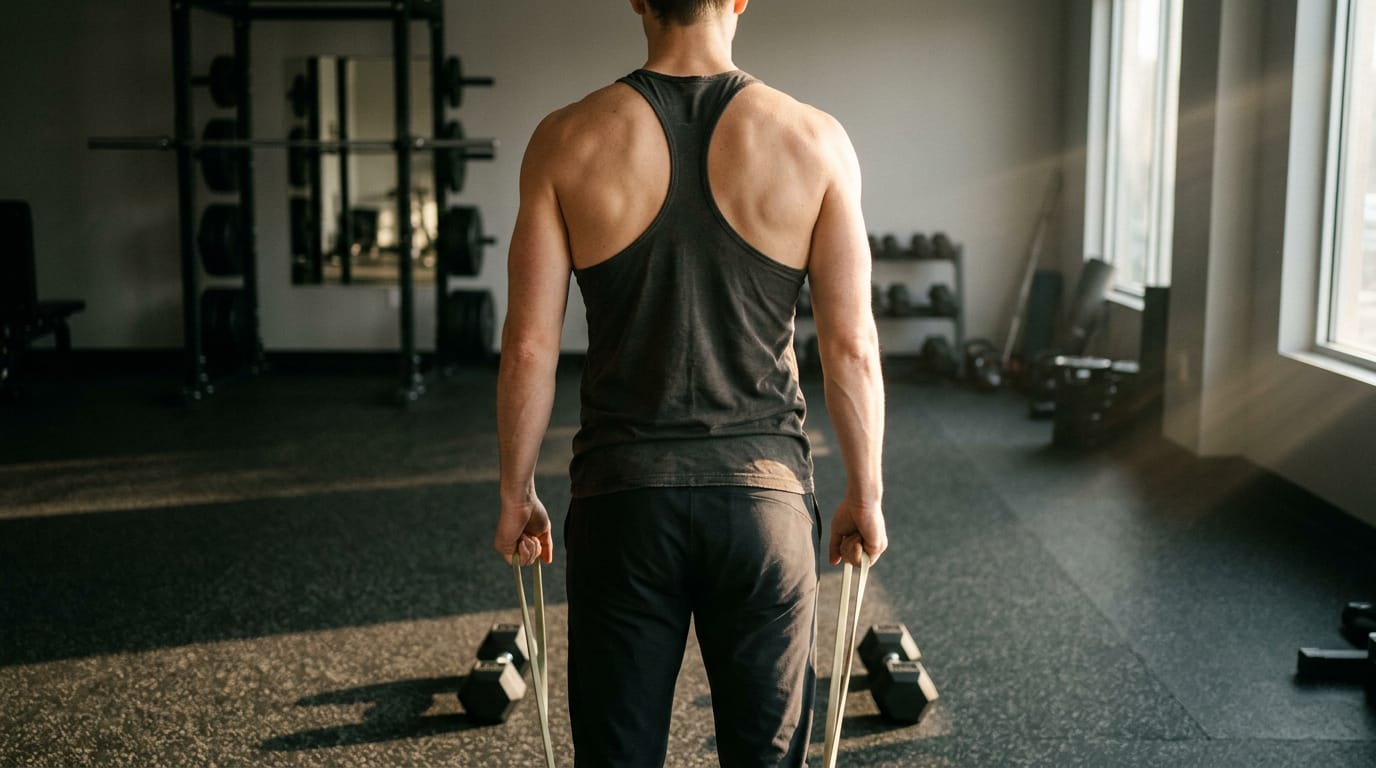
Your lats run along your sides and pull your arms down, traps cover the upper back and move the shoulder blades, and the lower back keeps your spine steady under load.
The rhomboids, between the shoulder blades, are usually classed with the shoulders because they draw the blades together. Balance is the goal.
Workouts for Different People and Spaces
Not everyone trains the same way or in the same space, so match your routine to your body and your room.
Seated workouts that spare your joints
According to Harvard Health, chair-based, low-impact exercise can be easier on the joints for people with limited mobility and seniors.
A chair-based routine works your major muscle groups with every move done from a firm seat, so a retiree can stay strong without pounding her knees.
Swap the chair for a stability ball to challenge your core, since your abs and lower back have to work to keep you balanced through each curl or press.
Routines for beginners to advanced lifters
Start with lighter dumbbells and simpler moves, then add weight or harder versions as sessions start to feel easy. Progress is about control more than load. Clean reps first, weight second.
Revisit beginner moves anytime, especially after time off or when you’re short on energy. Advanced lifters can add a balance challenge, like pressing on one leg, to familiar moves.
Making the most of a home gym
Hexagon dumbbells don’t roll away when you set them down. In a small room, favor moves like rows and goblet squats that need only a few feet of floor, and keep pairs on a storage rack.
If you have the Technogym app, check its programs before you plan from scratch. For tight spaces, adjustable dumbbells usually beat fixed pairs, since one set covers many weights.
Gear and Products Worth Buying
Your setup depends on two things: how much weight you’ll need as you get stronger and how much floor space you have. Start there.
Adjustable dumbbells and helpful extras
Adjustable dumbbells give you one set that grows with you instead of many pairs you outgrow. Think of a club tennis player who wants stronger arms for overhead serves but only has a spare bedroom.
One adjustable set fits in a single corner and covers the whole arm plan without taking over the room.
Worth a look as you build your setup:
- PowerBlock adjustable dumbbells: a name to compare first when you shop for an adjustable set.
- Barbell attachment: links your dumbbells into a bar for lifts that need one.
- Adjustable bench: lets you press and row from different angles.
- YouTube workout videos: free, and useful for checking form before you add weight.
Choosing weight depends on your level. Beginners should add load only once their last few reps still look controlled. Form first, weight second.
Fixed dumbbells, benches and free apps
Hex dumbbells are our pick for fixed pairs because their flat sides keep them from rolling away. Skull crushers, where you lower a weight toward your forehead while lying down, need a flat exercise bench, so add one if that move is on your list.
Rubber dumbbells add comfort, since they’re kinder on floors and your hands.
To find a workout app that’s truly 100% free, open the free version and confirm your exercises aren’t locked behind a subscription or paywall before you commit.
Good dumbbell training comes down to a few simple habits. Choose moves that cover your whole body, load them with a weight you can control, and fit your workouts to your level and your space. Do that, and a single pair can carry you a long way.
You don’t need a full gym to build real strength. Start with the moves that match your goals, add weight as they get easier, and keep the plan simple enough that you’ll stick with it. The best dumbbell is the one you actually pick up.
References
- Frontiers | Impact of resistance training intensity on body composition and nutritional intake among college women with overweight and obesity: a cluster randomized controlled trial — frontiersin.org (2025)
- Chair exercises for seniors: Boosting strength, flexibility, and stamina — health.harvard.edu
Questions
What is the 3-3-3 rule in the gym?
The 3-3-3 rule does not have one universally agreed meaning, so its exact sets, reps, or schedule depend on who is using the term. For a straightforward gym starting point, do 2 to 3 sets of 8 to 12 controlled reps and rest about a minute between sets.
What workout app is 100% free?
There is no single workout app that is guaranteed to be 100% free for every user, since apps can put workouts or features behind a subscription. Check the app’s free version to make sure the exercises and programs you want are not locked behind a paywall; free YouTube workout videos are another option.
Can I build muscle with just free weights?
Yes. Dumbbells and other free weights can build muscle when you use a load that challenges you and increase the weight or reps as it gets easier. Use controlled form and train the major muscle groups consistently.
Is it okay to exercise when I'm sore?
Usually, yes, if the soreness is mild. Consider training a different muscle group, and rest the sore area if the pain is sharp or getting worse.
Sources
Find your level
The Counter