Rowing Machine Workouts: A Complete Guide for Every Level
Rowing machine workouts build full-body cardio. Get form tips, sessions from beginner to advanced, strength exercises, and advice for choosing a machine.

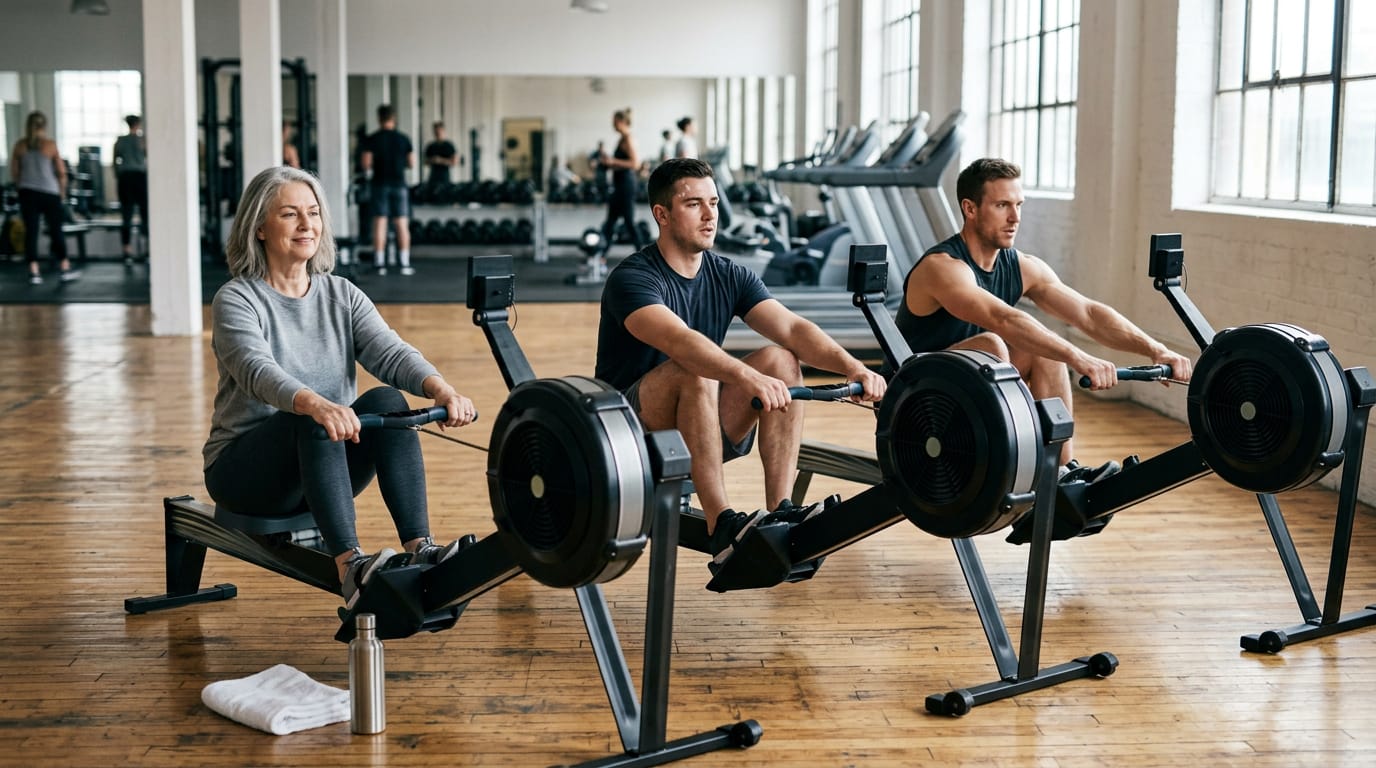
Buying a rowing machine is a lot like buying running shoes. The fanciest model means nothing if it doesn’t fit how you actually move. Getting the right one starts with knowing what rowing asks of your body.
A rowing machine is a full-body cardio tool that works your legs, back, core, and arms in one smooth stroke.
In this post, we’ll cover why it’s worth your time, how to set up and row with good form, beginner-to-advanced workouts, strength work to support your rowing, and how to choose a machine for your space and goals.
Why Rowing Machine Workouts Are Worth It
Few machines ask your legs, back, core and arms to work together the way a rowing machine does. That’s a big reason it’s worth making room for.
Hit legs, back, core and arms together
Each stroke runs through your legs, core, back and arms in one smooth motion. Rowing also works your upper back, including the muscles between your shoulder blades that often get skipped in a typical lifting session.
For building strength, rowing generally beats a treadmill, which mostly loads your legs.
You also get two kinds of training in one session:
- Cardio: your heart and lungs stay busy the whole time.
- Strength conditioning: your muscles keep working against resistance, building endurance along the way.
Build a stronger heart and lungs
Rowing raises your heart rate quickly, and steady sessions strengthen your heart and lungs over time.
A 2026 scientific statement from the American College of Cardiology calls regular physical activity a cornerstone of preventing cardiovascular disease (CVD), and rowing is one of the regular activities that can reduce your risk of heart disease.
It can also help lower blood pressure.
VO2 max, or maximal oxygen consumption, measures how much oxygen your body can use during hard effort, and it can climb with training. In one study in the International Journal of Sports Medicine, rowing training raised VO2 max by 14% over six months.
Wondering how rowing compares with 10,000 steps? Our research doesn’t include a verified equivalent, so we won’t guess at minutes. A step counter won’t register a single stroke, so judge your rowing by effort and time instead.
Do rowing machines help reduce belly fat?
Rowing can support overall fat loss, but it can’t selectively reduce belly fat. Harder efforts burn more, and a session can reach up to 800 calories an hour.
A comparison of energy expenditure during rowing and cycling ergometry found rowing’s energy cost was higher than cycling’s at every power output tested, including maximum levels.
The catch is spot reduction, the idea that you can burn fat from one targeted area through exercise.
A study on regional and general aerobic exercise in women with obesity cites a recent meta-analysis concluding that localized exercise alone isn’t enough to reduce fat in one area. So aim for overall fat loss rather than a belly-only fix.
Gentle on joints, good for recovery
Rowing is low-impact, so your feet don’t pound the ground the way they do when running. That’s easier on knees, hips and ankles.
A weekend tennis player with sore knees can still get a hard session on the rower after practice, with far less jarring on the joints. For many people, that makes rowing a lower-risk choice than running.
It’s also useful during injury recovery, since you can keep the effort easy and build back gradually. Less pounding, still a real workout.
Improve posture and shoulder and hip mobility
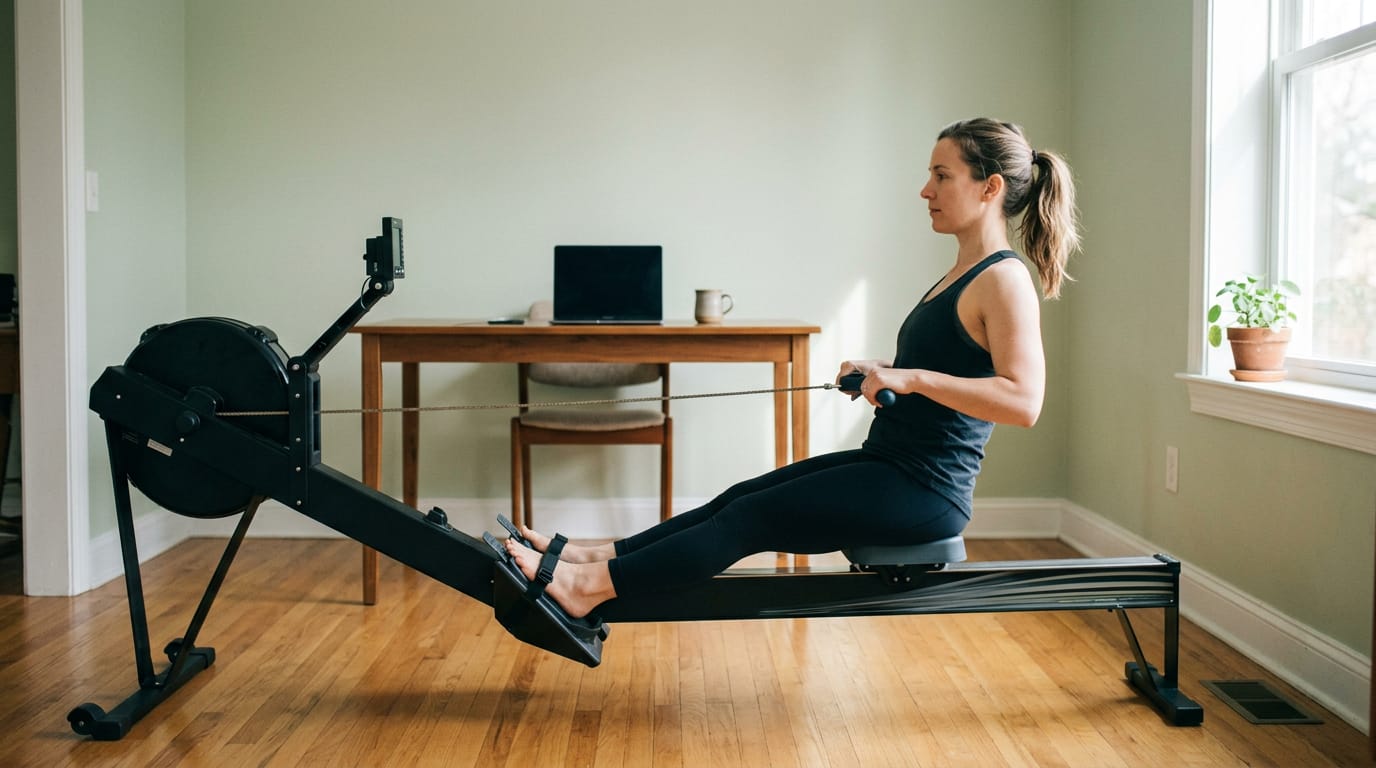
Good rowing form keeps your chest up and your back straight through the drive, which supports better posture and alignment. That’s a welcome counterweight if you spend long hours hunched over a desk.
Each stroke also moves your shoulders and hips through a full range of motion, which helps build flexibility in both.
How rowing lifts mood and reduces stress
Rowing is as much about how you feel as how you look. Endorphins, the feel-good chemicals your body releases during exercise, can give your mood a boost after a hard session.
A focused row also gives your mind a break from work and worry, and many people leave with clearer thinking. Over time, regular sessions can leave you with more energy and better sleep.
Available in any gym for every level
You’ll find a rowing machine in most gyms, so it’s easy to fold into the routine you already have. You control the resistance, so a beginner and a seasoned athlete can share the same machine and still get a real workout.
Machine rowing also skips the water-related risks of rowing on a lake or river. There’s no wind, rain or traffic to cut your session short. Show up, set the resistance, and start pulling.
Set up Your Machine and Form Correctly
Before you chase a fast split, get your form and settings right. A few small adjustments make every session smoother, safer, and easier to repeat.
Nail the stroke, legs first then arms
Secure your feet in the footrests and sit tall with your core engaged. Then run each stroke in order:
- Legs drive first. Push through your legs before your back or arms do any work.
- Pull the handle to your chest. Finish with your torso leaning back slightly.
- Reverse the sequence to return. Extend your arms, hinge forward from the hips, then bend your knees to slide back.
- Keep strokes smooth and controlled. Don’t rush the slide, since it’s the fastest way to lose rhythm.
The most common mistake is pulling with your arms instead of your legs. Think of a weekend rower who yanks with her arms from the first stroke. Her shoulders ache, and her pace fades halfway through.
Once she moves the push into her legs, the same effort lasts the whole workout. Same effort, longer session.
If your back starts to round, shorten the stroke and sit taller.
Set resistance and track your goals
The damper controls resistance, so a higher setting makes each pull feel heavier. Concept2 presets give you ready-made workouts, so you can start a session without building one from scratch.
Goal setting keeps every session honest. Pick a target by distance, time, or stroke rate, and focus on one at a time. Consider a dad who rows three mornings a week with his teenager.
He sets a time goal for the first month, then adds a distance target once his pace holds steady. Clear targets beat guessing.
Rowing Machine Workouts to Try
Pick a format that fits your time and fitness, then build up gradually.
How long should I exercise on a rowing machine?
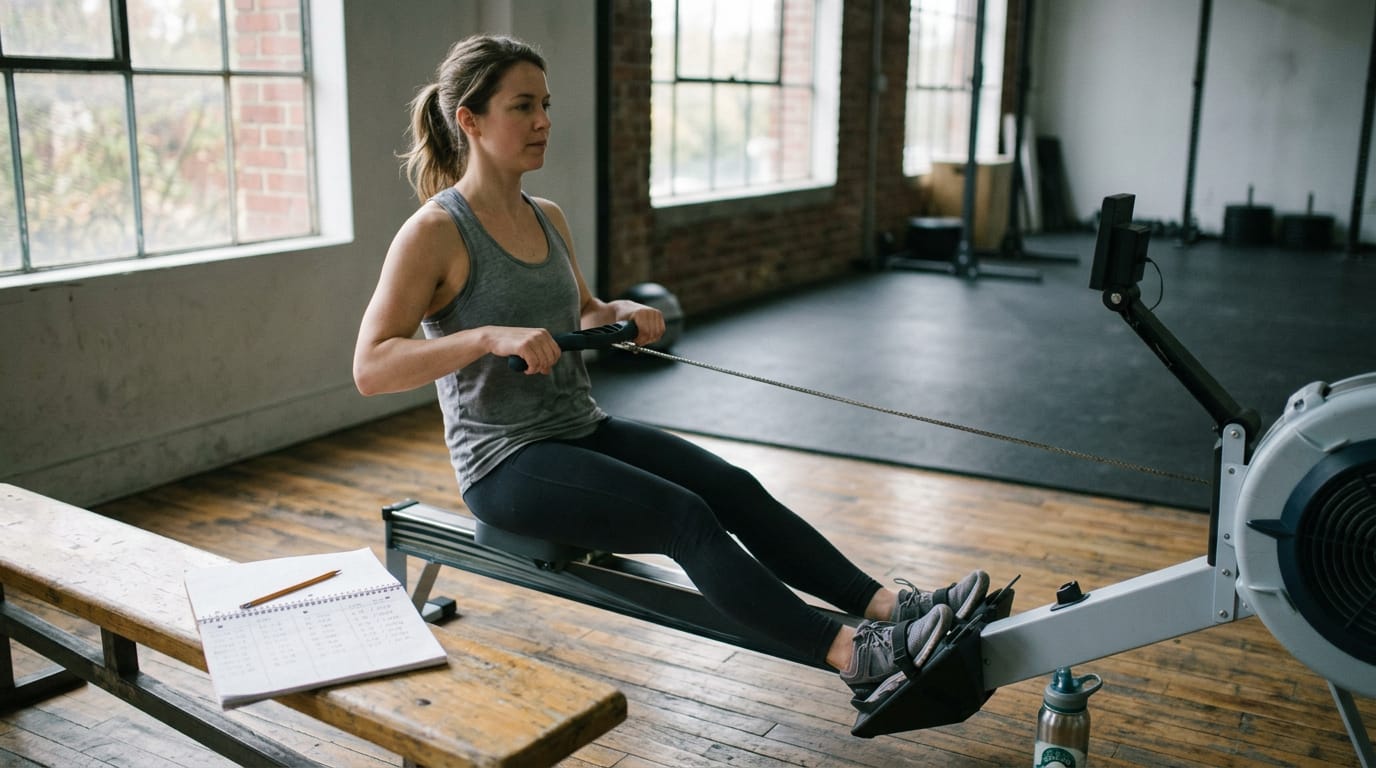
Start with a steady-state row at one even pace for 20 to 30 minutes. Is 20 minutes on a rowing machine enough? For many people, yes, especially once you add some intensity.
As you progress, use a 2K benchmark (a 2,000-meter row you repeat to track progress) and a 5K middle-distance piece (5,000 meters). Beginners should first build an aerobic base, the endurance foundation that makes harder work manageable.
Mix hard sprints with short rest
Intervals bring the intensity. Try these:
- 30 seconds on/off: 30 seconds hard, then 30 seconds easy, repeated for a set.
- Pyramid: Intervals that climb in length, then step back down.
- Tabata 20/10 for 4 minutes: 20 seconds hard, 10 seconds easy, for 4 minutes.
- Distance intervals (2000/1500/1000/500m): Row each distance hard, resting between.
- 500m sprints with rest: Fast efforts with a full rest between each.
A club rower with a short evening window picks the 500m sprints and still makes it to dinner. The work is in the effort, not the clock.
Warm up, cool down and build up slowly
Start every session with a warm-up: five minutes of easy rowing to loosen up. Finish with an easy cool-down that lets your breathing settle.
Progress from beginner to advanced by starting with steady rows, adding time once they feel easier, then layering in intervals. Mix steady and interval days so you’ll get variety. Start easy. Build from there.
A sample week: steady rows Monday and Friday, 30 seconds on/off Wednesday, and 500m sprints Saturday, each with a warm-up and cool-down.
Add Strength Work to Help Your Rowing
A rowing machine builds plenty of endurance on its own, but it can’t cover every need. Here’s how targeted strength work fills the gaps.
Why strength training helps your rowing
Strength work supports your rowing in four key ways:
- Muscle strength and power: More strength means more force per stroke, and power means delivering that force quickly.
- Muscle endurance: Your muscles need to hold good form late in a long session, not just at the start.
- Reduced injury risk: Strength training can help reduce injury risk for people who row. A paper on movement competency in rowing points to injury prevention as one benefit of sport-specific movement skill.
- Faster rowing performance: Strength training can improve rowing performance. A study of trunk muscle strength training in male rowers going through puberty calls strength training fundamental to building the strength and power behind sport-specific performance.
Strength work doesn’t replace your rowing. It supports it.
Injuries that often hit rowers
Rowing repeats the same motion stroke after stroke, so the same joints take the same load again and again. Common trouble spots include:
- Wrist tendon inflammation: Irritation of the tendons (the cords linking muscle to bone) that move your wrist.
- Rib stress fractures: Tiny cracks in a rib that build up from repeated loading.
- Low back and knee pain: Often a sign that your legs and core aren’t doing their share.
Stronger muscles share the load. Your joints will thank you.
Lower body moves to build power
The drive starts with your legs, so these moves are a good place to start.
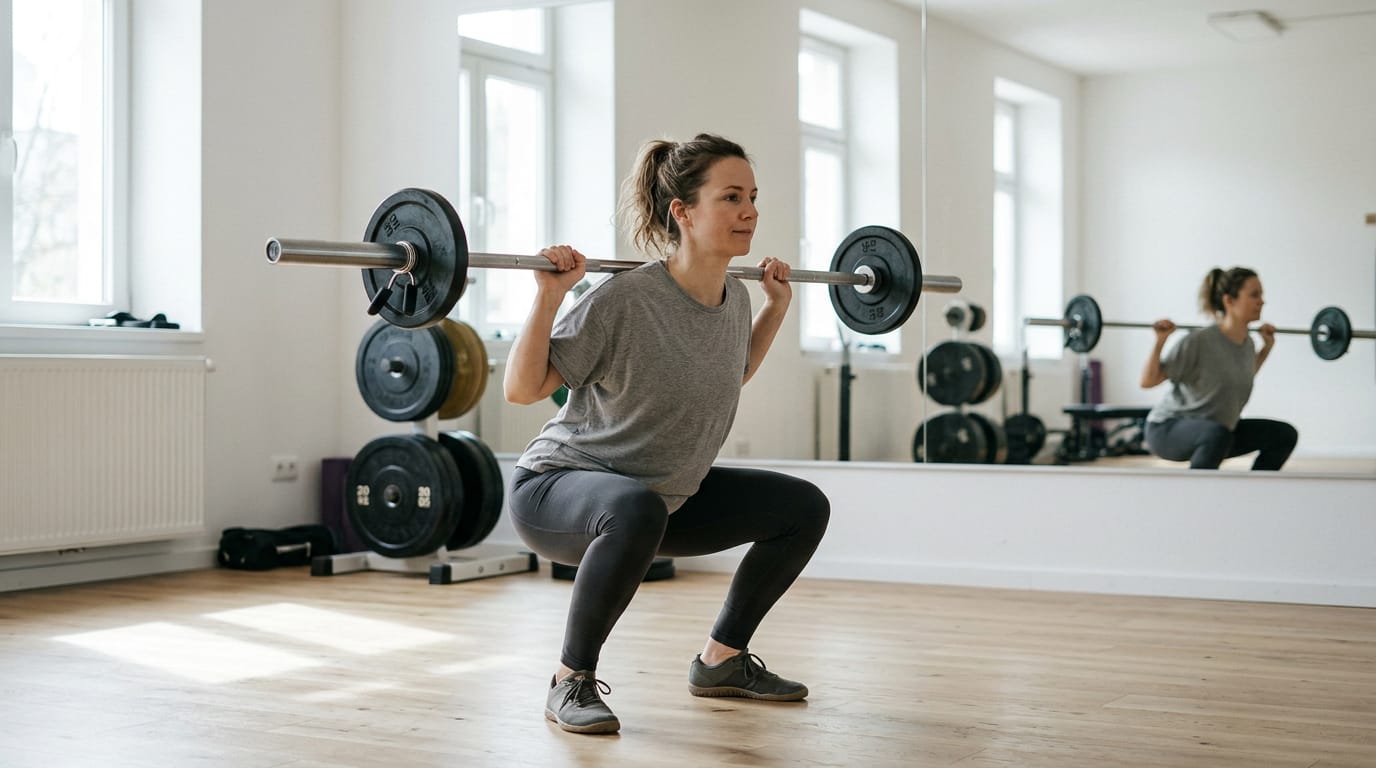
- Squat: Works your hips, thighs, and glutes (buttock muscles) as you lower and stand.
- Single leg step up: Trains one leg at a time, so you can spot and fix any imbalance.
- Leg press: A machine option that loads your legs with less balance demand.
- Lunge: Works each leg on its own while building balance.
- Deadlift: Lifts a loaded bar from the floor using your hips, back, and legs.
Choose a load that keeps your form clean, not one that just looks impressive.
Upper body moves for pushing and pulling
Rowing is mostly a pull, so pushing moves keep your upper body from getting lopsided.
- Overhead press: Pushes a weight straight up from your shoulders.
- Bench pull: Lie face down on a bench and pull a weight toward your torso.
- Bent over row: Hinge forward at the hips and pull a weight toward your waist.
- Push-up: Builds your chest, shoulders, and triceps (the muscles on the back of your upper arm) using only your body weight.
- Inverted row: Lie under a sturdy bar and pull your chest up toward it.
Strengthen your core, adding weight over time
A strong core keeps your trunk (your torso) steady, so force from your legs reaches the handle instead of leaking out.
- Plank: Hold a straight line from head to heels, resting on your forearms and toes.
- Russian twist: Sit with knees bent, lean back slightly, and rotate your torso side to side.
- Progress with added weight: Once a move feels easy, add load in small steps rather than big jumps, like a plate on your back for planks or a dumbbell for twists.
How often to strength train each week
Aim for 2-4 sessions weekly, starting low if you’re new to lifting. Leave 24 hours between strength sessions so your muscles can recover. Learning the basics of dumbbell exercises can help when you’re new to lifting.
Think of a club rower who lifts on the same afternoons as her hardest rowing machine intervals and finds her legs heavy by the weekend.
Moving her lifts a day away from those sessions gives her legs time to recover, so both workouts feel better. Recovery is part of the workout.
Picking the Right Rowing Machine
Decide where the machine will live and how often you’ll row before you compare models.
Top picks and what to check first
Start with the brand you’ll hear about most. A rowing ergometer is the technical name for a rowing machine, and the Concept2 is the most marketed model, according to a systematic review of rowing ergometer research.
It’s a commonly recommended indoor option for home workouts.
Rower types come in three main flavors:
- Air rowers use a flywheel and fan, so the harder you pull, the more resistance you feel.
- Water rowers pull a paddle through a tank of water, and resistance builds with your stroke.
- Magnetic rowers use magnets you set with a dial, so resistance doesn’t rise just because you pull harder.
The difference comes down to how the resistance responds. Air and water models answer your effort, while magnetic models answer the dial.
Budget magnetic option: If cash is the main constraint, a magnetic model is the place to start. You still get adjustable resistance for every session without paying for a more complicated setup. Knowing the home gym cost at each budget level helps you plan your spending.
Home gym fit matters as much as the machine. Consider a parent who wants a short row before the house wakes up. A model that folds against a wall gets used, while a bulky one becomes a clothes rack.
App-guided workouts can help if you’re new to structured rowing. Some machines pair with an app that guides intervals and logs your sessions. Check whether the app is included or charged separately before you buy.
Storage and height come next. Measure before you order. Compare the machine’s footprint and folded size with your space, and check the stated user height range so your legs don’t feel cramped at the start of each stroke.
Fit beats brand, and the right machine is the one you’ll actually use.
A rowing machine can do a lot for you, but only when the setup, form, and workout match your goals. Start with a smooth stroke, pick a routine that fits where you are now, and add strength work to support every pull.
When the machine fits your space and your level, you’ll actually look forward to your sessions. Fit beats fancy features every time.
Find the stroke that feels right, and the rest of the workout takes care of itself.
References
- The Evaluation of Physical Performance in Rowing Ergometer: A Systematic Review — pmc.ncbi.nlm.nih.gov (2025)
- Exercise Prescriptions for Cardiovascular Health in Adults: 2026 ACC Scientific Statement: A Report of the American College of Cardiology — jacc.org (2026)
- Thieme E-Journals — thieme-connect.com
- Movement competency in rowing: the key to an effective stroke — pmc.ncbi.nlm.nih.gov (2025)
- Effects of global versus local trunk muscle strength training on muscle strength, proxies of power and rowing-specific performance in pubertal male rowers — pmc.ncbi.nlm.nih.gov (2026)
- Impact of regional and general aerobic exercise on molecular regulators of lipolysis and adipose tissue composition in obese women — pubmed.ncbi.nlm.nih.gov (2025)
- A comparison of energy expenditure during rowing and cycling ergometry — pubmed.ncbi.nlm.nih.gov (1988)
Questions
How long should I exercise on a rowing machine?
Start with 20 to 30 minutes of steady rowing at an even pace. Build up gradually as your endurance improves, and add intervals once a steady aerobic base feels manageable.
How much rowing is equal to 10,000 steps?
There is no reliable fixed conversion between rowing and 10,000 steps because they measure different activities. Judge a rowing workout by its effort and duration rather than trying to match a step count.
Do rowing machines help reduce belly fat?
Rowing can support overall fat loss, but it cannot selectively burn belly fat. Pair regular exercise with habits that support overall fat loss rather than expecting exercise to target one area.
Is 20 minutes on a rowing machine enough?
Yes, 20 minutes is enough for many people, especially if the effort is appropriately challenging. Beginners can start with steady rowing and gradually add time or intensity as they become fitter.
Sources
- Exercise Prescriptions for Cardiovascular Health in Adults: 2026 ACC Scientific Statement: A Report of the American College of Cardiology | JACC, jacc.org,
- Thieme E-Journals - International Journal of Sports Medicine / Abstract, thieme-connect.com
- A comparison of energy expenditure during rowing and cycling ergometry - PubMed, pubmed.ncbi.nlm.nih.gov,
- Movement competency in rowing: the key to an effective stroke, pmc.ncbi.nlm.nih.gov,
- Effects of global versus local trunk muscle strength training on muscle strength, proxies of power and rowing-specific performance in pubertal male rowers, pmc.ncbi.nlm.nih.gov,
- The Evaluation of Physical Performance in Rowing Ergometer: A Systematic Review, pmc.ncbi.nlm.nih.gov,
- Impact of regional and general aerobic exercise on molecular regulators of lipolysis and adipose tissue composition in obese women, pubmed.ncbi.nlm.nih.gov,
Find your level
The Counter