Kettlebell Swing Exercise: Form, Muscles, and Benefits
Kettlebell swing exercise builds power through a hip hinge. Get step-by-step form cues, mistake fixes, and help choosing a weight that fits your level.
Think about the last time you lifted a heavy laundry basket off the floor. You didn’t bend at your back and yank it up. You pushed your hips back, let your legs take the load, and stood tall.
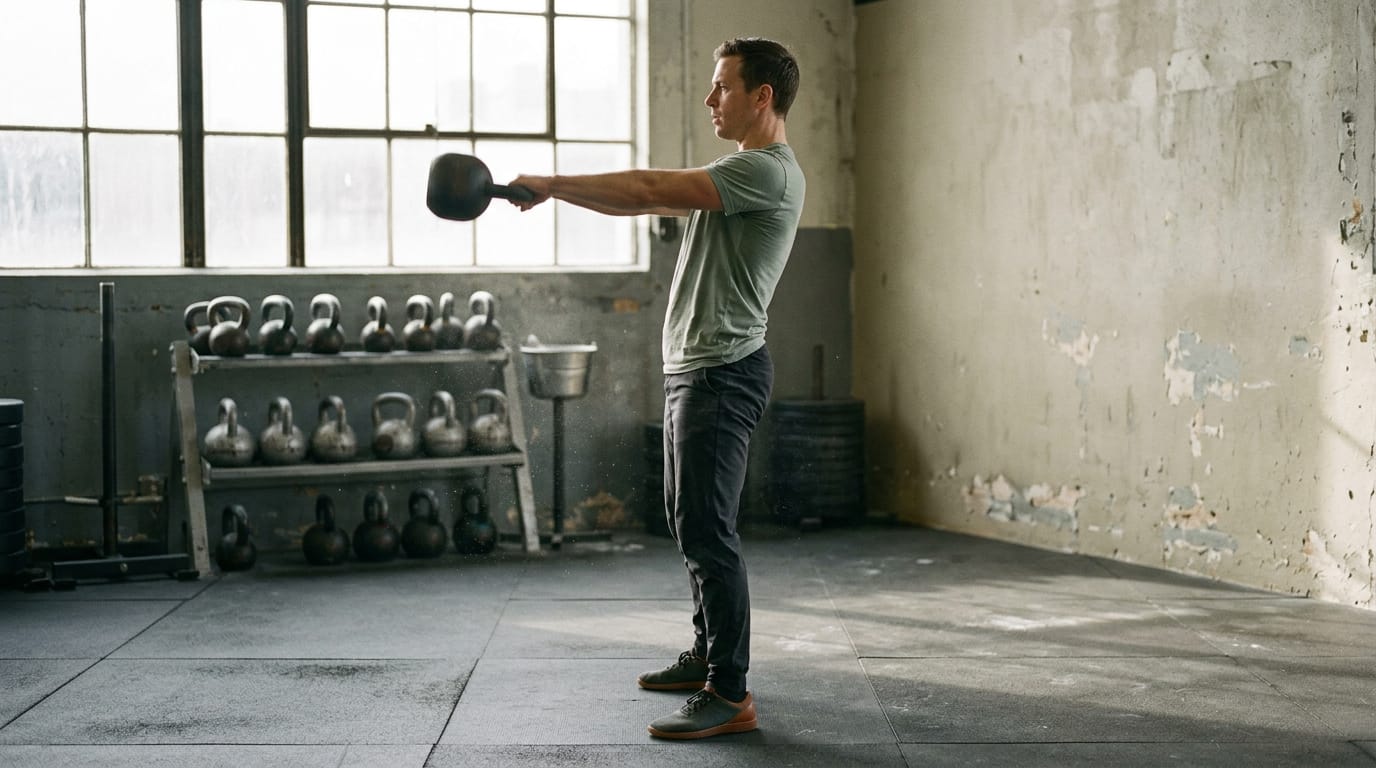
That’s the same basic move behind the kettlebell swing, a hip hinge that uses a kettlebell to build power and endurance.
This guide covers what the swing is, which muscles it works, how to do it with clean form, the mistakes to avoid, and how to pick a bell that fits your level and space.
Why the Kettlebell Swing Exercise Matters
The kettlebell swing packs a lot of training into one bell and a small patch of floor. Here’s what it does and what the research says so far.
The explosive hip hinge at its core
The swing is a ballistic hip hinge, a fast, explosive movement that starts with your hips pushing back and finishes with a sharp hip extension, the forward snap that sends the bell up. Your arms guide the bell, but your hips drive it. Hips do the work.
One kettlebell is all you’ll need to train that pattern.
Why one move trains your whole body
The swing covers a lot of ground in one movement:
- Strength, power, and endurance: one exercise trains all three at once.
- An efficient workout: a few focused sets can carry a full session.
- Time savings: you get a real training stimulus without a long gym visit.
- A foundation: learning the swing well sets you up for other kettlebell moves.
Think of a rec-league soccer player with only 30 minutes before work. A few focused swing sets make a real workout, and they still make it out the door on time.
Its roots and rise in popularity
Kettlebell training has classic roots as a strength tool, and the swing has long been one of its signature moves.
Later, functional fitness (training built around whole-body movements) programs such as CrossFit helped carry the swing to a much wider audience. Athletic trainers also use it to build explosive hip power.
What the research says about swings
Research has examined kettlebell exercise as an approach to lower back pain.
A mini review on kettlebell training for musculoskeletal rehabilitation and injury prevention notes that these movements may enhance strength, reduce pain, and restore mobility with minimal equipment.
On strength, a study on kettlebell swing training found maximum strength improved by 9.8% after the training period, and the swing group performed about as well as the comparison group.
The American Council on Exercise (ACE) has also studied an eight-week swing program, and sports performance studies look at whether that hip power carries onto the field, court, or track.
Gains after a six-week block are the next question, and we’ll get to structuring one in the programming section. Promising, but not a guarantee.
Which Muscles the Swing Works
A handful of large muscle groups do most of the swing’s work, and each one has a specific job.
Back-of-body muscles doing the heavy lifting
The swing is a hip hinge, so most of the power comes from the back of your body. Your glutes (the large muscles of your backside) drive your hips forward at the top of each rep, and your hamstrings (the muscles at the back of your thighs) share the load.
Your erector spinae (the long muscles along your spine) keep your back steady. Your calves, traps (upper back) and rhomboids (between the shoulder blades) play smaller supporting roles.
Consider a weekend golfer chasing more hip power off the tee. When she hinges instead of muscling the bell with her arms, the work comes from her hips, not her arms, and she’ll feel it in her glutes.
Your core and grip keep you steady
Power only transfers well if your middle stays rigid. Core bracing means tightening your abs and torso so your ribs and pelvis move as one unit.
Your lats (the broad muscles along your sides and back) keep your arms close, while your shoulders and deltoids (the rounded muscles capping each shoulder) hold the joint steady.
Your grip and forearms keep the handle locked in your hand. Your arms are passengers, not engines.
Supporting muscles that assist the move
Your quadriceps (the front of your thighs) assist by bending your knees slightly, giving the bell room to swing back between your legs.
Your hip flexors (the muscles at the front of your hips) decelerate the bell at the top, controlling the return so the swing stays smooth. Control matters as much as power.
Walking Through the Swing Step by Step
The swing is one connected movement, and the order of the steps matters more than speed. Here’s how each phase fits together, from setup to the next rep, plus a quick way to check your own form.
Setting your stance and bell position
Start with the bell placed in front of you. Stand with your feet shoulder-width or wider and your toes turned slightly out. Keep your back neutral and your shoulders down, and wear flat shoes or go barefoot so your feet stay planted. Setup feels boring.
It’s also the foundation for everything after it.
Hike the bell, then snap your hips
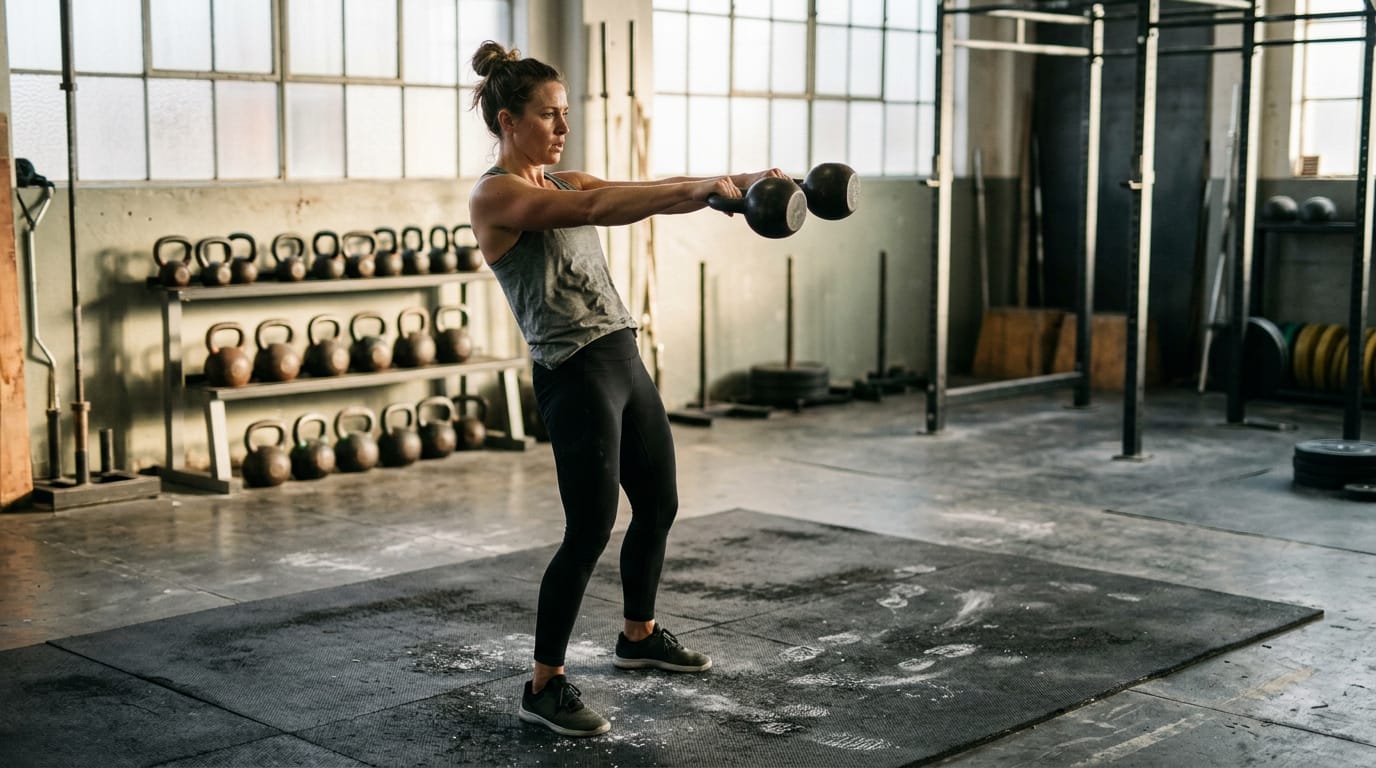
Now hike the bell back between your legs, the way a football center hikes the ball. Then drive your hips forward in an explosive thrust. That snap, not your arms, is what sends the bell up.
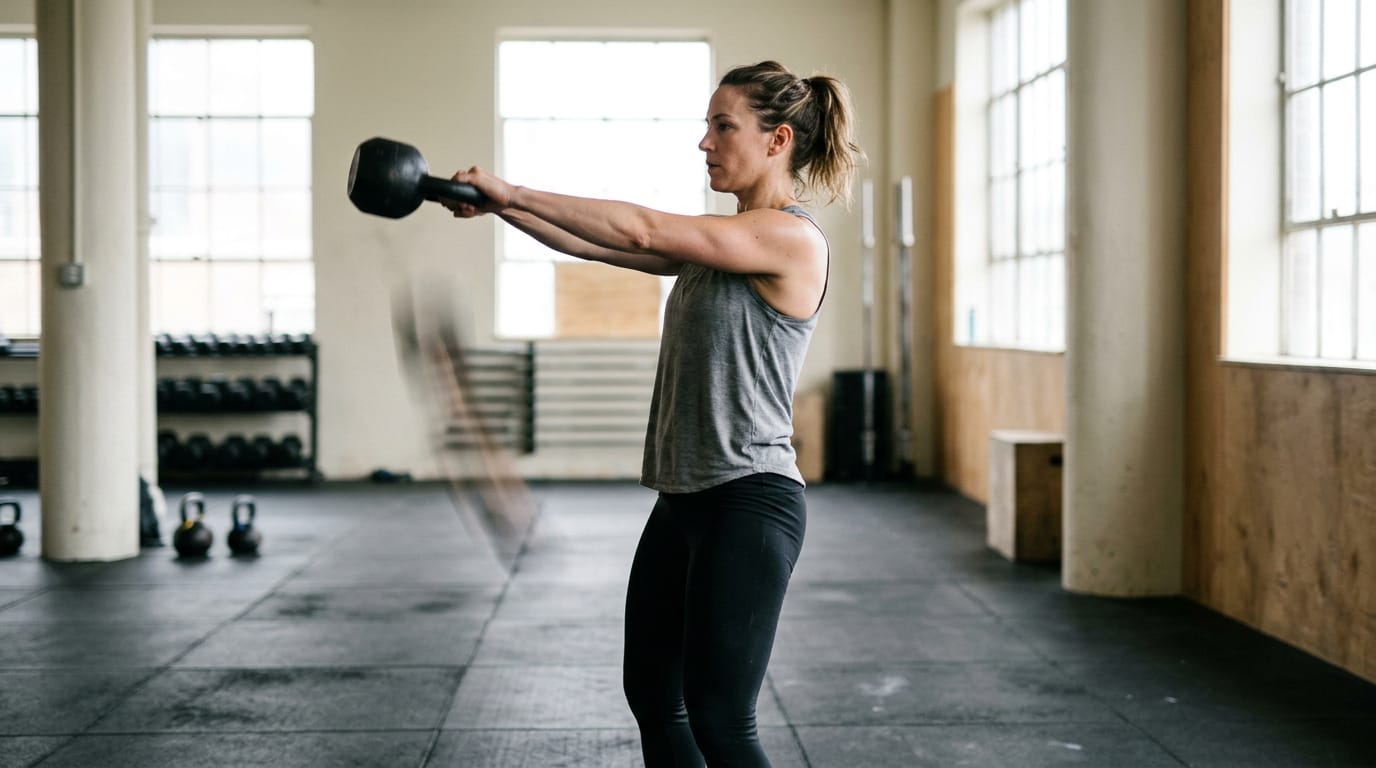
At the top, squeeze your glutes and let the bell float to chest height. Keep your arms loose, like ropes, so they only guide the bell while your hips do the lifting.
Controlling the backswing and return
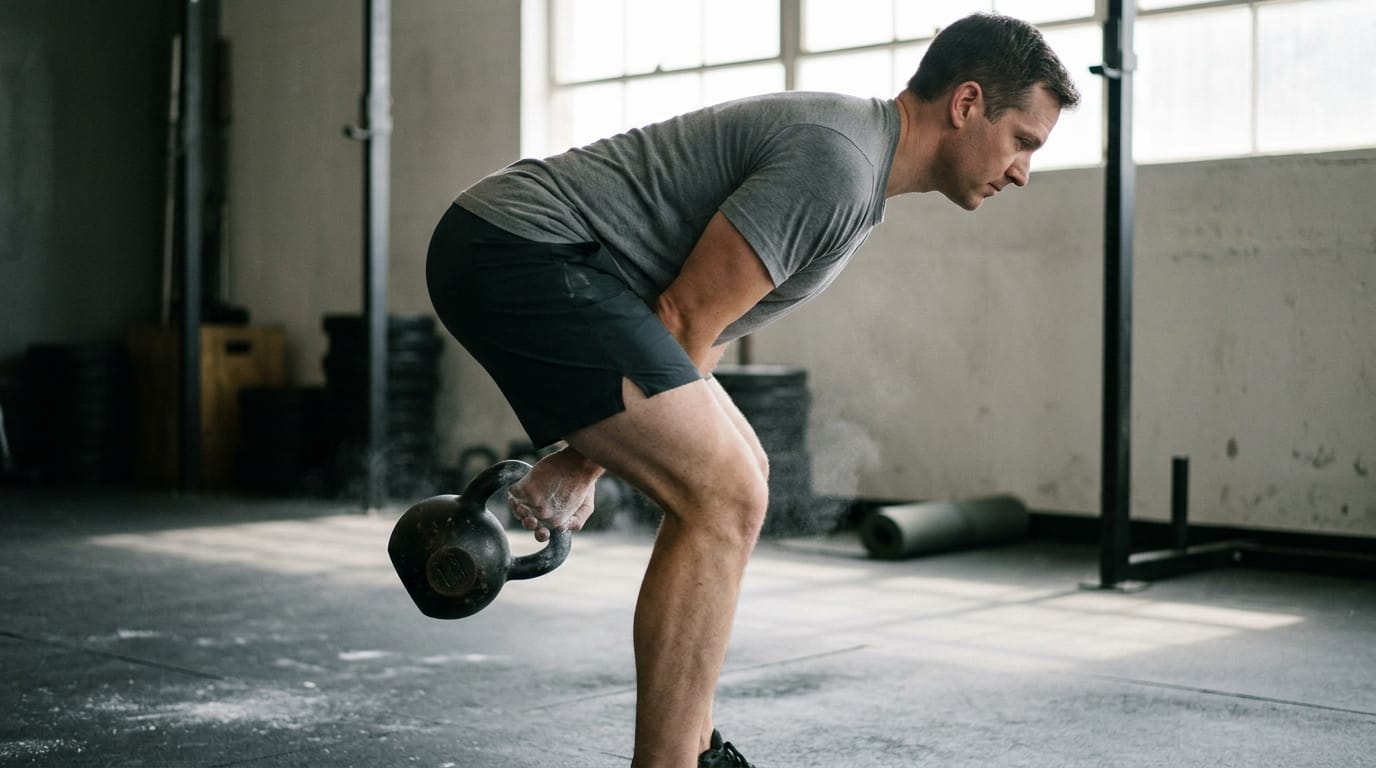
Your backswing should be a controlled descent, not a drop. Hinge at the hips to absorb the bell, with your forearms coming to rest on your inner thighs. Then move straight into the next rep instead of resetting between swings.
When to breathe during each rep
Breathing follows the movement. Exhale as your hips reach full hip extension at the top of the snap, then inhale as the bell travels back. Good bracing means your core is firm before every rep, so your torso stays solid through the snap.
Picture a club soccer player who holds their breath through an entire set and runs out of steam by the final rep. Matching breath to movement keeps the rhythm going, so the last swing looks like the first.
Hinge the hips instead of squatting
This is the hip hinge, and it’s what separates a swing from a squat. Send your hips back, not down, so your torso tips forward while your knees bend only slightly. Power comes from your glutes and legs, not from lowering yourself toward the floor.
Consider a weekend player who ends every session with sore quads. Once they push the hips back and let the glutes and legs drive, the quad burn fades and the swing starts to feel like one smooth motion.
So how do you know your swing is correct? Film a set from the side or have a training partner watch. You’re on track if these four things hold:
- Bell height. It floats to about chest height, driven by your hips.
- Arms. They stay loose, like ropes.
- Knees. They bend only a little.
- Back. It stays neutral through the snap.
If your hips are doing the lifting, you’re doing it right.
Common Mistakes and How to Fix Them
Most swing faults come from arms or knees doing work your hips should handle.
Stop muscling the bell with your arms
Muscling the bell makes your arms and shoulders take over. Power should come from a hip hinge: push your hips back, then snap them forward. Think of your arms as loose ropes that simply connect you to the bell.
Picture a weekend softball player who ends every set with burning shoulders. Once she lets her hips do the lifting, the same bell feels lighter and she finishes with energy left. Your hips drive the bell, not your arms. Arms just steer.
Squatting when you should hinge
Too much knee bend turns the swing into a squat and pulls power away from your hips. You’ll feel it at the top, where the bell stalls instead of snapping up. Your quads take over, so the front of your thighs burn or strain.
To check yourself, film from the side. If your knees do most of the moving, you’re squatting, not hinging.
Keeping your spine neutral throughout
A neutral spine keeps your back in one straight line from head to tailbone. Three faults break it:
- Rounded back. Your lower back curves under load. Keep your chest up and ribs down.
- Hyperextending at the top. Leaning back arches your lower back. Stand tall and squeeze your glutes instead.
- Not using core. A loose midsection leaves your torso as the weak link. Brace your abs before each swing.
When weight and speed go wrong
- Weight too heavy. Your arms and back end up finishing what your hips can’t. Go lighter until the hinge feels crisp.
- Swinging too fast. Speed can hide sloppy form. Slow down until every rep looks the same.
- Bell dropping below knees. That usually means you’re squatting or pulling it down with your arms.
- Shallow hinge. If your hips barely move back, you’re just lifting. Push them back until your hamstrings stretch.
Hands show the strain first. Calluses are normal, so let them form and trim loose skin rather than ripping it. If a tear opens, back off the volume until it heals. Chalk keeps the bell from slipping, so you don’t have to clench harder.
What Swings Do for Your Body
A kettlebell swing reaches further into your body than most people expect. We’ll walk through what it trains and where the evidence stands.
Do kettlebell swings count as strength training?
Yes, they do, though it’s a different flavor than a slow squat. What matters more is how fast your hips drive the bell than how heavy it is:
- Explosive hip power. The snap at the top of each swing trains quick force from your hips.
- Jumping and sprint transfer. Research has examined whether this carries over, including a study on short-term swing effects on lower limb performance.
- Stronger posterior chain. The muscles from your glutes and hamstrings up through your lower back do much of the work.
- Fast-twitch fiber engagement. Swings recruit fast-twitch fibers, the muscle fibers built for short, powerful bursts.
Raising your heart rate and calorie burn
A study on the oxygen cost of kettlebell swings found heart rate ran substantially higher than oxygen uptake, a sign of real cardiovascular demand. That effort also means a high calorie burn for the time you spend.
The afterburn effect is energy use that continues after you stop. A Frontiers study on high-intensity exercise lists excess post-exercise oxygen consumption (EPOC) as one of two hypotheses for the fat mass reduction seen after intermittent training.
Kettlebell training has been studied for fat loss. A comparison with plyometric training in volleyball and basketball athletes tracked body fat percentage before and after. Whether swings match running intervals is still an open question.
How swings help your posture and back
Hours at a desk tend to tighten your hips and slump your posture, and swings work against both.
Research has examined whether kettlebell exercise can reduce lower back pain, and a mini review on kettlebell training for musculoskeletal rehabilitation and injury prevention covers the rehab side.
Swings also build postural coordination, keeping your core and hips organized under a moving bell. They teach the hip hinge: pushing your hips back with a long spine, the same pattern you use to lift a laundry basket.
It’s less about bending over and more about hinging at the hips.
Low impact and easy to fit in
Both feet stay on the floor, so swings are easier on your knees than jumping. You need one bell and enough room to swing it. Once one bell starts to feel limiting, dumbbell exercises give you another way to train.
Consider a weekend basketball player who wants a quicker first step without more landing impact. A few swing sessions at home build her hip power and leave her legs fresh for Sunday’s pickup game.
The rehab research above hints at a recovery role, though you’d want a physical therapist’s guidance first. That makes swings a practical pick for home workouts.
How swings build grip and everyday strength
Grip strength is often treated as a longevity biomarker, a simple sign of how well you’re aging. Swings load your hands on every rep. Your grip does more work than you think.
Everyday lifting transfers well. Carrying groceries or lifting a toddler from a car seat uses the same hinge and grip pattern. Loaded, full-body work also supports women’s bone and muscle health.
Different Ways to Swing
The version you pick changes what the swing asks of your shoulders, grip and core. If you’re searching for the 3 best kettlebell exercises, the Russian swing, one-arm swing and double swing below are a practical place to start.
Choosing between Russian and American swings
The Russian swing stops at chest height, while the American swing carries the bell overhead. That extra range makes the Russian version the safer choice for your shoulders.
You’ll see the American style often in CrossFit, but overhead work needs solid shoulder mobility. Think of a weekend tennis player who wants a stronger swing for Saturday’s match without a sore shoulder on Monday.
Her answer is simple: start with the Russian swing and save the overhead version for when her mobility is ready.
Swinging with one arm or switching hands
A one-arm swing adds an anti-rotation demand: your core has to resist the bell pulling your torso toward the working side. That’s a bigger test for your grip too, since all the load sits in one hand.
Once it feels steady, switch hands at the top of the swing. Your goal is control rather than height.
Double, alternating and side-step swings
- Double kettlebell swing: Two bells let you move more total load with the same swing motion.
- Alternating and walking swings: Switch hands each rep, or step forward between swings, for added coordination.
- Side-stepping and lateral swings: Step sideways between reps to challenge your balance from a new angle.
- Advanced progression: Build toward these once the basic swing feels smooth.
Earn each step.
Choosing Weight and Building Your Routine
Your bell and your plan matter as much as technique. Here’s how to get both right.
Picking the right kettlebell weight
The right starting weight lets your hips drive every rep without your back rounding. For women starting out, 8 to 12 kg is a sensible range. Men use the same test: pick the bell your hips, not your arms, can drive.
- Too light: your arms end up doing the lifting.
- Too heavy: your back rounds or the bell drops at the top.
A soccer player grabs the heaviest bell on the rack and feels it in his lower back by the second set. Dropping to one he controls builds the hip power he came for.
Progress gradually. Add weight only when every set stays clean.
Check the handle (it should leave room for your fingers), the finish (the coating, which affects grip) and the fit (it should suit your hands and space).
Is it better to lift heavy or do more reps?
It depends on your goal: heavy, low-rep sets build strength, while more reps build conditioning.
- EMOM (every minute on the minute): start a short set at the top of each minute, then rest with what’s left.
- Tabata intervals: short, all-out bursts with brief rests.
- Beginner light sets: start lighter so technique settles before intensity climbs.
- Simple & Sinister protocol: a structured, ready-made plan worth a look.
A hockey player who wants to last the third period picks EMOM, while a dad chasing sprint power picks heavy sets.
Fitting swings into your workouts
Start every session with a few light swings and easy hip hinges. Pair swings with burpees, squats or pull-ups in a superset (two exercises back to back, no rest) or a HIIT (high-intensity interval training) block.
Progressive overload means getting a little harder each week through more reps, more rounds or a heavier bell. Goblet squats (bell held at your chest) and kettlebell cleans (bell racked at your shoulder) pair naturally with swings.
How often to swing and rest
Aim for three to five days a week. Lighter sessions double as low-impact recovery, keeping you moving without the pounding of running or jumping. If your grip gives out before your hips do, put the bell down. Rest before your form breaks, not after.
Who Should Swing, and Who Should Wait
Most people can find a place for the swing, but not everyone should start today.
Who can benefit from swings
The swing scales from beginner to elite. A newcomer learns the hinge with a light bell, while a competitor loads the same pattern heavier.
Consider an office worker who sits all day. A few swing sets at lunch can get the hips and legs moving again.
Women in perimenopause, the transition years before menopause, can also find it a good fit. Back-pain recovery can include swings too, but only under a coach who watches the hinge closely.
How beginners can build up to swings
Start with the kettlebell deadlift, which teaches a clean hip hinge. Then add the goblet squat, holding the bell at your chest as you sit between your heels, to build the leg and trunk strength the swing relies on. Form comes first.
Don’t add weight until your hinge stays clean on every rep, because the quality of each rep counts more than how heavy the bell feels.
Conditions that call for caution or avoidance
Hold off, or get clearance first, if any of these apply:
- Herniated discs and shoulder issues. A herniated disc (a spinal disc that has slipped out of place) or a shoulder problem needs clearance first.
- Pregnancy. Avoid swings while you’re pregnant.
- Seniors. Older adults need supervision, ideally from a trainer who can watch every rep.
- High blood pressure or vertigo. Talk with your doctor before you start.
- Any injury. If something hurts or you’re unsure, consult a professional.
The real question is whether swings are safe for you right now. When in doubt, wait.
The swing comes down to one skill: a clean hip hinge. Practice it with a light bell, keep your arms relaxed like ropes, and let your hips drive every rep.
Pick a weight and handle that fit where you are today, and the swing will start to feel like a habit you’re glad to have.
Form beats weight every time, so earn heavier bells as your hinge gets smoother. The bell is just the tool. Your hips are the engine, and that’s what you’re really training.
References
- Kettlebell training for musculoskeletal rehabilitation and injury prevention: a mini review — pmc.ncbi.nlm.nih.gov (2025)
- Kettlebell Training vs. Plyometric Training: A Comparison of Jump Performance in Volleyball and Basketball Athletes — pmc.ncbi.nlm.nih.gov (2025)
- Acute effects of kettlebell swings with different loads on lower limb performance — doi.org (2026)
- Frontiers | Is Oxygen Uptake Measurement Enough to Estimate Energy Expenditure During High-Intensity Intermittent Exercise? Quantification of Anaerobic Contribution by Different Methods — frontiersin.org
- Kettlebell swing training improves maximal and explosive strength — pubmed.ncbi.nlm.nih.gov (2012)
- Oxygen cost of kettlebell swings — pubmed.ncbi.nlm.nih.gov (2010)
- How Many Calories Do Kettlebell Swings Burn? — scienceinsights.org (2026)
Questions
What are the 3 best kettlebell exercises?
Three useful kettlebell swing variations are the Russian swing, one-arm swing, and double kettlebell swing. The Russian swing is a good starting point, while the one-arm and double variations add grip, core, or loading challenges once your form is solid.
What are the 7 types of strength training?
Common types of strength training include muscular endurance, hypertrophy (muscle growth), maximal strength, power, isometric training, bodyweight or calisthenics training, and circuit training. These categories can overlap, and the best approach depends on your goals.
How are kettlebell swings beneficial?
Kettlebell swings train explosive hip power, strength, and muscular endurance, especially in the glutes and hamstrings. They also challenge your core, grip, and cardiovascular system, and help practice the hip hinge used in everyday lifting.
How do I know if I'm doing kettlebell swings correctly?
Film yourself from the side or ask a knowledgeable training partner to watch. The bell should float to about chest height from hip drive, your arms should stay loose, your knees should bend only slightly, and your back should remain neutral.
Do kettlebell swings count as strength training?
Yes. Kettlebell swings count as strength training and also develop explosive power and endurance. They emphasize fast hip extension and the posterior-chain muscles, rather than slow, heavy lifting alone.
Is it better to lift heavy or do more reps?
It depends on your goal. Heavier loads with fewer reps generally emphasize strength, while lighter loads with more reps tend to emphasize muscular endurance and conditioning; use a load you can lift with sound form.
What strength exercises can I do with weightlifting?
Weightlifting exercises can include squats, deadlifts, presses, rows, lunges, and kettlebell movements such as swings, goblet squats, and cleans. Choose exercises that match your goals and experience, and use controlled technique and an appropriate load.
Do lifting weights help?
Yes. Lifting weights can build muscle and strength, improve muscular endurance, and support bone health and everyday function. Start with a manageable load, focus on good technique, and increase the challenge gradually.
Sources
- Kettlebell swing training improves maximal and explosive strength, pubmed.ncbi.nlm.nih.gov,
- Enhancing Athletic Performance: A Comprehensive Review on Kettlebell Training - PMC, pmc.ncbi.nlm.nih.gov
- Kettlebell training for musculoskeletal rehabilitation and injury prevention: a mini review, pmc.ncbi.nlm.nih.gov,
- How Many Calories Do Kettlebell Swings Burn? - ScienceInsights, scienceinsights.org,
- Frontiers | Is Oxygen Uptake Measurement Enough to Estimate Energy Expenditure During High-Intensity Intermittent Exercise? Quantification of Anaerobic, frontiersin.org
- Kettlebell Training vs. Plyometric Training: A Comparison of Jump Performance in Volleyball and Basketball Athletes, pmc.ncbi.nlm.nih.gov,
- Oxygen cost of kettlebell swings - PubMed, pubmed.ncbi.nlm.nih.gov,
- Acute effects of kettlebell swings with different loads on lower limb performance, doi.org,
- Grip Strength: An Indispensable Biomarker For Older Adults - PMC, pmc.ncbi.nlm.nih.gov
- Preventing muscle and bone loss in peri-menopausal and early post-menopausal females with heavy strength and impact training: Results from the STOP-EM, pmc.ncbi.nlm.nih.gov,
- Eight Weeks of Kettlebell Swing Training Does not Improve Sprint Performance in Recreationally Active Females, pmc.ncbi.nlm.nih.gov,
Find your level
The Counter