What Size Baseball Bat for a Kid: Length, Drop and Rules
Your league’s bat stamp first, then length by height and weight, three checks and drop weight explained, so your child’s bat is legal and right this season.

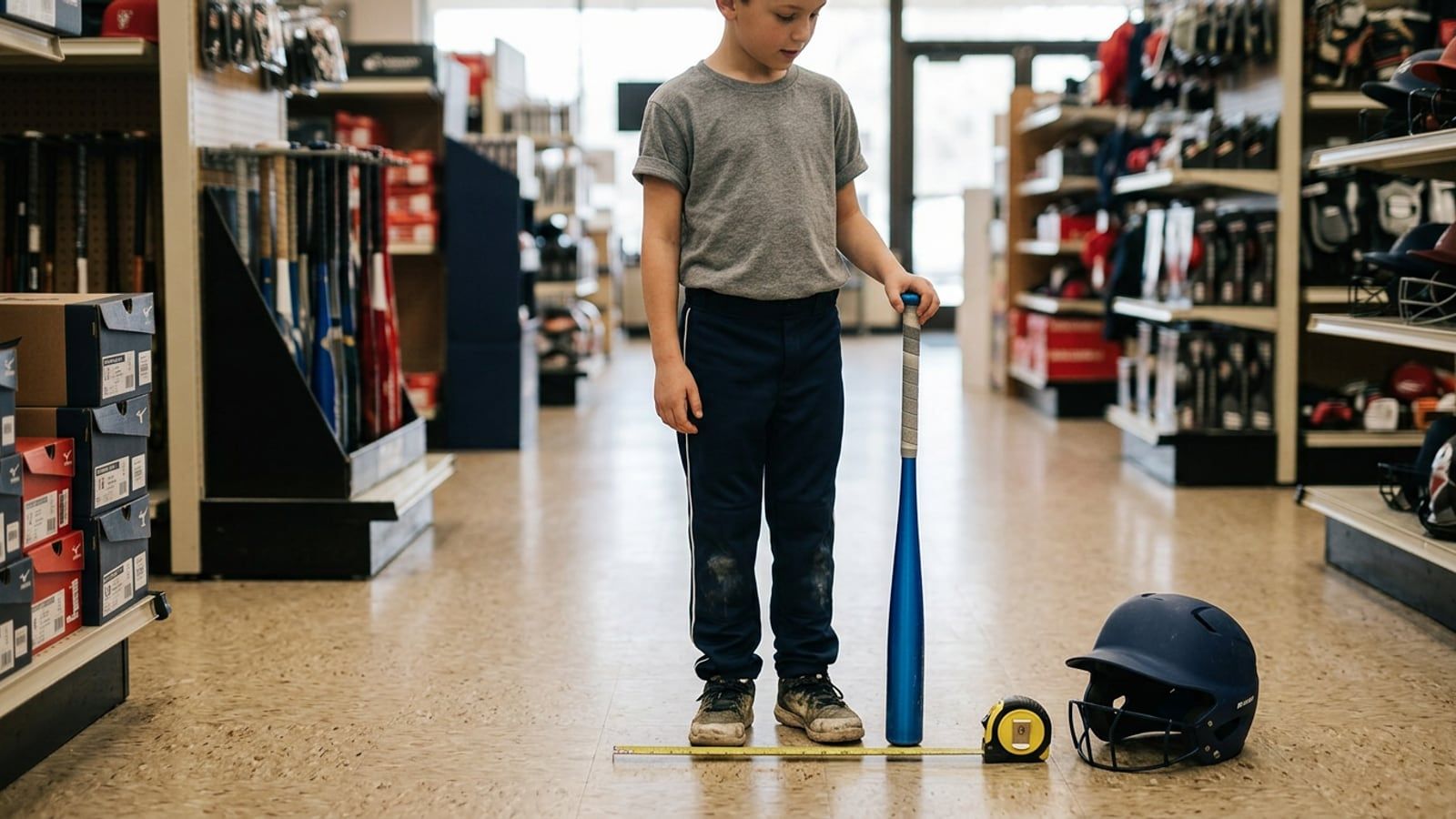
Before length, before weight, before price: find out which stamp your child’s league requires. A bat without the right one cannot be used in a game, however well it fits. Then take a starting length from the maker’s height-and-weight chart, check it with three quick tests, and choose a drop weight your child can swing on time. For most players under 11, that is a drop of -10 or lighter. Buy the bat that fits this season; most youth bats are outgrown before they wear out.
Check your league’s bat rule first
Every league sets its own bat rule, and a bat that does not meet it can be ruled out of a game. Ask the coach or the league before you shop, or look in the league’s rulebook. The rule usually comes down to three things:
- The certification stamp the bat must carry (USA Baseball, USSSA or BBCOR).
- The barrel diameter allowed, often 2 5/8 inches for younger divisions.
- The maximum length, and for older players a limit on drop weight.
Little League’s bat rules are a good example. In the Minor and Major divisions, a bat may be no more than 33 inches long and 2 5/8 inches in diameter, and non-wood bats must carry the USA Baseball mark. All bats stamped BPF 1.15 are prohibited. In the Intermediate (50/70) and Junior divisions, bats may carry either the USA Baseball or the BBCOR mark, up to 34 inches; in Senior League, bats that are not one solid piece of wood must be BBCOR. Solid one-piece wood bats do not need the USA Baseball mark.
Your league may not be Little League, and its rule may differ, so check your own. Travel teams and tournaments often play under different rules from the rec league down the road, and a player on both may need two bats.
USA, USSSA and BBCOR stamps
The stamp is printed on the bat’s taper or barrel. Here is what each one means:
| Stamp | Where it is used | Barrel (Rawlings’ guide) |
|---|---|---|
| USA Baseball | Little League Majors and below, and other youth leagues that adopt USABat | 2 5/8 inches |
| USSSA | Many travel teams and tournaments that play under USSSA rules | 2 5/8 or 2 3/4 inches |
| BBCOR | Older youth divisions, high school and college | 2 5/8 inches, always a -3 drop |
USA Baseball (USABat). The standard most recreational youth baseball uses, built to make non-wood bats perform more like wood. Little League has required it in the Majors and below since January 1, 2018. USA Baseball’s USABat site lists the organizations that use it, among them Little League, Babe Ruth and Cal Ripken, Dixie Youth, PONY and AABC, along with every approved model.
USSSA. The USSSA mark, printed on the bat’s taper with “1.15 BPF”, is for leagues and tournaments that play under USSSA rules, mostly travel ball. Rawlings describes these bats as usually heavier and hotter than USA bats, with a barrel of 2 5/8 or 2 3/4 inches. USSSA’s own bat mark rules also allow BBCOR and wood bats, and set age limits of their own, so ask the tournament director which bats a team’s age group may use. Little League bans every bat stamped BPF 1.15, so a USSSA bat is the wrong buy for a rec-league player.
BBCOR. The standard for teenage divisions, high school and college, always with a -3 drop. Little League notes that USA Baseball is taking over the standard as “USA BBCOR”, with no effect on its 2026 or 2027 seasons; parents of older players should watch for changes after that.
Length: a starting chart and three checks
Length comes from height and weight together, not age alone. Rawlings, which also makes Easton bats, publishes a height-and-weight bat chart; a 4-foot-2 player weighing 65 pounds, for example, lands on a 29-inch bat. Its age-based version is a rougher starting point:
| Age | Bat length (Rawlings’ chart) |
|---|---|
| 5 to 7 | 24 to 26 inches |
| 8 to 9 | 26 to 28 inches |
| 10 | 28 to 29 inches |
| 11 to 12 | 30 to 31 inches |
| 13 to 14 | 31 to 32 inches |
Makers’ charts differ by an inch here and there, and Rawlings calls its own tables a general guide. Treat the chart as a starting point and confirm the length with your child holding the bat. Sporting goods stores commonly use three rough checks; none of them is in a maker’s chart or a league rule, so treat them as a sense check, not a measurement:
- The side check. Stand the bat on its end beside your child’s leg. With their arm hanging down, their palm should reach the knob without bending over.
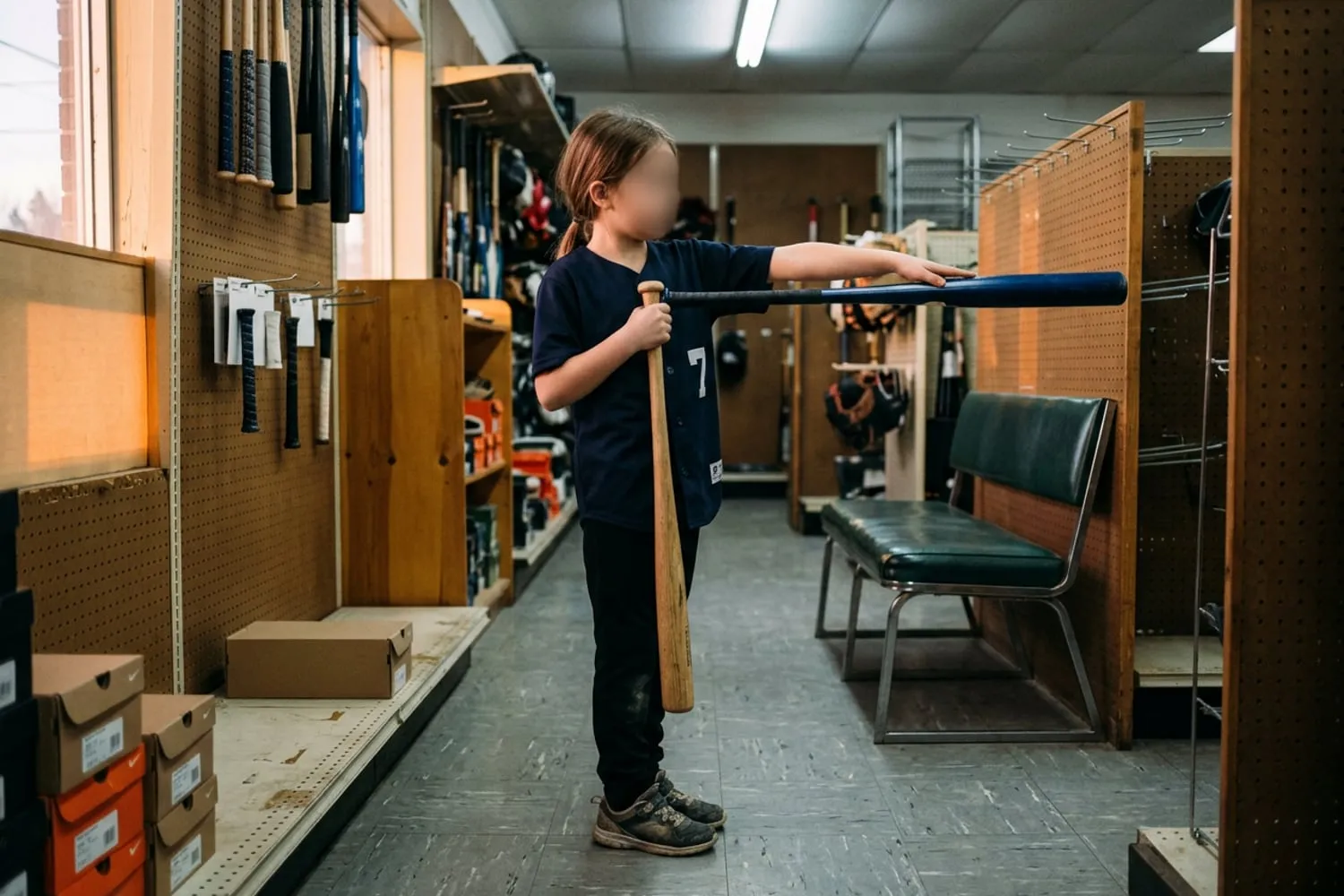
- The chest check. Have your child hold the knob against the center of their chest and point the bat out to the side, along their outstretched arm. Their fingertips should just reach the end of the barrel.
- The hold check. Have them hold the bat by the handle, arm straight out to the side, for about half a minute. If the barrel sags or the wrist shakes before then, the bat is probably too heavy for now, whatever its length.
Then let them take a few swings, in a cage if the store has one. A bat that fits comes through the zone on time; one that is too long or too heavy drags behind the hands.
Drop weight, explained
Drop is the bat’s length in inches minus its weight in ounces. A 30-inch bat that weighs 20 ounces is a -10. The bigger the number after the minus sign, the lighter the bat for its length, so a -12 is lighter than a -8 of the same length.
Rawlings’ sizing guide says players under 11 usually use a drop of -10 or higher, and older players can often move to -8 or -5. A heavier bat can hit harder, but only if the player can swing it on time; a bat that is too heavy slows the swing more than it adds. When a bat starts to feel easy, try the next drop down. Rawlings is clear that there is no fixed drop for each age: it depends on how the bat feels in your child’s hands, which is why the swings in the store matter more than the label.
Alloy, composite or wood
- Alloy (aluminum): usually the cheaper choice and ready to use out of the wrapper. The sensible bat for most young players, especially one-piece models. The Easton Havoc on our Gear page is a one-piece alloy USA bat in a -10.
- Composite: usually more expensive, and some makers advise a break-in period. Composite and alloy bats alike can be damaged in the cold: Rawlings’ bat warranty tells owners to avoid using a bat in cold weather and excludes bats used below 60°F, which rules out a good part of many spring seasons.
- Wood: heavier for its length and allowed without a stamp in Little League if it is one solid piece. Good for practice and for learning to hit the sweet spot; few youth players use one in games.
Whichever you buy, read the maker’s care notes. Rawlings’ warranty page asks owners to turn the bat a quarter turn each at-bat to spread the wear, and to hit nothing but baseballs with it.
Buy for this season, not the next three
Young players outgrow bats long before they wear them out. A bat bought to grow into is too long and too heavy for this season, which makes it late through the zone, and the habits a child builds to cope with it stay longer than the bat does. Buy the length and drop that fit now. If the chart and the checks land between two lengths, the shorter one is the safer choice for a young player.
The top of the range rarely earns its price at this age either. A well-sized alloy bat with the right stamp does everything a nine-year-old needs. Spend the difference on a glove that fits; our guide to breaking in a baseball glove will get it ready for the first practice. If your child plays more than one sport, the same rule runs through choosing soccer cleats: fit for today, with a little room only where it does no harm.
Used bats from older teammates and swap sales are worth a look too, provided the stamp is right for your league and the barrel has no cracks or dents.
Tee ball bats
Tee ball bats are shorter and lighter and are made for tee balls, which are softer than regular baseballs. In Little League, certified tee ball bats are 26 inches or shorter and carry the USA Baseball mark with the words “ONLY FOR USE WITH APPROVED TEE BALLS”. They may also be used in coach-pitch and machine-pitch Minor divisions, but only with approved tee balls, according to Little League’s bat information page. Rawlings suggests 24 to 26 inches for tee ball players, and at least 27 inches once they move on.
For more on kitting out young players, from sizing to what to buy used, see Kids’ Gear, the kids’ list on The Counter and, for gloves, cleats and the rest of the bag, Team Sports.
Questions
Can my child use a USSSA bat in Little League?
No. Little League requires non-wood bats in the Majors division and below to carry the USA Baseball mark, and it prohibits all bats stamped BPF 1.15, which is the USSSA mark. Many USSSA bats also have a 2 3/4-inch barrel, wider than the 2 5/8 inches Little League allows.
What drop weight should a 10-year-old use?
Rawlings’ sizing guide says players under 11 usually use a drop of -10 or higher, which is to say lighter. Start at -10 in the length the chart gives, and do the arm-out hold: if your child cannot keep the bat level for half a minute, go lighter.
Should I buy a bat a size up so they can grow into it?
No. A bat that is too long or too heavy slows the swing and teaches bad habits, and most youth bats are outgrown within a season or two anyway. Buy the length that fits now; when the bat starts to feel easy to swing, it is time for the next one.
Is a composite bat worth it for a youth player?
Usually not. Composite bats cost more, some makers advise a break-in period, and warranties such as Rawlings’ exclude bats used below 60°F, which rules out many spring games. A one-piece alloy bat with the right stamp is ready to use, and your child will likely outgrow either before it wears out.
Sources
- Little League Bat Rules, Little League International
- Bat Information, Little League International
- How to Know Your Bat Size, Rawlings
- Bat Size Chart, Rawlings
- Warranty Information, Rawlings
- USABat: Approved Bat List, USA Baseball
- USSSA Baseball Bat New Mark Rules, USSSA
Find your level
The Counter