What Size Bike Do I Need? Frame Size, Fit and Test Ride
Measure your height and cycling inseam, read the maker’s own chart for that model, then check standover, saddle height and reach on a test ride.
Measure your height and your cycling inseam, then look both up on the maker’s size chart for the exact model you want, not on a generic chart. That gives you a size, or two to choose between. Then settle it on a test ride: you should be able to straddle the top tube with at least an inch to spare, reach a nearly straight leg with your heel on the pedal once the saddle is set, and hold the bars with a slight bend in your elbows. If all three are right, the bike fits well enough to buy, and small changes to the saddle and stem can do the rest.
Measure your height and inseam
Height is easy. Your cycling inseam is not the inside leg of your jeans: it is measured up to where a saddle would sit, and it is the more useful number for sizing a bike.
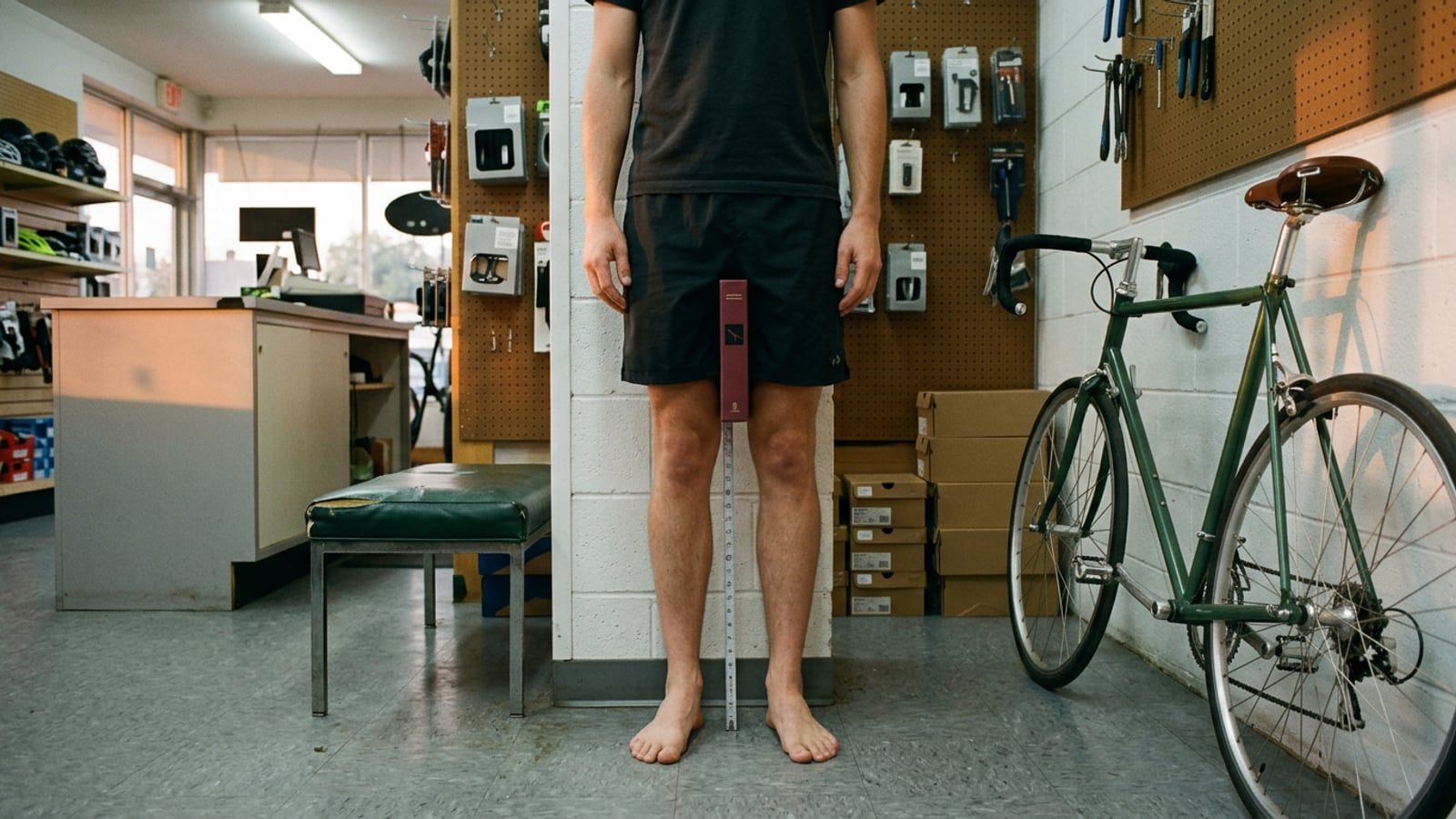
- Stand barefoot with your back against a wall and your feet a few inches apart.
- Hold a hardcover book between your legs, spine up, and pull it up firmly against your crotch, the way a saddle would press.
- Keep the book level and have someone mark the wall at the top of its spine.
- Measure from the floor to the mark. That is your cycling inseam.
- Measure two or three times and use the average.
Write down both numbers in inches and centimeters, because makers use either. The same inseam measurement is the starting point for saddle height later, so keep it.
Read the maker’s chart, not a generic one
Generic height-to-frame charts disagree with each other because frame sizes are not standard. One maker’s 54cm road frame is not the same shape as another’s, sizes may be given in centimeters or in letters (S, M, L), and the same letter means different things on a road bike and a hybrid. Trek, for one, has moved its road bikes from numbered to lettered sizes, and its road bike size guide points you to a Size Finder that asks for your height and inseam.
So find the size chart on the page for the model you want, quoted by its maker, and read it with both of your numbers:
- If both numbers land in one size, that is your starting size.
- If they land in different sizes, or in the overlap two sizes share, note both and plan to ride both.
- If you are comparing two brands, look at the geometry tables: the stack (how high the bars sit) and the reach (how far forward they are) compare the fit of two frames better than their size labels do.
How sizing differs by bike type
The type of bike changes how it should fit, and so what you check first.
| Bike type | Riding position | What to check first |
|---|---|---|
| Road | Leaning forward, bars low | Reach to the hoods and standover; a frame too long is hard to fix |
| Gravel | A little more upright than road | Standover with the tires fitted, which are larger than a road bike’s |
| Hybrid | Upright, flat bars | Standover and a relaxed reach; comfort over speed |
| Mountain | Upright to forward, wide bars | More standover clearance than other bikes, then reach |
| E-bike | Depends on the type above | Standover and being able to hold its weight upright at a stop |
E-bikes follow the sizing of the type they are built on, so a commuter e-bike fits like a hybrid and an electric mountain bike like a mountain bike. Because they are heavier, being able to plant both feet and hold the bike steady at a junction matters more, and a step-through frame helps there.
Check the fit on a test ride
A chart gets you to a size; a ride tells you whether it fits. Ask the shop to set the saddle height for you first, or do it yourself with the heel method below, because every other check depends on it.
- Standover. Straddle the bike in front of the saddle with your feet flat. You want at least an inch of clearance between the top tube and your body, the conventional figure Bike Insights gives, and more on a mountain bike. Makers measure standover at different points along the top tube, so check it on the bike, not just the spec sheet.
- Saddle height. Sit on the saddle and put your heel on the pedal at its lowest point. Giant’s saddle guide says your leg should be straight with the knee extended; if it is still bent, raise the saddle a little, and if your heel loses the pedal or your hips rock, lower it. Pedaling normally, on the ball of your foot, leaves a slight bend at the knee.
- Reach. With your hands on the grips or the brake hoods, your elbows should be slightly bent, your shoulders relaxed and your back neither cramped nor stretched flat. If you have to lock your arms to reach the bars, the frame is too long.
- Bar position. On a road bike the bars usually sit at or below the saddle; on a hybrid, at or above it. What matters is that you can hold the position for an hour without numb hands or a sore neck.
- The ride itself. Ride for at least ten minutes if the shop allows it: start and stop, turn tightly, stand up on the pedals and reach for the brakes and gears. Everything should be within easy reach without shifting on the saddle.
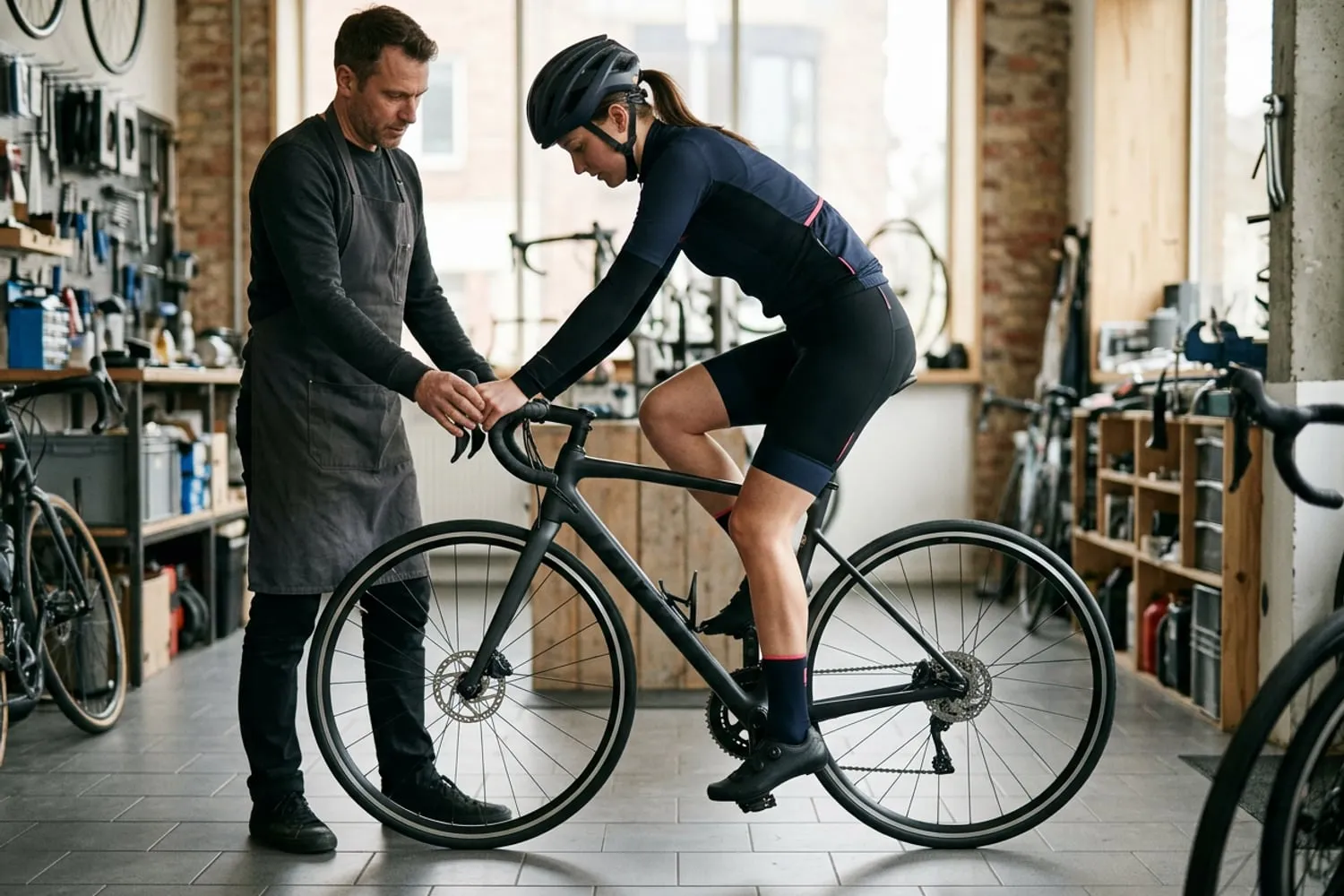
If you would rather start from a measurement, Giant and Cycling UK both give the same formula: multiply your cycling inseam by 0.883 for the distance from the center of the bottom bracket to the top of the saddle. Use it to set the saddle before the ride, then confirm it with your heel.
Tip: wear the shoes you will ride in, and bring cycling shorts if you ride in them. Both change the saddle height by more than you would think.
Between two sizes
Many riders fall between two sizes on a chart, and the answer depends on your shape and the riding you do more than on your height.
- The smaller size is usually lighter on its feet, easier to handle and gives more standover room. A slightly longer stem or a longer seatpost can stretch it a little.
- The larger size gives a longer, steadier position and suits riders with a long torso and long arms.
- Long legs for your height? The smaller frame usually fits, with the saddle raised.
- Long torso for your height? The larger frame usually fits better.
When you can, ride both sizes back to back on the same day. The one you stop noticing after five minutes is the one to buy.
Small changes that fix a near fit
A bike that is the right size but not quite right can usually be fixed for little money. Change one thing at a time and ride a few times before changing the next.
| What feels wrong | What usually fixes it |
|---|---|
| Knees bent too much at the bottom | Raise the saddle, keeping above the seatpost’s minimum insertion mark |
| Hips rocking, or toes reaching for pedals | Lower the saddle |
| Knee well ahead of or behind the pedal | Slide the saddle back or forward on its rails |
| Stretched out, arms locked | A shorter stem, or one angled up |
| Cramped, knees near the bars | A longer stem |
| Sore hands or neck | Raise the bars with spacers or a rising stem; check the saddle is level |
| Sliding forward on the saddle | Level the saddle; start with its nose level and adjust in small steps |
Giant suggests setting the saddle’s fore and aft position with the pedals level: the front of your kneecap should sit over the pedal axle. Treat that, like every rule here, as a starting point to adjust for comfort.
What these changes cannot fix is a frame that is a size or more out. If you cannot get enough standover clearance, or the reach is still wrong with the shortest sensible stem, it is the wrong frame.
When a professional bike fit is worth it
Most riders do not need one to buy a commuter or a hybrid. A professional fit, where a fitter measures you on the bike and sets the saddle, bars and cleats, is worth paying for when:
- you ride long distances or several times a week, especially on a road or gravel bike;
- you are spending a lot on a new bike and want to choose the size with a fitter before buying;
- you have numbness, saddle soreness or aches that adjustments have not fixed.
Giant itself says its general advice does not replace a personal fit with a fit technician. Ask when you buy whether the shop includes a basic fit with the bike. If pain persists after the bike has been fitted, see a doctor or physical therapist rather than changing parts.
Once the bike fits, you can keep riding through the winter on a trainer without losing the position: our guide to an indoor bike trainer versus an exercise bike weighs the two. The Counter’s cycling list, by level, covers the helmet, lights and lock to buy with a new bike, and our Cycling section has more on choosing and keeping one.
Questions
What size bike do I need for my height?
It depends on the maker and the type of bike, which is why a generic height chart is only a rough guide. Measure your height and cycling inseam and look both up on the size chart for the model you want. If the two numbers point to different sizes, give the inseam and a test ride more weight than height.
How much standover clearance should I have?
At least an inch between the top tube and your body when you straddle the bike with your feet flat, which is the usual recommendation for road, gravel and hybrid bikes. Mountain bikes need more, because you step off quickly on rough ground. Makers measure standover at different points, so check it on the bike itself.
Should I size up or down if I am between two frame sizes?
Ride both if you can. The smaller frame is usually easier to handle and gives more standover room, and a longer stem or seatpost can stretch it a little; the larger frame suits riders with a long torso and arms. If you have long legs for your height, the smaller size tends to fit better; if you have a long torso, the larger.
Are e-bike sizes the same as regular bikes?
They are sized the same way, from the maker’s chart by height and inseam, but each model has its own chart, so do not assume an e-bike matches the size of your other bike. E-bikes are heavier, so make sure you can stand over the frame with both feet flat and hold it upright at a stop; a step-through frame makes that easier.
Sources
- Road Bicycle Size Guide, Trek Bikes
- Standover Height, Bike Insights
- How to adjust the saddle on your bike, Giant Bicycles
- Video guide: How to set the correct saddle height, Cycling UK
Find your level
The Counter