Golf Grip Slice Explained: Causes and Fixes
A golf grip that causes a slice often starts weak; correct it, then align setup and club path to keep the face square at impact with focused practice.
Think of a garden hose with the nozzle angled slightly off. Aim straight at the flowers and the water still lands to the right.
A golf slice works the same way: the ball curves hard from left to right for a right-hander because the clubface is open at impact, and a weak grip is often the first thing tilting it.
The good news is that this is one of the most fixable causes of a slice. Here, we’ll explain why a weak grip opens the face, walk through the fix step by step, and cover setup, path, practice, and the gear that supports it.
Why Your Golf Grip Slice Happens
A grip that’s off can start a slice before you swing hard, so we’ll start there.
A clubface left open at impact
A slice curves sharply away from the target. For a right-handed golfer, it bends left to right, and for a lefty it flips to right-to-left.
The main culprit is an open clubface, where the face points right of your swing path at impact. A weak grip, with the back of your lead hand turned toward the sky, tends to leave it open.
Since the clubface sends the ball, your hands control most of the curve.
Think of a weekend golfer who keeps losing drives into the trees on the right. She finds her lead hand rotated well to the left, turns both hands a touch right, and her drives start finding the fairway.
Coming over the top on the downswing
Many slices start on the way down. An over-the-top move throws the club outward from the top instead of dropping it inside the target line, creating an outside-to-in path that cuts across the ball.
Pair that with an open face and the ball picks up sidespin, a sideways spin that bends its flight away from the target.
Find the root cause first
Before you change anything, figure out which link is failing. Check your grip in a mirror or film a few swings from face-on.
A shank is different: the ball hits the hosel (the neck where the blade meets the shaft) and shoots sharply off to the side, usually short.
Equipment can contribute too. A grip that’s too thin can let your hands roll over, while one that’s too thick can keep them from turning freely. Fix your hands first, then check grip size.
Build a quick grip check into your warm-up so you catch the curve early.
Slice versus fade and what it costs
A fade bends the same way as a slice, but it’s planned while a slice is accidental. A draw bends gently right to left for a right-hander, while a slice’s sidespin pulls the ball off line.
Sidespin steals distance, so slices fly shorter and land in the rough. Once a few drives land in the trees, you start steering instead of swinging, and that tension makes the slice worse. Fix the grip first. The rest gets easier to trust.
Getting Your Grip Right
Your grip is the only link to the club, and it sets the clubface angle before you swing. Get it right first, and the rest of the fix gets easier.
Reading a weak, neutral or strong grip
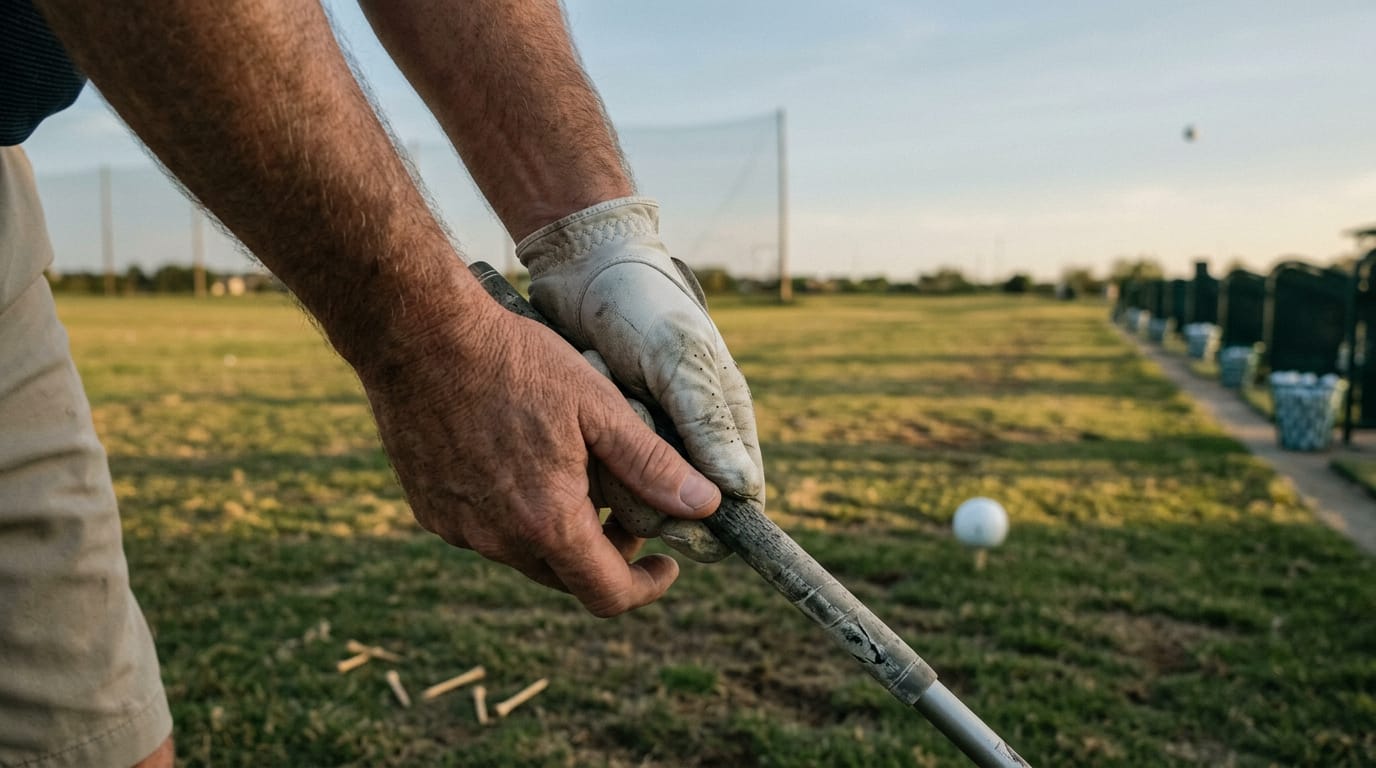
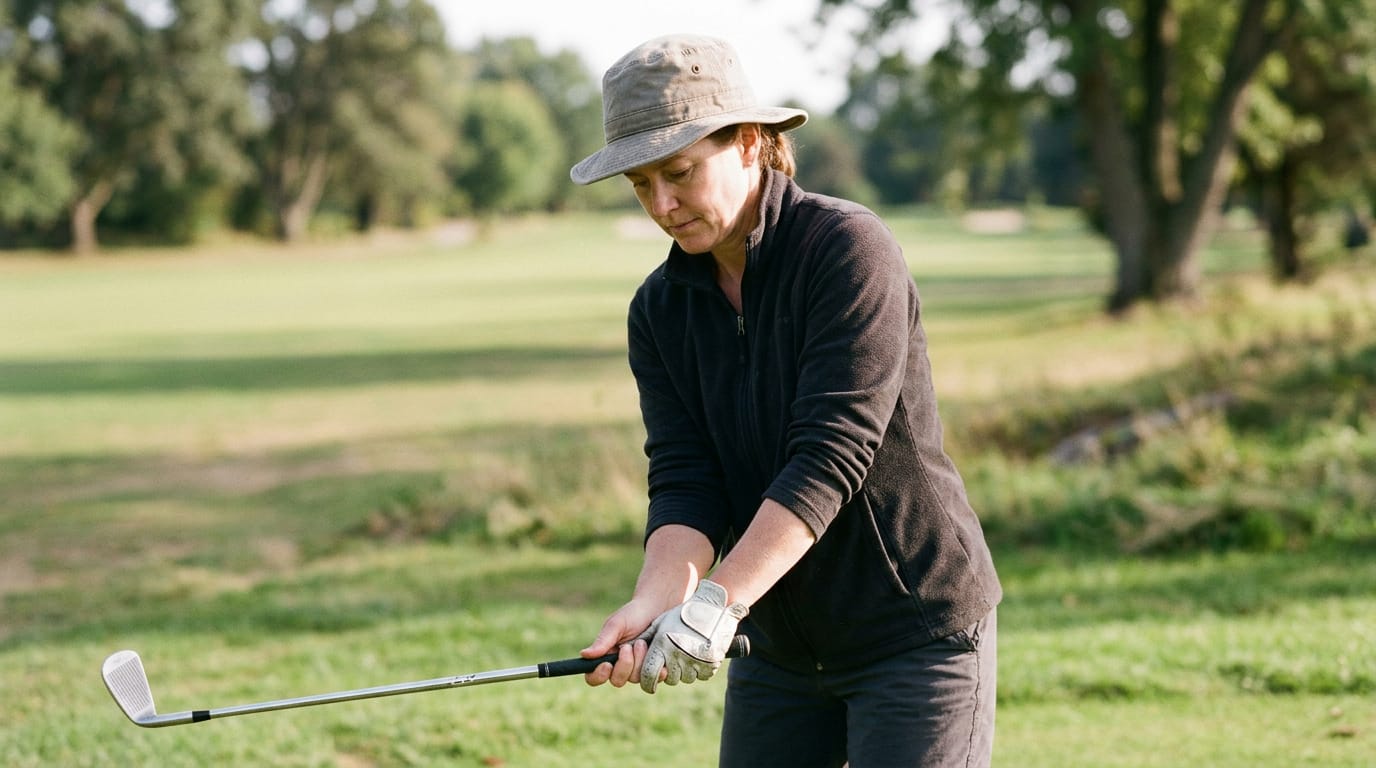
Check where your hands sit. A weak grip turns both hands too far left, so you see one knuckle or none on your left hand, and the face stays open at impact. That’s a classic slice setup.
Rotate both hands right until you see two or three knuckles on your left hand. That’s a neutral grip, and it gives the face a fair chance to square up. A strong grip closes the face even more, so don’t overdo it, or you’ll start hooking the ball.
A weekend golfer slicing into the trees turns her hands right until she sees two knuckles, and her shots fly straighter.
Placing your hands and showing knuckles
- Show two or three left knuckles. At address, count what you see on your left hand.
- Hold the club in your fingers. Lay the grip across your fingers, not deep in your palm, so your wrists stay free.
- Set the right-hand V. Point the V between your right thumb and index finger toward your right shoulder.
- Avoid excess right-hand knuckles. Seeing many of them usually means the right hand has crept over the top.
Keeping your hold firm but relaxed
Aim for firm rather than tight.
- Not too tight. Squeezing hard locks your forearms and blocks your wrists.
- Not too loose. A loose hold lets the club twist in your hands before impact.
- Allow wrist hinge. Let your wrists hinge naturally so the club can load and release.
- Relaxed for clubface rotation. Relaxed hands let the face turn through impact instead of staying open. Less squeeze, more release.
Picking a grip size and training aids
Size matters too: too small and you’ll squeeze, too big and your wrists lose freedom.
- Check your hand size before buying. Try a few sizes in your hand before you commit.
- Grip trainers fit over the grip and shape your hand position while you practice.
- Grip drills build the habit: lift your left hand, reset it, and look for two or three knuckles.
Regripping means swapping in a new grip. According to Caddy Grips, golfers regrip for comfort, ordinary wear and tear and competitive reasons, and each one carries a cost.
Watch for a grip that feels slick or looks shiny, since that’s your cue to plan a new one.
Setup, Aim and Where the Ball Sits
Your setup decides where the ball is headed before you swing. Line up your body, place the ball, and aim with intent, and you’ll give a good grip a fair chance to hold its line.
Lining up feet, hips and shoulders
Your feet, hips and shoulders should all run parallel to the target line, like rails on a train track. Avoid an open stance, where you aim left of the target as a right-hander, or any misalignment, since both pull your swing off the line.
The fix is a square stance, with the line across your toes pointing at the target. Picture a weekend golfer who’s fought a slice all season. Once she squares up, the ball starts finishing straighter instead of curling right.
Placing the ball and balancing your posture
Place the ball just inside your lead heel, the left heel for a right-hander. Spread your weight evenly across both feet. It shouldn’t drift back on your heels or forward onto your toes.
Then tilt from the hips rather than hunch over the ball, keeping your spine straight. A balanced posture gives your arms room to swing on the path you just set up.
Aiming with sticks, clubs and markers
Aim the clubface first, square to the target, then build your feet and body around it. Lay alignment sticks or a club on the ground along your target line to check your stance.
Head covers work as markers too: set one on the target line to give your eyes a spot to aim at.
A parent teaching a kid on the practice green can lay one club across the grass, and neither of them has to guess whether the stance is square. Line it up, then swing.

Keeping Your Path and Clubface on Line
Your swing path and clubface decide where the ball starts and how much it curves, so keep both in line.
Swinging the club from inside out
The goal is an inside-out path, where the club comes from inside the target line rather than across it.
Let your trail arm (the right arm for right-handers) drop under your lead arm on the downswing, and let your lower body lead, turning toward the target before your arms take over.
Two drills help you feel it:
- Brush-behind-ball drill. Brush the grass just behind the ball so the club drops down on the inside instead of coming over the top.
- Tee outside ball drill. Set a tee just outside the ball, on the side an over-the-top swing comes from. If you knock it over, you’re coming from outside.
Think of a weekend golfer who keeps finding the trees on the right. After a few range sessions with these drills, the ball curves far less.
Keeping the clubface square throughout
Square face at takeaway means the face points at the ball, not toward the sky. Check it at address, then return it to that same spot at impact.
Finally, reduce hand manipulation: hands that flip or roll the face change its angle on every swing, so keep them quiet. Quiet hands, straighter shots.
Keeping wrists flat and shaft leaning forward
- Flat or bowed lead wrist. Keep your lead wrist (left for right-handers) flat or slightly bowed through impact.
- Avoid cupped wrist. A cupped wrist, where the palm turns up like a cup, leaves the face open at impact.
- Early forearm rotation. Rolling your forearms too soon opens the face before impact. Let that rotation come later, through impact.
- Forward shaft lean. At impact, the shaft leans toward the target with your hands ahead of the ball, helping the face meet the ball square.
Fix the spin first, then the direction
Work through these in order:
- Step 1: fix the spin. Use the path and face fundamentals above until the ball curves less from side to side.
- Step 2: fix the direction. Then adjust your aim so the ball starts where you want it.
Avoid trading the slice for a hook. Swinging hard across the ball to fix it can flip the miss into a hook. Make small changes rather than big swings.
Practice, Feedback and the Right Gear
Your grip fix only holds up with purposeful practice, honest feedback and well-kept clubs. Here’s how we’d approach each.
Range plans, slow swings and home drills
Build a range session plan around one focus, like grip pressure. Start with short irons, which are easier to control than a driver, and mix in slow-motion swings at half speed.
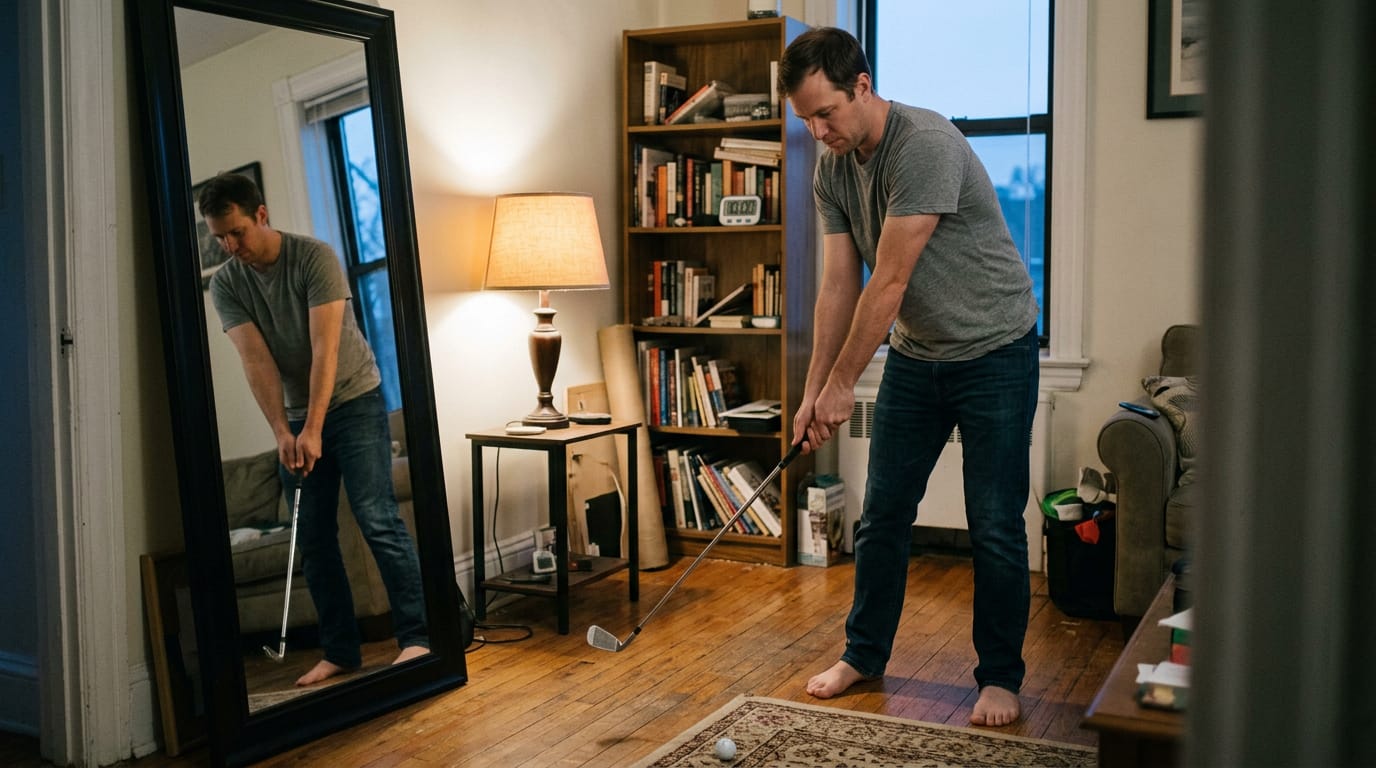
A weekend golfer with an hour might spend ten minutes on slow swings, thirty on 7-irons, and a few on the driver, so the new grip feels natural by the time the big club comes out. At home, swing slowly in front of a mirror with your new grip.
Ten minutes a night often beats one long range trip a month. Repetition sticks.
Tools that show what your swing does
Tools show what your swing does, not what it feels like. Video analysis is the simplest: film from the side and from behind, then compare your grip and club position at the top.
Ball flight monitoring tracks where the ball starts and how it curves, so you can see whether your slice is shrinking. Clip-on path trainers attach to the club and give you a visual cue for swing path.
Fitting, checking and regripping your clubs
A custom driver fitting matches the club to how you swing, not how you wish you did. Many drivers have adjustable draw settings a fitter can test for a face that closes more at impact.
Match shaft flex (how stiff the shaft is) to your swing speed, and watch grip size: a grip that’s too thick can keep your hands from turning through impact and leave the face open.
Check each club for dents, loose heads, and cracked or slick grips. Then regrip before buying a new driver. A fresh grip in the right size costs far less, and it may be all your fix needs.
Low-spin balls reduce sidespin, the side-to-side spin behind a slice. According to Kai’s 2008 article on the engineering behind Bridgestone Tour balls, a new core design can reduce the spin off a driver shot, which may lessen shot curvature.
Keeping your clubface and grooves clean
Dirt packed into the grooves (the small lines cut across the clubface) can keep the face from gripping the ball cleanly.
Build a simple cleaning routine: wipe the face after every shot and brush the grooves after each round. Clean clubs take almost no time.
Expectations, Lessons and Staying Patient
A slice rarely disappears overnight, so know what progress looks like. Here’s what to expect, when a lesson helps and how to keep going.
How long the fix really takes
Some gains come fast. A GOLF.com drill from a Top 100 Teacher is built to speed up the change a slice fix needs, and golfers can see initial gains within days of practice.
A full fix takes longer, since your body needs weeks to months of repetition to build a new swing path. Take a weekend player practicing twenty minutes, three times a week.
Her early shots may start on target, but the new move won’t feel automatic for months.
Be patient. A rough round is part of the process, not proof the fix isn’t working.
Fixing it yourself or taking lessons
Trying it alone first is a sensible start. Check your grip and clubface with a mirror, a practice net or the drill above.
If you’re still stuck, book one diagnostic lesson, a single session where a pro pinpoints what’s driving your slice. It’s less about guessing and more about knowing what to practice.
For longer-term work, a video lesson series lets you practice between sessions at your own pace.
Stick with it and celebrate small wins
Set small goals you can hit this week, like three shots in a row that start near your target line. Then celebrate progress, even when the scorecard doesn’t show it yet.
Golfers have shared testimonials, too.
In Birdie Breakdown’s review of the EyeLine Golf Speed Trap 2.0, one reviewer spent about an hour hitting balls into a net, then found the course results were exactly as hoped, with “a smooth baby draw.” Small wins add up.
A slice rarely comes from one bad move. It usually starts with a weak grip that leaves the clubface open, then gets worse when your setup and path work against you. Fix the grip first, tidy up your aim and ball position, and keep your path on line.
Practice with honest feedback, and choose grips and clubs that fit your hands and your swing. The changes stick best when your gear supports them instead of fighting them.
A squarer face is built one good swing at a time, and once it’s consistent, the slice has nowhere left to hide.
References
- Caddy Grips — doi.org (2016)
- Science and engineering technology behind Bridgestone Tour golf balls - Kai - 2008 - Sports Technology — onlinelibrary.wiley.com (2008)
- EyeLine Golf Speed Trap 2.0 Review – Is the Slice Fix Worth $100? — birdiebreakdown.com (2026)
- This slice-fix drill instantly gives you the feel of turning over the ball | Instruction — golf.com
Questions
What is a slice in golf for a lefty?
For a left-handed golfer, a slice curves sharply from right to left, away from the target. It usually happens when the clubface is open relative to the swing path at impact.
How to slice a golf shot?
A slice happens when the clubface points right of the swing path at impact for a right-handed golfer, often combined with an outside-to-in swing path. To correct it, work toward a neutral grip, a squarer clubface, and an inside-out path rather than trying to create the slice.
Will a bigger grip help my slice?
A bigger grip usually will not fix a slice, and one that is too thick can make it harder for your wrists and hands to turn through impact, leaving the face open. Choose a size that lets you hold the club comfortably without squeezing or restricting wrist movement.
What grip is better for slicers?
A neutral grip is a good starting point for most slicers: for a right-handed golfer, turn both hands slightly to the right until you can see about two or three knuckles on the lead hand. A slightly stronger grip can help the face close, but an overly strong grip may cause hooks.
What makes a golf ball slice?
A golf ball slices when sidespin makes it curve sharply away from the target, commonly because the clubface is open relative to the swing path at impact. An outside-to-in path can add to the curve, especially when paired with an open face.
Can a stronger grip fix a slice?
Yes, a stronger grip can help a slice by making it easier for the clubface to square or close at impact. Make a modest adjustment, since an excessively strong grip can turn the slice into a hook.
What's the difference between a shank and a slice?
A shank happens when the ball strikes the club’s hosel, the area where the shaft meets the clubhead, and shoots sharply sideways, usually over a short distance. A slice is a shot that curves sharply away from the target during flight, typically because of the face angle and swing path at impact.
What's the difference between a draw and a slice in golf?
For a right-handed golfer, a draw curves gently from right to left, while a slice curves sharply from left to right. A draw is usually intentional and controlled; a slice is generally an unwanted, larger curve. For a left-handed golfer, the directions reverse.
Sources
- Caddy Grips, doi.org,
- Science and engineering technology behind Bridgestone Tour golf balls - Kai - 2008 - Sports Technology - Wiley Online Library, onlinelibrary.wiley.com,
- This slice-fix drill instantly gives you the feel of turning over the ball | Instruction | GOLF.com, golf.com
- EyeLine Golf Speed Trap 2.0 Review – Is the Slice Fix Worth $100? - Birdie Breakdown, birdiebreakdown.com,
Find your level
The Counter