Do Football Cleats for Wide Feet Come in Extra Widths?
Football cleats for wide feet: compare wide-fit options, check fit before buying, and match traction and plates to your position and playing surface.

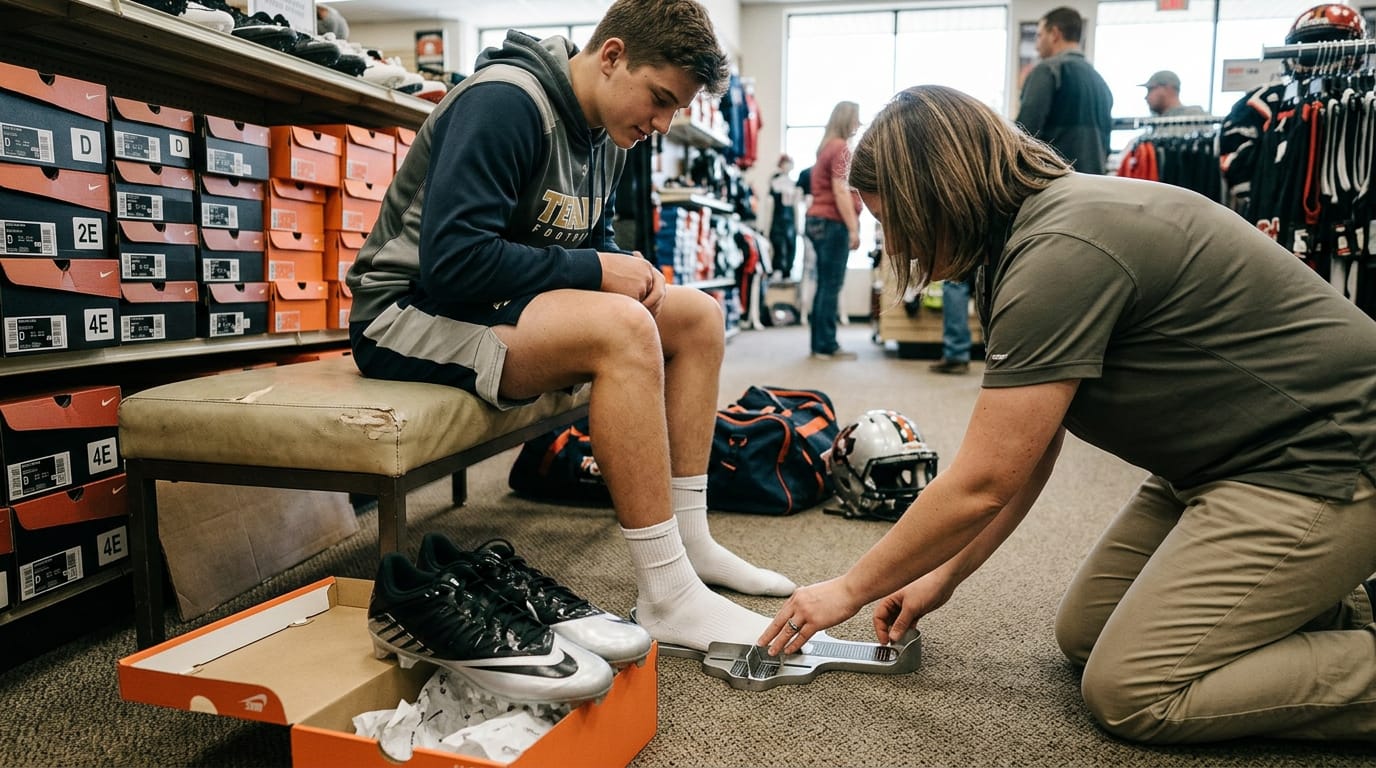
A cleat that pinches your forefoot can turn a good afternoon on the field into a long one. If your toes feel crowded or your foot spills over the sides of the shoe, you don’t have to just tough it out. The right width makes a real difference.
Here’s the short answer: look for wide-fit models, check fit before you pay, and match the plate and traction to your game. We’ll cover which wide cleats exist, how width, plate and fit work together, and a buying path by position, age and surface.
Football Cleats for Wide Feet, Explained
Width is where many football cleat fits go wrong, and the box label only tells part of the story.
Reading D, E and 2E width codes
Width codes are the letters on the box. D is usually the standard width, E is wider, and 2E is wider still. Brands label them differently, so a 2E from one brand may not match another’s.
The insole test beats the letter: pull out the insole, stand on it in your game socks, and check whether your foot spills past the edges. If it does, the cleat is too narrow.
So what size should you wear? Start with your regular size, then run the insole test. If your foot fits inside the edges with room at the front, you’re set. If it spills, try a wider width before going up in length.
Wide sizing versus a roomy toe box
Wide sizing and a roomy toe box aren’t the same fix. A wide cleat adds room everywhere. A roomy toe box is about shape, not size: it adds space at the front only. A broad forefoot with a narrow heel may only need that. Match the fix to your foot.
Picture a wide receiver planting and cutting all game. Toes that can spread give him a more stable base.
Signs your cleats are too narrow
Watch for these signs:
- Foot spills over the insole. Your foot hangs past the edges when you stand on it.
- Upper bulges past the plate. The plate is the hard base the studs mount to, so a bulge there means the cleat is too narrow.
- Sore pinky toe. Pain on the outside toe points to pressure along the side.
- Sore ball of foot. Pain under the ball of your foot points to pressure across the forefoot.
Where to Find Wide-fit Cleats
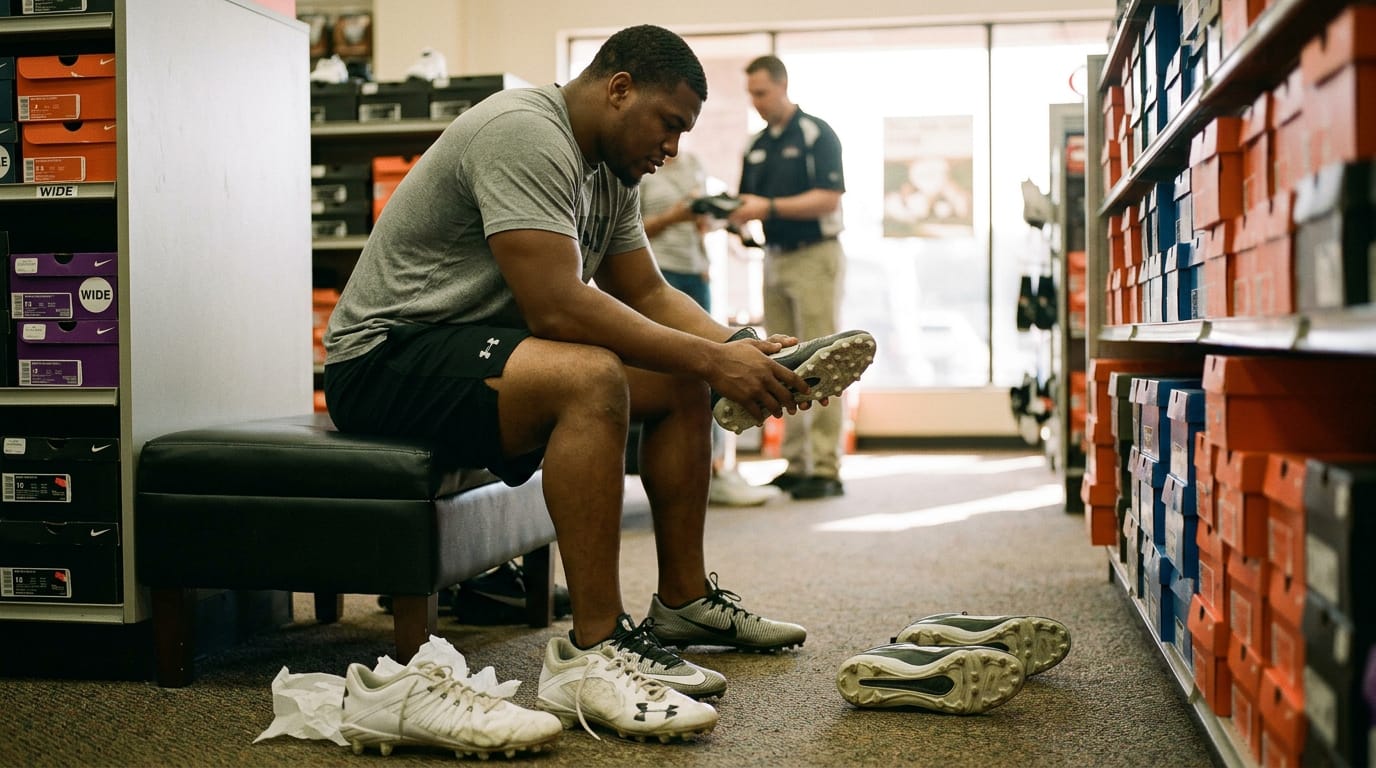
Wide cleats are easier to find than many players expect, but every brand labels width differently. Just confirm you’re looking at football cleats, not soccer boots, since the two often show up side by side.
Wide versions at major retailers
Several brands sell a wider option:
- Under Armour lists wide as E.
- New Balance uses D and 2E.
- Nike sells a wide version of the Alpha Menace 4 Shark.
Don’t assume an E means the same thing everywhere. Check the width field each season, then compare plates, not just uppers. The plate is the hard sole that holds the studs, while the upper is the fabric or leather wrapping your foot.
Consider a linebacker with wide feet who buys his usual size, then spends camp with cramped toes. A wide option with a plate that matches his foot is the fix he needed.
Why most cleats ship in one width
Most cleats come in one width because of how they’re built. Every shoe is shaped around a last, the foot-shaped form that sets its fit. Another width means another last, another mold and extra stock, so one width often becomes the only option.
A size is one number, so it says nothing about width, and one width fits few feet.
Sizing up or breaking in the upper
Sizing up is the usual workaround, and breaking in the upper is free and easy. Lace the cleats snug, wear them around the house, and let the material give. The upper stretches, but the plate doesn’t.
Consider a parent who sizes up a full number for a growing 11-year-old: the toes have room, but the heel slides on every cut, and the flex point, where the shoe bends, lands in the wrong spot.
Heel lift and slide are your warning signs, and a bigger size can add more of both.
Custom cleats built from a foot scan
When nothing on the shelf fits, a custom cleat built from a foot scan is worth a look. A phone scan captures your foot’s outline, and the width follows that outline instead of a letter code.
The plate is shaped to match, and the stud layout is set for your foot. Expect to pay for that fit and wait while the pair is printed.
Custom colors that leave fit unchanged
Customizing the look and customizing the shape are different jobs. A color configurator lets you pick colors, patterns and trim, while shape customization changes how the pair fits. Style options such as “By You” stay on the look side of that line.
Aesthetics don’t change the last, so you’re choosing how the pair looks, not how it fits. A new color won’t fix a bad fit.
Checks to Run Before Buying in Store
Trying cleats in the store is less about the size on the box and more about what you test while you’re there.
Hands-on fit checks in the store
Run these in order:
- Stand on the insole. Pull it out and stand on it with your full weight. Your toes shouldn’t curl over the edges.
- Flip wide against standard. Flip the wide and standard versions of the same model side by side and check whether the wide one adds real forefoot room.
- Flex the forefoot by hand. It should bend where your foot does, at the ball of the foot.
- Look for a thumb’s width of room. With your heel pushed back, you want about a thumb’s width in front of your longest toe.
- Run the heel lift jog test. Jog a few steps, then plant and cut. If your heel lifts or slides, the pair won’t hold you on a cut.
- Trace your foot against the insole. Outline your foot on paper, then lay the insole over it. The widest points should sit inside its edge.
A sophomore lineman loves the first pair he tries, then gets blisters by the third practice. A store aisle can’t mimic a real practice, so judge a cleat by how it feels moving, not standing still.
Ask about the return policy and whether you can run a short break-in trial at practice. A trial only helps if the store will take back a pair that still isn’t right.
Best time and socks for trying cleats
Shop later in the day, when feet are at their largest, so the fit matches game day. Wear the same game socks, since thick and thin socks change fit more than you’d expect.
Last, match the plate to the field you play on most. The plate is the sole base holding the studs, and turf and grass call for different setups, so check the label.
Plates, Traction and Injury Risks to Weigh
Three things shape how a cleat handles: the plate, the traction and the injury risks tied to both.
Keeping the forefoot on the plate
The plate is the stiff sole that holds the studs, and it’s where your load lands with every push. Your forefoot has to sit on it. Think of a wide-footed lineman who buys a narrow-plate cleat because the starters wear them.
If his forefoot hangs past the edge, that cleat is the wrong pick, even if the starters swear by it. Plate layouts change how load spreads, so same-size cleats can feel different.
How rotational grip relates to knee injuries
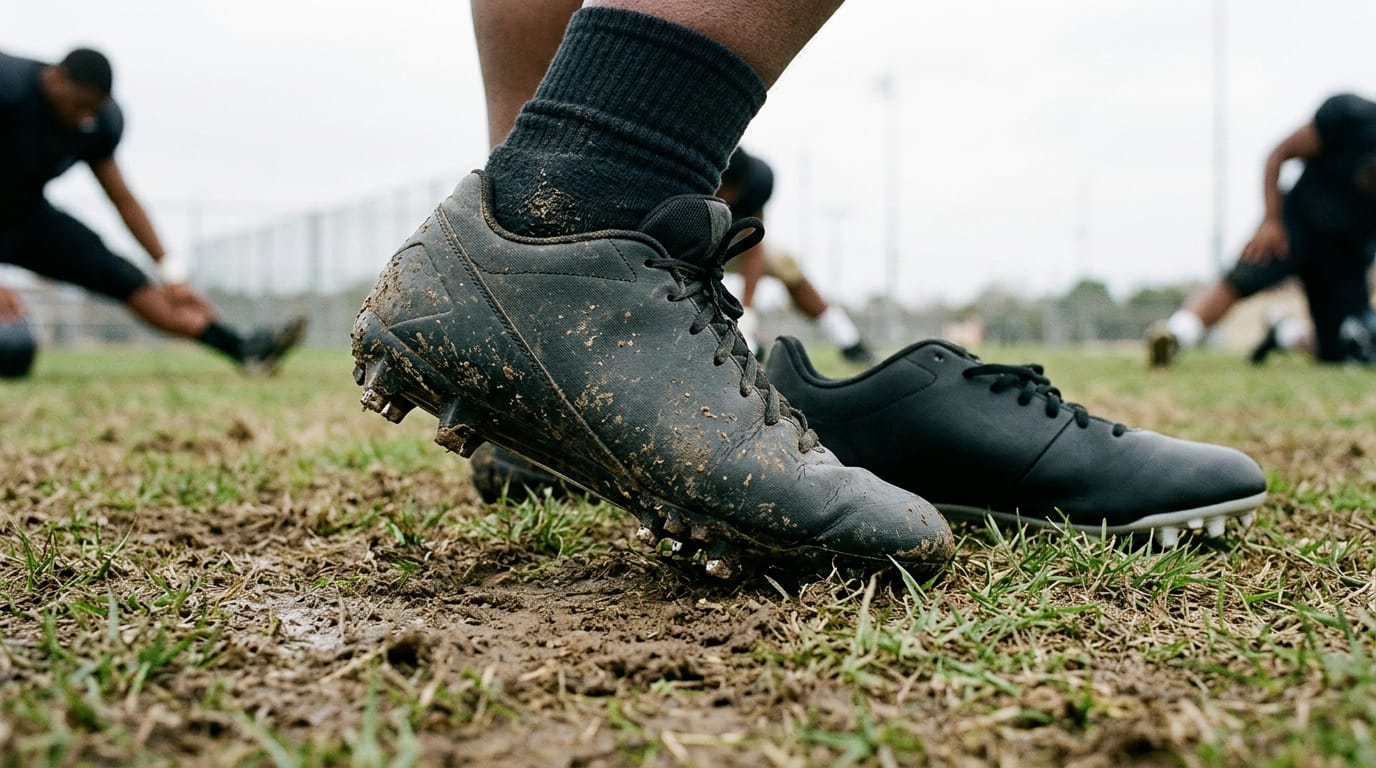
Rotational traction is how much a cleat resists sliding when you twist. More grip helps you stop and turn, but it can also keep your foot planted while your knee keeps going.
A study of footwear traction and lower-extremity noncontact injury found injury rates rose steadily as rotational traction increased, from 4.2 injuries per 1,000 game exposures at low traction to 19.2 at high traction.
Edge-style cleats show up in the knee research too. A three-year study of 3,119 high school players reported an anterior cruciate ligament (ACL) injury rate associated with edge-style cleats.
Keep the limits in mind: observational studies show association, not proof that a cleat caused the injury.
The goal is enough grip, not maximum grip: enough to resist sliding and plant a cut, not so much that your knee takes the twist.
What’s the difference between FG and AG cleats?
The short answer is the surface. Firm ground (FG) cleats are built for natural grass with longer studs, while artificial grass (AG) cleats use shorter studs because turf doesn’t give the way grass does.
Conical studs are rounded and tapered, while bladed studs have flat, blade-like edges. Pick by surface first and stud shape second.
Turf toe and foot injury history
Turf toe is a painful injury to the joint at the base of the big toe. The research we have doesn’t tie it to any cleat design, so be skeptical of claims that a plate prevents it.
A systematic review of injuries at the National Football League (NFL) Scouting Combine counted five studies on foot injuries. They’re descriptive, recording what happened without testing which cleat might help.
How Fit Changes by Position and Age
Position and age both change what a wide foot needs, so the checks split by role and season.
What linemen need from their fit
Linemen live on the push, so the cleat has to back that up. Push is the job.
- Push off the forefoot. Drive from the front of the foot.
- Plate under the whole forefoot. The plate, the stiff sole holding the studs, should cover all of it.
- Stiffness against toe bending. The toe shouldn’t fold when you drive.
- Lace properly regardless of cut. Snug, even laces stop your foot from sliding, whatever the cut.
Fit checks for skill position players
Receivers and backs live on sharp direction changes, so test the cut, not the jog.
- Hard cuts shift the foot sideways. A cleat that feels fine on a jog can let the foot slide on a sharp cut.
- Heel stays put test. Lace up, jog, then plant and cut hard. Any heel lift means keep looking.
- Forefoot stays on plate. The ball of your foot should still sit over the plate after the cut.
Think of a receiver running an out route in his first wide pair. If the heel and forefoot hold, the cut stays crisp.
Remeasure youth width every season
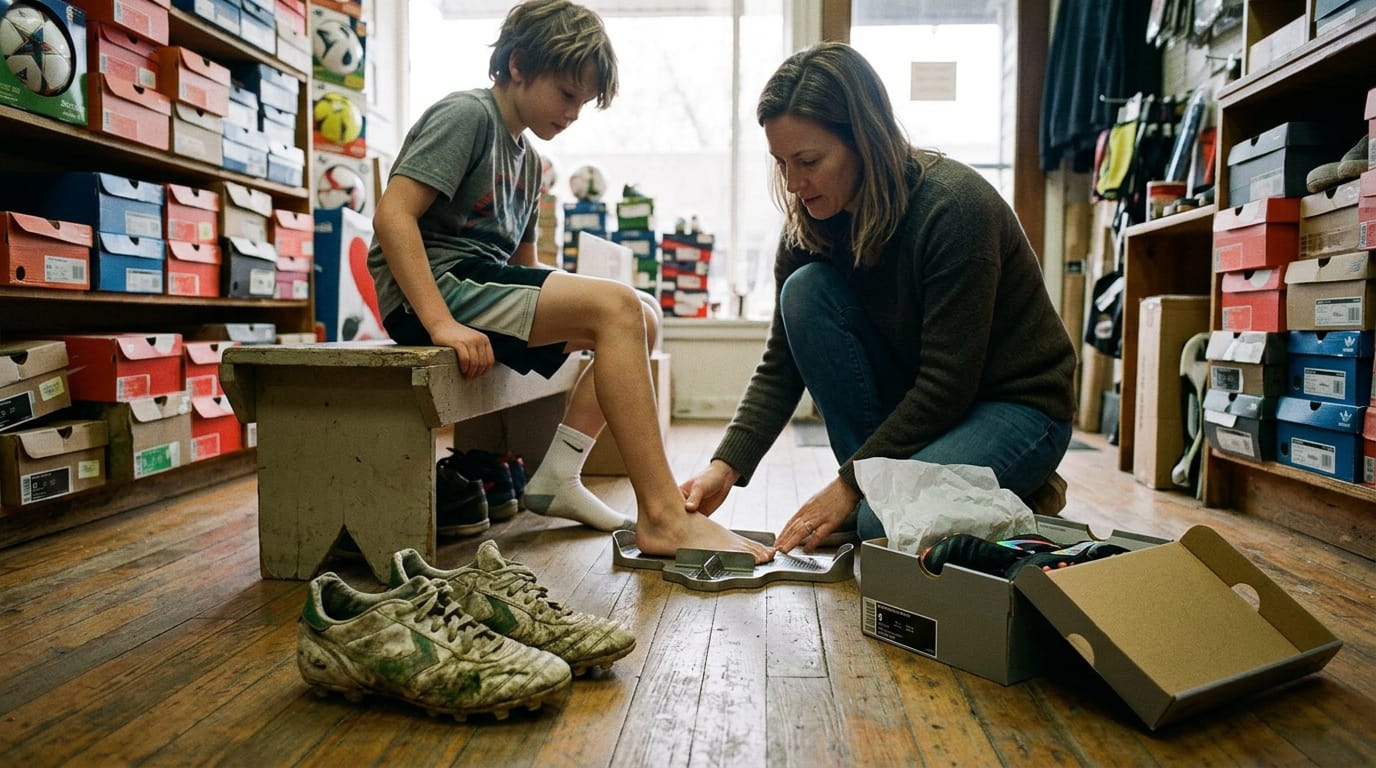
Kids’ feet change fast, so last season’s width may be wrong now.
- Recheck fit each season. Remeasure width every season, not just when the old pair pinches.
- Don’t buy to grow into. Buy for the foot your kid has today.
- Sizing youth cleats by width. Measure width first and match it, not the number on the box. The same approach works for youth soccer cleats.
- Wide youth cleat option. Check that the model you like comes in a wide youth size.
There’s no single best pick for every kid. The best football spikes for kids, and the best football cleats for kids, are whichever pass these checks on their surface.
Building Flexible Feet and Stronger Toes
Your toes push you off the line and stop you on a dime, so your cleat has to work with them. Here’s how toe strength, plate stiffness and simple foot work fit together.
How stronger toes improve agility
A study on toe muscular strength and changing direction measured toe force and agility times to see how toe strength relates to quick direction changes. Strong toes also help you plant before a cut, so your next step fires right away.
Matching plate stiffness to weight and position
The plate is the firm sole piece under your foot that holds the studs. What matters most is where it bends, not just how stiff it feels. A good plate bends where your toes bend, at the ball of the foot, so the shoe moves with you.
Match stiffness to your size and position. Heavier players and linemen who drive off the line usually want a firmer plate. Consider a wide receiver who makes sharp cuts all game.
A more flexible plate lets the toes bend and push off without fighting the shoe, so each break feels quicker.
Flexibility has a downside, too. A clinical update on the injury notes that flexible footwear has been discussed as a factor in turf toe, an injury to the big toe joint.
The name itself traces back to a spike in these injuries after firm artificial fields and flexible footwear arrived in American football. More flex isn’t automatically better.
Toe spacers and foot strength work
Toe spacers are small inserts that sit between your toes to keep them spread apart. Pair them with regular foot strength work rather than relying on spacers alone.
Insoles built for everyday wear can carry some of that work off the field, so your feet get support even when the cleats are in the bag.
Cleat Ranges and What They Cost
Nike’s cleat lineup covers a wide range of levels, and knowing where each tier sits keeps you from overpaying for features your player won’t use.
Nike models from elite to base tiers
Nike’s lineup includes the Vapor, the Alpha Menace and the Force Savage, along with Jordan cleats. The models sort into elite, pro and base tiers, so pick the tier first and the style second.
Each tier comes in low, mid and TD styles, using Nike’s own labels.
Think of a lineman grinding through blocks on every snap and a receiver running routes all game. Both need reliable traction, but their days on the field look nothing alike.
Matching the tier to the position means you pay for what your player actually uses. Pick by position and level, not by the name on the box.
Price ranges and youth models
Prices run roughly $50 to $210, so the real question is where your player’s needs fall in that span.
Sale discounts can bring a higher tier within reach, so check clearance before paying full price. Fit still comes first. A discounted pair in the wrong size is still the wrong pair.
Big kids’ cleats cover the stretch between youth and adult sizing, so check the size chart, and width if your player needs it, rather than guessing from age.
The Shark youth line is another option for younger players, so compare its size chart against Nike’s before you order. Sizing varies from brand to brand.
Wide feet don’t have to mean compromise. Once you know what width, plate and fit are doing for your foot, shopping gets a lot simpler.
Match the cleat to your position, age and surface, and you’ll spend less time thinking about your feet and more time playing.
Get the fit right, and your cleats will do their job quietly while you do yours.
References
- Football cleat design and its effect on anterior cruciate ligament injuries. A three-year prospective study — pubmed.ncbi.nlm.nih.gov
- Relationship Between Toe Muscular Strength and the Ability to Change Direction in Athletes — pubmed.ncbi.nlm.nih.gov
- Footwear traction and lower extremity noncontact injury — pubmed.ncbi.nlm.nih.gov (2013)
- Athletes With Musculoskeletal Injuries Identified at the NFL Scouting Combine and Prediction of Outcomes in the NFL: A Systematic Review — pmc.ncbi.nlm.nih.gov (2018)
- Turf toe: A clinical update — pmc.ncbi.nlm.nih.gov (2018)
Questions
What are the best football shoes for people with wide feet?
For wide feet, look for Under Armour models labeled wide (E), New Balance in 2E, or the wide version of Nike Alpha Menace 4 Shark. The best choice is the pair that keeps your foot within the insole and fully on the plate without pinching; try it on in your game socks and test cuts for heel movement.
What are the best football spikes for kids?
The best football spikes for kids are the ones that fit their current foot and match the playing surface. Check wide youth options, leave about a thumb’s width in front of the longest toe, and make sure the heel stays put during a jog and cut; the Nike Shark youth line is one option to compare.
How to size youth soccer cleats?
Measure your child’s feet and try cleats with the socks they will wear for games. With the heel pushed back, allow about a thumb’s width in front of the longest toe, and check that the foot stays within the insole without heel slipping. Recheck the fit every season, and don’t buy a larger size for your child to grow into.
Which football cleats are best for wide feet?
For wide feet, consider Under Armour cleats labeled E, New Balance models in 2E, or the wide Nike Alpha Menace 4 Shark. Width labels vary by brand, so check the fit directly: your foot should not spill over the insole or plate, and your heel should stay secure when you cut.
What cleats come in wide width?
Some football cleats are offered in wider widths, including Under Armour options labeled E, New Balance options in 2E, and a wide version of the Nike Alpha Menace 4 Shark. Availability can vary by model and season, so check the listed width and try the cleats on before buying.
What's the difference between FG and AG cleats?
FG means firm ground, and those cleats are designed for natural grass with longer studs. AG means artificial grass, and those cleats use shorter studs for turf, which does not give the way grass does. Choose based on the surface you play on most.
What size cleats should I wear?
Start with your regular size, then check the fit in your game socks. With your heel pushed back, you should have about a thumb’s width in front of your longest toe, and your foot should fit within the insole edges. If your foot spills over the sides, try a wider width before increasing the length.
Sources
- Footwear traction and lower extremity noncontact injury - PubMed, pubmed.ncbi.nlm.nih.gov,
- Football cleat design and its effect on anterior cruciate ligament injuries. A three-year prospective study - PubMed, pubmed.ncbi.nlm.nih.gov
- Athletes With Musculoskeletal Injuries Identified at the NFL Scouting Combine and Prediction of Outcomes in the NFL: A Systematic Review, pmc.ncbi.nlm.nih.gov,
- Relationship Between Toe Muscular Strength and the Ability to Change Direction in Athletes - PubMed, pubmed.ncbi.nlm.nih.gov
- Turf toe: A clinical update - PMC, pmc.ncbi.nlm.nih.gov,
Find your level
The Counter