Body Weight Squats Without Any Equipment, Step by Step
Body weight squats turn an everyday sit-to-stand into a home workout, with step-by-step form cues, muscle targets, and ways to progress safely at home.
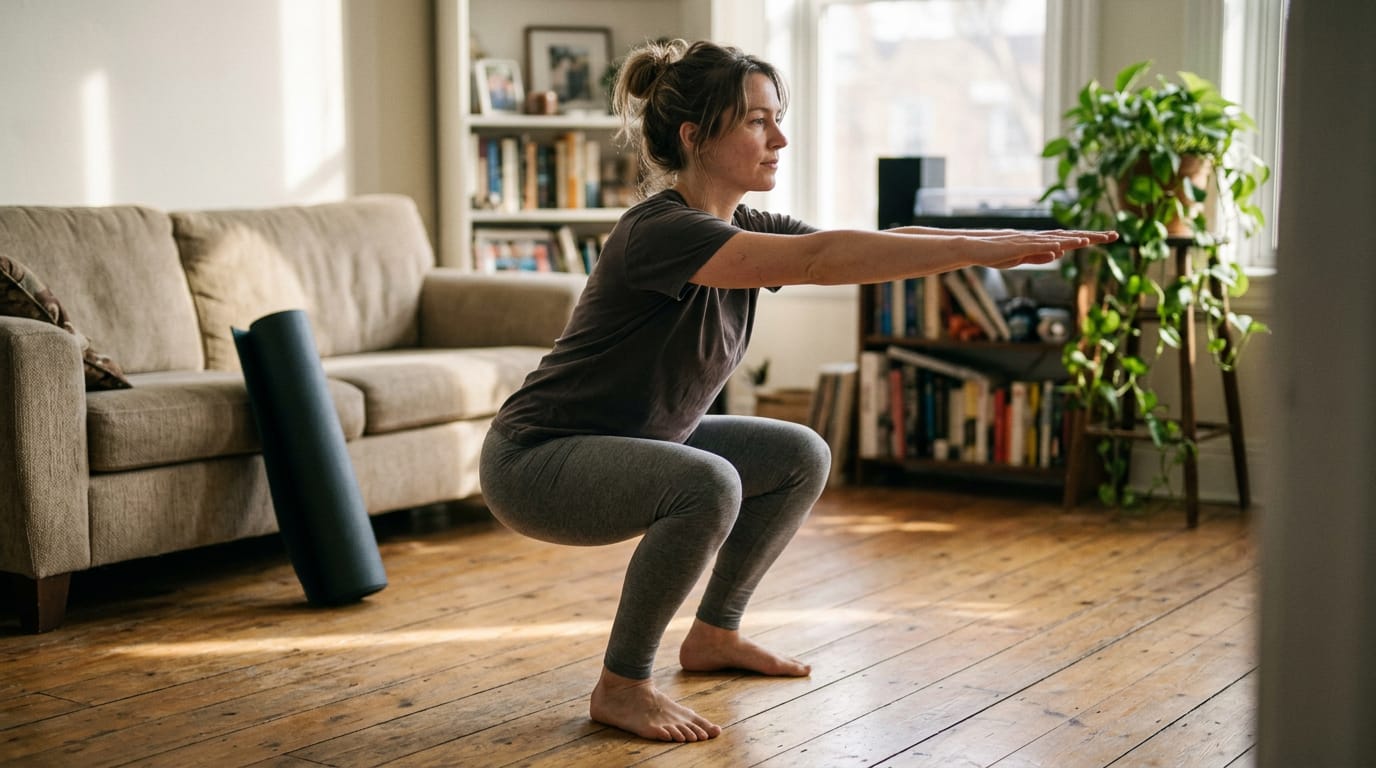
Think about the last time you sat down in a chair without reaching for the armrests. That everyday motion is basically a squat, and you can train it without buying a single piece of equipment.
Bodyweight squats use nothing but your own body for resistance. You lower your hips, bend your knees, then stand back up. Footwear and the surface under your feet matter more than you might think.
Here, we’ll cover what the squat is, which muscles it works, clean step-by-step form, and how to progress. We’ll also share practical tips on gear for home training.
Body Weight Squats and Who They Suit
A bodyweight squat is a squat with no added load: you bend at the hips and knees, then stand back up using only your body. Weighted squats share that pattern, so the real difference is load. Are they effective?
For beginners, yes, though less so once you’re experienced.
Why beginners can start with little risk
Bodyweight squats are a good starting point for resistance training beginners. With no load, injury risk stays low, so you can focus on form.
- Learn the movement pattern. You practice the hip-and-knee bend behind most lower-body lifts.
- Prepare for weighted squats. Once the pattern feels natural, adding a bar is a smaller step.
Do it anywhere with little equipment
Bodyweight squats can be done almost anywhere, at home or in the gym. A parent squats in the kitchen during dinner prep and never skips a session.
A 100-squat routine needs no external weights and little equipment, and a review of bodyweight training notes growing interest in programs with little or no equipment.
At 100 a day, the work comes from volume rather than heaviness, so expect your legs to feel it.
Do body weight squats really build muscle?
Yes, for beginners. A study comparing free weight and body mass-based resistance training found that thigh muscle size grew in the bodyweight group as well.
A systematic review of resistance training load found untrained people gain more muscle, so bodyweight squats alone may not give a seasoned lifter enough resistance.
- Superset or finisher. Pair squats back to back with another exercise, or end a workout with them.
- High-intensity interval training (HIIT). Squats can serve as one short, hard burst in a session.
Doing the Squat Step by Step
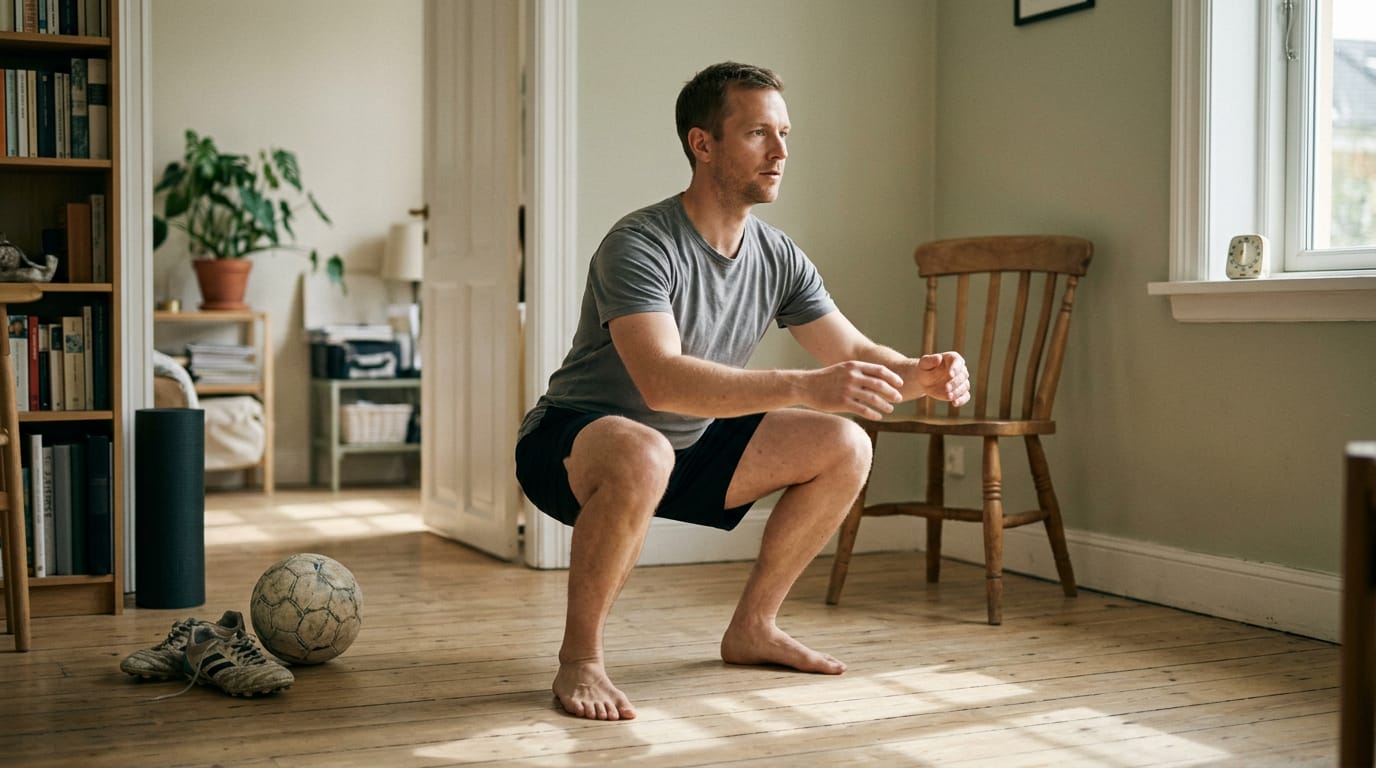
Good form is what turns a bodyweight squat into a useful exercise. Each stage below breaks down one part of the movement:
Get your feet and shoulders in place
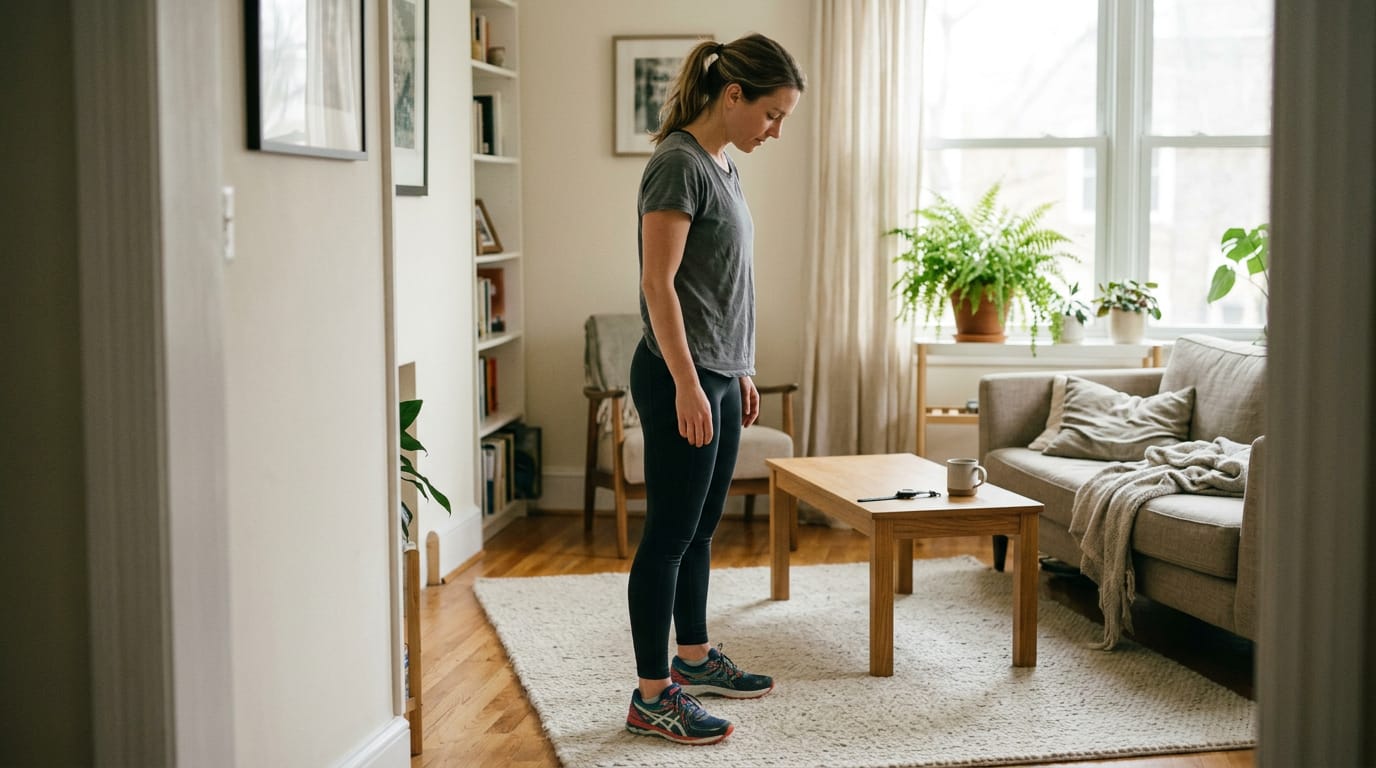
Every rep starts here, so set up before you move. Consider a weekend runner squatting in the living room before Sunday’s long run. A solid setup means the last rep looks as good as the first.
- Feet: Place them hip to shoulder width.
- Toes: Turn them slightly outward.
- Stance: Choose a width that feels comfortable, not one copied from someone else.
- Shoulders: Keep them down and back, away from your ears.
- Arms: Hold them by your sides, across your chest, or out in front, whichever stays steady.
Lowering yourself and how deep to go
Start by pushing your hips back first, not your knees forward, as if you’re reaching for a chair behind you. Then bend your hips and knees together so the descent stays smooth instead of folding at one joint.
Picture a parent squatting in the kitchen after bedtime, sinking with the knees leading. Hips back first keeps you balanced and in control.
- Depth: Squat to parallel or below, meaning your thighs are level with the floor or lower.
- Stop point: If your heels lift or your torso rounds, stop there and come back up.
- Knee travel: Control how far your knees move forward over your toes.
Control beats depth, every time.
Rising back up and finishing the rep
Push through your feet to stand, letting your hips and torso rise together.
- Heels: Keep them flat the whole way up.
- Knees: Avoid locking them out at the top.
- Squeeze: Finish with a light squeeze of your glutes, the big muscles of your backside.
A club player running squats between drills stays ready for the next sprint when every rise ends the same way. Same finish, every rep.
When to breathe and brace your core
Set your core brace before you start lowering. Tighten the muscles around your midsection to keep your spine stable, as if you’re about to take a light poke to the stomach.
Then let your breath follow the movement: inhale on the way down, exhale as you rise. Keep that brace on through both halves, and the rep stays steady from bottom to top. Simple, but easy to forget.
Key Form Cues to Keep in Mind
Good form comes down to a few cues you can check on every rep. Here’s what to watch as you lower and stand back up.
Keeping knees and feet in line
Your knee tracking is the first thing to get right, and it’s easier than it sounds. Check these as you go:
- Track your knees over your second toe.
- Push your knees out so they don’t cave inward.
- Keep your feet planted the whole time.
- Keep your ankles from collapsing in or out.
- Choose flat, stable shoes, since they help your alignment hold steady.
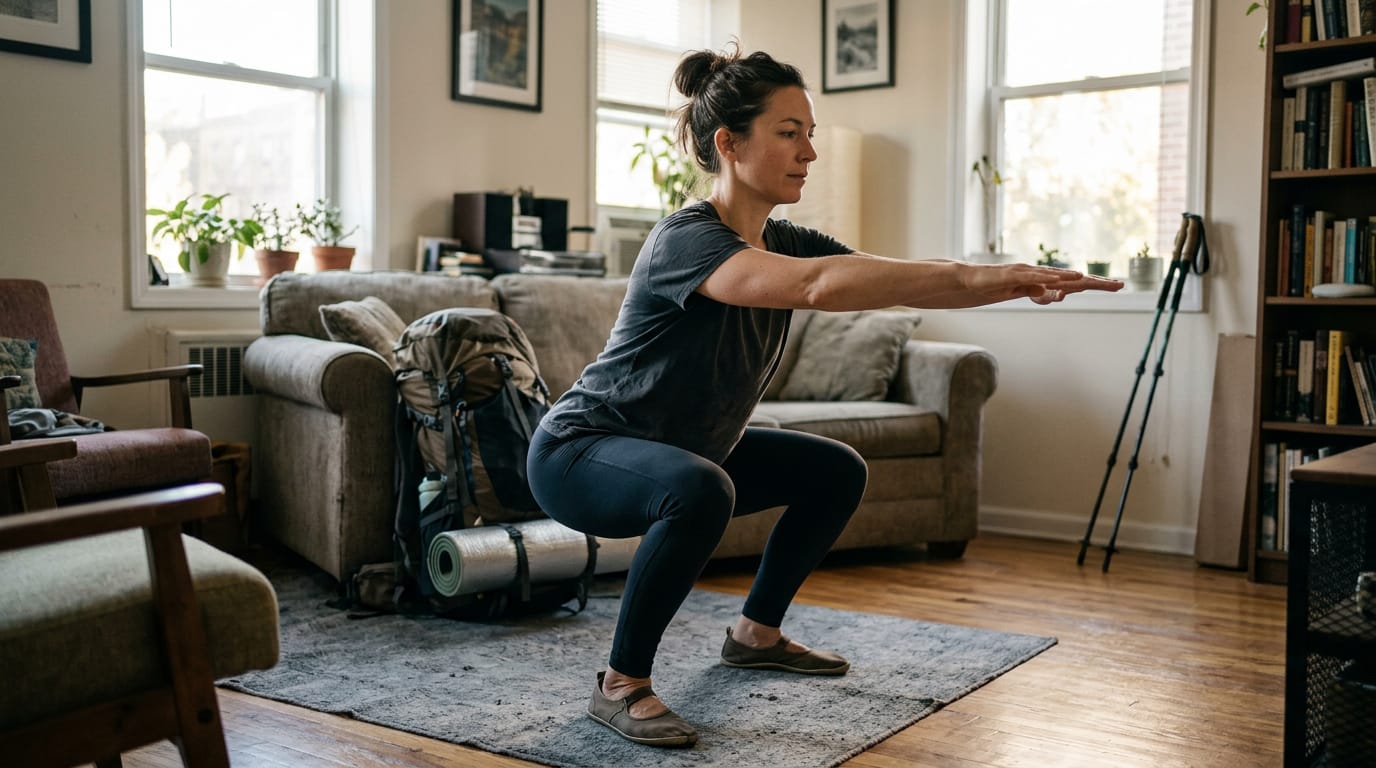
Think of a weekend hiker squatting in the living room before a long trail day. When her knees drift inward, the form she’s practicing isn’t the form she wants on the trail. Pushing them out keeps her steady from the first rep to the last.
Keep your spine neutral and chest up
Your upper body sets the tone for the whole rep. Here’s what to hold:
- Keep a neutral spine, neither rounded nor overly arched.
- Keep your chest up and out, not collapsed forward.
- Keep your back flat throughout the movement.
- Keep your torso and shinbone parallel as you descend.
Your chest leads, and your back follows.
Balancing weight and moving with control
Where your weight sits decides how smooth each rep feels. Pay attention to these:
- Balance your weight between the balls and heels of your feet.
- Push through your whole foot as you stand.
- Move at a deliberate, controlled tempo.
- Use your legs, not gravity, to drive yourself back up.
Consider a club volleyball player squeezing in squats between drills at practice. Bouncing at the bottom turns the reps into a blur, but an even tempo gives her a set she can trust. Aim for controlled over quick, especially when you’re tired.
Which Muscles the Squat Works
A bodyweight squat looks like one simple move, but it works most of your lower body and trunk at the same time. Knowing who does what helps you feel the right work and spot when something’s off.
Main muscles and what keeps you steady
Each group has a specific job:
- Hips and thighs: The glutes (your buttock muscles) do much of the lifting as you stand back up, while the quads on the front of your thighs and the hamstrings on the back share the work.
- Calves: They work through your ankles to keep your weight balanced over your feet.
- Erector spinae: These long muscles run up either side of your spine, keeping your back upright so you don’t tip forward on the way down.
- Core: Your abs, obliques, and deeper trunk muscles brace your midsection so your upper and lower body move as one unit.
Consider a weekend soccer player who squats after practice to loosen tight legs. When she feels the work in her glutes and quads, she knows the right muscles are doing the job, so she can keep each rep smooth and controlled.
The squat is less about how deep you go and more about how steady your trunk stays on the way down. Stability is the quiet job.
Ways to Vary and Progress the Squat
Once your form is solid, you can make the squat harder without buying anything.
Challenge yourself with no added weight
Try a three-second pause at the bottom, heels down and chest up, before you stand. Pausing raises time under tension, the total time your muscles spend working, so the same rep feels much harder.
You can also change the tempo, the speed of each phase. Lower over three seconds, then rise steadily. Depth matters too: a shallower squat is easier, while going deeper (only as far as your mobility allows) adds work.
For a harder option, try 1 and ¼ reps: drop to the bottom, come up halfway, lower again, then stand fully. That extra bottom-half movement keeps your quads working longer.
Not ready for full depth? Regress with a box squat, sitting back onto a sturdy chair before you stand, or an assisted squat, holding a doorframe for support.
A sample week: three sessions of three sets of 10 to 15 slow reps, mixing pauses and 1 and ¼ reps. A weekend soccer player who sticks with it will feel steadier late in the game.
When to add dumbbells or kettlebells
When bodyweight sets stop feeling hard, add load. A goblet squat is the simplest start: hold one dumbbell or kettlebell vertically against your chest and squat as usual.
Progress only after you’ve mastered form. Add weight once every rep hits the same depth, your heels stay planted and nothing wobbles. The goal is control first, not load, since sloppy heavy reps undo the work.
Think of a parent training at home after bedtime. One pair of adjustable dumbbells covers goblet squats without a gym membership or a long drive.
When should you buy? Pick a weight you can control on every rep, not the heaviest one you can lift. Light and controlled beats heavy and rushed.
Staying Safe and Getting Expert Help
Squats are simple, but simple doesn’t mean risk-free for everyone. Knowing when to pause and who to ask keeps your training on track.
Ask a doctor or trainer when unsure
If you have a past injury, ongoing joint pain or a health condition you’re unsure about, check with your doctor before you start a squat routine. A short conversation can tell you whether bodyweight squats fit where you are right now.
- Consult a doctor if unsure. Pain in your knees, hips or lower back is your cue to get a medical opinion first. Ask whether a full range of motion is safe for you and whether any movement should be modified.
- Ask a personal trainer. A trainer can watch your depth, knee alignment and back position in person, which is hard to judge from a mirror or a video. Ask for a couple of sessions to lock in your form before you train on your own.
Think of a masters tennis player who feels a twinge in his lower back after long matches and wants squats for court strength.
His doctor clears the way, and two sessions with a trainer teach him to keep his back steady, so he builds stronger legs without another flare-up.
The smart move is to ask before something hurts, not after. Ask early.
Bodyweight squats show that you don’t need a full gym to train your legs well. Clean form, a steady progression and a supportive shoe on a stable surface will take you further than fancy equipment.
Start with a few controlled reps, add challenge as the movement gets easier, and pay attention to how your body responds. Patience is what turns a simple exercise into real, lasting strength.
The floor you’re standing on is all the gym you need to begin.
References
- Effects of free weight and body mass‐based resistance training on thigh muscle size, strength and intramuscular fat in healthy young and middle‐aged individuals — pmc.ncbi.nlm.nih.gov (2023)
- Bodyweight Training for Muscular Strength & Endurance — doi.org (2022)
- Resistance Training Load Effects on Muscle Hypertrophy and Strength Gain: Systematic Review and Network Meta-analysis — pmc.ncbi.nlm.nih.gov (2020)
Questions
What is a body weight squat?
A bodyweight squat is a squat performed without added weight, using your own body for resistance. You bend at the hips and knees, then stand back up.
Are bodyweight squats actually effective?
Yes. Bodyweight squats can help beginners build thigh muscle and strength while practicing a useful movement pattern; experienced lifters may need added resistance or harder variations for continued progress.
What will 100 bodyweight squats a day do?
Doing 100 bodyweight squats a day creates a high volume of leg work, so your legs may feel tired or sore. It may help beginners build strength and muscle, but results depend on your fitness level, form, recovery, and whether the exercise remains challenging.
What's the difference between squats and bodyweight squats?
A squat is the general movement of bending at the hips and knees and standing back up. A bodyweight squat is that movement performed without added load; a weighted squat uses extra resistance, such as a barbell or dumbbell.
Sources
- Effects of free weight and body mass‐based resistance training on thigh muscle size, strength and intramuscular fat in healthy young and middle‐aged individuals, pmc.ncbi.nlm.nih.gov,
- Resistance Training Load Effects on Muscle Hypertrophy and Strength Gain: Systematic Review and Network Meta-analysis - PMC, pmc.ncbi.nlm.nih.gov,
- Bodyweight Training for Muscular Strength & Endurance, doi.org,
Find your level
The Counter