Fastest MLB baseball pitch: official records explained
The fastest MLB baseball pitch on record comes from Statcast; learn how speed is measured and why legendary throws never made the official list.

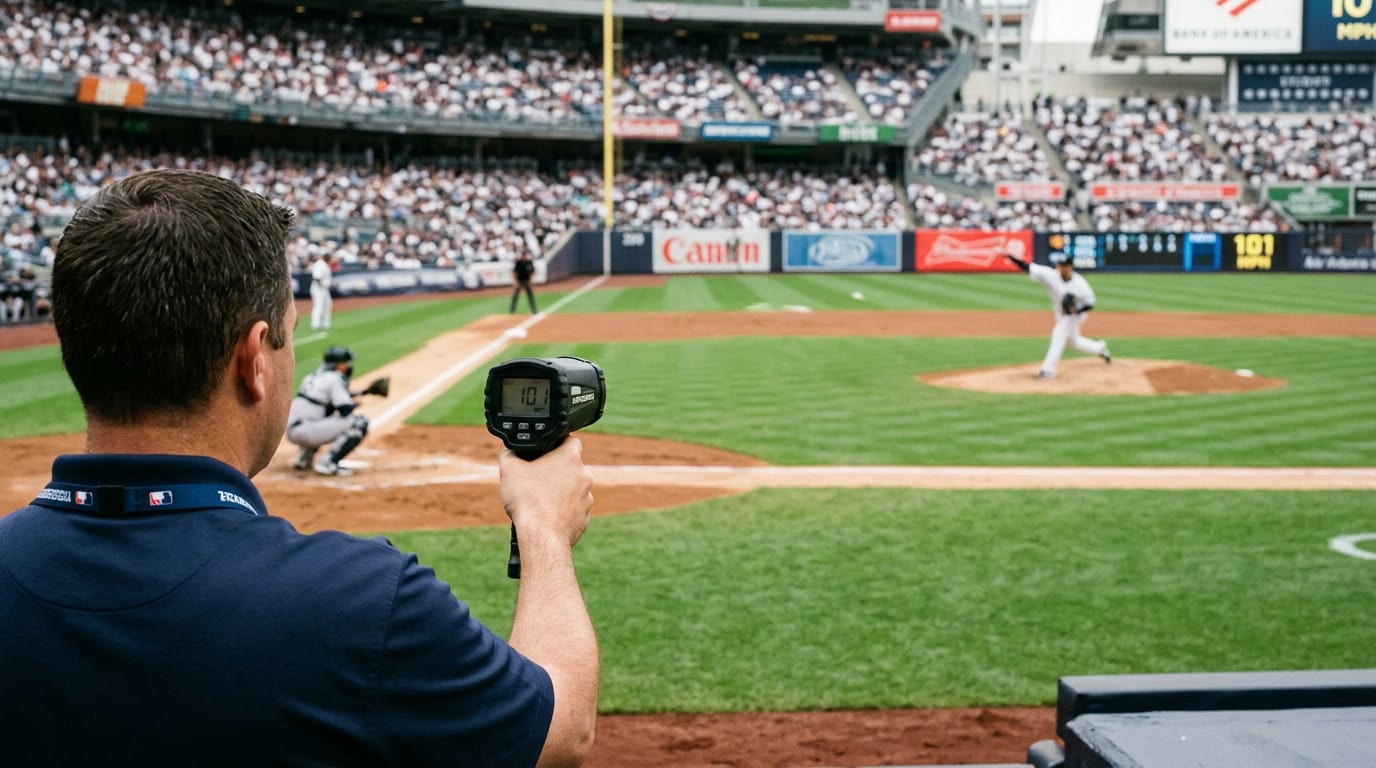
Ever glance at a car’s speedometer and wonder if that needle is really telling you the truth? Pitch speed works the same way. A number flashes on the screen, and you naturally want to know who set it, how it was measured and whether it holds up.
The short answer is that the fastest pitch in MLB is tracked in the official Statcast record.
In this post, we’ll cover that record, how speed gets measured, the legendary throws that were never officially timed, today’s hardest throwing starters, how fastball speeds have changed over time, and practical gear and training tips for players chasing more velocity.
Official Fastest Baseball Pitch Records Since Statcast
One name sits atop the official Statcast record, MLB’s pitch-tracking system. Here’s who holds it and who’s close behind.
Who has the fastest MLB pitch ever?
Aroldis Chapman holds the mark with a 105.8 mph four-seam fastball, the standard straight fastball. He threw it on September 24, 2010.
According to MLB’s roundup of the speediest plays in Statcast history, Statcast revised that speed upward, and the corrected figure is the one recognized as the record. It’s also a Guinness world record.
The number that counts is the revised one, not the first reading. That’s the number everyone measures against.
No verified source shows anyone reaching 106 mph. Chapman’s 105.8 is the top figure we can confirm.
The ten fastest pitches ever thrown
Chapman dominates the list, and the 2016 season produces a cluster of the hardest throws. The top marks look like this:
- Aroldis Chapman: 105.8 mph
- Ben Joyce: 105.5 mph
- Jordan Hicks: 105 mph
- Ties: 105.1 and 105.0 mph
Think of a high school pitcher checking this list before bullpen work. The 105.8 mark gives them a clear target and a question to answer: is the next gain in velocity, or in control?
Profiles of the fastest pitchers
Chapman’s nickname, ‘Cuban Missile,’ fits the heat he’s known for, and he’s still throwing 100-plus mph. Our sources don’t cover his debut or team history.
Hicks is the other name to know. According to MLB’s coverage of a Brewers-Cardinals start, Jordan Hicks reached 105 mph twice with the Cardinals on May 20, 2018, against the Phillies.
Our sources don’t single out the fastest pitch by a lefty, so we won’t guess at one.
How Pitch Speed Gets Measured
A pitch’s speed is only as trustworthy as the method behind it. Tracking methods have changed a lot, so numbers from different eras don’t always line up.
How speed tracking tech has evolved
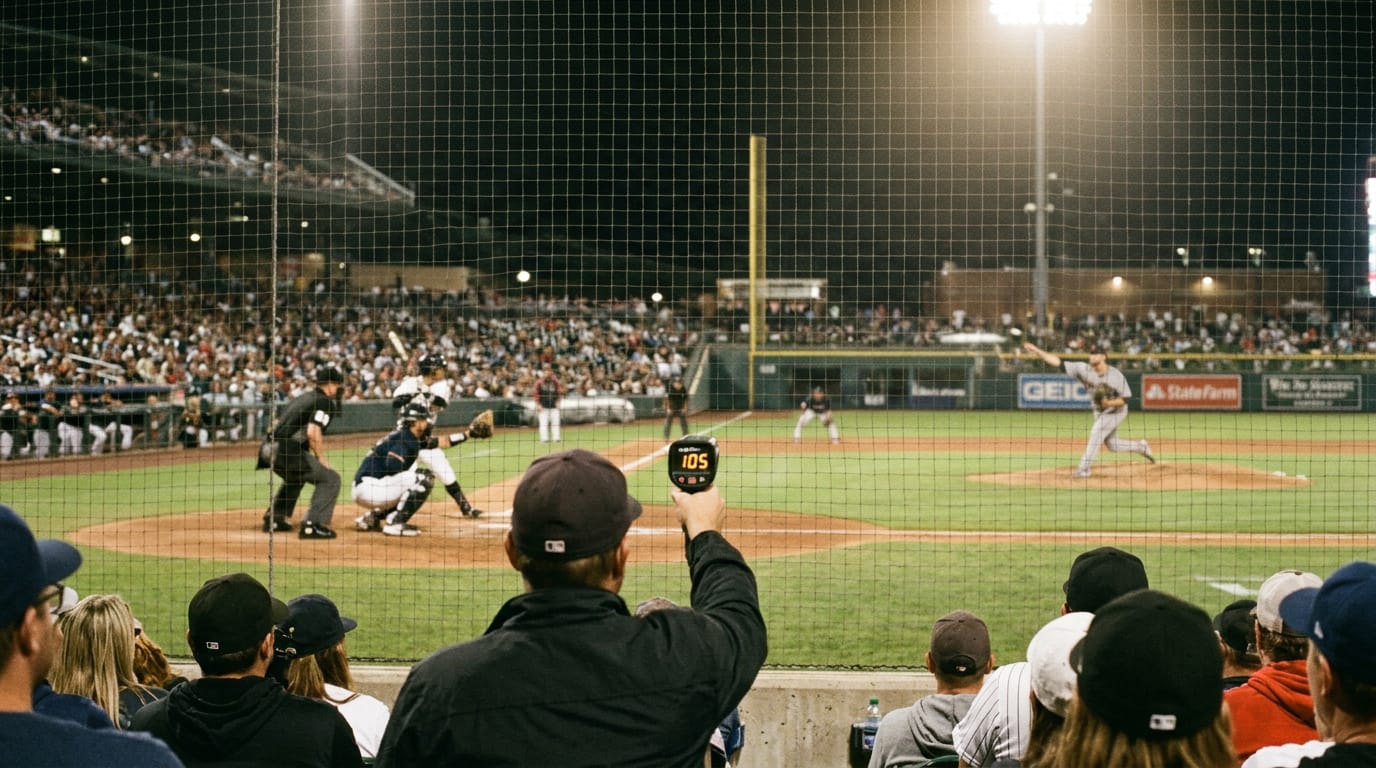
Efforts to time pitches date to the 1940s, and radar guns arrived in the 1970s. PITCHf/x was in use by 2008. Today’s Statcast system pairs Doppler radar, which reads how a moving ball shifts radio waves, with Hawk-Eye tracking.
Amateur players can also use radar guns for a quick read, though they don’t produce the official record.
Why pitches lose speed before the plate
A pitch doesn’t reach the plate at the speed it left the hand. According to Legion Report’s fastest-pitch history, a pitch loses 5-10% of its speed from its release point to home plate.
One reading there caught a pitch at 83.2 mph, measured 7.5 feet behind home plate, where the ball had already lost roughly 10 mph to drag.
That’s why home plate readings were the slowest, and why modern tracking measures speed at release. Think of a parent who clocks their kid’s fastball from the stands and posts the number to the team chat.
What matters is less about how hard the kid threw and more about where the clock started. Same pitch, two possible numbers.
Why old pitch speeds were revised upward
Old speeds were revised upward, since home plate readings ran slowest. Standardized measurement keeps modern records consistent, but older records aren’t directly comparable to today’s numbers. Comparisons across eras need an asterisk.
Legendary Pitches That Were Never Officially Timed
Some of baseball’s hardest throws never got a clean, official reading, so the famous numbers come with asterisks. Here’s what we can actually say, and how much weight you should give each one.
Nolan Ryan’s disputed speed readings
According to the Society for American Baseball Research, radar clocked Nolan Ryan at about 100 mph (100.8, to be exact) in an Angels win over the White Sox.
That reading came during the 1974 debut of the radar gun, which tracks speed by bouncing radio waves off a moving ball.
Later adjustments to that speed, as The Athletic reports, produce an estimate near 108 mph. Accuracy is still disputed, so treat it as an estimate, not an official record.
Bob Feller’s famous 1946 speed test
Bob Feller’s legend rests on a 1946 Lumiline Chronograph test, a timing device, plus a motorcycle race test.
According to Sportscasting, a documentary adjusted that pitch to today’s standards and put it at 107.6 mph. It’s an estimate, not a measurement, and since it was a one-off, nobody can rerun it to check the number.
Think of a Little League coach who wants to know how his arms stack up against Feller’s legend. He’ll learn more by tracking each pitcher against his own past readings than by chasing a 1946 number.
Other legendary fireballers and their stories
Randy Johnson’s bird incident is a story fans still tell, though it says more about the moment than his velocity.
Roger Clemens earned the nickname ‘The Rocket,’ but the detail speed chasers should study is that he sustained his velocity into his late 30s. Staying fast is the harder trick.
Today’s Hardest Throwing Starting Pitchers
Here’s who’s throwing the hardest right now, starting with the record for starters and then the arms chasing it.
Jacob Misiorowski’s record for starters
A starting pitcher is the one who opens the game, so his velocity has to hold up deep into an outing.
Jacob Misiorowski’s night against the Phillies set a mark: he threw a 104.5 mph pitch, and as Sporting News reported, MLB shared on social media that it was the fastest pitch ever thrown by a starter in league history.
He’s also shown up more than once on the list of the hardest-throwing starters, which points to repeat appearances rather than one lucky night. Velocity like that takes work.
We don’t have verified details on his 2026 season stats or his contract and free agency status, so check current reports before you rely on any numbers you see.
Think of a high school pitcher who sees that 104.5 flash on a scoreboard and wonders what it would take to add a few ticks to his own fastball. The names below give that pitcher a realistic yardstick.
Other fast arms, starters and relievers alike
Hicks reached 103.2 mph in a start, and Verlander hit 103.1 mph back in 2011, which shows elite velocity has been around for a while. Mason Miller, Duran, and Halvorsen each average 100 mph or more.
That’s a steadier standard than one fast pitch, and the group mixes starters and relievers, so you’ll see both roles here.
How Fastball Speeds Have Changed over Time
Fastball speed has been climbing for years. Here’s what the numbers show and what they cost pitchers’ arms.
Average fastball speed in 2007 versus 2025
Average fastball velocity in Major League Baseball (MLB) rose between 2007 and 2025. Jonathan Broxton’s 97.6 mph average topped the league in 2007, but Sports Illustrated notes that the same heater would be tied for 28th in 2025.
Pitches of 100 mph or more have surged, and bullpens are now stacked with fireballers.
Why pitchers throw harder than before
Several forces explain the jump:
- Better training programs. Pitchers build velocity on purpose now.
- Surgery and recovery advances. Better repairs keep hard throwers healthy and on the mound.
- Nutrition habits. Players fuel and recover with more care than before.
- Fewer innings per starter. Shorter outings let pitchers go all-out on nearly every pitch.
- Player evaluation changes. Teams weigh raw velocity more heavily when they scout arms.
What all that velocity costs pitchers’ arms
Throwing harder puts more load on the elbow and shoulder. Every extra mph has a price, and the arm pays it.
Tears to the UCL (ulnar collateral ligament, the main ligament on the inside of the elbow) are a major concern and often lead to Tommy John surgery.
Pitchers also work deep into games less often, and some critics argue the game is becoming homogeneous.
Higher velocity has coincided with more strikeouts and walks and fewer balls in play, and The Washington Post links that to about 25 more pitches per game in 2019 than in 1989.
Young arms need the most care. Picture a 14-year-old who sees a triple-digit number on TV and throws every day to chase it. If you coach or parent that kid, ask about workload and rest days before anything else.
How the Main Fastball Types Differ
Two pitches can leave the hand at the same speed and still behave differently. The grip and seams explain why.
The fastball types MLB officially recognizes
Three types sit in the fastball family:
- Four-seam fastball: the straight-ahead benchmark.
- Sinker (two-seam): a grip that adds sink and movement.
- Cutter: a fastball thrown a bit slower, with a late, short break.
The splitter often gets lumped in, but it’s not a fastball. It’s an off-speed pitch. Fastballs are only one branch of MLB’s full pitch-type list.
The four-seamer is usually the fastest
The four-seamer usually tops the list for raw speed and moves the least from side to side. Its grip runs across the horseshoe seams, which sends the ball spinning back toward the catcher.
Picture a 15-year-old in the bullpen working on her four-seamer. Her fingers sit across the seams, the ball jumps out with little side-to-side movement, and the radar gun shows the speed.
For a scout, the question is less about movement and more about speed, which is why four-seam velocity works as a scouting criterion for prospects.
How sinkers and cutters move differently
Sinkers and cutters look like close cousins, but they behave differently. The sinker is built to induce ground balls, so hitters often pound it into the dirt.
Both pitches get extra movement from the seam-shifted wake, where the seams disrupt the air flowing around the ball and push it off a straight path.
The cutter runs about 2 to 8 mph slower than the four-seamer. Slower doesn’t mean soft, though. Clase’s cutter reaches 102.8 mph.
Why backspin makes fastballs seem to rise
Backspin creates the Magnus effect, a force that works against gravity and keeps the pitch from dropping as much as you’d expect. A pitch can’t actually rise, though. It just falls less than gravity alone would predict.
Vertical break measures that gap against the path a ball would take with no spin. What counts as good depends on velocity, so compare a fastball with others thrown at similar speeds rather than chasing one number.
Fans and hitters often call a hard fastball ‘heat,’ and the speed is real. The rise is the illusion.
Pitch speed isn’t just a bragging number. The official Statcast record, the top-10 list and the legendary throws that were never officially timed show how velocity gets measured, remembered and compared across eras.
For players chasing more velocity, the approach is simple: pair the right gear with patient, consistent training. Chasing one big number rarely gets you there, so build the arm first and let the velocity follow.
References
- Speediest plays in Statcast history — mlb.com (2026)
- Jacob Misiorowski tells Mookie Betts he can throw 105 mph — mlb.com (2026)
- Fastest Pitches Ever Thrown in MLB History — si.com (2025)
- September 7, 1974: Radar clocks Nolan Ryan’s fastball at 100.8 mph in Angels’ win over White Sox — sabr.org (2026)
- Nolan Ryan on Brewers’ Jacob Misiorowski and radar gun readings: ‘He has a gift’ — nytimes.com (2026)
- Who Has Thrown the Fastest Pitch in MLB History? - Sportscasting — sportscasting.com
- Fastest pitches in MLB history: Brewers’ Jacob Misiorowski breaks own hardest-fastball record — sportingnews.com
- Fastest Pitch in MLB History: Every 105 MPH Pitch on Record — legionreport.com
- Velocity is strangling baseball — and its grip keeps tightening — washingtonpost.com
Questions
What is Jacob Misiorowski's fastball speed?
Jacob Misiorowski has thrown a 104.5 mph pitch, the fastest pitch recorded by an MLB starting pitcher. That is different from the overall Statcast record of 105.8 mph, held by Aroldis Chapman.
What is the best and most affordable pitching machine?
There isn’t one best pitching machine for every player or budget. For affordability, look for a basic manual or entry-level machine that matches the ball type and speed range you need, and compare its price, safety features, portability, and replacement-ball costs.
What are the different types of fastballs in baseball?
The main fastball types are the four-seam fastball, the sinker (also called a two-seam fastball), and the cutter. Four-seamers are usually the fastest and straightest, while sinkers and cutters have more movement.
What are some good softball pitcher training tools?
Useful softball pitcher training tools include a regulation softball, a pitching target or net, a radar gun, and video recording for checking mechanics. Resistance bands and a weighted ball may also be used in structured training, but young pitchers should follow age-appropriate workload and safety guidance.
How fast does a pitching machine go?
Pitching-machine speed varies by model and settings. Many machines for youth and amateur practice offer adjustable speeds, while specialized machines can throw substantially faster; check the manufacturer’s specifications and use a machine rated for the ball being used.
Who threw 106 mph?
No pitcher has a verified 106 mph pitch in the official records described here. Aroldis Chapman’s confirmed record is 105.8 mph; higher figures attributed to Nolan Ryan or Bob Feller are estimates rather than verified measurements.
Is a 120 mph pitch possible?
A pitch of 120 mph has not been verified in baseball and would be far beyond the established official record. Because pitch speeds depend on measurement method and release point, any claim at that level would need reliable, standardized tracking to be confirmed.
What equipment is used for baseball?
Baseball equipment commonly includes a bat, balls, gloves or mitts, a batting helmet, and protective gear such as a catcher’s mask, chest protector, and leg guards. Players may also use cleats, a batting glove, and a helmet with a face guard, depending on their position and league rules.
Sources
- Speediest plays in Statcast history, mlb.com,
- Jacob Misiorowski tells Mookie Betts he can throw 105 mph, mlb.com,
- September 7, 1974: Radar clocks Nolan Ryan’s fastball at 100.8 mph in Angels’ win over White Sox – Society for American Baseball Research, sabr.org,
- Nolan Ryan on Brewers’ Jacob Misiorowski and radar gun readings: ‘He has a gift’ - The Athletic, nytimes.com,
- Who Has Thrown the Fastest Pitch in MLB History? - Sportscasting | Pure Sports, sportscasting.com
- Fastest pitches in MLB history: Brewers' Jacob Misiorowski breaks own hardest-fastball record | Sporting News, sportingnews.com
- Jacob Misiorowski throws fastest-tracked pitches by starter, mlb.com,
- Pitch velocity keeps rising with MLB pitchers, mlb.com,
- Fastest Pitches Ever Thrown in MLB History, si.com,
- Velocity is strangling baseball — and its grip keeps tightening - The Washington Post, washingtonpost.com
- Fastest Pitch in MLB History: Every 105 MPH Pitch on Record, legionreport.com
Find your level
The Counter