Charge Bike Guide: Models, Riding, Battery and Buying Tips
A Charge bike should fit your route: compare model ride feel, battery charging, included storage, and reviews before choosing where your money goes.


Buying an e-bike is a lot like buying a new pair of cleats: the box looks great, but the real test is how it feels on your own route.
If you’re weighing a Charge, you want a straight answer on which model fits how you ride, how to keep the battery ready, and whether the price matches what you’ll actually use.
An electric bike (e-bike) is a bicycle with a battery-powered motor that helps you pedal, so the details matter more than usual.
The short answer is simple: match the model to how you actually ride, not how you hope to ride next year.
In this post, we’ll walk through the full model lineup, how the bike rides day to day, how to charge the battery, extras and storage, what reviews say, where to buy, and where to find manuals when you need them.
The Full Charge Bike Model Lineup
Charge covers electric, city and mountain bikes, so start with the ride you actually plan to do.
Electric models sold direct in the US
Charge’s electric range has three core families: Comfort, City and XC, where XC means cross-country trail riding.
- Comfort e-bikes suit relaxed rides on paved paths.
- City e-bikes are built for commuting and errands.
- XC e-bikes handle dirt trails and rougher ground.
The Comfort 2 is a step-through model, so you can swing a leg over it easily at every stop. The Class 2 Charge City is the one to check if class labels matter where you ride, so confirm local rules first.
Charge sells these electric models direct-to-consumer in the US, so you order online instead of at a dealer. Ask for sizing help before checkout, since there’s no shop counter to lean on.
Think of a commuter riding a few miles to work on pavement. A City model will feel easier on daily stops than an XC bike built for rough trails, and you’ll notice that difference by Friday.
Traditional and mountain bikes on offer
If you don’t need a motor, the non-electric side gives you a simpler option. The Plug urban bikes cover everyday city riding, and the Cooker mountain bikes handle off-road trails.
The Grater, Faucet and Cleaver models round out the range, so compare them by feel before you decide.
Frames come in steel and titanium, and the two ride differently. Test both if you can, and pick by how the bike feels under you, not by what the spec sheet says.
Newest parts and brand innovations
The latest updates include new saddles and wheels, which you’ll feel on every ride, so check which version your model ships with. Charge has also introduced 3D-printed titanium parts, and the founders’ own innovations show up in the newer range too.
Newer doesn’t automatically mean better for your ride.
Where the brand came from
The brand’s roots include making Schwinn bikes, so the name may feel familiar if you grew up riding one.
According to Pinkbike’s Industry Insider feature, Charge began in 2005 in a small farm building in the south west of England, and that British start is a useful backdrop when you compare models.
How the Bike Rides Day to Day
Spec sheets tell you what a bike has. Riding it tells you what it does, from the motor to the display.
How the motor and pedal assist work
The key pieces are:
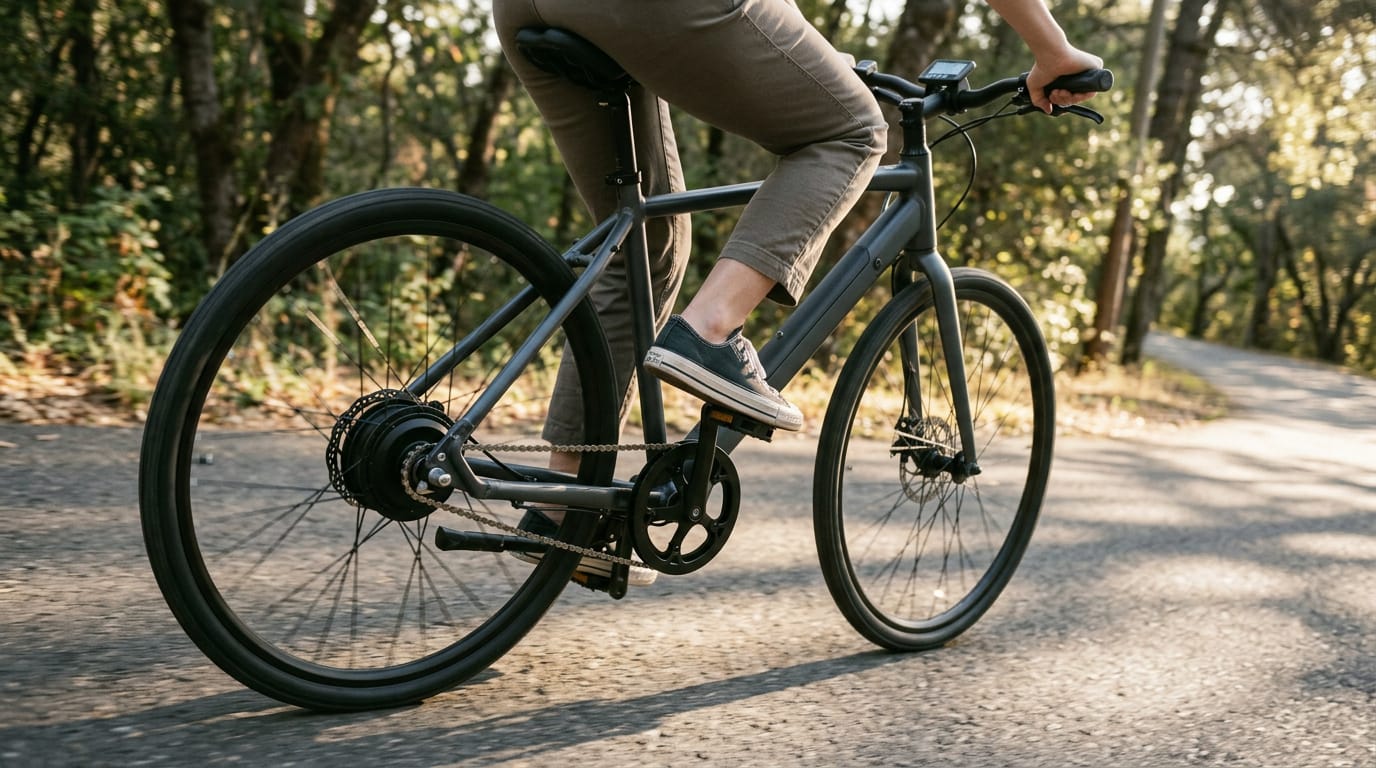
- 250W geared hub motor. It sits in the wheel hub and adds power to your pedaling.
- Five pedal assist levels. Each level sets how much help the motor gives you.
- Thumb throttle. It moves you along without pedaling when you want a break.
- 20 mph top speed. That’s the bike’s ceiling.
- Cadence sensor. It reads when the pedals turn, so the motor kicks in as soon as you start pedaling.
How it performed in our tests
Strong acceleration gets you up to speed quickly, and braking was good. Think of a weekend rider catching up to the group at a stoplight, then scrubbing speed for a crowded corner. Both moments feel controlled, and that confidence is the payoff.
With the assist off, it still pedals easily, so it works as a regular bike when you want it to. We also tested range and hill climbing.
How far the battery really goes
Charge Bikes claims up to 50 miles per charge, and Road Bike Rider’s review puts the estimated range at around 50 miles. In our testing, range was mediocre, so don’t plan around the headline number alone.
Real range depends on how you ride, not just the number on the box. Three factors matter most:
- Hills. Climbing takes more power, so the charge drains faster.
- Weight. Carrying more weight, whether it’s you or your gear, makes the motor work harder.
- Assist level. Higher levels pull more from the battery than lower ones.
What the display tells you
The display gives you three readouts:
- The battery capacity indicator shows how much charge is left.
- The speed and assist display shows how fast you’re going and which of the five levels you’re on.
- The trip computer tracks the ride so far.
Think of a rider on a Sunday loop who checks the battery halfway through, sees it dropping faster than expected on a hill, and drops to a lower assist level for the ride home. That one glance is what lets you finish the loop without guessing.
How to Charge Your E-bike Battery
Charging is the chore you’ll repeat most often, so it pays to get the routine right from the first plug-in. Here’s the process, what the charger lights mean, and how to keep the battery healthy, including through winter storage.
The charging steps, in order
- Place the charger on a stable surface.
- Plug the charger into a wall outlet.
- Wake the battery with its power switch.
- Insert the charging plug into the port.
- Close the port cap afterward.
Safety starts with the right charger. Use only the 36-volt, 2-amp unit that matches your battery, never a look-alike that just happens to fit the port.
What each charger light means
The light is your status report, so you don’t have to guess:
- Blue means ready.
- Red means charging is underway.
- Green means fully charged.
Once charging wraps up, the light returns to blue. Red means wait. Green means go.
Charge speed and keeping the battery healthy
The charger works in two stages. A fast charge brings the battery up to 80%, then a trickle charge takes it the rest of the way to full. Expect the whole charge to take about 3 hours.
Trickle charging is less about speed and more about lasting, since it extends the battery’s life.
Think of a weekend rider who wants to hit the trail at 8 a.m. Saturday. Plugging in Friday night gives the battery plenty of time to finish, so the bike is ready when the alarm goes off.
Charging on the bike or off it
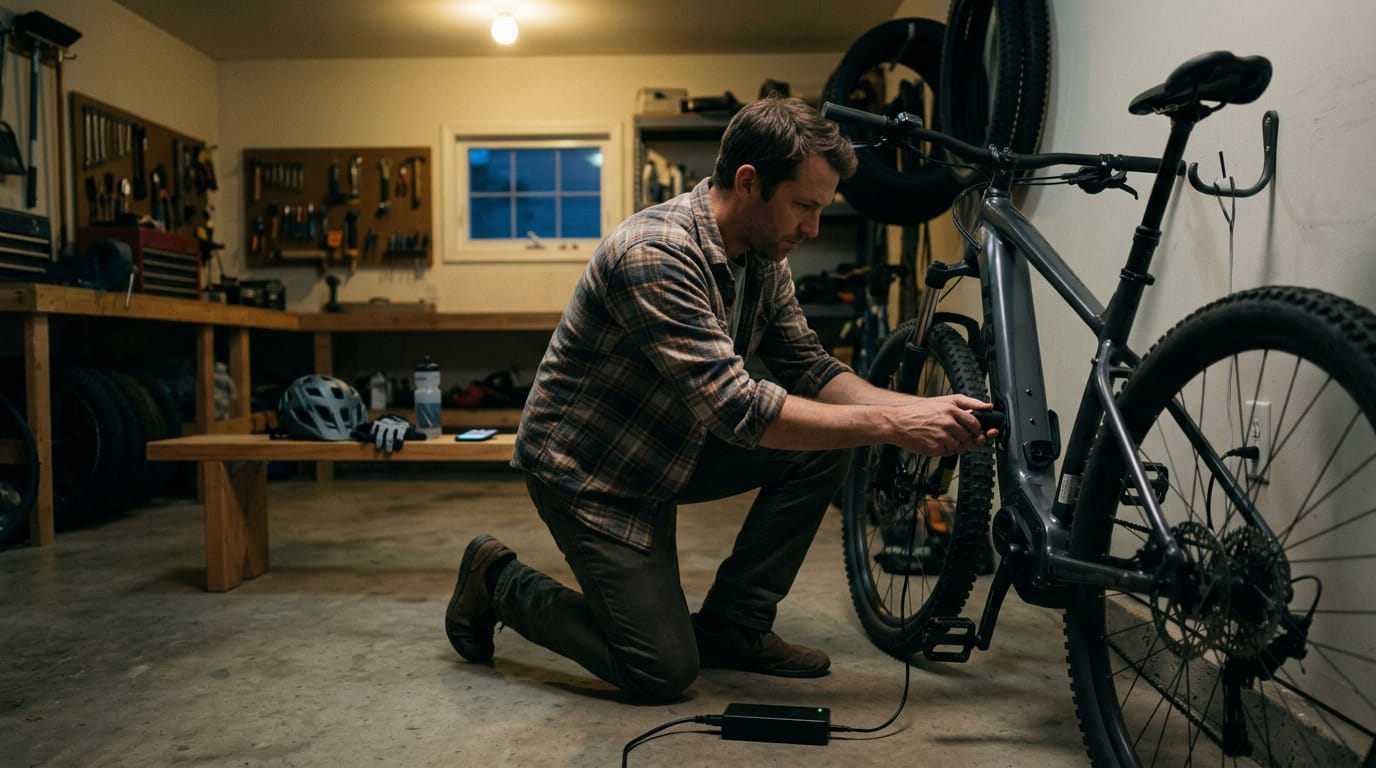
You can charge the battery on the bike, or remove it and charge it separately, since the battery is easily removable. The port sits on the right side of the case, so it’s within reach either way.
Think of a parent whose teenager rides the e-bike to practice. Charging the battery at the kitchen counter lets the bike stay parked in the garage, and the battery is ready for the next ride.
Winter storage is where the removable battery earns its keep. Pull it off, bring it indoors, and follow the manufacturer’s storage guidance for charge level and how often to top it up while the bike sits. Don’t guess on this one.
Battery and charger specs at a glance
- Battery: 36-volt, rated at 11.6 amp-hours (Ah), a measure of charge capacity, and 418 watt-hours (Wh), a measure of total energy.
- Cells: Samsung cells, the individual units that store energy inside the pack.
- Charger: 36-volt, 2-amp, the rate at which it sends current into the battery.
- Range: Up to 50 miles per charge. Treat that as a ceiling, not a promise.
Comfort, Included Extras and Storage
The details you’ll notice after the first ride decide whether the bike gets used.
Why the ride feels comfortable
The step-through frame lets you get on without swinging a leg over a high bar. You sit upright rather than hunched over the bars, so your neck and wrists carry less strain on a long ride.
The ergonomic saddle and grips target the spots that get sore first, and the wider tires feel more stable underneath you.
Think of a parent riding alongside a kid’s bike to practice, able to watch ahead and chat instead of craning forward. Check frame size against your height in the shop before you buy.
A frame that’s too big or too small fights your comfort, no matter how good the saddle is. Comfort keeps the bike in use.
Accessories that come with the bike
Several extras come standard:
- Fenders and rack. Fenders keep road spray off your back, and the rack is ready for gear.
- Front and rear lights. They help drivers and pedestrians spot you on dusk rides.
- Integrated horn. It’s built in, so you can warn someone without reaching for a separate bell.
- No accessory upcharge. You won’t pay extra to add any of them.
Carrying loads and storing it easily
The rear rack works with a child seat. A study on child safety in bicycle-mounted seats considered rear-rack mounting alongside other setups, so researchers have looked at that setup directly. Check the seat’s manual for weight limits.
The rack carries up to 55 lb. Picture a weekend player riding to the court with a gym bag and a water jug on the rack instead of on their back. Folding handlebars and pedals make the bike easier to tuck into a garage corner or apartment hallway.
Puncture-resistant tires and safety extras
The bike rides on puncture-resistant Goodyear tires, which helps you avoid the flat that ends a ride before it starts.
- Reflective side strips. They make you visible from the sides, not just the front and back.
- Tire pressure sensors. They help you catch low tires before they make the ride feel sluggish.
Good safety gear is the kind you forget about until you need it.
What Reviews Say and Where to Buy
Before you spend money, check what reviewers say and where the model you want is sold.
What experts think and how it scored
Start with first ride reviews, which describe how a bike feels under real pedaling: how it starts, climbs and handles. Then look at the lab-tested overall score, a single number for comparing models side by side.
A high score makes a bike a very good overall choice, but not automatically the right one for you. Use the score to shortlist and the ride reports to decide.

Prices and where you can buy it
Model price listings give you a starting point, so compare the same model across sellers. Check each retailer’s:
- price
- return policy
- setup help
Watch for limited distribution, meaning only a few shops or sites carry the bike. If it’s hard to find nearby, try a test ride first if you can.
Buying guides for comparing and choosing
Best electric bikes roundups show what’s on the market, and budget e-bike guides focus on value. Choosing the right e-bike starts with how you’ll ride it.
Think of a parent who pedals a few miles to the train each weekday and takes the kids to the park on Saturdays.
A comfortable, easy-to-stop model that’s light enough to lift onto a rack suits the commute, and it gets ridden every week instead of collecting dust by midseason. For weekend rides, put comfort and handling first.
So what are the cons of an electric bike? The upfront cost is higher, the extra weight makes lifting harder, and the battery needs regular charging and will eventually wear out.
Range also shrinks on hills, into headwinds and at higher assist levels, so the advertised figure is a best-case number, not a guarantee. Know these going in.
Manuals and Help When You Need It
Before you plug anything in, a few reference pages can save you a lot of guesswork. Here’s where to look first, in the order that saves you the most time.
Related help articles to read next
- Owner’s manual. This is the authority on your specific bike, so read it before the first charge, not after something goes sideways.
- Model-specific charging guides. Charging details can vary by model, so match the guide to your exact bike rather than a general tip from a forum.
- Removing the battery. If your model’s battery comes out, check the steps before you take it off the frame and bring it inside to charge.
- Walk assist mode. This low-speed setting is meant for pushing the bike alongside you, not for riding. Check your manual to see how your model turns it on.
Consider a weekend rider who just bought her first e-bike and wants to top it off in the garage before Saturday’s trail ride. A quick read of the manual the night before means she plugs in the right way and rolls out on time.
Five minutes with the paperwork beats a surprise at the trailhead.
Choosing a Charge e-bike comes down to three things: the model that fits your riding, a charging routine you’ll actually keep, and a purchase you still feel good about after the first few rides.
Match the bike to your routes and your reality, and let the storage and extras make daily use easier.
Think of it like a good pair of running shoes: once they fit, you stop thinking about them and start enjoying the miles. The right e-bike should disappear under you the moment the ride starts, and that’s exactly what you’re shopping for.
References
- CHILD SAFETY ON VARIOUS BICYCLE-MOUNTED SEATS DURING VEHICLE IMPACT — doi.org (2019)
- Charge Comfort Ebike Review — roadbikerider.com (2025)
- Industry Insider: Charge Bikes and Fabric — pinkbike.com (2014)
Questions
What are the cons of an electric bike?
Common drawbacks of an electric bike include a higher upfront cost, extra weight that can make it harder to lift, and the need to charge and eventually replace its battery. Its range also decreases on hills, in headwinds, and when using higher levels of pedal assist.
How do I charge my electric bike?
Use the charger specified for your bike and battery. For the described Charge battery, place the charger on a stable surface, plug it into a wall outlet, wake the battery with its power switch, then connect the charging plug to the battery port and close the port cap afterward. The battery can be charged on or off the bike; its charger light is red while charging and green when full, and a full charge takes about three hours.
Are charge bikes any good?
Charge bikes offer options for different uses: Comfort models for paved paths, City models for commuting and errands, and XC models for cross-country trails. The tested bike had strong acceleration and good braking, and pedaled easily with the assist off, though its tested range was described as mediocre. Whether one is a good choice depends on how well its model, fit, and range suit your rides.
Who owns charge bikes?
Charge began in 2005 in southwest England, with roots that include making Schwinn bikes. The information available here does not identify a current owner, so check Charge Bikes’ official company information for its present ownership.
Which is the best charger bike?
The best Charge bike depends on where and how you ride. Choose a Comfort model for relaxed paved rides, a City model for commuting and errands, or an XC model for dirt trails and rougher ground; compare fit and handling before deciding.
Sources
- Charge Comfort Ebike Review – Road Bike Rider Cycling Site, roadbikerider.com,
- Industry Insider: Charge Bikes and Fabric - Pinkbike, pinkbike.com,
- CHILD SAFETY ON VARIOUS BICYCLE-MOUNTED SEATS DURING VEHICLE IMPACT, doi.org,
Find your level
The Counter