Pickleball Rules Explained, From Serve to Scoring
Pickleball rules make more sense when you know the legal serve, scoring order, two-bounce rule and kitchen limits before your first game.

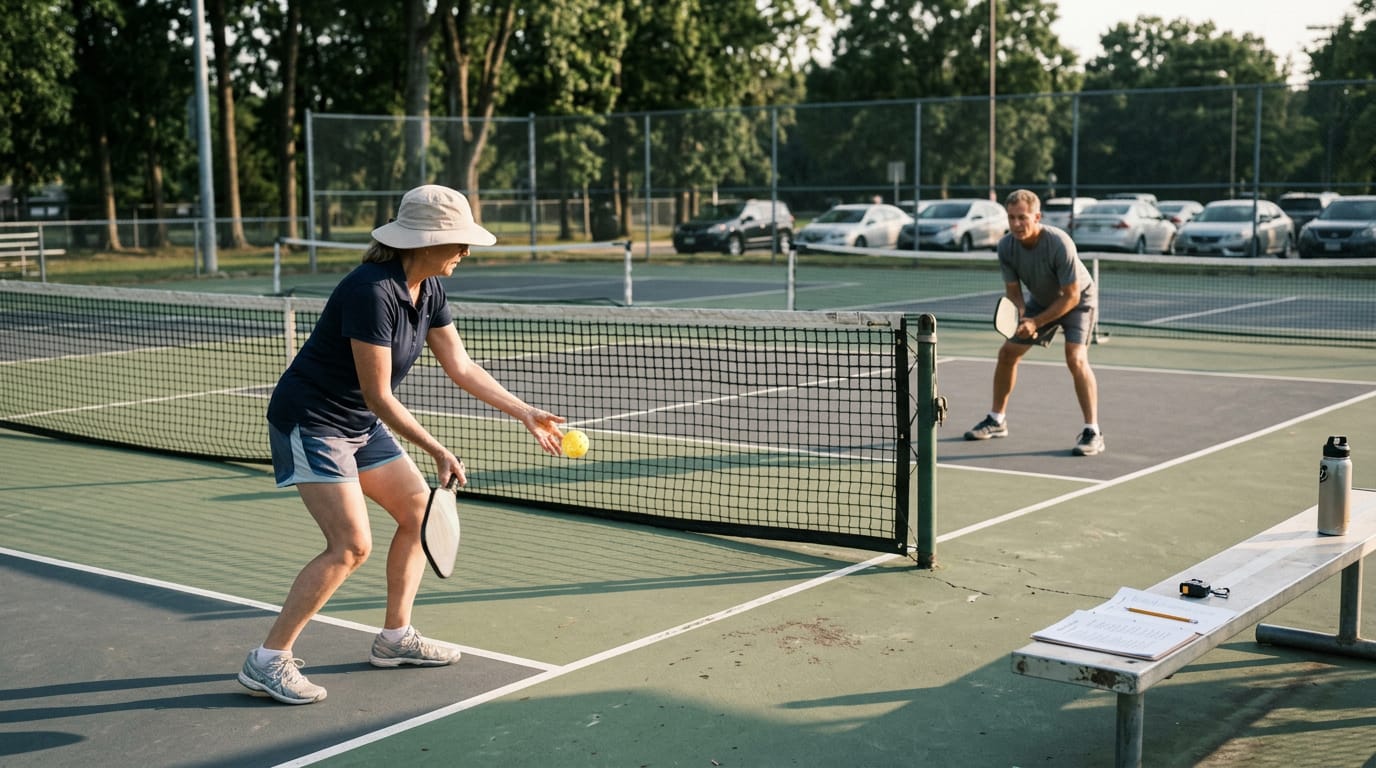
Ever tried to join a pickleball game and felt like everyone else had a rulebook you never saw? You’re not alone.
The game looks simple from the sidelines, but a few rules about serving, scoring and where you can stand trip up plenty of players who’ve swung a racket for years.
In this post, we’ll walk through the rules in a logical order: court and serve first, then scoring, faults and line calls. We’ll finish with a gear-aware look at paddle and ball legality, plus what a new player should actually buy before the first game.
The Basic Pickleball Rules and Game Format
Before you can score a point, you need to know how a game is set up. For a sanctioned match, check the 2026 rule changes in the official rulebook, since the exact wording is what counts on court.
Choosing between singles and doubles
Most games are doubles, with two players on each side. Singles puts one player on each side, and the court and rules stay the same as doubles. Only the workload changes. In singles you cover all of the court, and in doubles you cover half.
Think of a parent who plays Saturday mornings with their teenager. In doubles, each one takes a side, so neither spends the hour sprinting corner to corner.
Whichever format you pick, keep these gear basics in mind:
- Approved gear: confirm your paddle and ball are on the approved list.
- Beginner paddle: choose one that feels comfortable in your hand.
- Court shoes: pick a pair built for quick side-to-side steps, not straight-line running.
How the court is laid out
Three court details matter first:
- Court size: 20 x 44 feet
- Kitchen: extends 7 feet from the net on each side
- Full-court play: singles uses the whole court
The kitchen is one of the five core rules, and we’ll walk through the rest in the sections that follow.
Picking who serves first
Any fair method works, as long as both players accept it. For example, two friends about to start a match flip a coin: heads, the first player serves; tails, the other does. The call takes seconds, so the match starts on the court instead of in a debate.
Once you know who serves, the serve rules come next.
Rules for a Legal Serve
Every rally starts with a serve, so getting yours legal from the first shot saves a lot of trouble. Here’s what we’ll cover: your motion, the optional drop serve, your feet, and where the ball has to land.
What makes a serve motion legal
Your serve has to be an underhand stroke, with the paddle moving upward through the ball. Two more limits shape the swing:
- Contact below the waist. The rules define your navel as your waist, so contact has to happen below your belly button.
- Paddle head below the wrist. The head of the paddle stays below your wrist when you make contact.
Using the optional drop serve
The drop serve is optional, not required. According to Sports Rules Explained, the drop serve was added as a provisional rule in 2021 and made permanent in 2022. When you use it:
- Drop, don’t toss. Let the ball fall from your hand rather than toss it upward.
- No paddle motion limits. Unlike the standard serve, the drop serve doesn’t restrict how you move the paddle.
Where your feet must stay on serve
Your feet are the easiest part to get wrong. The official USA Pickleball rulebook defines the serving area as the space behind the baseline and on and between the extensions of the centerline and each sideline. In practice:
- Behind the baseline at contact. Both feet stay behind the baseline when the ball is struck.
- No touching court early. Your feet can’t touch the court before contact.
- Within the sideline extensions. Both feet stay inside the imaginary lines running out from the sidelines.
Take a weekend player at her first league night who keeps stepping in just before she swings. Once she holds her stance behind the baseline, her one serve attempt counts instead of getting wasted on a footing call.
This rule was part of a 2007 rule change, so older guides may word it differently. Easy to miss, easy to fix.
How many tries and where serves land
Your serve goes crosscourt, not straight ahead, landing in the service court diagonally across from you.
- One attempt per server. You get one try, with no second serve to fall back on.
- Watch the kitchen. The kitchen line is the short line nearest the net, and a serve that lands between it and the net doesn’t count.
- Let serves are now playable. A serve that clips the net and still lands correctly stays in play.
Calling the score before you serve
Call the score out loud before you serve, not after the ball is in the air.
- Call the server’s score first. Your team’s score comes before the other team’s.
- Include the server number. Add your server number so everyone knows whose serve it is.
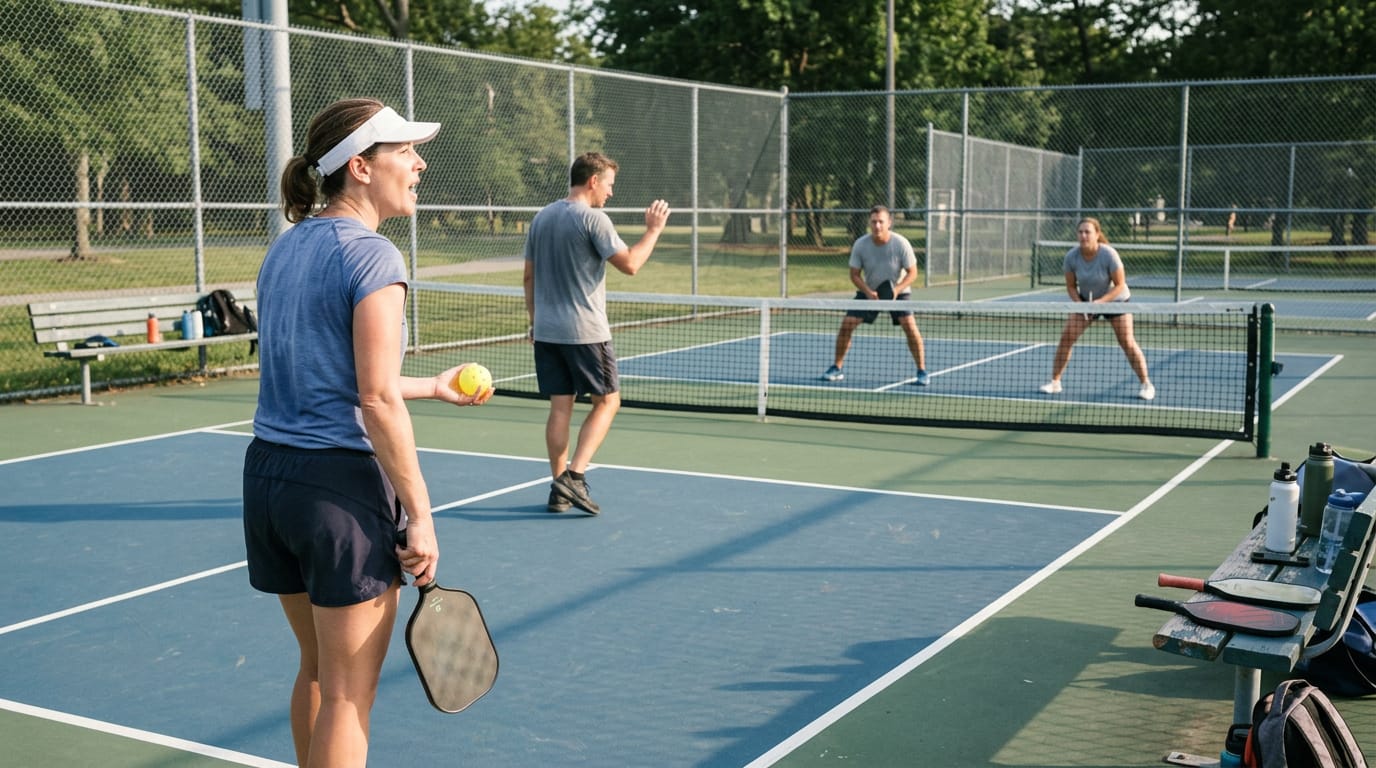
Who Serves Next and in What Order
Serving order trips up a lot of new players. Once you know the pattern, you’ll stop wasting the first rally sorting it out.
How doubles partners rotate serves
Doubles adds a partner, so keep these four rules straight:
- Both partners serve. Each player gets a turn before the serve passes to the other team.
- The first server starts right. That player begins from the right side.
- Servers switch sides after points. When your team wins a point, you cross to the other side for the next serve.
- Receivers never switch sides. Whoever is receiving stays put on their side of the court.
Picture Dana and her teenage son, Marcus, on a club doubles court. When Dana wins a point from the right, she crosses to the left for her next serve. Nobody has to ask, and the game keeps moving.
Why only one player serves first
Only one player serves at the start of the game, which catches plenty of people off guard. That first server hits the opening serve alone.
Once that server commits a fault, the partner takes over, and from then on both team members serve before the ball goes to the other side.
Consider Lena on her first doubles night. She knows the opening serve is hers alone, so she steps up without waiting for a cue from her partner. The rally starts on time, and nobody stands around wondering who’s up.
Which side to serve from in singles
In singles, the score tells you where to stand. Even scores serve from the right, and odd scores serve from the left. Serving at 4? Start on the right. Win the point to reach 5, and you move to the left.
The receiver adjusts position to match the server’s side, so they’re ready for the serve coming from that direction.
When the other side gets serve
The serve passes to the other side whenever the serving team commits a fault. When that happens, their first serve comes from the right side.
Picture Ana and Ray on the same club court. Ana’s serve sails into the net, which is a fault, and suddenly Ray’s team has the ball. Ray steps to the right side for his first serve. Same rule, every time.
How Scoring Works in a Match
Scoring trips up plenty of new players, but it follows clear logic once you see it. We’ll walk through points, games, matches and court position in that order.
How points are won and lost
The golden rule of pickleball is that only the serving team can score, and everything else builds on it. Faults decide what happens next:
- Server fault: the server loses the serve, and the other team takes over.
- Receiver fault: the serving team gets the point.
Think of a weekend player on a Saturday rec league team who serves deep and watches the other side’s return sail long. That’s a receiver fault, so the point goes to their team without anyone hitting a winner.
Sometimes the other side just hands you the point.
How many points wins a game
A game normally goes to 11 points, but you have to win by two. So 11-10 isn’t over, because you need a two-point lead to finish. Tournament games play to 15 or 21, and consolation games play to 15.
Best of three and switching sides
Matches are best 2 of 3, so the first team to win two games takes it. Teams switch sides after the first game, and in the deciding third game they switch at 6 or 8 points. The match goes to whoever wins games, not whoever stacks up the most points.
Picture a club doubles team that drops game one, then wins games two and three. They take the match 2-1 even after losing game one. Game one isn’t the match.
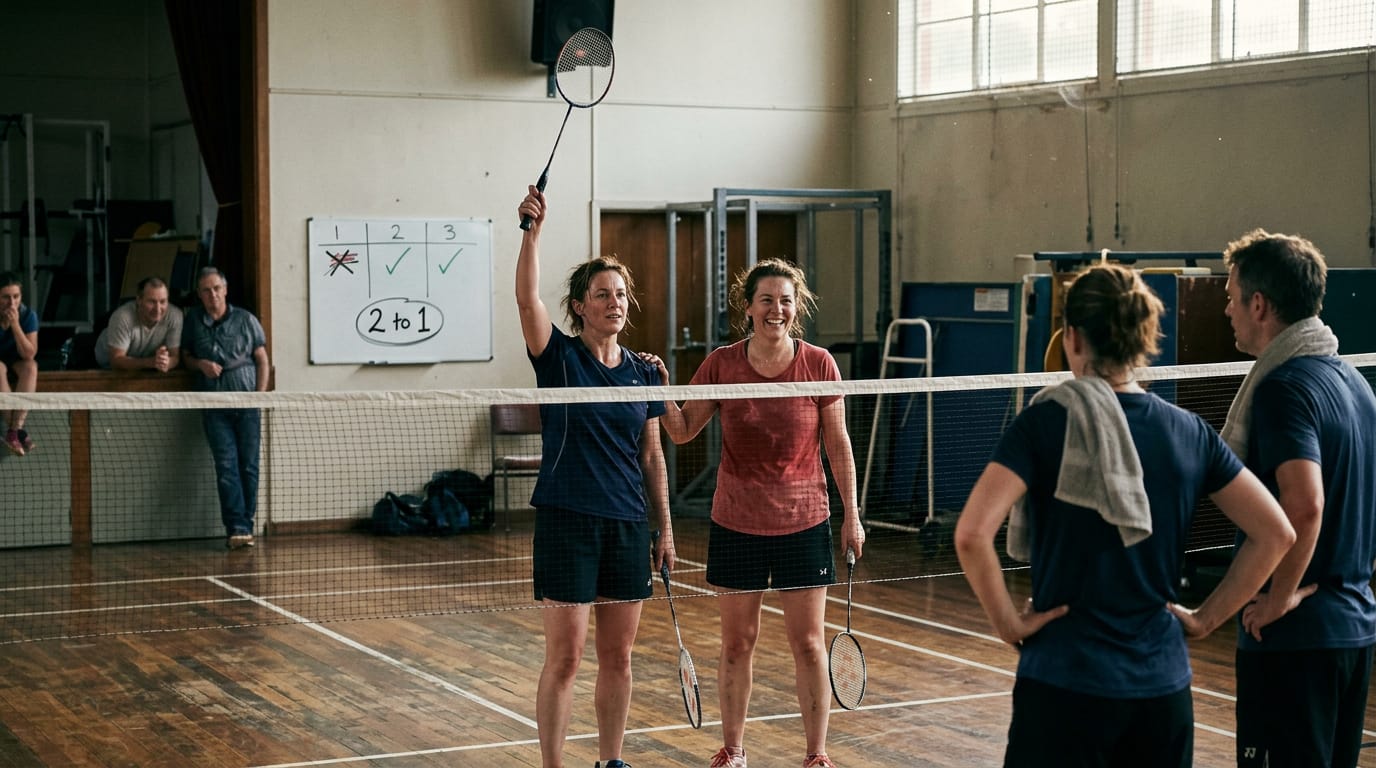
How the score sets your court position
The score tells you where to stand, not only how you’re doing. With an even score, the serving team serves from the right court, and with an odd score, it serves from the left.
In doubles, you call a three-number score before each serve: the serving team’s score, the receiving team’s score, and which server is serving. Consider a parent teaming up with a partner in a rec league match.
Before each serve, the server calls all three numbers, the partner nods, and nobody argues mid-rally about whose turn it is. The match keeps moving.
Why Every Rally Starts with Two Bounces
Pickleball’s two-bounce rule trips up plenty of new players, but the reasoning behind it makes it click.
How each side takes its bounce
Every point opens the same way:
- The receiver has to let the serve bounce, not hit it on the fly.
- The server then has to let the return bounce too.
- Only after both bounces are volleys allowed, meaning you can hit the ball out of the air before it touches the ground.
Think of a weekend player at her first doubles night, with a booming serve and a habit of charging the net. Under this rule she can’t volley the return the instant it comes back.
She has to wait for the bounce, and that small pause changes how the whole point plays out.
Why the bounce rule exists
The rule does three jobs:
- Removes the serve-and-volley advantage. Without it, a strong server could follow the serve straight to the net before the receiver ever got set.
- Extends rallies. Both sides have to play the ball off a bounce before they can attack, so points last longer.
- Gives fair reaction time. Everyone gets a moment to read the ball and respond, so the point turns on placement and patience rather than who’s quickest at the net.
That’s the whole idea, and it’s a good one.
Singles follows the same bounce rule
Singles doesn’t change a thing. The same sequence applies: the receiver lets the serve bounce, the server lets the return bounce, and then volleys are allowed. The good news? You only have to learn it once.
Staying Out of the Non-volley Zone
The net is where this rule bites hardest, so learn it early. Here’s where the zone sits and how momentum can cost you a point.
How deep the kitchen zone runs
The non-volley zone, called the kitchen, reaches 7 feet back from the net on each side. It includes the line itself, so a foot resting on the line counts as being inside.
Don’t volley while standing in the kitchen
A volley is any shot hit before the ball bounces. When you volley, keep your feet behind the line, since that’s what stops players from smashing down from right at the net. The rule is about volleying from the kitchen, not standing there.
You’re free to stand in it otherwise, so step in to play a ball once it has bounced.
Court shoes help with the footwork. Consider a dad who kept drifting into the kitchen in running shoes. Once he switched to court shoes, he could stop right where he meant to.
When momentum or gear causes a fault
Momentum is the sneaky one. If your body carries you into the kitchen after a volley, that’s a fault, even if you didn’t mean to step in. Your paddle, clothing, and hat count too, so touching the kitchen with any of them counts just like a foot.
The fault still applies after the ball is dead, so don’t assume a stopped rally wipes it out. Jumping across the zone is legal, though, so a leap over the line isn’t a fault on its own. Slow down before the line.
How Faults and Line Calls Work
Every rally ends with a winner or a fault, and knowing which plays count keeps the game moving.
Which plays count as a fault
- Out of bounds: the ball lands outside the court.
- Into the net: a shot or serve hits the net and fails to clear it.
- Volleying before bounces: you hit the ball out of the air before it bounces once on each side, or you volley while touching the kitchen, the no-volley zone by the net.
- Missing the ball: a swing that never makes contact counts against you.
- Wrong service area: serves travel diagonally into the opposite service court, so serving from the wrong side or box is a fault.
What counts as in or out
Lines are in. A ball that lands on a line is in, not out. On a serve, the ball has to clear the kitchen line. If it lands short, inside the kitchen, it’s a fault.
Each side must let the ball bounce once before anyone volleys, so the serve and the return both land first. That’s the two-bounce rule. Learn it early.
Most casual games are self-officiated, so you make your own calls. When you’re unsure, give the point to your opponent, and keep it friendly, not heated.
What happens after a fault
- Server loses serve: a serving fault ends your turn on serve. In doubles, your partner gets a serve before the team loses it.
- Receiver fault gives point: if the receiving side faults on a return, the serving side wins the point.
- Instant side-out in singles: with no partner to pass to, a fault ends your serve on the spot.
Think of a weekend player in her first singles match who serves into the net. The serve flips right away, so she can reset and move on.
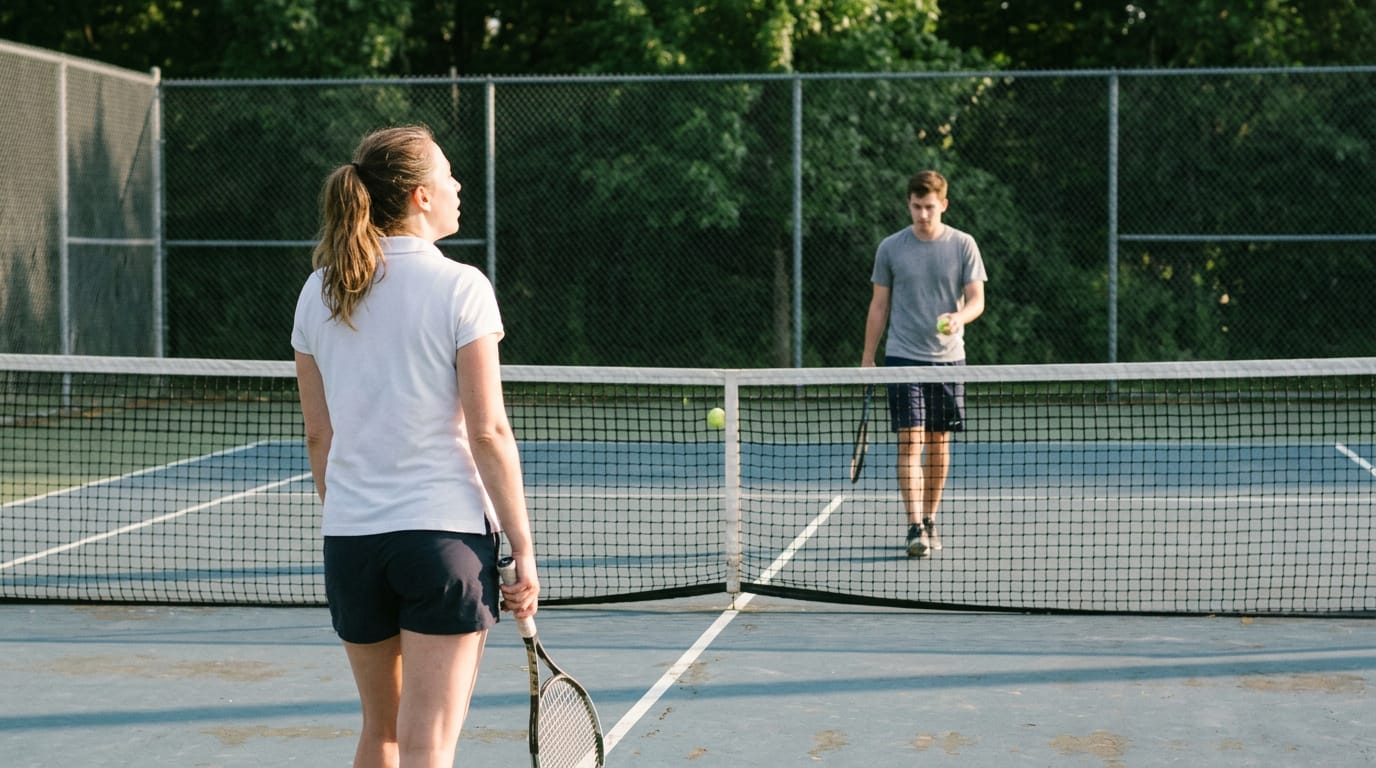
Singles Rules and Smart Strategy
Singles is one player against one player, so a few parts of the game shift while the core rules stay put. Here’s what changes on serve, footwork and strategy, and what stays the same.
Only one player serves in singles
- No second server. In doubles, a fault can hand the serve to your partner. In singles, a fault simply passes it to your opponent.
- Faster pace. With one player per side, points tend to move quickly, so be ready from the first shot.
- Serve until fault. The server keeps serving while winning points, until a fault hands the serve over.
Why covering the court is harder
In singles you cover the entire court yourself. Think of a club player who’s comfortable in doubles and steps onto a singles court for the first time. Every lunge and recovery is hers, and her legs feel it more than she expected.
A study of fatigue after singles tournament play suggests singles may be more tiring than doubles for this reason: each player has to cover the court without a partner. Expect a tougher workout.
Because you’re alone at the net, expect your opponent to aim a passing shot past you. Watch their paddle and shift toward the open side early.
Tactics that help in singles
- Deep serve. Hit it deep so your opponent returns from near the baseline, giving you time to move up.
- Drop serve. A soft serve that lands near the kitchen takes pace off the return.
- Skinny singles practice. Play singles on a narrower part of the court so every shot lands in a tighter space, which sharpens your accuracy.
Aim for placement rather than power, especially on your serve.
Must you let the return bounce in singles?
Yes. Just as in doubles, you have to let the return bounce. Here are the three points that govern it in singles:
- One serve per turn. Each turn gets one serve, with no second try if it misses.
- Same bounce rule. The serve and the return must each bounce before either player can volley.
- Same kitchen rules. The kitchen, or non-volley zone, is the area beside the net where volleying is off limits. You can’t volley while standing in it or touching its line, and that holds in singles too.
Adaptive and Wheelchair Play Rules
Adaptive play keeps the same basic game but adjusts a few rules for wheelchair players. Here’s what changes with the bounce, at the net, and in tournaments.
How bounce and court sizes differ
Adaptive play can change the bounce rule. Players may allow two bounces before returning the ball, which gives everyone more time to reach a shot.
Think of a club player chasing a ball toward the sideline. With two bounces instead of one, the point doesn’t end before they get there.
A larger court is recommended so chairs have room to maneuver, and stadium court dimensions are worth checking before you arrive.
Wheelchair serves and kitchen contact
The kitchen is the non-volley zone beside the net, where you can’t hit a volley, a shot struck before the ball bounces.
- At the serve, rear wheels stay behind the baseline, the back line at each end.
- Front wheels may touch the kitchen, but rear wheel contact there restricts your volley.
- Your chair counts as part of your body, so track the wheels near the net.
Picture a weekend player rolling up for a soft shot at the kitchen line. Her front wheels can touch the line, but if the rear wheels drift over it, that shot can’t be a volley. Wheels count.
Playing in tournaments with standing partners
Adaptive events run in singles and doubles. Players can also team up with standup partners, so a wheelchair user and a standing player can compete together.
Say a wheelchair user and her standing friend enter doubles together. Both play under the adaptive rules above, so they can map out positioning around the kitchen before the first serve. Sort out the rules together before you play.
Once the basics click, pickleball gets a lot more fun. Knowing who serves, how points are scored and when a fault happens lets you focus on your rallies instead of pausing to check the score.
Pair that knowledge with a legal paddle and ball, and you’re ready for your first game. You don’t need every gadget on the shelf, just gear that fits how you play.
Good rules keep the game fair, and the right gear keeps you in it. Learn both, and the court is yours.
References
- Measuring Neuromuscular Fatigue After Singles Pickleball Tournament Play — doi.org (2025)
- usa pickleball official rulebook — brightspotcdn.byui.edu
- Pickleball Rule Changes Over the Years — sportsrulesexplained.com (2026)
Questions
What is the golden rule of pickleball?
The golden rule of pickleball is that only the serving team can score a point. A fault by the serving team ends its turn on serve, while a fault by the receiving team gives the serving team a point.
What are the 2026 new pickleball rules?
The 2026 rule changes depend on the official USA Pickleball rulebook for the exact current wording. Check that rulebook for the changes that apply to sanctioned play; rules such as the playable net serve and optional drop serve are already in use.
What are the five rules of pickleball?
Five core pickleball rules are: only the serving team scores; serves are underhand and land diagonally beyond the kitchen; each side must let the ball bounce once before volleys are allowed; players cannot volley while touching the kitchen or its line; and a game is normally played to 11, win by two. These basics apply in both singles and doubles.
Do you have to let the return bounce in pickleball singles?
Yes. In singles, the server must let the return bounce before hitting it, just as in doubles. The two-bounce rule requires the serve and the return to bounce before either player may volley.
Sources
- Pickleball Rule Changes Over the Years | Sports Rules Explained, sportsrulesexplained.com,
- usa pickleball official rulebook, brightspotcdn.byui.edu
- Measuring Neuromuscular Fatigue After Singles Pickleball Tournament Play, doi.org,
Find your level
The Counter