Tennis Terms Explained in Plain English
Tennis terms decode courtside calls, scoring, court lines, shots, slang and gear in plain English. See what also carries over to pickleball and padel.


Ever sat courtside and heard someone shout deuce while everyone else nodded along? Tennis has its own language, and it can feel like a menu written in another tongue when you’re just trying to order.
Here’s the straight answer: this is a plain-English A-to-Z of tennis terms, covering scoring, serving, shots, court lines, slang and equipment.
We’ll also show how those words and court dimensions carry over to pickleball and padel, so newcomers and gear buyers can follow all three.
Tennis Terms for Court Lines and Areas
Before you learn the lines, know the space beyond them.
Court dimensions are specified separately from the run-off space around the court: the International Tennis Federation (ITF), as laid out in Playmore’s guide to tennis court dimensions, gives recommended minimum distances from the lines to the fence or wall.
So how much space do you need to make a tennis court? More than the lines alone.
Where the baseline and service line sit
The baseline is the back boundary at each end. The service line marks the front of the service box, and the backcourt is the zone between it and the baseline. Serves start behind the baseline, so stepping on or over it before you hit is a fault.
Picture a weekend player who keeps creeping forward on serve. Once she stays behind the baseline, her serves count. Stay behind it.
Doubles alleys and the sideline difference
The strip between the inner and outer sidelines is the doubles alleys. The inner line is for singles and the outer line is for doubles, so the court changes shape with the match.
That wider court adds strategy, since you and your partner have to split the ground. A club pair who learns the alley is in play stops backing off wide shots and starts chasing them down.
A pickleball court has its own dimensions, so its lines won’t line up with a tennis court’s. Can you play it on a tennis court? Yes, but you’ll be working around lines that weren’t drawn for pickleball.
For exact measurements, check the official pickleball rulebook before you mark anything.
Dividing the court at net and center
The net splits the court into two halves, and every rally has to cross it. It sits lower at the center than at the posts, so the middle is where a ball has the least room to clear.
The center mark splits each baseline in half and tells you which side to stand on for a serve. Show a new player that mark first, and they’ll stop guessing.
The tricky no man’s land zone
No man’s land is the stretch between the service line and the baseline, and it’s one of the hardest places to hit a good shot. Balls that land there tend to be awkward, so you want to move forward or back, not stay put.
Picture a weekend player who always stops at the service line to hit. Once she steps back to the baseline or up to the net, her shots get cleaner. Don’t camp there.
The Words You Hear About Serving
Serving is the only shot you start on your own, so most of the confusing rules live right here. Here’s what we’ll walk through, term by term.
How the server and receiver take turns
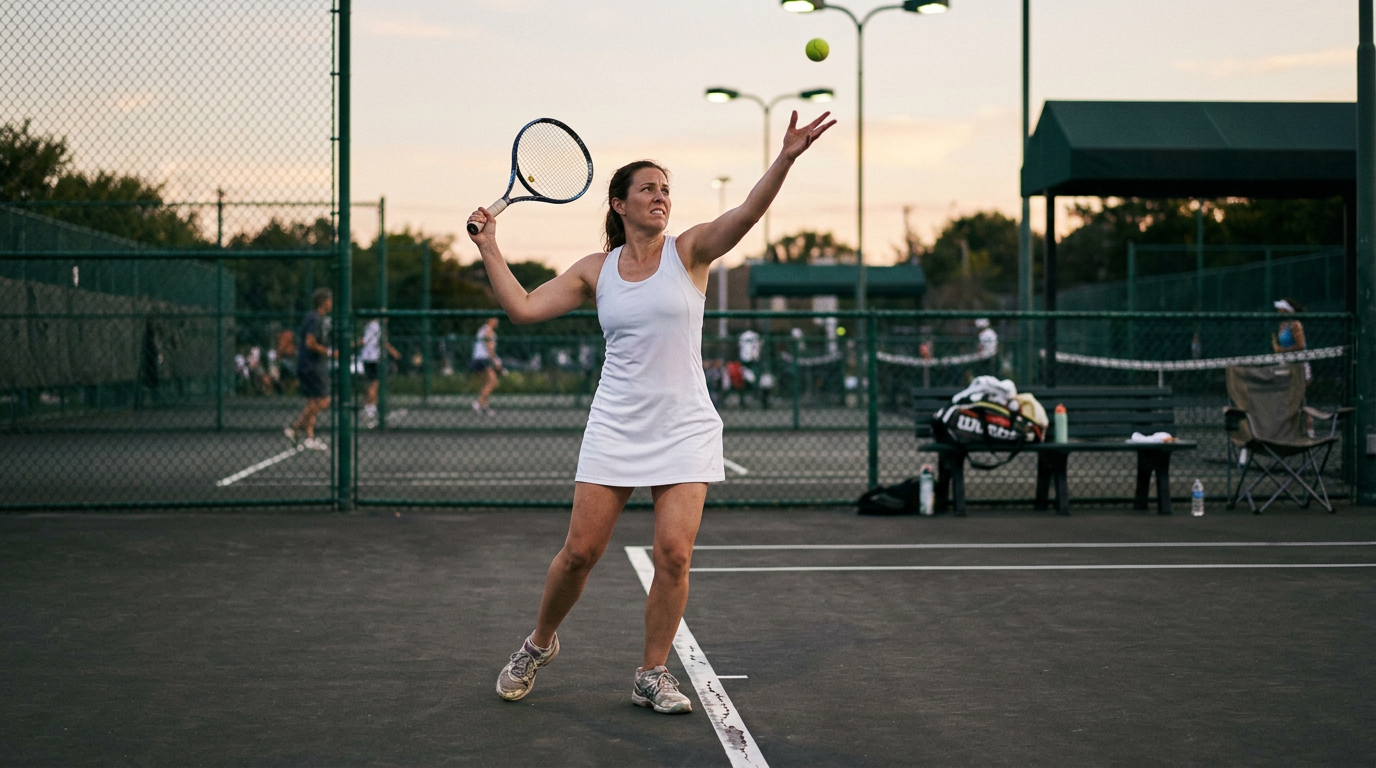
Every point starts with a serve. The player hitting the ball is the server, and the player waiting to return it is the receiver. The server gets two serve attempts on each point, so a miss on the first try still leaves you a second chance.
Serving duties switch after every game, so the player who served first receives in the next one.
Serves that count as faults
A fault is any serve that breaks the rules, and one fault just means a second try. Here’s what typically counts:
- Foot fault. The server steps on or over the baseline before hitting the ball.
- Net fault. The serve hits the net and doesn’t land in the correct service box.
- Missed or out-of-bounds serve. The ball misses the service box or lands outside the lines.
- Double fault. Two faults in a row, which loses the point.
Think of a weekend player at her first club night who keeps stepping over the baseline during her toss. Each one costs her a point she could have kept. Once she plants her feet behind the line, those easy points stop disappearing.
Aces, lets and replayed points
An ace is a serve the receiver never touches, and it wins the point outright. Few things end a point faster.
A let is different. When a serve clips the net and still lands in the correct box, it’s a let, and the serve is taken again. No point is awarded on a let. It’s a replay, not a lost point.
Interference works the same way: if something outside normal play, like a stray ball, disrupts the point, it’s replayed.
Serving from the right or left court
Your serving spot depends on the score. The deuce court is the right side of the court, and the ad court is the left. The name is confusing, since the deuce court has nothing to do with a deuce score.
When the total points played in the game is even, the server uses the deuce court. When it’s odd, the server moves to the ad court.
Every serve has to land in the diagonal service box, not the one straight ahead.
What are the three types of serves?
The three main types of tennis serves are the flat serve, the kick serve, and the spin serve. Here’s the quick version:
- Flat serve. The fastest and most direct, with little spin.
- Kick serve. Heavy topspin that makes the ball bounce high.
- Spin serve. Curves the ball so it bounces off the expected path.
Tennis Scoring from Point to Match
Tennis scoring looks odd at first, but it’s one clear ladder from a single point to a full match.
How points climb from love to 40
In tennis, love means zero, so a player with no points is at love. Each point moves up one rung: 15, 30, then 40. Picture a parent watching a Saturday club match, trying to follow the scoreboard.
A call of 30-15 means the server has 30 and the returner has 15, because the server’s score is always called first, even when it’s the smaller number. When the scores match, it’s called all, so 30-30 becomes 30-all.
The origins of love and the 15-30-40 progression are disputed, but BBC Bitesize says the 15, 30 and 40 scores most likely date back to the French court of the 15th and 16th centuries.
Winning from deuce, advantage or no-ad
At 40-40, the score is deuce, and you need two points in a row to win. Win one and you have advantage, shortened to ad on the scoreboard. Win again and the game is yours; lose it and you’re back at deuce.
A game is decided by two clear points, not one lucky bounce.
Advantage for the server is ad-in; for the returner, it’s ad-out. Some club and recreational formats use no-ad scoring instead, where the next point at deuce decides the game. It’s quicker, which keeps a busy club night on schedule.
How games stack into sets and matches
Here’s how the levels stack up:
- Game: first to four points, and you must lead by two.
- Set: first to six games, and you must lead by two.
- Match: best of three or best of five sets, so the first to two or three sets wins.
At 6-all, a tiebreak to seven points, won by two, usually settles the set. Some events skip it in the final set, which runs until one player leads by two games.
Break, set and match points under pressure
A break point gives the returner a chance to win the server’s game. Win it and you’ve earned a service break. Taking someone else’s serve is a different job from holding your own.
Set, match and game point each sit one point from a win, which is where nerves tend to show. Being up a break means leading by one service break, and on serve means holding your own games.
Players switch ends after every odd-numbered game, a short changeover to towel off and reset.
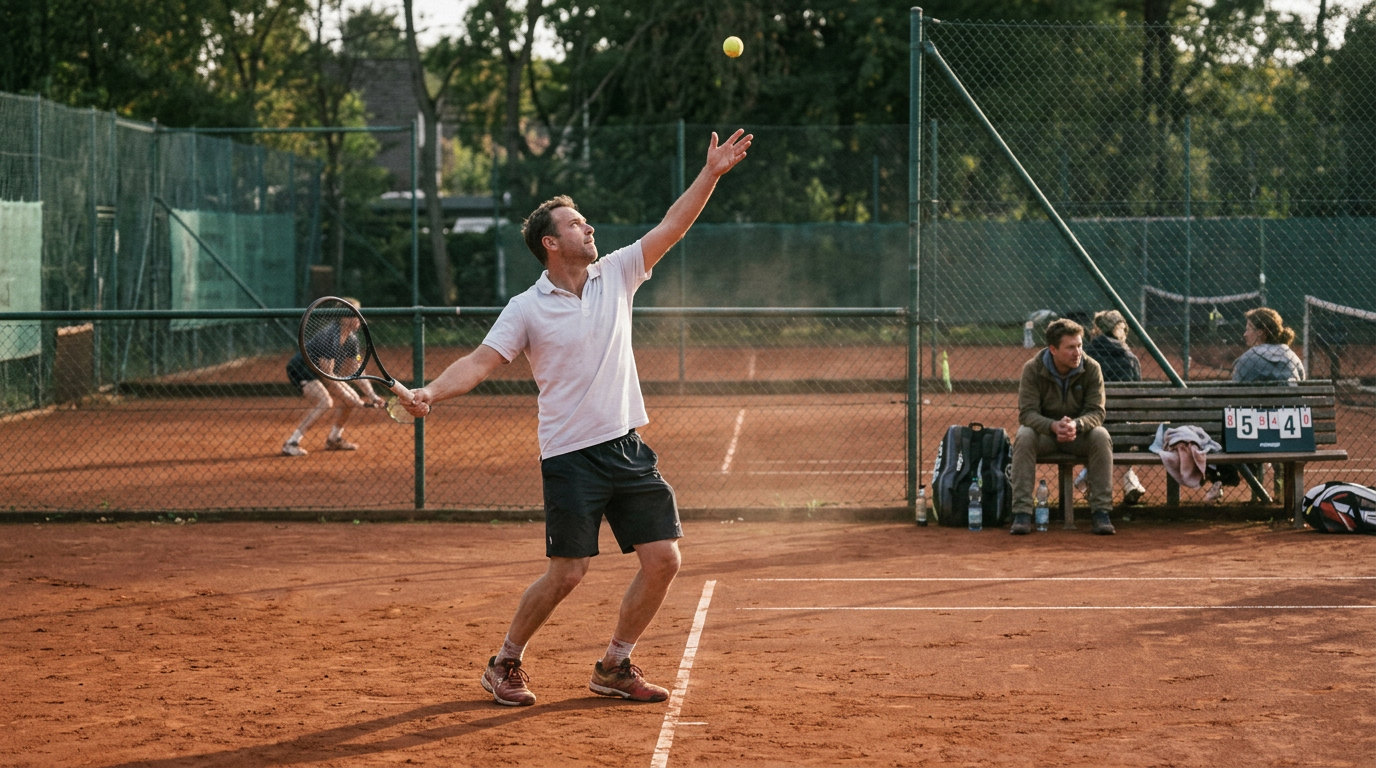
Picture a club player serving at 5-4 in the first set, where one more game settles it. Knowing which points matter keeps the nerves in check.
Funny names for lopsided set scores
A bagel is a 6-0 set, where the loser wins no games. A breadstick is a 6-1 set, where the loser wins just one. A double bagel is a 6-0, 6-0 match, so the loser takes zero games overall.
A new club player who loses 6-0 can laugh off the bagel, shake hands and ask what worked on the other side of the net.
Scoring’s origins and how long matches run
Modern tennis traces back to jeu de paume, an earlier racquet sport. Tennishistory.com places its roots in the enclosed corridors of medieval France.
One proposed explanation for 15-30-40 is the clock-minute theory, and BBC Bitesize describes it as clock faces used to record the score on court.
Matches often last hours, so a parent heading to a tournament might pack water and a folding chair for the kid. According to ESPN, the longest match in tennis history lasted 11 hours and 5 minutes, spread over three days. Bring snacks.
What Are the 8 Basic Shots in Tennis?
The eight basic shots are the forehand, backhand, serve, volley, overhead, drop shot, lob and slice. Learn what each one does and the rest of the game clicks.
Forehands and backhands after the bounce
The forehand is the stroke most players learn first, hit from the racket-hand side after the ball bounces. The backhand is its mirror image, played one-handed or two-handed. Both are groundstrokes, hit from near the baseline after the bounce.
Your stroke also sets the spin, which we’ll cover below.
Think of a weekend player with a dependable forehand who dreads the backhand side. Every ball sent there gets pushed weakly or into the net.
Many players find a two-handed backhand steadier, and for most beginners the goal is consistency first and power second.
Attacking the net with volleys and smashes
A volley is struck before the ball bounces, with a short, firm punch near the net. A half-volley is hit just after the bounce, while the ball is still low.
The overhead, or smash, is a serve-like shot for a high ball near the net. A serve-and-volley means serving, then rushing the net to volley. An approach shot sets up your move to the net, and a chip-and-charge is a low chip followed by a sprint forward.
In doubles, poaching means one partner steps across for the other’s ball.
Soft touch shots and defensive lobs
A lob is a high shot that sails over an opponent standing at the net. A drop shot is a short, soft shot that dies just over the net. A moonball is a very high, looping shot that lands deep. A slice is a sliding shot that keeps the ball low.
A defensive lob is a high ball hit from under pressure.
Consider a club player pulled wide by a hard hitter. A well-placed defensive lob buys the seconds needed to get back to center. It’s a reset, not a surrender.
How topspin, backspin and slice differ
The difference comes down to how the racket brushes the ball, not how hard you swing. Change the brush, change the ball.
- Topspin brushes the ball from low to high, so it dips quickly and kicks forward.
- Backspin, also called underspin, brushes down under the ball, so it floats and skids low.
- Slice is backspin, so it shares that downward brush.
How rallies end in winners or errors
A rally is the back-and-forth from the serve until someone wins the point or makes an error. Points usually end one of three ways:
- Winner: a shot your opponent can’t reach or return.
- Passing shot: a ball hit past an opponent at the net.
- Unforced error: a miss when nobody is pressing you, like a ball into the net.
Keep the ball in play first, and winners get easier to find.
Players, Formats and Gear You Need
Before you buy anything, know who’s on the court and what each part of your racket does.
Singles and doubles, and who does what
Tennis comes as singles (one player per side) or doubles (four players, two per side). Each point has two roles:
- Server: the player who starts the point.
- Receiver (also called the returner): the player who tries to hit the serve back.
Think of a weekend player at her first doubles night, serving one game and returning the next. Knowing her role keeps her from standing flat-footed.
Racket, string and grip details
A racket is a frame with strings across its face, plus a grip you hold. Each part changes how the ball feels.
Racket terms:
- Head size: the area of the strings. Bigger heads forgive off-center hits, while smaller ones reward precision.
- Weight: how heavy the racket feels. Heavier frames add stability, while lighter ones are easier to swing.
- Balance: where the weight sits. Head-heavy feels powerful, head-light feels quick.
String terms:
- String tension: how tight the strings are pulled. Tighter feels more controlled, looser adds pop.
- Gauge: the thickness of the string. Thinner gauges feel crisper, while thicker ones trade a little feel for durability.
- Polyester: a common string material that favors control but can feel stiff.
Grip terms:
- Grip size: how thick the handle is. Too small and you squeeze; too big and your wrist can’t move freely.
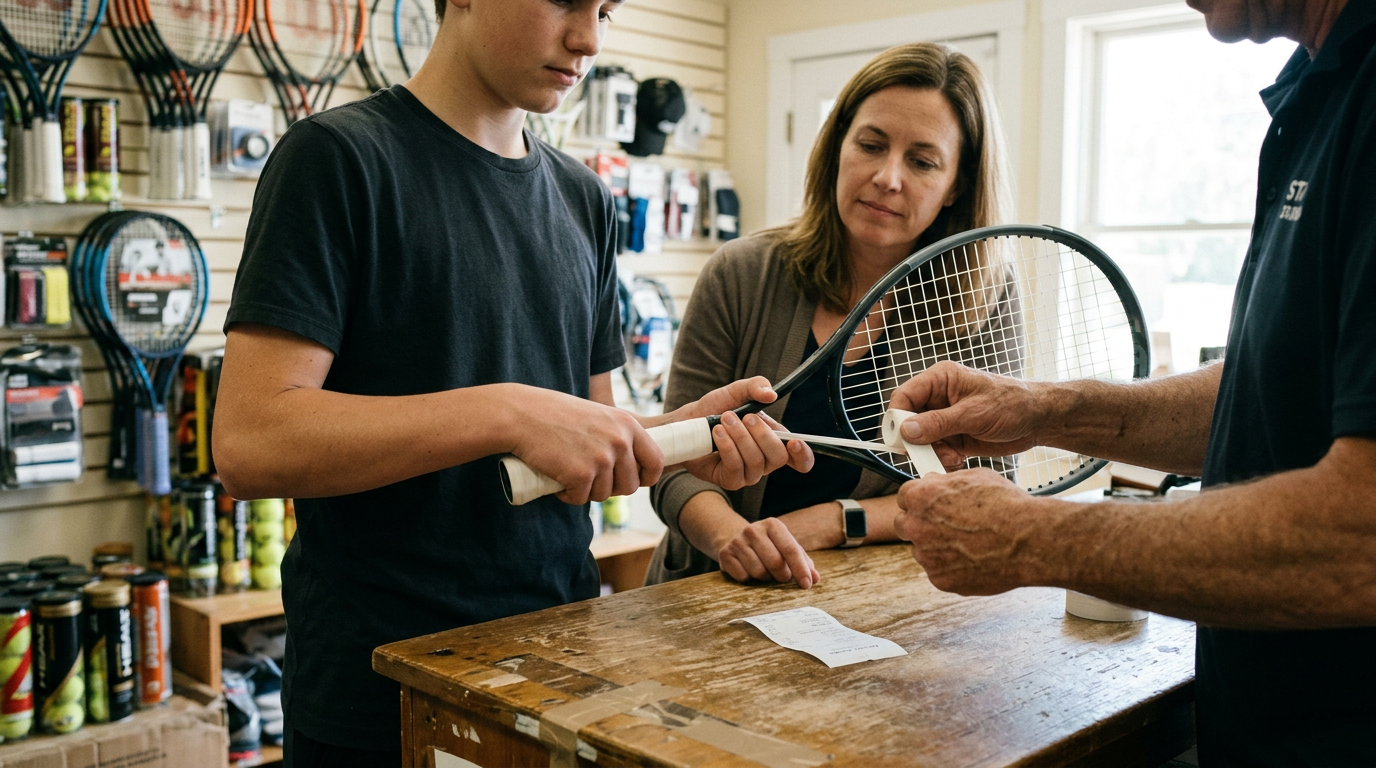
- Overgrip: a thin wrap over the grip that adds tackiness and absorbs sweat.
Take a parent buying a first racket for a sweaty-palmed teen. A fitted grip stops the handle from twisting, and a fresh overgrip keeps it from slipping. Comfort wins.
Slang Players Actually Use on Court
Walk onto any local court and you’ll hear words that never appear in the rulebook. Here’s what the common ones mean, so you can follow the chatter.
Player types and styles on court
- Pusher. A player who keeps every ball in play with soft, steady strokes and waits for you to make the mistake.
- Junk ball. A slow, high, spin-heavy shot with little pace, meant to throw off your timing rather than hit a winner.
- Choke. Losing your nerve on a big point, when your usual game falls apart under pressure.
- Treeing. Hitting the ball so far long that it sails into the trees behind the court.
Consider a club player in a Saturday doubles match who keeps getting stuck across from a pusher. She starts swinging harder and treeing balls over the fence, but the pusher’s simply waiting for those errors.
Her fix is patience rather than power: keep the ball deep and let the pusher miss. Points start coming back fast.
Colorful shots and calls you’ll hear
- Tweener. A shot hit between your own legs, usually after you’ve been forced to turn your back to the net and scramble.
- Paint the lines. Hitting shots so close to the sidelines and baselines that they look painted on, a sign of real control.
- Hook. A bad line call, where a ball that was clearly in gets called out, or the reverse.
- Safinate a racket. To smash or hurl your racket in frustration after a missed shot.
- Moon ball. A high, looping lob with heavy topspin that sails over your opponent’s head and drops deep, buying you time to reset.
Grand Slam Wins and Career Milestones
The four Grand Slam tournaments, called majors, are the sport’s biggest events. Winning one is a big deal, but the rarest achievements come from stacking wins across them.
The four majors and their surfaces
The majors use three different surfaces, so it’s the floor that changes from one event to the next, not the sport:
- Australian Open: hard court
- French Open: clay
- Wimbledon: grass
- US Open: hard court
Think of a weekend player who watches Wimbledon on grass, then heads to the shop for shoes for her Saturday hard-court league.
Knowing the surface lets her ask the right question at the counter, and she walks out with a pair matched to the court she actually plays on. Check the surface first.
Rare milestones, like the Golden Slam
The rarest wins stack even higher. Here are the terms you’ll hear when a player is chasing history:
- Calendar Grand Slam: winning all four majors in a single calendar year.
- Career Slam: winning all four majors at some point across a career.
- Golden Slam: a calendar Grand Slam plus Olympic singles gold in the same year.
- Career Golden Slam: a career Slam plus Olympic singles gold at any point in a career.
Steffi Graf won the calendar-year Golden Slam in 1988.
The study How Big Is the Prize Money Gap? notes she was one of only three players, one man and two women, to win a Grand Slam in singles during the Open Era (the modern stretch since professionals were allowed to play the majors). That’s a short list.
Once the vocabulary clicks, the game gets more fun to watch and play. You’ll know what a let is, why the score sounds odd, and which shot your partner just called.
The same logic carries over to pickleball and padel. Once you recognize the shared ideas behind the court, the serve and the shot, switching between racket sports gets easier and your gear choices get smarter.
Know the language, and every rally starts to make sense.
References
- How Big Is the Prize Money Gap? — doi.org (2017)
- What does deuce and love mean in tennis? — bbc.co.uk
- Tennis Court Dimensions in Metres and Feet (ITF, LTA) — join.playmore.co (2026)
- Epoc 1000-1500 Jeu de Paume — tennishistory.com
- What are the longest tennis matches in Grand Slam history? — espn.com
Questions
What are some common slang terms used in tennis?
Common tennis slang includes “bagel” for a 6-0 set, “breadstick” for a 6-1 set, “pusher” for a player who keeps the ball in play, and “choke” for losing composure under pressure. Players also say “junk ball” for a slow, high, spin-heavy shot and “tweener” for a shot hit between the legs.
What are the 8 basic shots in tennis?
The eight basic tennis shots are the forehand, backhand, serve, volley, overhead (or smash), drop shot, lob, and slice.
What are tennis hits called?
Tennis hits are generally called shots or strokes. Specific names include forehand, backhand, serve, volley, overhead, lob, drop shot, and slice.
What are the three types of tennis serves?
The three main types of tennis serves are the flat serve, kick serve, and spin serve. A flat serve has little spin, a kick serve bounces high, and a spin serve curves and bounces off its expected path.
How much space do you need to make a tennis court?
A tennis court’s playing area is 78 feet long and 36 feet wide for doubles, or 27 feet wide for singles. You also need extra run-off space beyond the lines for safe play, so the total area must be larger than the court itself.
How big is a pickleball court vs tennis court?
A standard pickleball court is 20 by 44 feet. A tennis court is 78 feet long and 36 feet wide for doubles, or 27 feet wide for singles, making it substantially wider than a pickleball court.
How much space should be around a tennis court?
Allow additional run-off space between the court lines and nearby fences or walls. The required amount depends on the court’s intended use and applicable standards; the playing dimensions alone do not include this surrounding space.
Can I play pickleball on a tennis court?
Yes. Pickleball can be played on a tennis court, but the tennis lines do not match pickleball court dimensions, so you may need temporary lines or markings. Check the official pickleball rules before marking the court.
Sources
- What does deuce and love mean in tennis? - BBC Bitesize, bbc.co.uk
- Epoc 1000-1500 Jeu de Paume | Tennishistory.com, tennishistory.com
- What are the longest tennis matches in Grand Slam history? - ESPN, espn.com
- How Big Is the Prize Money Gap? - Analysis of Prize Money in 2016 Grand Slam Tournaments, doi.org,
- Tennis Court Dimensions in Metres and Feet (ITF, LTA) | Playmore, join.playmore.co,
Find your level
The Counter