How Does Tennis Scoring Work? A Complete Guide
How does tennis scoring work? Trace points through games, sets, and matches, and see how deuce and tie-breaks reshape the score during a real match.


Watching your first tennis match can feel like walking into a kitchen where everyone’s following a recipe you’ve never seen.
Players call out deuce, the scoreboard counts in numbers that don’t add up the way you’d expect, and someone mentions a tie-break as if everyone already knows what that is.
The good news is that tennis scoring is built in layers. Points make up games, games make up sets, and sets make up a match. Once you see that structure, every call starts to make sense, so let’s walk through it from the first point to the final one.
Court Setup and How Tennis Scoring Works
Before you can follow the score, you need to know the court and who’s on it. Once you do, the rating numbers and gear choices start to make sense.
Reading the court, net, and lines
A tennis court is a rectangle with a net across the middle, and the net stands three feet high.
The baseline runs along each short end, and the center line splits each half into two service boxes. Singles and doubles share the same net but use different outer lines, with the doubles sidelines wider.
Consider a first-timer who walks the court before a doubles match, spots the wider lines and knows exactly where a ball must land to count.
Who plays and what gear they need
Matches are played as singles or doubles, and every player needs a stringed racket. You’ll often see ratings like 3.0 to 3.5 when you shop or sign up to play.
A 3.0 to 3.5 rating describes a player with a steady rally game who is still building consistency, placement and shot choice.
Beginner rackets and balls by level are built for where you are, not where you hope to be. A lighter, more forgiving racket and slower balls help a newer player keep rallies going.
Consider a weekend player who buys a heavy, stiff racket because her favorite pro uses it. After three sets her arm aches and her shots keep sailing long. Fit beats fame.
How Do Tennis Scores Work?
Tennis scoring looks odd at first, but it’s really three layers stacked together: points build games, games build sets, and sets build the match. For the quick version, win enough points for a game, enough games for a set, and enough sets for the match.
Counting points from love to game
Every game starts at love, meaning zero. The calls climb like this:
- 15 means one point
- 30 means two points
- 40 means three points
- A fourth point wins the game
Each point is the smallest unit of scoring, so every rally moves the score. Picture a weekend player who wins one rally, loses the next, then takes the two after that. The score runs 15-love, 15-15, 30-15, 40-15, and one more point ends the game.
Calling each score out loud keeps play moving.
Playing through deuce and advantage
At 40-40 the score is called deuce, and the game isn’t over until one player wins two consecutive points. Win the first of them and you have advantage. Advantage isn’t the game yet. It’s just a chance to win it. Win the next point and the game is yours.
Lose it and the score returns to deuce, with no limit on how many times it can repeat.
Think of a club player who wins a point at deuce and suddenly has the advantage. One more clean point wins it, but one error sends the score right back to deuce.
Winning a set by two clear games
A set goes to the first player to win six games by a two-game margin. A 6-4 set is over, but 6-5 keeps going until one player leads by two, such as 7-5. At 6-6 the set is decided by a tie-break, a special game that settles it.
It’s the margin that counts, not just reaching six.

How many sets decide a match
Matches are either best of three sets, where the first to two sets wins, or best of five sets, where the first to three sets wins. Men’s Grand Slam matches are best of five, while women’s matches are best of three.
Here’s a worked example we can follow from one game to the whole match:
- The player wins a game at 40-15.
- The set moves from 5-2 to 6-2, so the player takes it.
- The sets read 6-2, 4-6, 6-3, so the player wins the match two sets to one.
Rules for Serving and Playing Points
Every point ends one of a few ways, so we’ll walk through the rules before you step on court.
How points are won or lost
- Invalid return. A return that isn’t legal loses the point.
- Double hit. Hitting the ball twice loses the point.
- Touching the net. Touching the net during play loses the point.
- Ball on the line. A ball that lands on a line is in, not out.
- Doubles partner hit. In doubles, if the ball hits your partner, your side loses the point.
Picture a weekend player in her first doubles match who volleys the ball straight into her partner. The point goes to the other side, and she learns the rule before the next point.
Serve order, faults, and lets
A coin toss decides who serves first. The server starts each game on the right side of the baseline, serves diagonally into the opposite service box, and keeps serving for the whole game.
Underhand serves are allowed, so a new player can start a point without an overhead swing.
A serve that clips the net and still lands in is a let. It’s replayed, and no point is lost.
Two faults in a row lose the point. That’s a double fault.
When you call the score, say the server’s score first.
When players switch ends
Players switch ends after odd-numbered games: the first, third, fifth, and so on. Serving alternates each game, so the player who was receiving now serves.
Think of a parent and a teenager on a casual Saturday set. After the first game they swap ends, and the parent who just received now serves.
Settling a Tied Set with a Tie-break
When the games in a set are level, a tie-break decides the winner. Here’s how it plays out, where it applies, and why it came into the game.
How a tie-break plays out
- Winning: First to seven points takes the tie-break.
- Margin: Win by two points, so a one-point lead isn’t enough and play continues until someone is ahead by two.
- Counting: Points are counted 1, 2, 3, and so on.
- Serving: The serve changes every two points.
- Ends: Players switch ends every six points.
Final sets and when tie-breaks apply
In the final set, there’s no tie-break. Play on until one player has a two-game lead, and keep count in games rather than points.
Some tournaments now use tie-breaks in the final set too, and final-set rules can differ by Grand Slam, so check the format before you enter.
Think of two weekend players who expect a tie-break to end a long final set, only to find play goes on. Checking the format beforehand keeps that surprise off the court.

Why tie-breaks came into tennis
In a game theoretic study of tournament rules, Pollard and Meyer (2010) note that James Van Alen pioneered the tie-break set, first introduced at the Philadelphia Indoor Tournament in 1970.
The aim was to speed up match conclusions and keep tied sets from running too long. A clear finish, by design.
Shorter Ways to Score a Match
Not every match has to run the full three-set course. Here are three shorter versions you’re likely to run into, and what each one changes for you.
Playing no-ad with one deciding point
Under no-ad scoring, there’s no advantage game at deuce. At 40-all, the game goes to whoever wins the next point, not the first player to get two ahead. The rally doesn’t change. The ending does.
Because deuce is settled on one point, games finish sooner. You’ll often see this in doubles, so check the format before you book club doubles.
Think of a weekend player who reserves a Saturday court, assumes the usual rules, and spends the first set adjusting to deuce games that end on a single point. One question before booking would have told her exactly what to expect.
Fast4 sets end at four games
Fast4 is a shorter set format. Each set is played to four games, not six, so it finishes sooner. If the score reaches 3-3, a tie-break decides the set. With no lets on serve, a serve that clips the net and lands in the box is played out, not replayed.
Parents watching a Fast4 match should keep an eye on the score, since the tie-break can arrive sooner than expected.
A 10-point decider that replaces set three
Some matches skip a full third set and play a 10-point match decider instead: a tie-break to 10 points that replaces the set rather than adding to the match. You’ll see it often in doubles, where it gives both pairs a short, clear finish.
Think of two friends who’ve split the first two sets, with a court booked for the morning. The 10-point decider fits that slot and gives them a finish they can actually plan around.
Why these formats exist
Each of these formats solves a different problem:
- Recreational play. Players with limited court time want a match that ends when they expect it to.
- Professional exhibitions. Shorter formats keep exhibition events moving.
- Junior tennis. Shorter matches give younger players a manageable length on court.
- Faster-paced matches. Less time per match means more of them fit into a day.
The strokes don’t change. Only the scoreboard does.
Where Tennis Scoring Came From
Tennis scoring sounds odd the first time you hear it: why 15 instead of 1, and why does zero become “love”? Here’s where those words and numbers came from.
Where 15, 30, and 40 came from
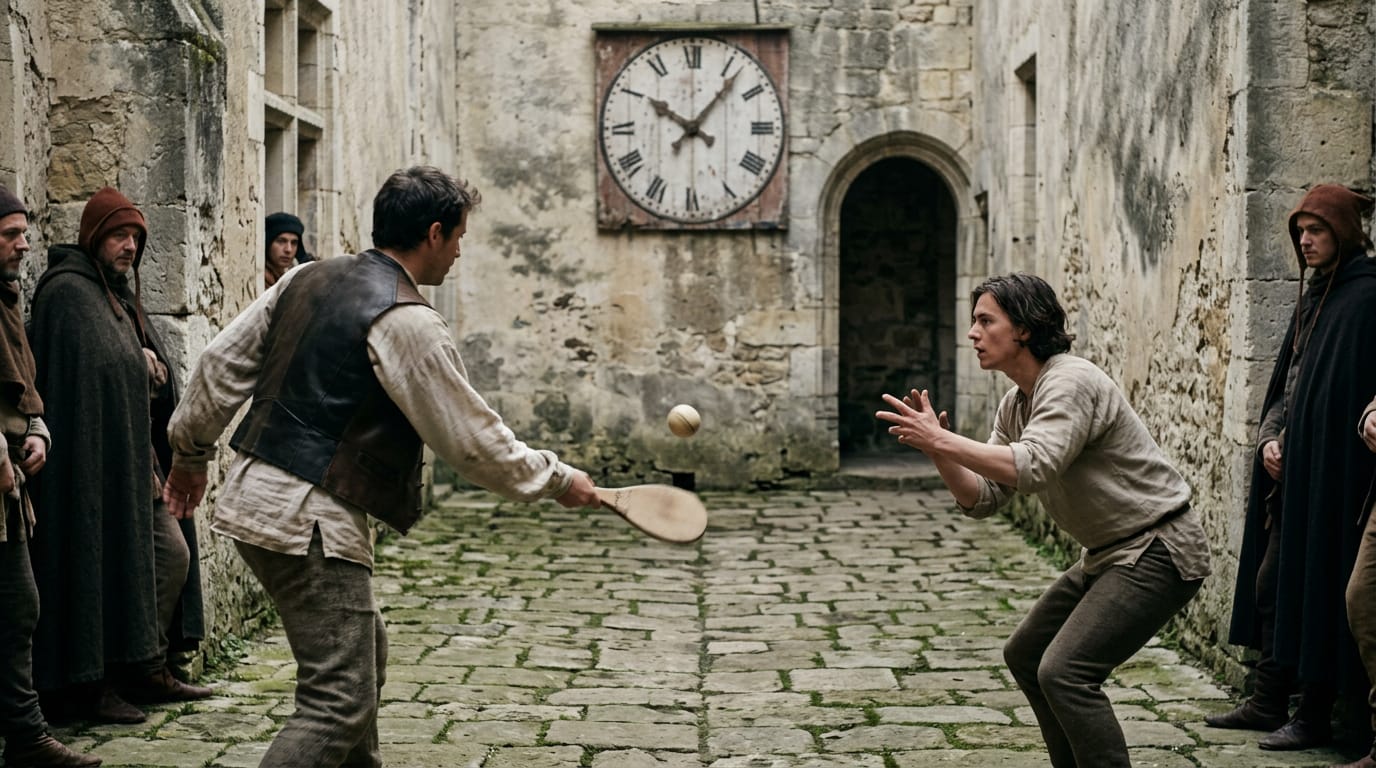
The sequence is associated with the medieval French game jeu de paume, where players hit a ball back and forth face to face. A scholarly article on outdoor ball games before 1830 describes those players counting by fifteens:
- 15
- 30
- 40
- then game.
Another theory points to clock faces. Sporting News reports that scores were originally kept with hands placed at the 15, 30 and 45 minute marks. Somewhere along the way, 45 was shortened to 40. Odd, but it stuck.
Where deuce and love come from
Deuce comes from the French à deux le jeu, roughly “at two, the game,” and describes a tie at 40-all. Love is trickier. One proposed origin is the French l’oeuf, meaning egg, because a zero looks like one.
Sporting News is upfront that there’s no definitive answer, so treat it as a strong theory, not settled fact.
Why matches are split into sets
Matches aren’t decided by one game. Instead, they’re split into sets, which are groups of games. This keeps a match from ending too quickly, and it tests endurance and skill, since a player has to stay sharp over a long stretch rather than in one burst.
How tennis scoring compares to other sports
Many sports keep one running total. Tennis counts games and sets instead, which creates pressure points. One is the break point, a chance for the receiver to win a game on the other player’s serve.
Think of a weekend player serving at 30-40 in a Saturday league match, knowing her opponent is one point from breaking her serve. That knowledge lets her treat the next rally as the one that matters and stay calm enough to play it.
Every point counts, but some count more.
Quick Answers and a Final Recap
Tennis scoring looks odd until a few quirks click. Here’s where new players usually get tangled, and why it’s worth the effort.
Where new players usually get stuck
Love is simply the word for zero, so 15-love means the server has won one point and the receiver none. Points go 15, 30, 40, and a game needs four points with a two-point lead, so 40-40 becomes deuce until one side pulls ahead by two. If words like love and deuce still feel foreign, a glossary of tennis terms explains them.
Why not 1, 2, 3? Nobody can give you a single logical reason, so memorize the sequence. Every club and tournament uses it.
Recreational groups often trade the drama for speed:
- No-ad scoring: a deuce point decides the game.
- Match tie-break: a first-to-10 contest, won by two, replaces a full final set.
A regular set goes to a tie-break at 6-6, played to seven points. Many events play the final set as that 10-point match tie-break instead, so the deciding set wraps up faster.
Why knowing scoring helps players and fans
Scoring is less about what the numbers say and more about how pressure builds. A player serving at 40-30 is one point from holding serve, so that rally carries weight a 15-love rally doesn’t.
An unforced error is a missed shot nobody forced you into, like netting an easy forehand with no pressure on you. Players and coaches watch these closely because they show who’s beating whom and who’s beating themselves.
Think of a parent keeping score at a junior match. Once they can call 40-30 without hesitating, the kids keep rallying instead of stopping to ask, and nobody argues over who’s ahead. Get the count right and the scoreboard starts telling a story.
Once you know that points build games, games build sets, and sets build a match, tennis scoring stops feeling like a puzzle. You can follow a tie-break, make sense of alternative formats, and keep score with confidence.
Add the practical habits, like calling and tracking the score and choosing gear that fits how you really play, and you’re ready for real matches. The scoreboard was never meant to be a mystery, and now you can read every point on it.
References
Questions
What is the correct scoring method in tennis?
Tennis scoring has three layers: points make games, games make sets, and sets decide the match. Points in a standard game are called love, 15, 30, and 40; a player usually must win by two points after deuce. A set is generally won by reaching six games with a two-game lead, with a tie-break commonly used at 6-6.
What are unforced errors in tennis?
An unforced error is a mistake on a shot that the opponent did not make unusually difficult. Examples include hitting an easy forehand into the net or sending a comfortable shot out. Players and coaches track these errors to assess consistency and whether a player is losing points through their own mistakes.
How do tennis scores work for dummies?
A tennis match is scored in points, games, and sets. In a standard game, the calls go love, 15, 30, and 40; at 40-40, called deuce, a player must win two points in a row to take the game. Games build a set, usually won by the first player to six games with a two-game lead, and sets build the match.
How many sets are needed to win a match?
Most matches are best of three sets, so the first player to win two sets wins the match. Best-of-five matches require three sets to win. Men's Grand Slam matches are best of five, while women's Grand Slam matches are best of three.
Why is 40-40 called deuce?
Deuce comes from the French phrase à deux le jeu, roughly meaning “at two, the game.” At 40-40, a player must win two consecutive points to win the game: the first gives advantage, and the next wins the game unless the score returns to deuce.
What does 3.0 to 3.5 mean in tennis?
A 3.0 to 3.5 tennis rating generally describes a player with a steady rally game who is still developing consistency, shot placement, and shot selection. The rating is a guide to playing ability and can help players choose suitable opponents, equipment, or classes.
Sources
Find your level
The Counter