Gym Floor Guide: Materials, Thickness and Costs
Gym floor choices depend on your training: compare materials and thickness, match surfaces to workout zones, and see what installation parts cost.

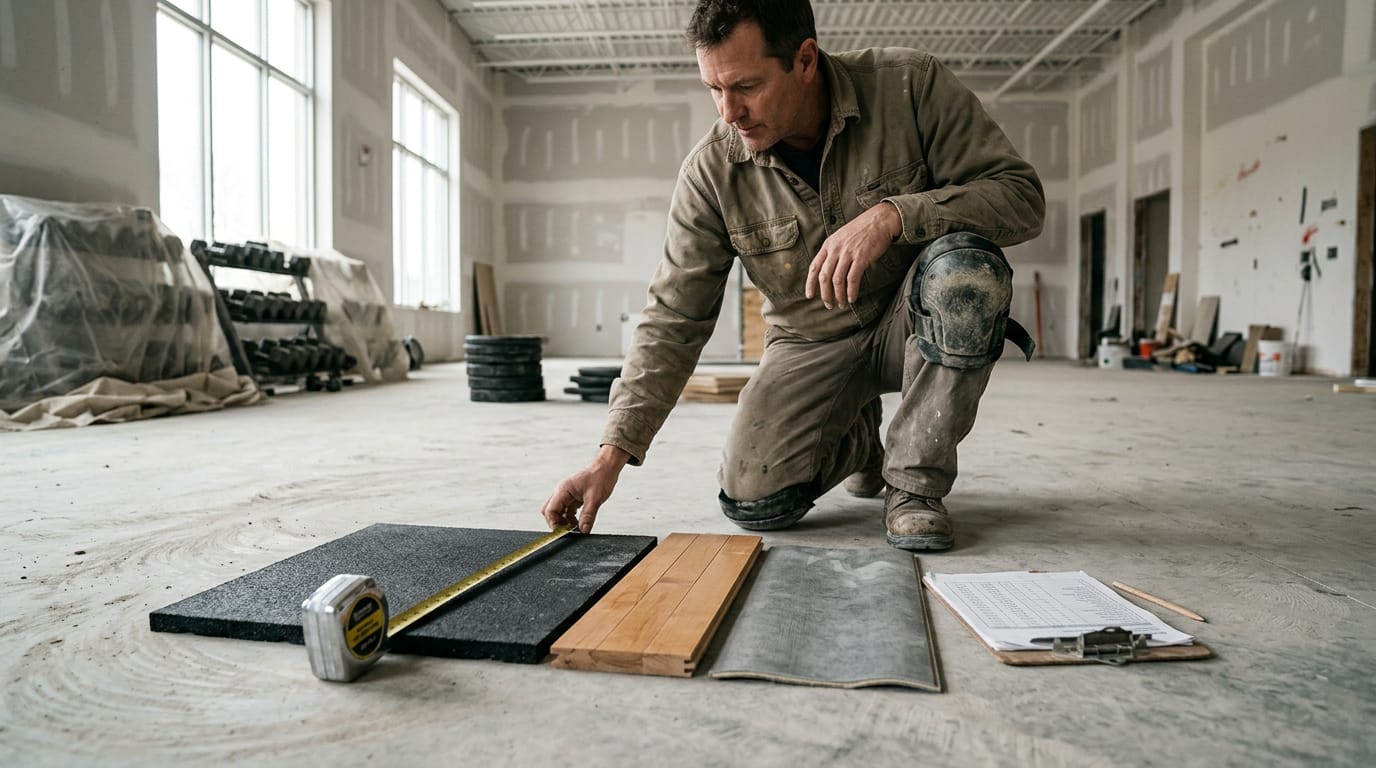
Think about the difference between stepping onto a hard driveway and landing on a cushioned mat after a set of box jumps. Your gym floor does quiet work under every rep, sprint and dropped weight.
In plain terms, it’s the surface that absorbs impact, supports your equipment and keeps you steady, and the right one depends on what you actually do on it.
We’ll cover the main materials, how thickness changes protection, and how to match each zone of your space to your training. Then we’ll walk through installation, cost and practical home-gym guidance.
Gym Floor Products You Can Choose From
Gym floors come in a few main types, and each suits different training. Here’s what each one is built for.
Rubber flooring in rolls and tiles
Rubber comes in several formats:
- Rolled rubber flooring comes in long sheets you cut to fit.
- Rubber tiles are square pieces you lay side by side, so one worn tile is easy to swap.
- Interlocking puzzle tiles click together at the edges, with no glue needed.
- Speckled or fleck options mix colored bits into the rubber.
- Pallet and bulk rolls come in larger quantities for big spaces, so check what’s included.
Choose by how you’ll install it, not just how it looks.
What’s the best material for a workout mat?
There’s no single best material, since the answer depends on what you do on it. If you’re lifting, rubber is the safer bet. If you’re mostly stretching or doing bodyweight work, foam is lighter and easier.
- Turf rolls are artificial grass for sled pushes and drills that need a grassy feel.
- Foam mats are light and easy to move, better for floor work than heavy loads.
- Impact resistant surfaces are built to take the knocks of drops and hard landings.
Consider a parent training with a teenager in a basement: rubber tiles under the barbell, a foam mat by the couch. The foam never sees a dropped plate. Match each surface to its job.
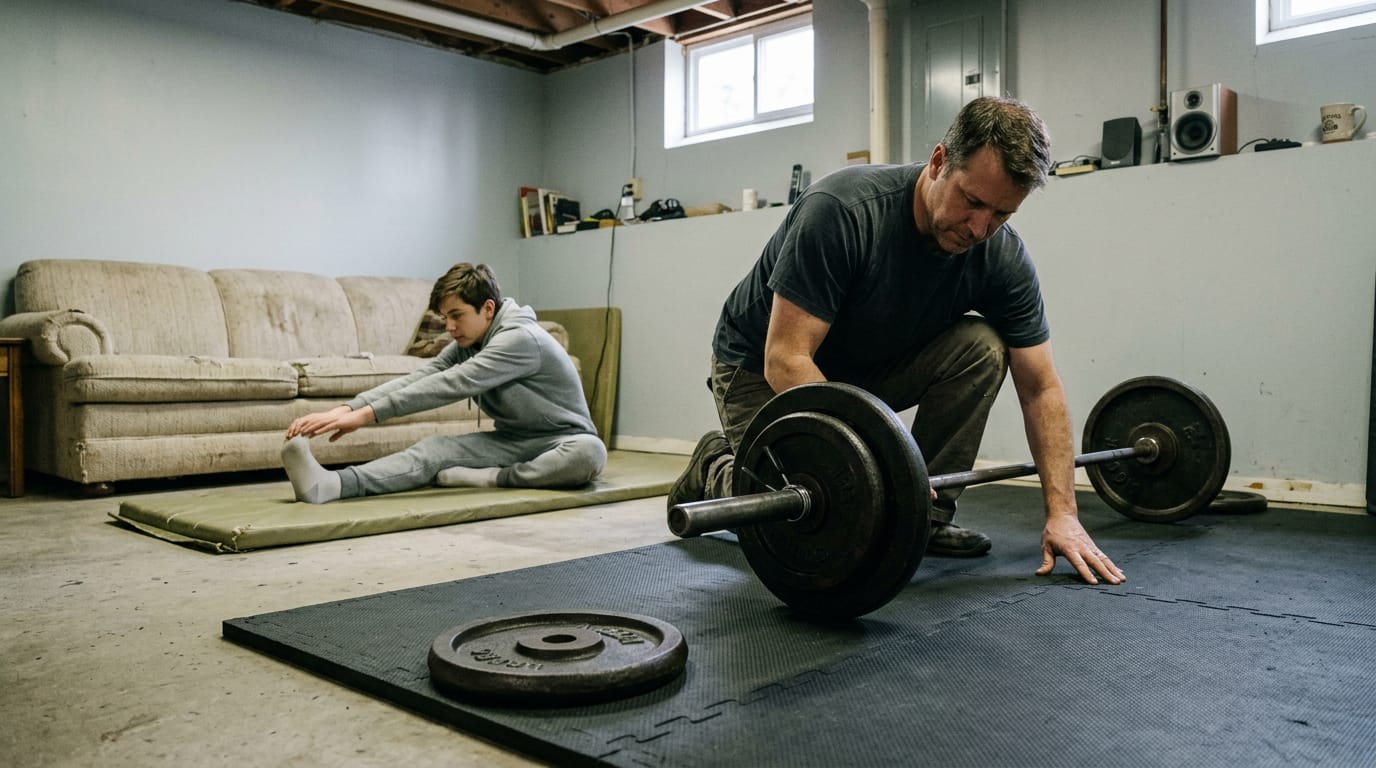
Platforms for heavy lifting
A lifting platform gives a heavy deadlift a flat, stable spot to start from.
- Deadlift platforms are made to handle heavy, repeated drops.
- Wood platforms give a firm, flat surface for a solid stance.
- Rubber platform designs put rubber where the weight lands.
Platforms earn their keep on the heaviest lifts, not your everyday warm-ups.
How a Good Gym Floor Helps You
A good gym floor does the unglamorous work so your gear and lifts can stay where they belong.
Protecting gear and keeping lifts steady
Think of a dad who sets up a power rack in his basement and drops a loaded barbell on his first heavy set.
A solid floor protects your equipment and the subfloor (the structure beneath the surface) and absorbs impact, so each drop is softer on everything it touches.
A firm, level surface keeps the rack and bench steady during a heavy squat or press, so you can focus on form instead of bracing against a wobble. The best floor isn’t the one that looks good in photos. It’s the one that works under a loaded bar.
Comfortable, quiet, grippy, and long lasting
Consider a weekend lifter who trains early, before the house wakes up. A noise-dampening surface turns a dropped dumbbell into a dull thud instead of a crash the whole house hears.
Traction keeps you planted. Sweaty palms and slick shoes make a deadlift setup feel shaky, while a grippy top lets you stand firm before the first pull.
Long-lasting performance is the payoff. A floor that keeps its grip and shape for years means you won’t be shopping for a replacement next season.
Odor, off-gassing and cleaning matter too. Off-gassing (vapors released from new materials) can leave a fresh floor smelling strong for a while, so keep things fresh with two habits:
- Ventilate early. Open a window or run a fan while the new floor settles in.
- Wipe down easily. Choose a smooth top that cleans up sweat and dust quickly.
Get those right and the floor fades into the background. That’s exactly where a good one belongs.
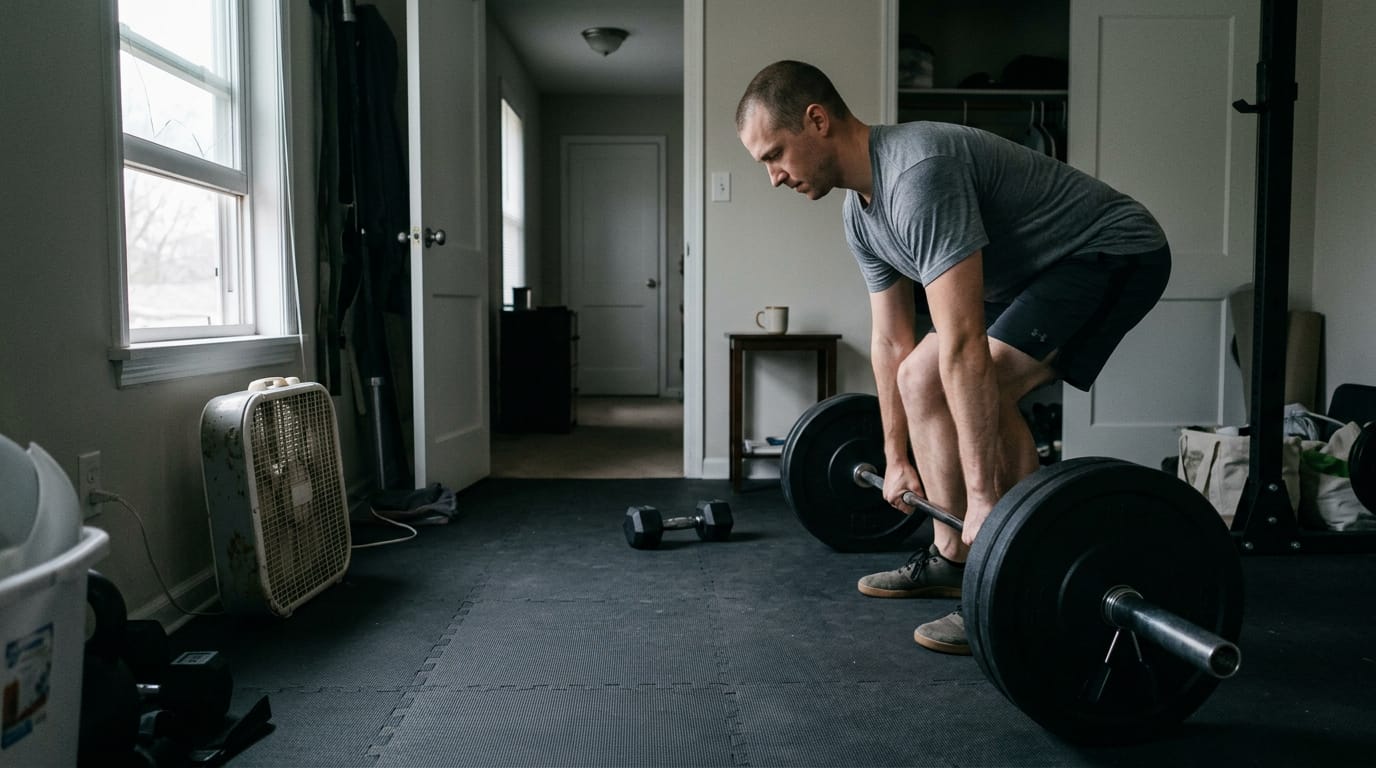
What’s the Best Gym Floor for You?
The best gym flooring is the one that fits your room and training, not one that wins for everyone. Start with the use zone: the spot where you actually lift, stretch, or move.
Home gyms, studios, and commercial spaces
Each setting asks something different of the floor:
- Home gyms. A basement or spare room needs a forgiving floor that quiets noise.
- Commercial facilities. Busy gyms need commercial-grade flooring for constant foot traffic.
- Functional training studios. Sprints and sled pushes call for grip and cushion across the room.
- Garage and spare-room setups. Cold concrete needs cushion and grip, plus a floor you can pull up later.
Flooring for lifting zones and floor work
Lifting areas need thick, dense flooring to absorb drops. Picture a weekend powerlifter setting down a loaded barbell after a heavy set. A dense mat protects the slab and keeps the bar from skipping away. Compare horse stall mats for home gym floors when you shop for a lifting mat.
For floor work like planks and stretches, you want cushion over height: a mat that protects your knees without wobbling. High-traffic spots like entryways and rack paths wear fastest, so reinforce those first.
In a full gym, pair heavier flooring for lifting with lighter flooring for stretching.
The best gym mat for exercise is a dense, thick mat sized to where you train. You don’t need to cover the whole room.
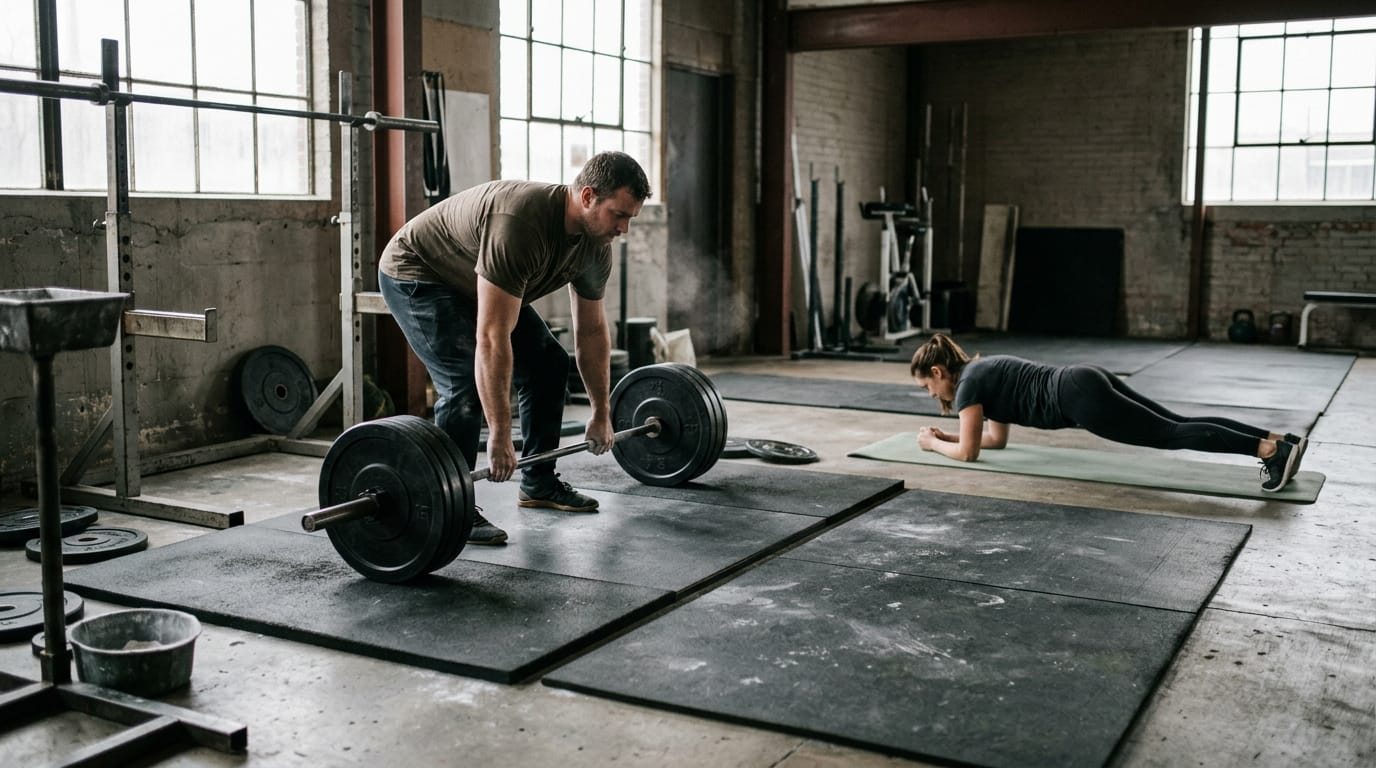
Picking thickness, texture, and grade
Four choices shape the floor, and the weight you drop matters most.
- Multiple thicknesses. Thinner mats suit stretching; thicker ones suit heavy lifting.
- Different textures. Smooth surfaces look clean but slip; textured ones grip better.
- Commercial-grade series. Built for heavy daily use in busy spaces.
- Match thickness to weight dropped. The heavier the drop, the denser the floor needs to be.
Fit beats brand.
Installation Parts and What They Cost
Installation is where a gym floor’s real price shows up, so know each part before you check out.
Adhesive, dowels, and transition pieces
Three parts do most of the work:
- Adhesive bonds tiles to the base, and it matters most over concrete.
- Dowels are small pins that lock seams together on some interlocking systems.
- Transition pieces, also called reducers, are tapered strips that give you a smooth ramp where the floor meets carpet or hardwood.
Concrete should be clean, dry, and level before any glue goes down. Carpet is a poor base since it compresses and lets the floor shift, so pull it up first. A garage slab needs a good sweep and a check for oil or damp spots.
If you skip glue entirely, loose mats still need a home between sessions. Keep them dry and off bare concrete, store rolls upright or stacks flat, and keep them out of direct sun so the edges don’t curl.
How much each option costs
Compare options by per-square-foot price: your total divided by the square footage you need. A low box price can hide a higher rate, so do the math first.
Pallets can lower the per-square-foot price, but you’re committing to the whole order. Think of a weekend lifter turning a two-car garage bay into a training space.
She buys one full pallet plus enough adhesive for the slab, and finishes the job in one weekend instead of two.
Sale and closeout pricing can be a real bargain, but only if you buy everything in one order, not in two rounds. Closeout lots can vary in color, so a second batch may not match the first. Measure twice, order once.
Choosing a gym floor comes down to matching the surface to how you actually train. Get the material, thickness and zone fit right, install it with care, and budget for what you truly need instead of what merely looks impressive.
That’s how a floor stops being an afterthought and starts working for every session.
Good flooring disappears once you’re training, and that’s exactly the point.
Questions
What is the best material for a workout mat?
There is no single best material for every workout. Rubber is a safer choice for lifting, while foam is lighter and better for stretching and bodyweight exercises.
What is the best gym mat for exercise?
A dense, thick mat sized to your training area is a good choice for exercise. Use thicker, denser flooring for lifting and a cushioned, stable mat for floor work.
What is the best flooring to put in a gym?
The best gym flooring depends on your training and room. Dense rubber suits lifting zones and protects the subfloor, while foam works well for stretching; choose thicker, denser flooring where heavier weights may drop.
How to store gym mats at home?
Keep gym mats dry and off bare concrete, and protect them from direct sunlight to help prevent curling. Store rolls upright or stacks of mats flat.
Find your level
The Counter