Running Shoes for Everyday Use: Complete Guide
Running shoes for everyday use can cover your run and the rest of your day. Compare support, cushioning, fit, and top picks to find your pair.
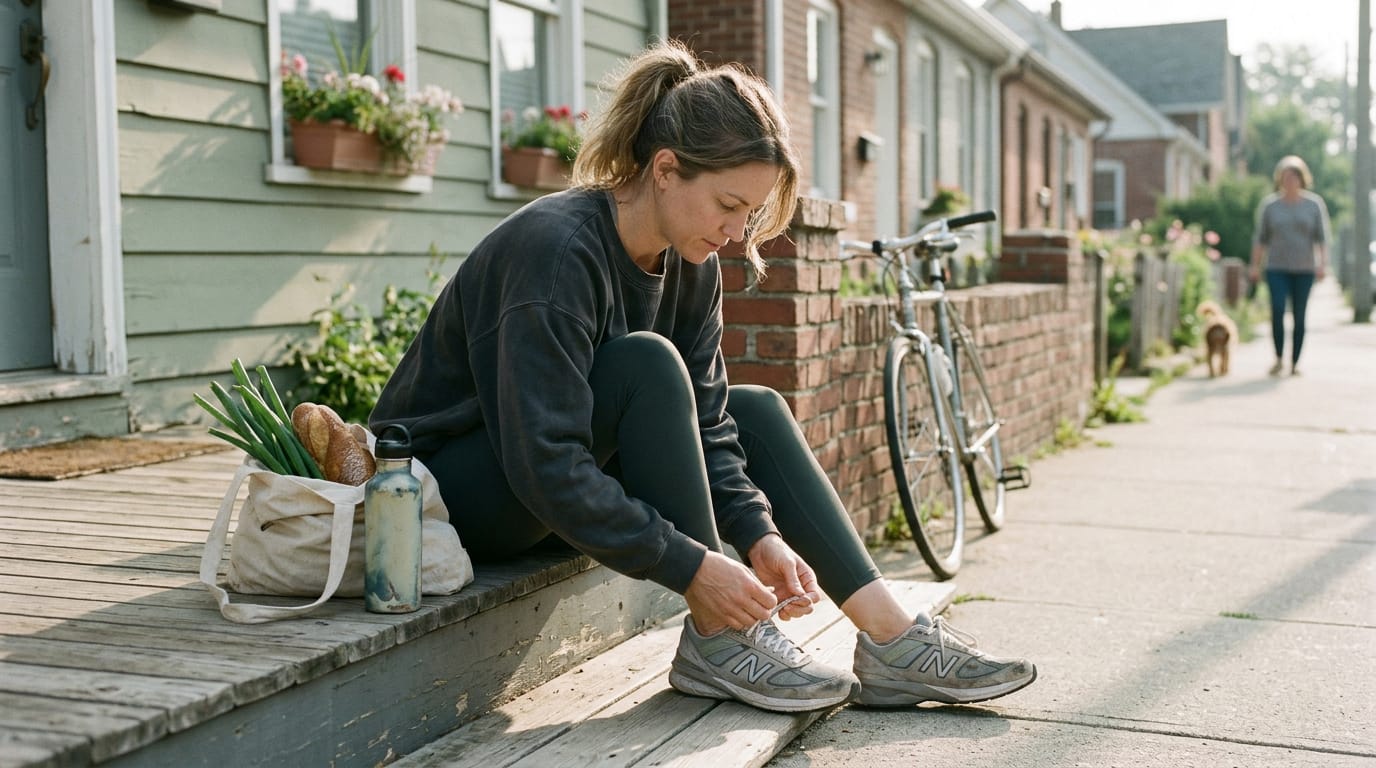
Think about the sneakers by your door. You lace them up for a morning run, then wear them to the grocery store, the office, and your kid’s game. Running shoes can handle that double duty, but not every pair does it equally well.
The short answer: yes, running shoes work for everyday use, as long as you match the shoe to how much you run and how you actually spend your day on your feet.
In this guide, we’ll cover support, cushioning, fit, and sizing, plus our top picks and when it’s time to replace your pair.
Picking Running Shoes for Everyday Use
Can one pair of running shoes cover your runs and your errands? Often, yes, if you match the shoe to your routes and daily life.
Road or trail shoes for your route
Your surface does most of the deciding. Road shoes suit pavement, sidewalks and treadmills. Trail shoes add lugs, raised knobs that grip dirt, mud and loose gravel, and some include a rock plate, a firm layer that shields your foot from sharp stones.
Road shoes can handle packed dirt, but they’ll slide on wet roots. Think of a parent who jogs a paved loop on weekdays and a gravel path on Saturdays. A grippier trail shoe keeps those gravel days from turning into a slip-and-slide.
Which shoe category fits your goals
Most running shoes fall into three groups:
- Daily trainers. Balanced cushioning and support for most miles and everyday wear.
- Tempo and speed shoes. Lighter and more responsive, built for faster efforts and workouts.
- Race and super shoes. The lightest, most responsive option, made for race day rather than daily life.
Weight generally drops as you move toward race shoes, and lighter usually means less cushioning and durability. So the fastest shoe is rarely the everyday one. Marathon training stretches that trade-off, since durability matters more over long weekly miles.
Consider a weekend player who runs three mornings a week and wears the same shoes to the office. A daily trainer covers both jobs.
How far and how fast you run
Your weekly mileage and pace set how much cushioning and structure you need. Easy runs suit a comfortable, cushioned shoe, while speed workouts call for something lighter and firmer.
Long runs favor the most cushioned pair you own, since fatigue tends to build late.
If you mix running and walking, a daily trainer handles both. A first-time runner on a run/walk plan can cover the whole routine with one daily trainer, no race pair required.
Can running shoes be worn every day?
For most people, yes. If you run regularly and want one pair for everything, a daily trainer is the smart pick. If you rarely run, a walking shoe may suit your days better.
Running shoes double as walking shoes well enough. Walking shoes favor a steady heel-to-toe roll, while running shoes absorb the bounce of each stride. For standing all day, cushioning and a stable heel matter more than a stiff, race-ready feel.
Treadmill use is an easy yes, but a raised, cushioned heel can feel wobbly under heavy squats, so keep those lifts for a cross-training shoe.
Think of a barista on her feet for eight-hour shifts who runs before work. A daily trainer with solid heel support covers both, and she’s not hauling a second pair around.
Men’s and women’s builds differ
Many brands sell separate men’s and women’s versions because male and female builds differ on average. Women’s models generally have a narrower heel to hold the foot more snugly.
Consider a woman who’s been wearing a men’s pair only because it was the only size on the shelf. A women’s version may hold her foot better and cut down on heel slip. Fit comes first.
Finding Support for Your Foot Type
Support should match how your foot moves when it lands, and a few simple checks reveal what yours needs.
Neutral versus stability shoes compared
A study on running shoes for preventing lower limb injuries found that most runners can use neutral shoes rather than stability shoes. Stability shoes target overpronation, when the foot rolls inward too far on landing. Watch for ankles that tilt inward.
They add guide rails along the sides and sometimes a medial post, denser foam on the inside, to slow that roll. If you wobble late in a long run, a bit more support may help.
Reading wear patterns on your soles
Flip your old pair over. The question isn’t what the box promises but how your foot lands.
- Inner-edge wear means overpronation, where the foot rolls inward on landing.
- Outer-edge wear means underpronation, where the foot doesn’t roll inward enough.
Wear also shows your foot strike, which part of the foot lands first: heel, midfoot or forefoot.
A weekend runner who wears one pair for Saturday’s 5-kilometer race and every errand has heavy inside-edge wear. A fitter checks her stride and she leaves with a shoe built for how she lands.
Shoes for arch height and foot width
Arch height is one clue, so check it against your wear.
- Flat feet and high arches: Flat feet often roll inward more, so check stability features. High arches often suit extra cushioning.
- Wide feet: Many models come in wide sizes, so look for a width option.
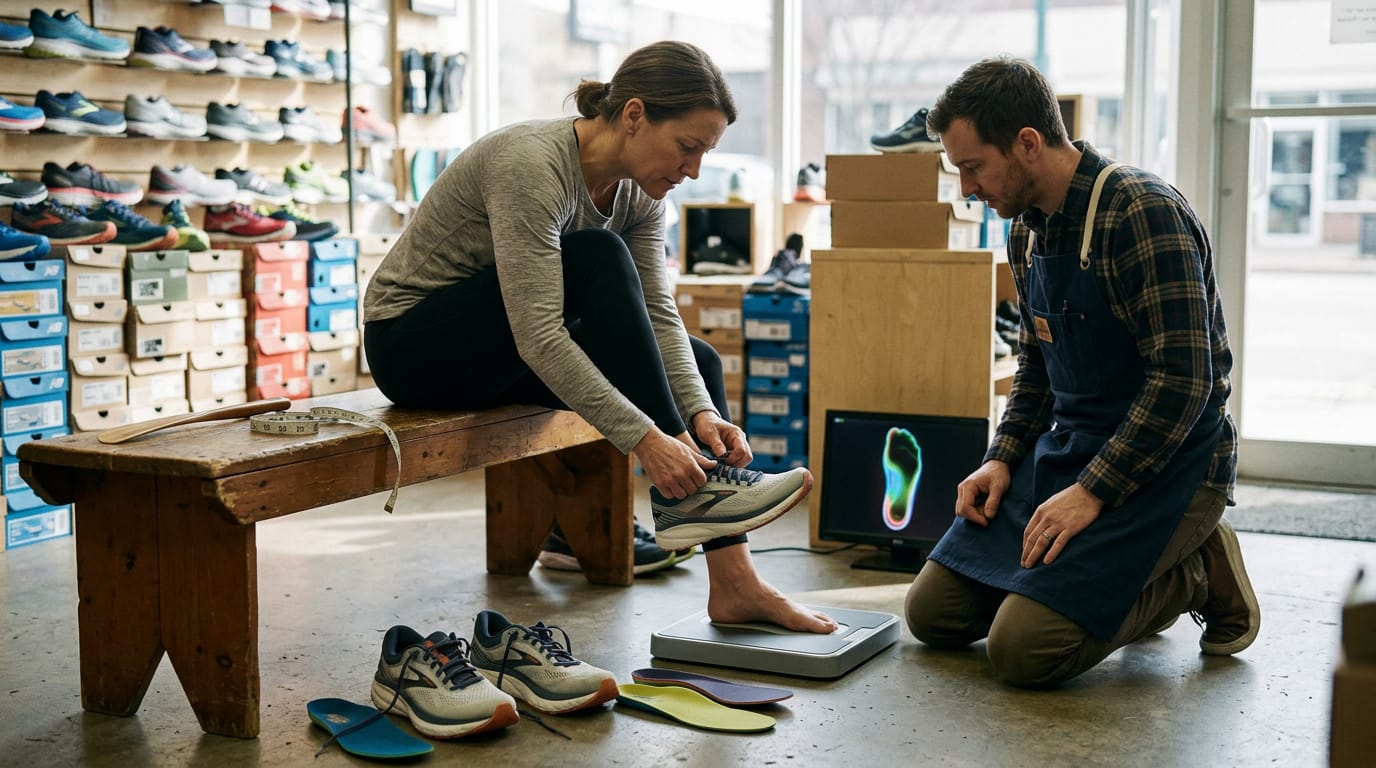
- 3D foot scanning: Some stores use it to measure length, width and arch. Still try the shoe on, since a scan is only a starting point.
How Cushioning and Foam Change the Ride
Cushioning shapes how a shoe feels on every step, so here’s what to weigh before you buy.
Choosing the right stack height
Stack height is the foam between your foot and the ground. Daily trainers sit in the middle, max-cushion shoes stack thicker for a plusher ride, and beginners usually land in that middle range.
Consider a weekend runner logging three easy mornings a week: a moderate stack keeps her comfortable without extra bulk.
A minimalist low stack feels closer to the ground but offers less cushion, while competition shoes push height to the limit, which suits race day but feels unstable on daily miles.
Which foams feel soft or firm
Many everyday shoes use EVA (ethylene-vinyl acetate), a common foam. Supercritical foam is a lighter, springier take on it, made by infusing gas under pressure.
Premium options like PEBA (polyether block amide), TPEE (thermoplastic polyester elastomer), and TPU (thermoplastic polyurethane) feel more responsive. Soft foam feels plush, firm foam feels stable as you push off.
Softness isn’t the same as shock absorption: a shoe can feel soft yet absorb impact differently once you’re moving, so trust the ride over the squish.
Absorbing shock and bouncing back
Cushioning is meant to absorb impact and help protect your joints. According to a randomized controlled trial with 848 recreational runners, shoe cushioning is expected to protect against repetitive loading and running-related injuries.
Rebound is how much energy foam returns as you push off. Some brands publish lab-measured scores for side-by-side comparison. Premium foams cost more, and for everyday miles a solid EVA trainer often does the job.
Heel-to-toe drop and your legs
Heel-to-toe drop is the height gap between heel and forefoot. Higher drops may ease Achilles strain, and a biomechanical analysis of heel-to-toe drops found larger drops produced a lower vertical loading rate.
Lower drops change where stress lands: a study of standard running shoes found a 4 millimeter drop raised loading rate and ankle moment while lowering maximum knee moment compared with 8 and 12 millimeters.
Zero-drop shoes need a gradual adaptation period, so start with short, easy runs. Lab-measured drop can differ from the advertised figure, so check it on your feet.
When plates, rockers and weight matter
A carbon plate is a stiff insert in the midsole. A systematic review and meta-analysis in Frontiers found carbon-plated shoes can improve running economy, so you use less effort at a given pace.
Rocker geometry is a curved sole that rolls you from heel to toe. Lighter shoes suit fast efforts, while heavier, more cushioned pairs suit daily miles.
Consider a club player who races Saturdays and jogs Tuesdays: the plated racer comes out only for race day. Beginners are better off skipping plates for now.
Getting the Fit and Size Right
Fit matters more than any spec on the box, so get it right first. Here’s how to check your room, compare sizes, and try shoes on the right way.
How much room your toes need
Start with a thumb’s width of space between your longest toe and the front of the shoe. That’s room to move, not extra length.
Next, do the finger test for width. With the shoe laced, slide a finger along the side of your foot. If the fit feels pinched there, the shoe is too narrow.
Check the toebox too, for width and height, so your toes can spread and lift. Finally, your feet aren’t identical, so fit the larger one.
Why sizes differ from brand to brand
A size 9 in one brand might fit like a 9.5 in another. Brands such as Hoka and Puma tend to run narrow, while Altra and Topo are the wider options.
Consider a weekend player who grabs her usual size, only to find a narrow brand pinching her forefoot by the end of the first run. She’s back at the store the next day.
Check each brand’s size chart, and measure your foot length rather than trusting the size on your last pair.
Trying shoes on and returning them
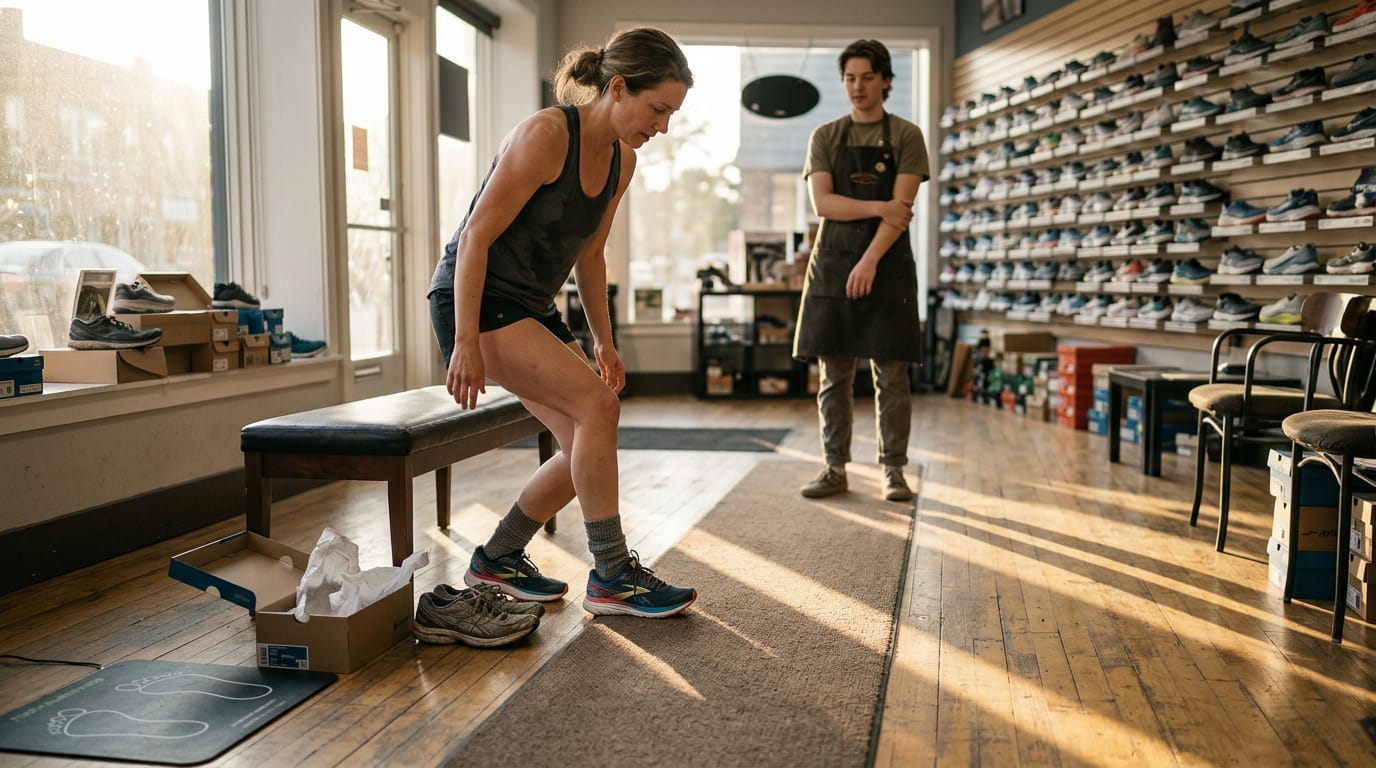
Try shoes on at the time of day you usually run, ideally after a long day on your feet, when they’re at their largest. A few habits help:
- Wear the socks you run in, since thickness changes the fit.
- Don’t count on a break-in. Running shoes should feel right from the start, so a pair that pinches in the store is the wrong pair.
- Buy from a shop with a generous return policy, and jog a few steps in them before you decide.
- Specialty fit stores can scan your feet and suggest models that match, which helps when you’re unsure.
Common fit mistakes runners make
- Buying too small. A snug fit feels secure in the aisle, but your toes need room to spread once you’re moving.
- Choosing by looks. A bright colorway says nothing about how it fits. Fit beats looks.
- Sizing up or down by habit. Switching sizes without checking the brand’s chart often means guessing wrong twice.
Top Picks for Everyday Running
Not every shoe suits every job, so these picks are grouped by what you’ll ask of them. Match a group to your week, then confirm the fit before you check out.
Best all-round daily trainers
Start here for one pair that covers the morning run, errands and a full day on your feet. The Adizero Evo SL earns the top pick, the Novablast 6 is a versatile favorite, and the Ghost, Ride and Pegasus round out the list as dependable staples.
Think of a parent who runs three mornings a week and spends the rest of the day on school pickup. They need one shoe for a quick loop and a long shift on their feet, not two pairs that each do one job.
You don’t need the fastest shoe on the shelf for daily wear. Fit wins.
Plush trainers for max comfort
Plush trainers put comfort first, with extra cushioning that feels soft underfoot. The New Balance 1080 is the plush ride to know.
The Nimbus, Clifton and Cloudmonster offer more cushioned options, the Glycerin suits long runs, and the Bondi suits recovery days.
Picture a weekend player with a long Sunday loop and a Monday shift on hard floors. A plush pair eases both days. Just make sure it’s a secure fit, not only a soft feel.
Budget picks that offer good value
Good value doesn’t have to mean compromise. We’d start with these three:
- Asics Dynablast 6: the value pick for a dependable daily shoe.
- Adizero SL2: a budget trainer for everyday runs.
- New Balance Ellipse: the best value in this group.
Sale and clearance pricing is worth checking, but a discount only saves money when the fit is right.
Easy-to-start picks for new runners
Your first shoe doesn’t have to be complicated. The Saucony Ride is a beginner pick, and the Ghost is recommended for newbies. When you shop this group, look for:
- Moderate cushion and support: comfort without an extreme ride.
- A simple, no-fuss ride: nothing new to adjust to while you build the habit.
Consider a first-time runner who wants shoes she can forget about. A moderate, no-fuss pair keeps her focus on showing up three times a week. Her goal is consistency, not perfection.
Stability shoes for overpronating feet
If your foot rolls inward more than usual as it lands, you may have overpronation. Stability shoes add inside support that guides your stride rather than forcing it.
Try the Brooks Adrenaline GTS or the Gel-Kayano, and step up to the Structure Plus for maximum stability.
Stability designs use one of two approaches: guide rails are firmer strips along the edges of the midsole that keep your foot on track, while a medial post is a denser block of foam on the inner side.
Zero-drop and wide-fit options to try
Drop is the height difference between the heel and the forefoot, and zero-drop shoes sit flat. The Altra Torin and Escalante are the picks to try in that group.
Roomy toe box choices (the front of the shoe where your toes sit) give your toes space to spread. Not every model comes in wide sizes, so check the width options before you buy. If your feet need extra room, the Glycerin is worth a try.
Take a runner with wide feet who squeezes into a narrow pair every Saturday. A roomier toe box can ease the pinching on the last miles of a long run.
Fast racers, tempo shoes and trail picks
These are built for a specific job, so treat them as a second pair unless you already know you want one.
- Tempo shoes: models like the Endorphin Speed suit faster workouts.
- Carbon-plated racers: these have a stiff carbon plate in the midsole, so save them for race day.
- Trail picks: the Cascadia and Speedgoat handle dirt and rocky paths.
- Hybrid road-to-trail shoes: they blend pavement and trail use for mixed routes.
Other Things to Check and Care For
Cushioning gets most of the attention, but the rest of the shoe decides how it handles everyday wear. Here’s what to check and when to replace a pair.
Breathability and whether to go waterproof
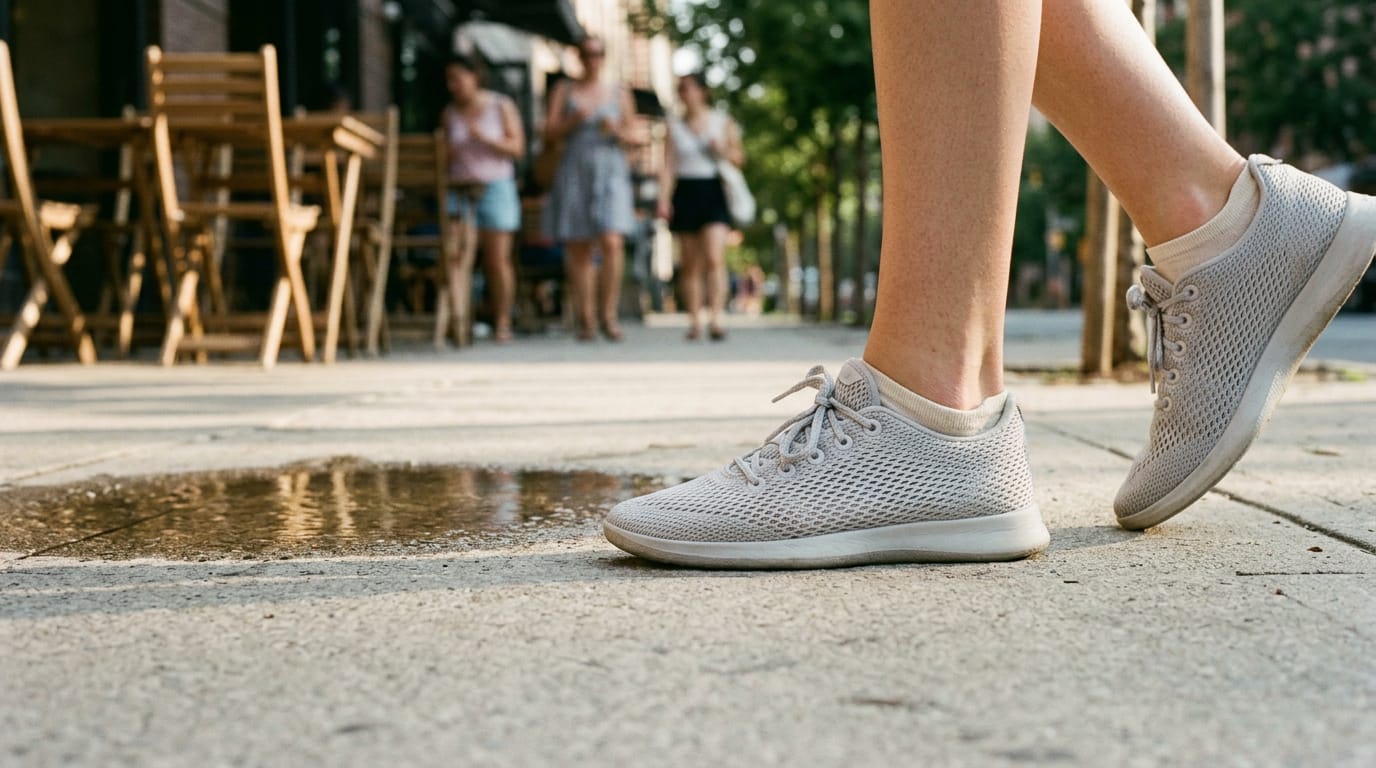
Mesh panels let air move through the shoe, which matters on warm days. Waterproof models are rarely needed for everyday use, so don’t pay extra for one. Road shoes breathe better, which suits the pavement most everyday wear happens on.
How long grip and outsoles last
Grip fades gradually, so check it before you buy and as the miles add up. Look at the outsole, the rubber bottom that meets the ground, and see how much rubber is left under your heel and the ball of your foot.
Rubber coverage matters too: bare foam showing through means the grip is gone. Test traction on a wet surface if you can, since a shoe that grips dry tile can still slide when wet.
Cheap shoes tend to wear faster, so a bargain pair can cost more over a year.
Knowing when it’s time for new shoes
Shoes don’t announce when they’re finished. The Cleveland Clinic notes that running or walking shoes should be replaced every 300 to 500 miles, a common guideline many runners follow. Watch for these signs too:
- New aches in your shins, knees, or feet
- Blisters that keep showing up in the same spots
- Visible sole wear, especially where the rubber has gone smooth or flat
If you wear your running shoes every day, a twice-yearly check is a useful rule of thumb. Pavement is hard on shoes, and all-day wear adds up.
Think of a server who jogs before her shift, then spends eight hours on concrete. Logging both her runs and her daily wear shows her when it’s time for a new pair, and it’s one reason many people keep separate pairs for running and all-day wear.
Shoes rarely warn you, so check them regularly.
What shoes cost and where to save
Premium models sit at the top of the price range, and the newest version isn’t always the smartest buy. Clearance racks are a good place to save, especially on older models that already fit you well.
Before you spend, ask yourself how many miles you’ll run each week and what you need the shoe to handle the rest of your day. Spend on fit and mileage rather than the brand name.
Parts of a shoe you should know
Knowing the basic parts makes product descriptions easier to compare. Here’s the quick version:
- Upper: the fabric or mesh that wraps around your foot
- Midsole: the cushioning layer between the upper and the outsole
- Outsole: the rubber bottom covered above
- Heel counter: the firm cup around your heel that keeps it in place
- Collar: the padded opening around your ankle
- Tongue: the flap under the laces
- Gusseted tongue: a tongue attached along its sides to the upper, so it stays in place as you lace up
How We Test and Who Does It
Running shoes earn their spot in your closet only if they hold up on real roads and feel right on your feet. Here’s how we check both.
Real runs, lab tests and wear panels
We check shoes in four main ways:
- Real-world run testing: Testers wear each pair on the roads and trails where you’d use it, noting how the cushioning holds up mile after mile.
- Lab measurements: We record objective numbers, such as weight and how firm the midsole is under load, so you can compare shoes side by side.
- Cutting shoes in half: We cut certain pairs in half to see how the foam and internal structure are built, which helps explain how durable a shoe really is.
- Wear-tester panels: Groups of everyday wearers use the shoes through daily life, not just running, and report back on comfort and durability.
The lab shows what a shoe measures, but only the road shows how it feels. Feel still counts.
Who tests and how shoes are sourced
Our testers are experienced runners who know what a shoe should feel like at mile five and at mile fifty. Consider a parent who squeezes in three easy morning runs a week, then wears the same sneakers to the grocery store and the kids’ soccer sidelines.
That’s the mix we test for: everyday wear, not just race day, so you’ll know whether a pair handles both.
We buy the shoes we review ourselves, just as you would.
Some links on this page are affiliate links, so we may earn a commission if you buy through them.
Our testing history spans years, so we can compare each new version against the ones we’ve already worn out.
Running shoes can handle everyday duty well when you choose them with your whole week in mind, not just your longest run.
Get the fit right, pick support and cushioning that suit your feet, and keep an eye on mileage so the cushioning doesn’t quietly wear out.
Do that, and one pair can carry you from the trail to the checkout line without sore feet by dinner. Good shoes disappear once you’re moving. That’s the whole point.
References
- Frontiers | Metabolic effects of carbon-plated running shoes: a systematic review and meta-analysis — frontiersin.org (2026)
- Biomechanical Analysis of Running in Shoes with Different Heel-to-Toe Drops — doi.org (2021)
- Running shoes for preventing lower limb running injuries in adults — pmc.ncbi.nlm.nih.gov (2022)
- The effect of the heel-to-toe drop of standard running shoes on lower limb biomechanics: Footwear Science: Vol 11 , No 3 — tandfonline.com (2019)
- Shoe Cushioning Influences the Running Injury Risk According to Body Mass: A Randomized Controlled Trial Involving 848 Recreational Runners — pubmed.ncbi.nlm.nih.gov (2019)
- Tips on How To Prevent Shin Splints — health.clevelandclinic.org (2026)
Questions
What is the best running shoe for everyday use?
A daily trainer is usually the best running shoe for everyday use because it balances cushioning and support for running, walking, and time on your feet. The best model depends on your fit, foot support needs, and routes; the Adizero Evo SL is a top all-round pick, while the Novablast, Ghost, Ride, and Pegasus are dependable alternatives.
Can running shoes be used for daily use?
Yes. Running shoes, especially daily trainers, can work well for errands, walking, and many jobs that keep you on your feet. For all-day standing, prioritize a secure fit, cushioning, and a stable heel; if you rarely run, a walking shoe may suit you better.
Should I get running shoes for everyday use?
Yes, if you run regularly and want one pair for both running and daily activities. Choose a daily trainer that fits well and suits your routes and support needs, and replace it when its cushioning or outsole wears down. If you rarely run, consider a walking shoe instead.
Sources
- Tips on How To Prevent Shin Splints, health.clevelandclinic.org,
- Biomechanical Analysis of Running in Shoes with Different Heel-to-Toe Drops, doi.org,
- The effect of the heel-to-toe drop of standard running shoes on lower limb biomechanics: Footwear Science: Vol 11 , No 3 - Get Access, tandfonline.com,
- Frontiers | Metabolic effects of carbon-plated running shoes: a systematic review and meta-analysis, frontiersin.org,
- Running shoes for preventing lower limb running injuries in adults - PMC, pmc.ncbi.nlm.nih.gov,
- Shoe Cushioning Influences the Running Injury Risk According to Body Mass: A Randomized Controlled Trial Involving 848 Recreational Runners - PubMed, pubmed.ncbi.nlm.nih.gov,
Find your level
The Counter