Golf Swing Drills That Fix Common Misses
Golf swing drills build a repeatable motion, with skill-level practice for setup, clean contact, short-game control, and no-equipment work at home.


Think about learning a new recipe from a written list alone. The ingredients are there, but timing and feel make the dish. A golf swing works the same way, and drills are where the motion starts to feel like yours.
Here’s the short answer: the best drills are simple, repeatable, and aimed at one problem you can see in your ball flight.
We’ll cover drills by swing phase, short game work, at-home practice, and fixes for common misses, plus the gear and fit basics a good golf shop would share.
Planning Golf Swing Drills by Skill Level
Before you grab a club, decide what you’re working on, because the right drills depend on where your game is today.
Why drills work better than aimless hitting
Picture a weekend golfer who fills a bucket every Saturday but never fixes the slice. That’s a lot of reps with no plan. A drill gives you one job, like holding your wrist angle, so every swing counts, and that focused repetition builds muscle memory.
A systematic review on motor learning in golf notes that focusing on specific parts of the swing helps you learn the whole movement.
PaR (Plan-act-Review) golf research goes further, recommending that practice lean on planning and review, not the repetitious act of executing full swings.
Where new golfers should start practicing
Start small with two or three simple drills that each target one piece of the swing, like grip or setup. Put short game first, since chipping and putting need only a few balls and some open ground.
Keep repetition counts modest and stop when your focus fades. Drills suit all skill levels, from first-timers to seasoned players.
Set up a repeatable practice routine
Use the same structure each time so you can measure progress. A 60-minute session might run like this:
- Warm up for a few minutes with easy walking, arm swings and gentle turns to protect your back and shoulders.
- Work on one or two focused drills.
- Practice chipping and putting.
- Finish with a few full swings to see if the work carried over.
Keep score across sessions by logging each drill and how the ball flew in a notebook or phone note. Review that log every few weeks to track improvement over time.
Get Your Setup, Grip and Alignment Right
Your grip, alignment and posture set up everything that follows. Get them right first.
Grip the club the right way
Hold the club in your fingers, not your palm. Then set your V, the gap between your thumb and index finger, so it points toward your back shoulder. At address, you should see visible knuckles on your lead hand, usually two or three.
Practice regripping without a ball a few times while you watch TV, until the feel is automatic.
Line up square to the target
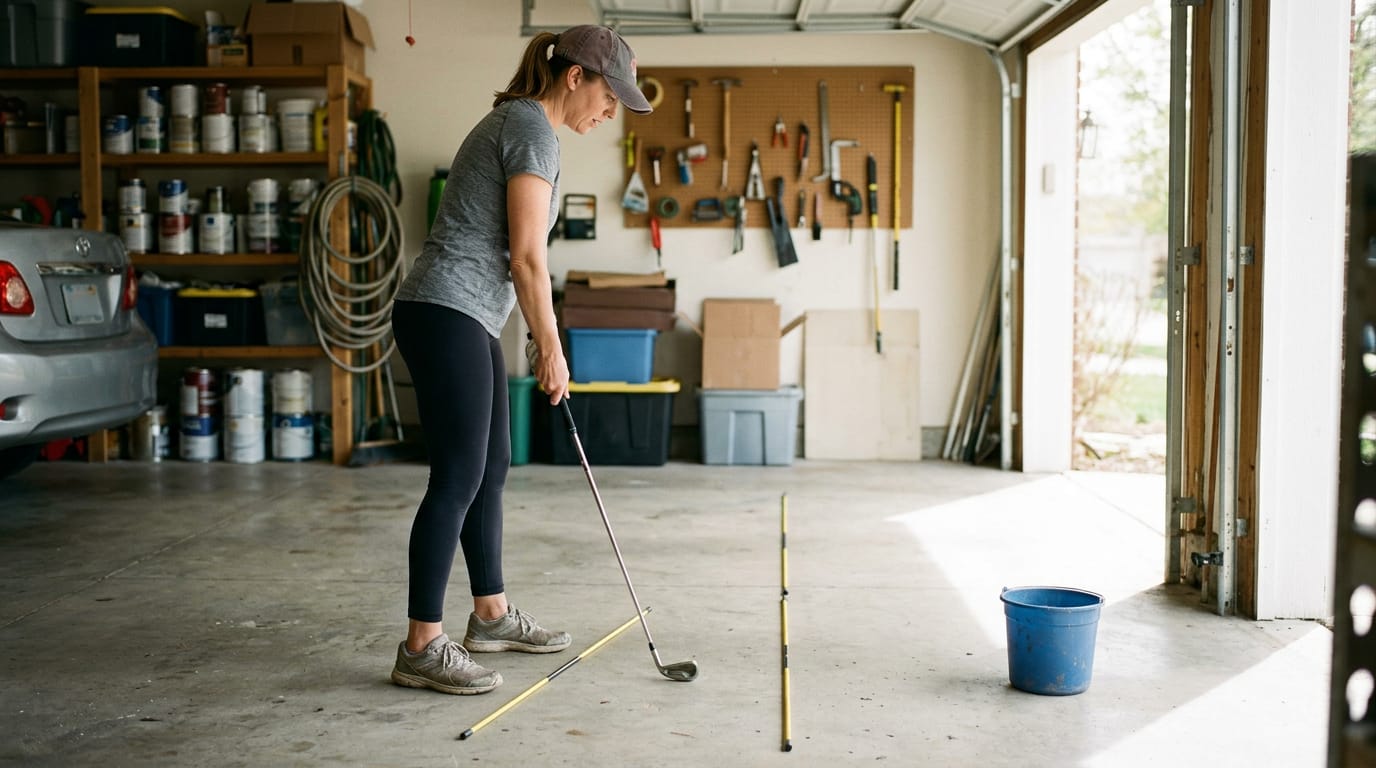
Good alignment means your body and clubface point where you want the ball to go. Lay an alignment stick on the ground along your target line, then place a second one parallel to it at your toes.
Your feet, hips and shoulders should run parallel to that line, with the clubface square to the target, not open or closed.
Think of a weekend golfer who keeps missing right. Lining up two sticks on her garage floor shows her shoulders aimed right of the target, so she can fix her aim before she ever swings.
Cheap alignment sticks or even a club laid on the floor work fine for home practice.
Use a mirror to check your form
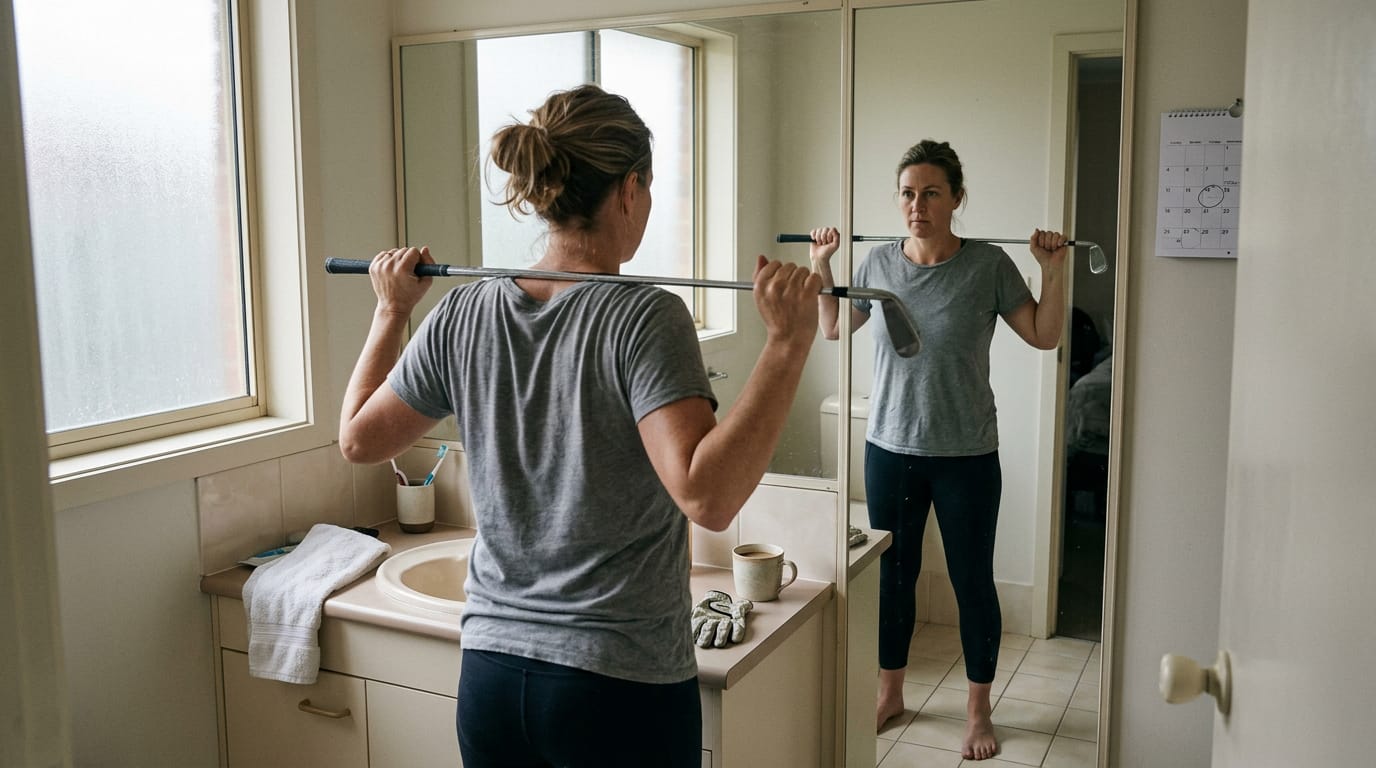
A full-length mirror is one of the cheapest coaches you’ll ever have. Start with a mirror drill for setup, then try the shadow swing drill: swing slowly without a ball and watch these three things:
- Head: does it stay steady or drift toward the target?
- Shoulders: do they turn back and through smoothly?
- Hips: do they turn with your upper body or slide sideways?
Slow reps reveal more than fast ones.
Sequence Your Full Swing with Drills
A good swing is a chain, and each link sets up the next. These drills follow that order, from your feet to the top of your backswing.
Move your weight and feet correctly
Try the step-through drill: swing to the finish, then step your lead foot toward the target as the club comes through. That teaches your lower body to fire first and your weight to shift from back to front.
It also helps prevent the over-the-top move, the outside-in path behind many slices.
Think of a weekend golfer who’s fought a slice all season. After a few weeks of step-through reps, her weight moves forward on its own and her drives find the fairway.
Rotate your body around a still head
Turn around your spine rather than swaying off it. Cross your arms over your chest with the club across your shoulders, then make full turns back and through.
Keep your head still while your hips and knees follow your shoulders, so your chest faces the target by the finish. Your head is the anchor.
Keep your arms and torso connected
When your arms drift from your body, the swing falls apart. Tuck a towel under both armpits and swing without letting it drop. Then swap in a soccer ball or volleyball and keep it from falling the same way.
Your arms and torso should move in sync, together rather than in separate pieces. If the towel stays put, you’re connected.
Smooth takeaway and a sound backswing plane
Start back smoothly, since a rushed takeaway throws off everything after it. Speed is a result of good rhythm, not a goal you chase.
These drills build your plane, the tilted path the club travels around your body, and a steady tempo, the rhythm of your swing:
- Alignment stick takeaway. Lay a stick along your target line and swing the club back parallel to it.
- Pause at the top. Hold a beat at the top to check your position.
- Wall drill for plane. Stand with your trailing side near a wall and make slow backswings, feeling for a consistent path.
- Slow-motion backswing. Count ‘one’ on the takeaway and ‘two’ at the top, using the same count every time.
Drills for Clean Contact and Clubface Control
Solid contact comes before distance, so these drills build from irons to the driver.
Fix fat and thin iron shots
A fat shot hits the ground before the ball, and a thin shot catches the ball too high on the face.
Claude Harmon at GOLF.com uses a tee drill: push a tee low into the ground about one inch in front of the ball, which encourages you to strike the ball before the ground.
Then try hit ball then ground, taking a small divot just past the ball. Picture a weekend player chunking 7-irons short of the green. A three-ball line setup helps: line up three balls in a row, hit each in turn, and keep your ball position steady.

Keep the clubface under control
Hit shots with the face open, closed, then square:
- Open face: the usual cause of a slice, which curves right for a right-handed golfer.
- Closed face: the usual cause of a hook, which curves left.
- Square face: the position you’re aiming for at impact.
To fix a slice, check for an open face at impact. For a hook, check for a closed one.
Use a shortened 7-iron swing for control, then focus on hand feel at impact. Slow the iron swing so you can feel the face square up, and work on feel rather than force.
Build up your driver swing gradually
The driver is the hardest club to control, so earn speed in stages:
- Slow-motion driver swing: rehearse your path and face at a slow tempo.
- Gradually increase speed: add pace in steps, moving up only when contact stays solid.
- 4-out-of-5 fairway challenge: hit four of five drives into the fairway before adding speed.
- Pre-shot routine under pressure: repeat the same routine every swing, even with a group waiting.
Control first, speed second.
Sharpen Your Short Game
Putting, chipping and bunker play can lower your score without a swing overhaul. Each has a simple drill you’ll run on the practice green.
Work on putting with gates and tees
Start with a gate: push two tees into the ground just wider than your putter head. Roll putts through it with the face square to the target and the path straight through the gate.
Work through short, mid and lag putts (long putts that finish close to the hole), aiming for a smooth stroke, not a hard one. A weekend golfer who warms up this way before each round soon rolls her putts on her intended line.
Dial in chip distance and landing spot
In the circle chipping drill, chip a handful of balls placed in a ring around the hole. In the towel carry drill, land the ball on a towel laid on the green. Your landing spot is where the ball first touches down, and it controls how far the ball rolls.
Use one landing spot for every chip, so distance comes from where the ball lands, not how hard you swing. Let feel set the distance, and choose a lower-lofted club for a running shot or a higher one for a soft stop.
Get consistent contact from bunkers
In the line in the sand drill, draw a line one inch behind the ball and swing so the club enters the sand on that line. Your entry point should be the same spot every swing. Let the club slide under the ball, so the sand lifts it out.
The goal is a slide, not a dig. That’s what turns a scary shot into a routine one.
Practice at Home Without Any Equipment
You don’t need a driving range or a full bag to get better.
Drills you can do indoors or outside
Start with mirror, wall, and towel drills. Check your posture and grip in a mirror, then make slow swings with your back a few inches from a wall to feel where your arms stay in bounds.
Next, try a shadow swing outdoors. Move slowly so your feet and hips match the rhythm of your arms, making the swing feel like one connected turn.
Most of this work needs no course, no tee time, and no gear. Small spaces work too: a hallway or spare bedroom is plenty, as long as your swings stay controlled.
Consider a weekend golfer who reaches the range once a month. She spends five minutes each morning checking her shoulder turn and grip in the bathroom mirror, so her swing feels familiar when Saturday’s round starts. Consistency beats marathon sessions.
Use everyday items as practice aids
Chances are you already have these around the house:
- Towel. Roll it and tuck it under your arms to keep them close to your body. If your elbows drift away, the towel slips, and you’ll know to adjust.
- Soccer ball or volleyball. Tap a soft ball on the lawn with a club to practice a centered strike. It’s easier to track than a small golf ball, so you can focus on contact.
- Alignment stick or club. Lay one on the ground along your target line to check that your feet, hips, and shoulders point where you want.
- Practice mat and net setup. A mat and hitting net let you swing repeatedly without chasing balls. This is about repetition rather than distance.
Tech and Gear That Support Your Practice
Drills only pay off when your gear fits and you can see what your swing is doing.
Learn from your simulator and launch monitor
Your simulator turns a hunch into a number. The TruGolf LaunchBox data shows ball speed, spin, and path for every shot, so you can tell whether a drill actually changed anything.
A weekend golfer chasing a drifting drive can check the path numbers instead of guessing.
Ball speed shows how solidly you’re hitting it, spin adds detail about the strike, and path shows where the club travels through impact.
Year-round simulator practice keeps your progress alive. Rain or a cold January doesn’t have to erase your gains.
Short game practice modes let you rehearse chips and pitches, even when the range is closed. The numbers show what happened, not how it felt. Believe the numbers.
Gear beginners should check before drilling
Even a well-designed drill can’t fix equipment that doesn’t fit you. Check these three things first:
- Golf gloves for grip: A well-fitting glove keeps the club from sliding, so your grip stays steady.
- Consistent hand position: A familiar glove gives your hands the same starting point every time you set up.
- Check club fit before drilling: Ask for a fitting that checks length and lie, the angle the sole sits against the ground. A club that’s wrong for you can cause a miss no drill will fix.
Consider a retired golfer who drilled for a month with old clubs and kept making the same miss. A quick fitting showed the clubs didn’t suit them, and the next session finally felt like progress. Fit first, then drill.
Good golf practice doesn’t have to be complicated. Start with your setup, grip, and alignment, build through each swing phase, and use short game and at-home work to keep your feel sharp between range sessions.
When a miss shows up, you’ll have a fix to match it instead of guessing. Pair that with gear and a fit that suits how you actually play, and every practice minute starts working harder for you.
Practice with a plan, and the swing you want will start showing up on the course.
References
- Motor learning in golf—a systematic review — pmc.ncbi.nlm.nih.gov (2024)
- PaR (Plan-act-Review) Golf: Motor Learning Research and Improving Golf Skills — doi.org (2014)
- Struggling to make solid contact with your irons? Try this | Instruction — golf.com (2022)
Sources
Find your level
The Counter