Parts of a Bike Wheel Explained, Piece by Piece
Parts of a bike wheel: see how rims, hubs, spokes and tyre size numbers work, then choose wheels that fit your bike and riding style with confidence.

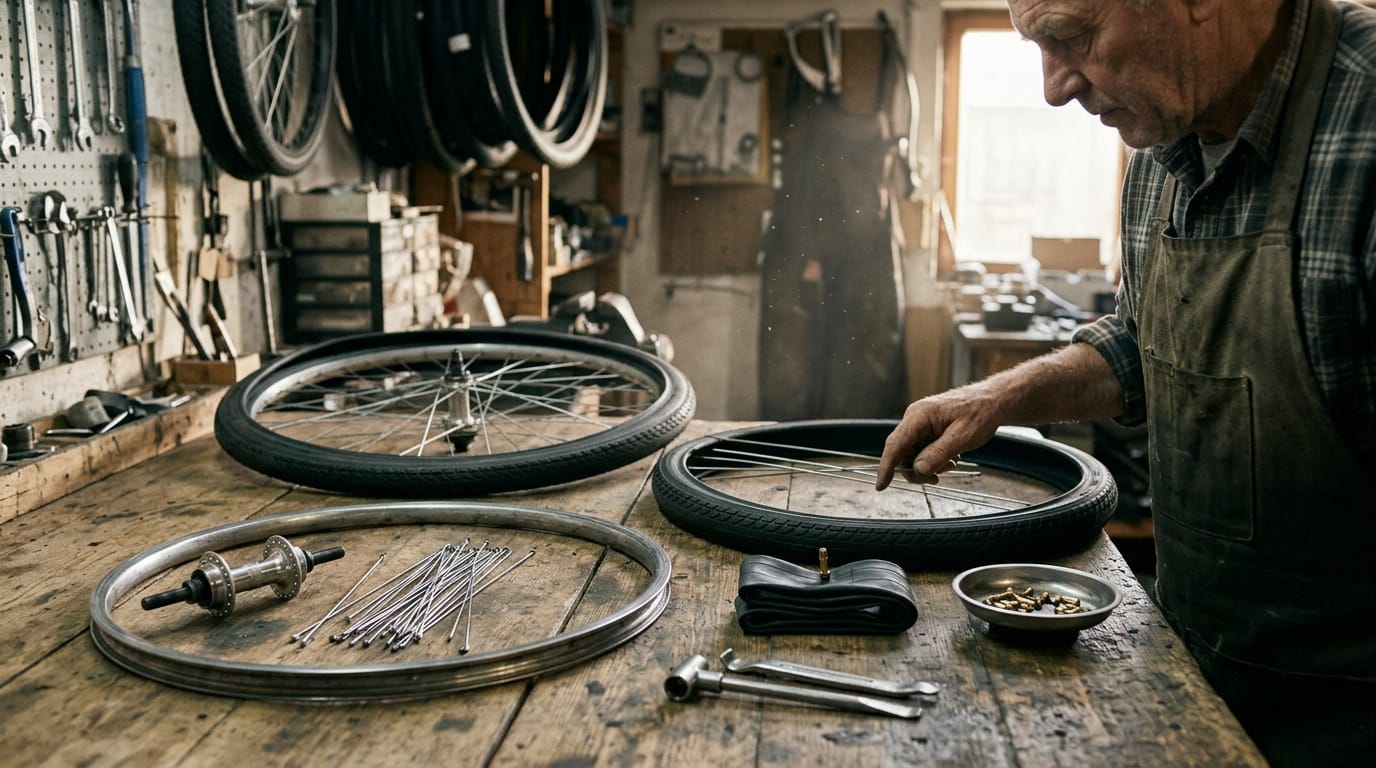
Think of a bike wheel like a well-built bridge: many thin parts sharing the load so the whole thing stays strong as it spins. You rarely notice them until something goes wrong.
A wheel is made of a rim, a hub, spokes, an axle, and a tyre, and each part shapes how your bike rolls, feels, and stops.
In this guide, we’ll walk through every part, decode the numbers printed on tyres, and help you match your wheels to how you ride before you buy or replace them.
The Main Parts of a Bike Wheel
A bike wheel packs several roles into a few parts, so here’s how we break it down.
How the wheel grips, drives and supports
The wheel does three jobs:
- Contact point: The tyre is the only part touching the road or trail.
- Traction and propulsion: Chain power reaches the rear wheel, and the tyre’s grip turns it into forward motion.
- Support: The wheel carries the weight of the bike and rider.
Consider a parent riding a kid to school on a wet morning. Worn tread means less grip, so checking it before the rainy season keeps the ride predictable. Pressure shapes comfort too: firmer tyres feel quicker, softer ones soak up bumps.
Tyre choice is less about looks and more about matching the ground.
What are the things inside a bike wheel?
The things inside a bike wheel are called the hub, spokes, rim, tyre, nipples and axle:
- Hub: The centre, where the axle passes through.
- Spokes: Thin wires running from the hub to the rim.
- Rim: The outer ring the tyre sits on.
- Tyre: The rubber cover that meets the ground.
- Nipples: Small fittings that anchor each spoke and let you tighten it.
- Axle and skewer: The axle runs through the hub; a skewer or thru-axle holds the wheel in the frame.
Inside the tyre you’ll find an inner tube or a tubeless setup, where the tyre seals straight onto the rim.
Is a bike wheel and axle the same thing? Not quite: the wheel spins around the axle.
Spokes keep the rim centred on the hub, and nipples let you adjust them. A wobbly wheel often points to a loose spoke. Check it early.
Other bike parts include the frame, fork, handlebars, saddle, pedals, chain and brakes.
The Rim That Holds the Tyre
The rim is the metal hoop you see first, and it does more than frame the wheel.
How the rim holds the tyre in place
The rim is the outer ring the tyre sits on. Its tyre bed is the channel where the tyre’s beads lock in place.
On rim-brake bikes, the brake pads clamp the rim’s sides, so the rim doubles as the braking surface. Disc brakes grab a separate disc instead. The rim’s closed hoop-shaped structure keeps the wheel round.
A weekend rider with a rim-brake road bike and a disc-brake gravel bike needs wheels that match each bike’s brakes, so no set ends up on the wrong bike.
Aluminium, carbon or steel rims compared
Rims come in three main materials:
- Aluminium: cheaper and durable, the safe default for training.
- Carbon: lighter and stiffer, but costly.
- Steel: the less common option you’ll still come across, worth knowing about.
The right choice is less about what’s impressive and more about how you ride. Take a club rider who logs most miles on training loops: aluminium serves her better than a carbon set she fears scratching. Carbon’s the upgrade, not the starting point.
How rim depth affects speed and climbing
Rim depth is how tall the rim’s profile is, and it changes how a wheel behaves on hills and flats.
- Shallow rims: suit climbing, where a lighter feel matters most.
- Mid-depth rims: the all-rounder, a sensible default for mixed riding.
- Deep rims: built for speed and time trials.
- Full disc wheels: a solid, spokeless extreme, used mainly in time trials.
Depth’s about where you ride, not how good the wheel is. The catch with deep rims is crosswinds. Gusts push hard against the tall profile and make the bike harder to steer, and full discs feel that most.
Matching rim width to your tyres
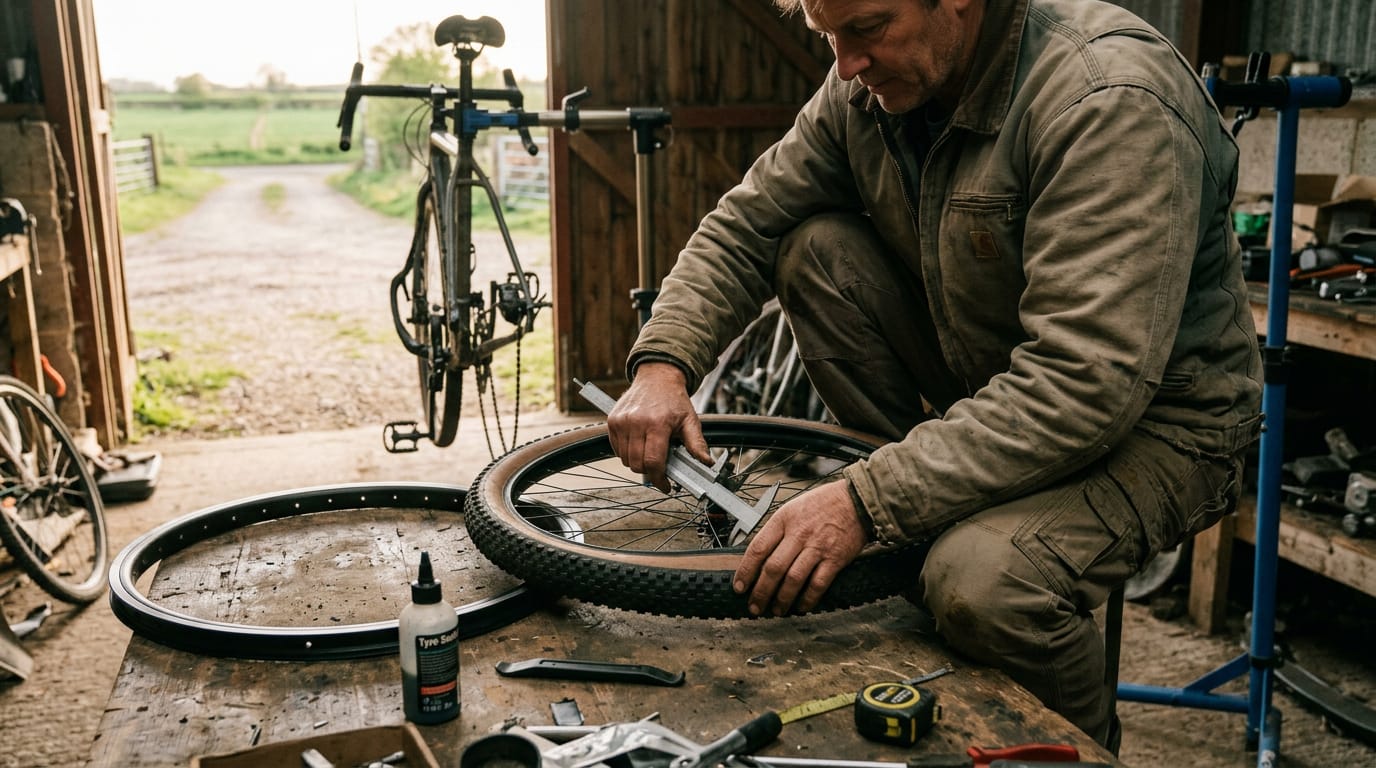
Rim width dictates which tyre sizes fit well, so match it to the tyres you plan to run. The internal width, measured across the rim’s inside, is what counts. Gravel rims are generally built wider inside than road rims, so they can take wider tyres.
The bead seat diameter, the surface where the tyre’s bead sits, must match the tyre or it won’t seat properly. Width also shapes the tyre’s profile, which affects comfort and handling.
For example, a parent buying a gravel bike for farm tracks can avoid buying new wheels later by checking the rims take wider tyres now.
Rim styles for each tyre system
How the tyre seals to the rim decides which style you need:
- Clincher: the classic setup, with an inner tube inside a tyre whose beads hook onto the rim.
- Tubeless: the tyre seals directly to an airtight rim, usually with sealant.
- Tubular: a tyre and tube sewn into one unit and glued onto the rim.
- Hookless: a rim without bead hooks, so it needs tyres designed for it.
Check the tyre system first. Everything else follows.
The Hub and Freehub Explained
The hub is the quiet centre of the wheel, and it does more work than most riders realise.
Inside the hub and its materials
The hub is the central part of the wheel, where the spokes meet. It houses the bearings and axle, so the wheel turns freely instead of dragging. Hubs are made from alloy, carbon or steel, and each trades weight, cost and durability differently.
Disc-brake hubs also carry the rotor mounting, where the brake rotor attaches.
Why front and rear hubs differ
The rear hub is the more complex of the two, mainly because it handles drivetrain power transfer. The chain turns the cassette, and the hub carries that force into the wheel. The front hub mostly spins and carries load.
Put simply, the rear is about driving the bike while the front is about carrying it. That’s why they’re not interchangeable.
A club cyclist who orders a spare wheel online might find it’s built for the wrong end of the bike, so checking before you order saves a return and a week off the bike.
How the freehub and cassette work together
The freehub is the part of the rear hub that allows coasting. A ratchet inside it engages when you pedal, driving the wheel forward, and lets go when you stop, so the wheel keeps spinning while your legs rest.
The cassette, the cluster of sprockets on the back wheel, mounts on the freehub body, and the chain shifts between them to change gears. Speed and brand compatibility matter: the cassette has to match the freehub body’s speed count and brand.
Fixed-gear bikes have no freehub, so the pedals always turn with the wheel and there’s no coasting. Think of a rider gliding down a long hill to a café stop without pedalling once. That’s the freehub doing its job.
Specialty hubs for lights, motors and more
Not every hub is standard. Here’s what to know about a few specialty types:
- Dynamo hubs generate power as the wheel turns, so lights run without batteries, which suits a commuter riding home at dusk.
- E-bike motor hubs house a motor in the wheel to add assistance.
- Premium CNC handbuilt hubs are cut by computer-guided tools (CNC, or computer numerical control) and assembled by hand, suiting riders who want something tailored.
- Sealed and larger bearings keep grit and water out and carry more load, useful on wet commutes or heavier bikes.
Spokes and Nipples That Hold It Together
Spokes do the quiet structural work in a wheel, and nipples let you fine-tune them.
How spokes link the hub to the rim
Spokes connect the hub to the rim, sharing your weight and every bump across the wheel. They also hold tension that keeps the rim round and rigid.
More spokes make a tougher wheel, but they also add weight, so the count is a trade-off. Rear wheels often have more than front ones because they also handle pedaling force.
Spoke shapes, lengths and materials
Length and gauge (wire thickness) vary by wheel, so replacements must match the original. A club cyclist who snaps a rear spoke after training needs the exact fit, not a close guess.
Shape changes how a spoke behaves:
- Bladed spokes are flattened to cut wind resistance.
- Butted spokes are thinner in the middle and thicker at the ends.
- Round spokes are plain, even-thickness wire.
Straight-pull spokes run straight into the hub, while J-bend spokes hook at the hub end.
Steel is the common, sturdy default, while carbon fibre is lighter but usually pricier. If you ride rough roads, weigh durability before lightness.
Using nipples to true a wobbly wheel
Each spoke ends in a nipple, a small threaded fitting that anchors it to the rim. Turning it changes that spoke’s tension and pulls the rim toward one side. Adjusting spokes this way is called truing, and it’s how we get the rim running straight again.
Say a weekend rider notices a wobble rubbing the brake pads. Small, even nipple adjustments, checked often, can bring it back into line. Catch it early.
Signs of wear include a wobble that returns soon after truing, a slack spoke, or a rounded nipple that won’t turn. Those call for a shop, not more tweaks.
How the Wheel Attaches to the Bike
Before you pull a wheel for a repair, you need to know how it’s held on. Every wheel is secured to the frame through its axle, the rod that runs through the center of the hub, and the way that clamp works depends on the bike.
Three ways a wheel can be fastened
Most bikes use one of three systems:
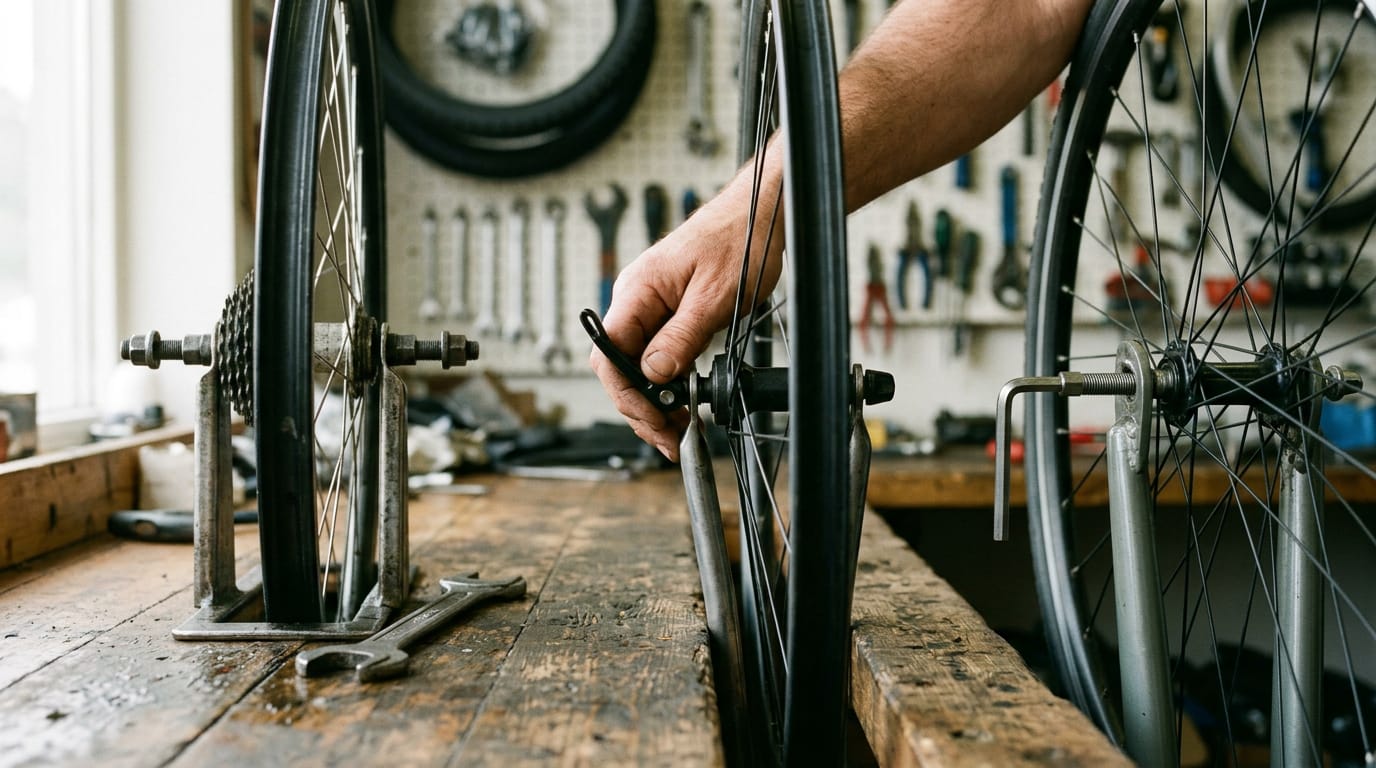
- Bolt-on axle with nuts. Nuts thread onto each end of the axle and clamp the wheel in place, so you’ll need a wrench to take it off.
- Quick release lever. A lever on the hub clamps the axle, and you flip it open by hand with no tools.
- Thru-axle with Allen key. The axle passes all the way through the frame and is tightened with an Allen key (a hex key).
Picking a thru-axle or quick release
The choice comes down to how you ride and what brakes your bike has. A thru-axle is stiffer and stronger than a quick release. Its axle runs straight through the hub bearings, and it pairs best with disc brakes.
The quick release, by contrast, is tool-free, which matters if you pull wheels often. Think of a parent who rides to the park with a kid every Saturday and wants to take the back wheel off to fit the bike in the car.
A quick release lets them do that in seconds with bare hands, while a thru-axle means grabbing an Allen key first.
Pick for the riding you actually do, not the riding you hope to do.
How Disc and Rim Brakes Differ
Your brake type decides what the wheel has to do.
Making sure wheels match your brakes
A wheel has to match the brake type on your bike, so look at your frame and fork before you shop. A rim brake squeezes pads against the rim, so the wheel needs a braking surface there.
A disc brake clamps a rotor, so the wheel needs rotor mounts on the hub.
What disc brake wheels need and offer
Disc brakes do their work at the hub, not the rim. The rotor bolts onto the hub, and the pads squeeze it to slow you down. Disc systems come in hydraulic and mechanical versions.
Hydraulic brakes push the pads with fluid, while mechanical brakes use a cable.
Picture a commuter caught in a downpour. They need the bike to slow on the first squeeze of the lever, and that’s where disc brakes earn their place. A Cyclingnews comparison notes that disc brakes are much less affected by wet weather than rim brakes.
Rotors are replaceable, so a worn one is a part swap, not a whole new wheel. Disc wheels also need a reinforced hub and spokes to handle the braking forces.
Rim brake wheels and their trade-offs
Rim brakes show up on fewer modern bikes, so you’ll see them less on new models. Their trade-offs are worth weighing:
- Light and easy to repair. Rim brake wheels are lighter and simpler to fix at home.
- Rim wear. The pads grind against the rim itself, so over time the rim wears out.
- Weak in wet weather. They lose ground in the rain, the flip side of the disc advantage above.
Match the wheel to how you ride.
Choosing Tyres, Tubes or Tubeless
The tyre is where your bike meets the ground, so choose it carefully.
How tyres grip and how they’re sized
Your point of traction is the patch of tyre touching the ground, and it’s your bike’s only grip. Start by matching the bead seat diameter, the rim size the tyre’s edge locks onto, or it won’t seat properly.
Then keep the width inside the range your rim lists.
Wider tyres add grip on rough ground, but narrower ones feel quicker on pavement. Think of a city commuter: a narrower tyre inside the rim’s range means less effort.
Matching tread to the terrain you ride
Tread matches the surface in front of you:
- Knobbly for mountain biking. Raised knobs bite into dirt and loose rock.
- Slick for road. Smooth tread puts more rubber on dry pavement.
- Fast-rolling for gravel. A lightly textured tread rolls quickly and still grips loose stones.
A weekend rider who mixes paved roads with gravel towpaths can cover both with one fast-rolling tread. Buy for the terrain you ride, not the trail you hope to tackle.
How tube and tubeless setups differ
Three setups differ mainly in how they hold air:
- Clincher with inner tube. The tyre hooks onto the rim, and a separate tube holds the air.
- Tubeless with sealant. The tyre seals to the rim, and sealant plugs small punctures.
- Tubular glued to rim. A sewn-up tyre attached to the rim with glue.
A clincher is easiest to fix roadside with a spare tube, and tubeless may need a plug for larger holes. Tubulars are the hardest to fix on the go.
Fitting is easiest with a clincher, which needs just tyre levers. Tubeless takes patience to seat, and tubulars need glue and time. Easy fixes win when you’re miles from home.
What Wheel Size Numbers Actually Mean
Wheel size labels look like a code, but they follow a few simple patterns. Let’s decode them one group at a time.
Road and gravel sizes at a glance
Most road and gravel bikes run 700C or 650B wheels. The tyre’s width figure, given in millimetres, is the quickest way to spot the difference, since road tyres are narrower than gravel tyres.
Think of a weekend rider who wants one bike for club rides and rough backroads. Checking the width figure first shows whether a road or gravel setup fits how they really ride.
Mountain bike wheel sizes in inches
Mountain bikes measure wheel diameter in inches, and you’ll mostly see:
- 26 inch
- 27.5 inch
- 29 inch
The 29 inch size, often called a 29er, matches 700C in diameter. Mountain bike tyre width is written in inches rather than millimetres, so it reads in a different unit.
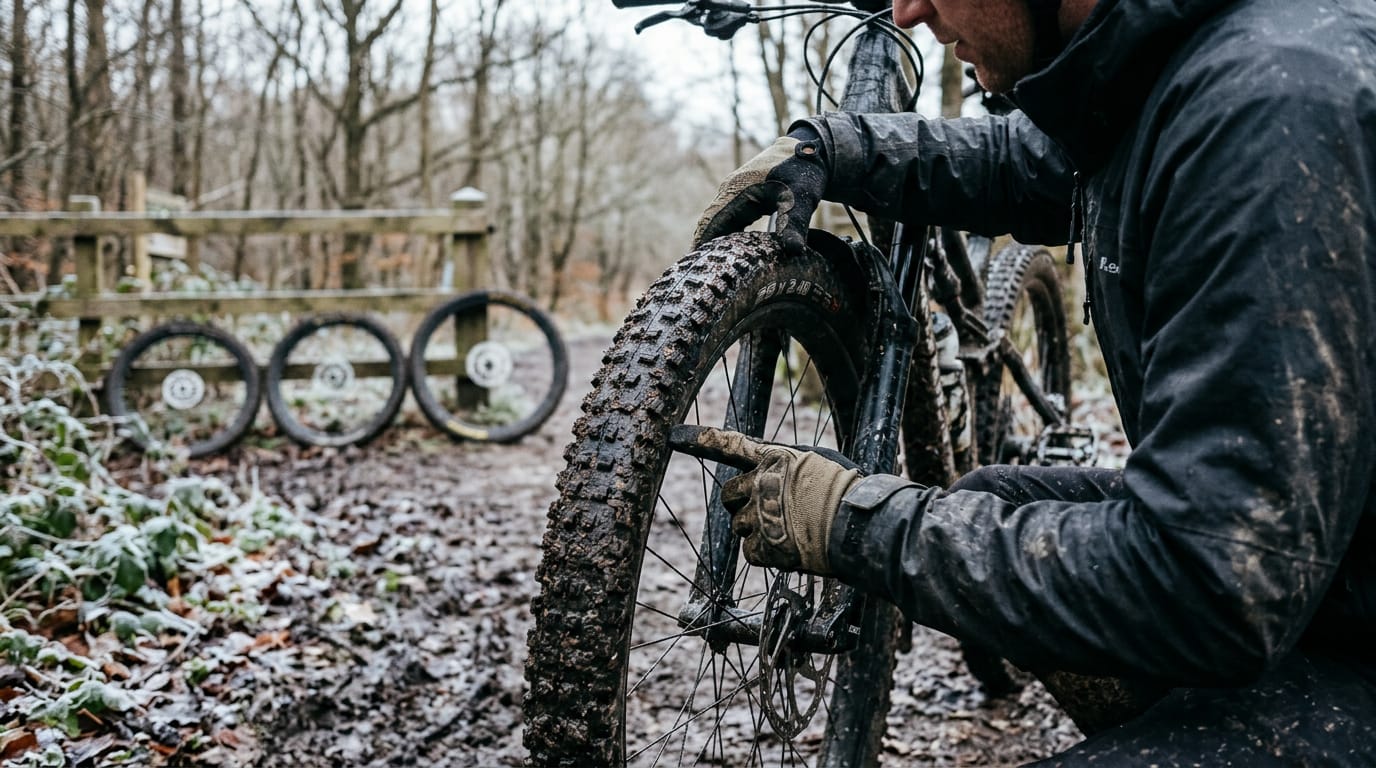
A trail rider hunting for more grip for winter mud can read the inch width on their current tyre and buy a replacement that fits the wheel.
How far tyre width can safely vary
Two tyres can share a diameter and still differ in width, so you have some room to choose. That room has a ceiling set by fork clearance, the space your tyre gets inside the fork and frame.
Width flexes within those limits, not beyond them, and extreme mismatches simply won’t fit. Check the clearance before you buy.
Which Wheels Suit Which Type of Riding
Here’s the key idea: where you ride should drive the choice, since each wheel type is built for specific ground.
Features of road, mountain and e-bike wheels
Road wheels are narrow, light and aero, built for speed on smooth pavement. Mountain wheels are wide and knobbly, built for grip on loose ground. E-bike wheels are built to support motor weight. Knowing what makes a bike an e-bike, from its motor to its legal class, helps when you shop.
If you ride a fixie, you’ll want a flip-flop hub, which runs a fixed gear on one side and a freewheel on the other.
What are the parts of a mountain bike (MTB) wheel? Every wheel shares these core parts:
- Rim: the outer hoop the tyre sits on.
- Hub: the centre that spins on the axle.
- Spokes: the wires linking the rim to the hub.
- Axle: the shaft the hub turns on.
- Tyre: the rubber that meets the trail.
Wider tyres and sealed hubs for gravel
According to BikeRadar’s buying guide, gravel wheels are designed to accommodate wider tyres measuring 32 to 50 mm. Look for an internal width of 20 mm or more, meaning the distance between the rim’s inner walls.
Better-sealed hubs keep grit and water out of the bearings. Most gravel wheelsets are tubeless (the tyre seals to the rim without an inner tube) and built for disc brakes.
Picking climbing, mid or deep wheelsets
Weight ranges vary by category, so compare each wheelset within its class. Rim depth, or how tall the rim is, sets what the wheel does best:
- Shallow: suits climbs.
- Mid-section: suits rolling terrain.
- Deep: suits time trials.
Think of a club rider on rolling weekend loops with the odd hill. A mid-section set covers that ground, and a deep race wheel would be overkill.
Tough, affordable wheels for everyday riding
You don’t need a race-grade wheel for every ride. Durable, cheaper wheelsets take the everyday miles, which extends performance wheel life.
Consider a parent who commutes on weekdays and rides with the kids on Sundays. A tough set handles potholes and drizzle, so the lighter wheels stay fresh for group rides.
Wet, gritty winter roads are hard on gear, so a tough set earns its keep. Expect more weight in return, since durability comes with heft. Match the wheel to your riding level, not your favourite rider’s set.
Everyday wheels should be judged on toughness rather than lightness.
Why some riders choose handbuilt wheels
Most factory wheels are machine-laced, meaning a machine does the lacing. Handbuilt wheels are laced by hand, so you choose each component yourself, and spoke replacement is easier too.
Touring builds favour durability, while performance builds chase lightness. Think of a rider loading up for a week away, who needs a wheel that can carry the load. Build for the job.
Choosing and Replacing Your Wheels
Replacing a wheel is a bigger call than it looks, so know what to weigh and what to check before you buy. Some parts, such as the tyre, the tube, and the cassette (the cluster of rear gears), replace separately, so you may not need a whole new set.
What to weigh before upgrading wheels
Better wheels can improve comfort, especially on the surfaces you ride most. But a full set can be very expensive, so start with the problem you’re trying to solve. Match the wheel to how you ride, not how you wish you rode.
Think of a weekend commuter who buys race-day wheels for stop-and-go city traffic. That money goes to speed the commute never uses, while a sturdier, simpler set would have been the smarter buy.
Checks to run before buying new wheels
Run through these checks first:
- Brake system. Rim brakes and disc brakes need different wheels, so confirm which type your bike has first.
- Gearing and hub type. The rear hub has to match your cassette, or the gears won’t work as expected.
- Front vs rear differences. The rear wheel carries the gears, so it’s built differently from the front. Check each one separately.
- Ask your local bike shop. A shop can check compatibility against your actual frame and brakes, and one quick conversation can save a return trip.
- Measure axle spacing before buying. Check the gap between the frame’s dropouts (the slots the axle sits in), front and rear, because a mismatched wheel won’t seat properly.
Consider a club rider who orders a rear wheel online without checking, only to find the axle won’t sit in the frame. Measure first, then buy.
A bike wheel is more than a circle of metal and rubber. Its parts work as one system, and when they match how you ride, your bike feels smoother, stops more predictably, and lasts longer.
Before you buy or replace, check your brake type, read the size markings, and be honest about where you ride. Those three checks save a lot of guesswork.
The best wheel is the one you forget is there, and now you know exactly what to look for.
References
- Best gravel wheels in 2026: top-rated gravel wheelsets and buying advice — bikeradar.com
- Disc brakes vs rim brakes in 2026: Understanding the differences — cyclingnews.com (2026)
Questions
What are the things inside a bike wheel called?
The main parts inside and around a bike wheel are the hub, spokes, rim, tyre, nipples and axle. The inner tube or tubeless setup sits inside the tyre.
What are the names of the bike parts?
Common bike parts include the frame, fork, handlebars, saddle, pedals, chain, brakes and wheels. Each wheel has a rim, hub, spokes, axle and tyre, among other parts.
What are the parts of MTB?
An MTB, or mountain bike, has a frame, fork, handlebars, saddle, pedals, chain, brakes and wheels. Each wheel includes a rim, hub, spokes, axle and tyre, usually with knobbly tread for grip on trails.
Why is it called a penny farthing?
“Penny farthing” refers to its two wheels: the large front wheel was like a penny, and the much smaller rear wheel like a farthing, an old British coin. The name distinguishes this high-wheeler from later bicycles with more similarly sized wheels.
Where is the best place to buy bike parts online?
The best place depends on the parts you need and your bike’s specifications. Buy from a reputable cycling retailer that provides clear compatibility information, and check brake type, axle spacing, wheel size and cassette fit before ordering; a local bike shop can help verify the match.
Is a bike wheel and axle?
A bike wheel rotates around an axle, so a wheel and axle are distinct parts of the wheel-and-axle mechanism. The axle runs through the hub, while the rim and tyre rotate with the hub.
Which is better, 7 gear or 21 gear?
Neither is universally better: 7 gears may be enough for flatter routes and simpler riding, while 21 gears provide a wider range for hills and varied terrain. The useful range and gear spacing matter more than the number alone.
Sources
Find your level
The Counter