What is a balk in baseball, and how do umpires call it?
What is a balk in baseball? See what happens to runners after the call, how 2023 rules limit step-offs, and how lefty and righty pitchers differ.

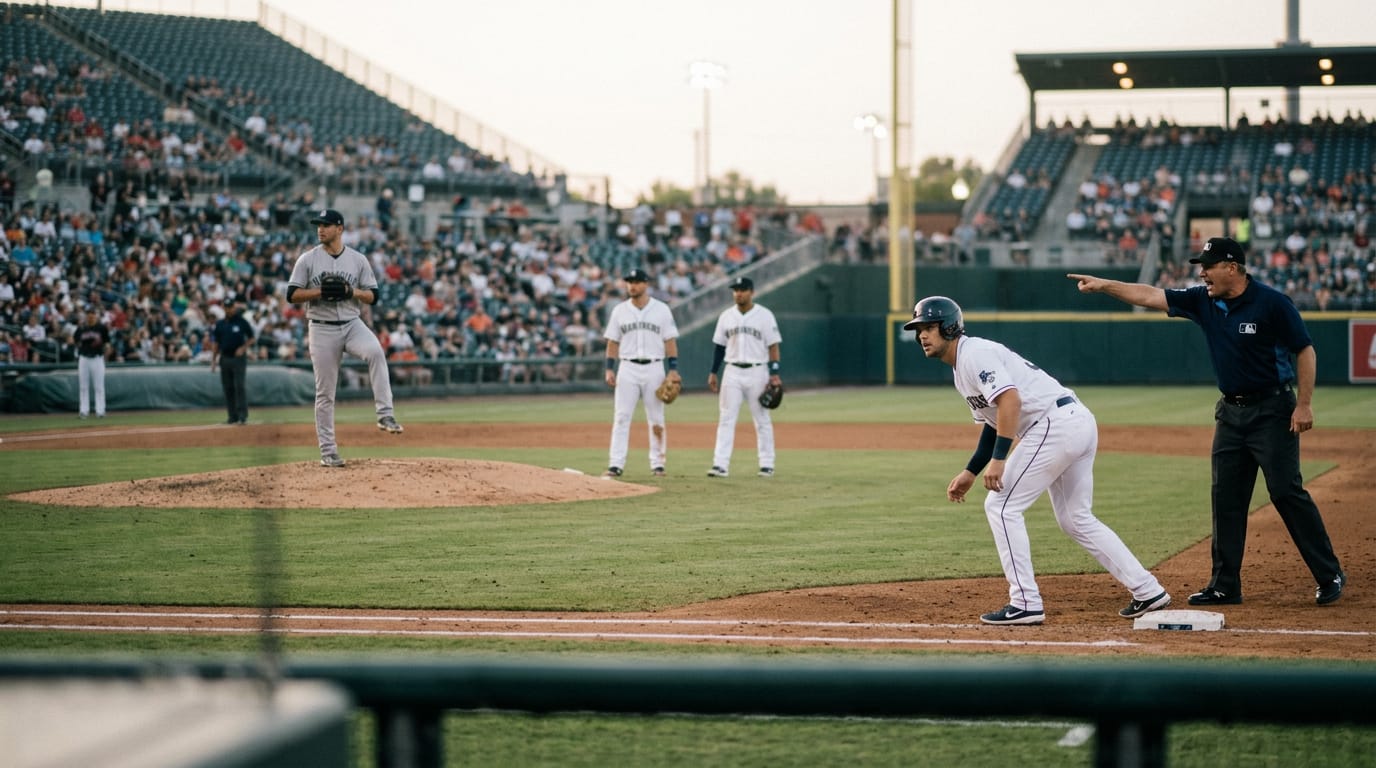
Picture a runner leaning off first base when the pitcher’s motion suddenly stops halfway through. The umpire’s arm goes up, and the play changes in a hurry. That’s a balk, and it’s one of baseball’s most misunderstood calls.
Here’s the short version: a balk is an illegal move by the pitcher that deceives a baserunner. Don’t worry if the rulebook feels confusing, because we’ll explain it plainly.
This post covers common examples, what happens after the call, the 2023 changes that limit step-offs, and how the rules shift from level to level. Whether you play, coach, or parent, you’ll leave knowing what to expect.
What Is a Balk in Baseball?
Here’s what we’ll walk through: what counts as a balk, why the rule exists, and how it changes when the bases are empty.
The basic idea behind the rule
A balk happens when the pitcher makes an illegal motion on the mound that deceives a runner. The rule isn’t about any unusual move. It’s about one meant to deceive. Umpires judge whether a move was deceptive, so their read carries real weight.
It only applies when someone is on base. Picture a 12-year-old in a rec league who stops halfway through her delivery and throws to first while the runner leans off the bag. The umpire may call a balk, and a coach can help her finish the motion cleanly.
Check your league’s rulebook. Balk rules can vary by level, from the majors to high school to youth ball, so the version your league follows matters most.
Why the rule protects base runners
The rule keeps the game fair for runners in three main ways:
- Prevents deceiving baserunners. A pitcher can’t use a misleading move to catch a runner off guard.
- Fair chance for base stealers. A runner should get a real look at the pitch, not a fake.
- Limits fake pitches and pickoffs. A show move to a base can’t freeze a runner in place.
When a move is genuinely unclear, the pitcher’s intent settles it: a real throw to a base versus a move built to fool a runner.
How the rulebook lays it out
Start with the rulebook itself. According to a balk explainer from Sport Rules, the Official Baseball Rules (OBR) list roughly 13 actions that count as a balk, under section 6.02(a).
The list reads like dos and don’ts for pitchers, and there’s no single tidy definition that covers every case.
With bases empty, it’s an illegal pitch
No runners means no balk. With the bases empty, that same motion is an illegal pitch, and the umpire adds a ball to the count. Same motion, different call.
Think of a weekend pitcher warming up with nobody on base. She uses the same quick move she’d use to hold a runner, and the batter gets an extra ball. A coach who spots this in practice can fix it early.
Common Ways Pitchers Commit a Balk
Most balks come from a few habits that feel harmless mid-game. Here’s where pitchers run into trouble:
Flinching, faking, or stopping mid-windup
- Flinching during the set. Picture a Little League pitcher who freezes halfway through her motion after a sudden noise from the dugout. The umpire calls a balk on the spot.
- Motion then no pitch. Starting the motion and not delivering counts, even if you were just adjusting your grip.
- Stopping mid-windup. Halting once the motion is underway is the same problem.
- Fake pitch while off the rubber. Stepping off doesn’t make a fake pitch legal.
Coming set without a full stop
The set position has its own checklist:
- Complete stop required. Rolling through the stop doesn’t count.
- Hands together in front. Keep them together in front of your body as you set.
- Quick pitch before batter ready. Don’t deliver until the batter is set.
- Hands separating without throwing. Pulling your hands apart without a pitch is a balk.
- Windup to set without stepping off. Switching from the windup to the set position without stepping off the rubber is a balk.
- Practice set-position stops in bullpens. Drill the stop in bullpen sessions until it’s habit, not something you have to remember mid-inning.

How pickoff attempts go wrong
- Must step toward base. A pickoff throw needs a step toward the base you’re throwing to.
- Lead foot direction matters. That foot has to head toward the base, not away from it.
- No stopping mid-pickoff throw. Once the throw starts, don’t halt it.
- Fake to third, throw to first. A fake throw to third followed by a throw to first is a balk.
Dropping the ball on the rubber
- Dropped on rubber is balk. If the ball falls while you’re on the rubber, it’s a balk.
- Accidental or intentional. A slip counts the same as a deliberate drop.
- Off rubber, ball stays live. Drop it after you’ve stepped off, and the play goes on.
What matters is where the ball lands, not how it got there.
Less obvious ways to balk
- Not facing batter. Turning away from the batter can draw a balk.
- Standing on rubber without ball. Standing there without the ball is a balk.
- Unnecessary game delay. Dragging things out on the mound can draw a balk call.
- Catcher outside box on intentional walk. If the catcher is outside the box on an intentional walk, that counts as a balk.
- Extra step or pivot-foot reset. An extra step or a pivot-foot reset on the rubber counts as a balk.
- Sleeve and distraction rules. Check your league’s rulebook for what a pitcher can wear and what can distract the batter.
Why can’t pitchers wear white sleeves? Whether they can depends on your league’s rulebook, and we don’t have a verified source for the reasoning behind that rule, so check before you buy a shirt.
Legal moves after stepping off the rubber
- Legal fakes once off. After you step off, fake throws to a base are legal.
- Treated like a fielder. Off the rubber, you’re treated like a fielder.
- Three legal actions on rubber. On the rubber, you can pitch, step off, or throw to a base.
Stepping off changes which rules apply to you, and it’s easy to forget that mid-game when a runner is dancing off first. Know that line cold.
What Happens After a Balk Is Called
Once the umpire calls a balk, the play changes fast. Here’s what happens next.
How runners move up after the call
When a balk is called, the rules hand the offense a set of automatic results:
- Each runner advances one base. A runner on first goes to second, and so on.
- Ball is dead. Play stops, so runners can’t push for extra bases.
- Runner on third scores. That run counts.
- Pitch thrown is nullified. It doesn’t count as a ball or a strike.
Think of a youth coach with a runner on third in a tied last inning. A balk sends that runner home without a swing.
When a pitch is thrown anyway
Sometimes a pitch is thrown anyway, and the play stays live. What matters is what happens on the bases.
According to Baseball Rules Academy’s explanation of the balk penalty, a balk is ignored and the play remains live if every runner advances at least one base. In that case, the balk is disregarded instead of enforced.
The 1977 Piniella example is worth looking up if you want to see this rule in action.
How a balk can swing a game
Don’t dismiss the balk as a technicality. Picture a parent in the bleachers on a tied Saturday, with a runner on third and one call deciding the game.
- Can decide close games. One free run can be the whole ballgame.
- Game-ending balk wins. If a balk scores the winning run, the game ends right there.
- Free bases for opponents. Every runner moves up, so the offense can gain bases without a hit.
How Lefty and Righty Pitchers Differ
The same move can look different depending on which hand throws it. Lefties and righties face different directions on the mound, so umpires check different things. Here’s how we’ll break it down, starting with lefties.
How lefty mechanics get judged
A left-handed pitcher faces first base directly before starting the delivery. The key check is the lead foot, the front foot that steps toward the base. It should land toward first base, not across the body or off to the side.
A 45-degree line guide helps judge where that foot lands.
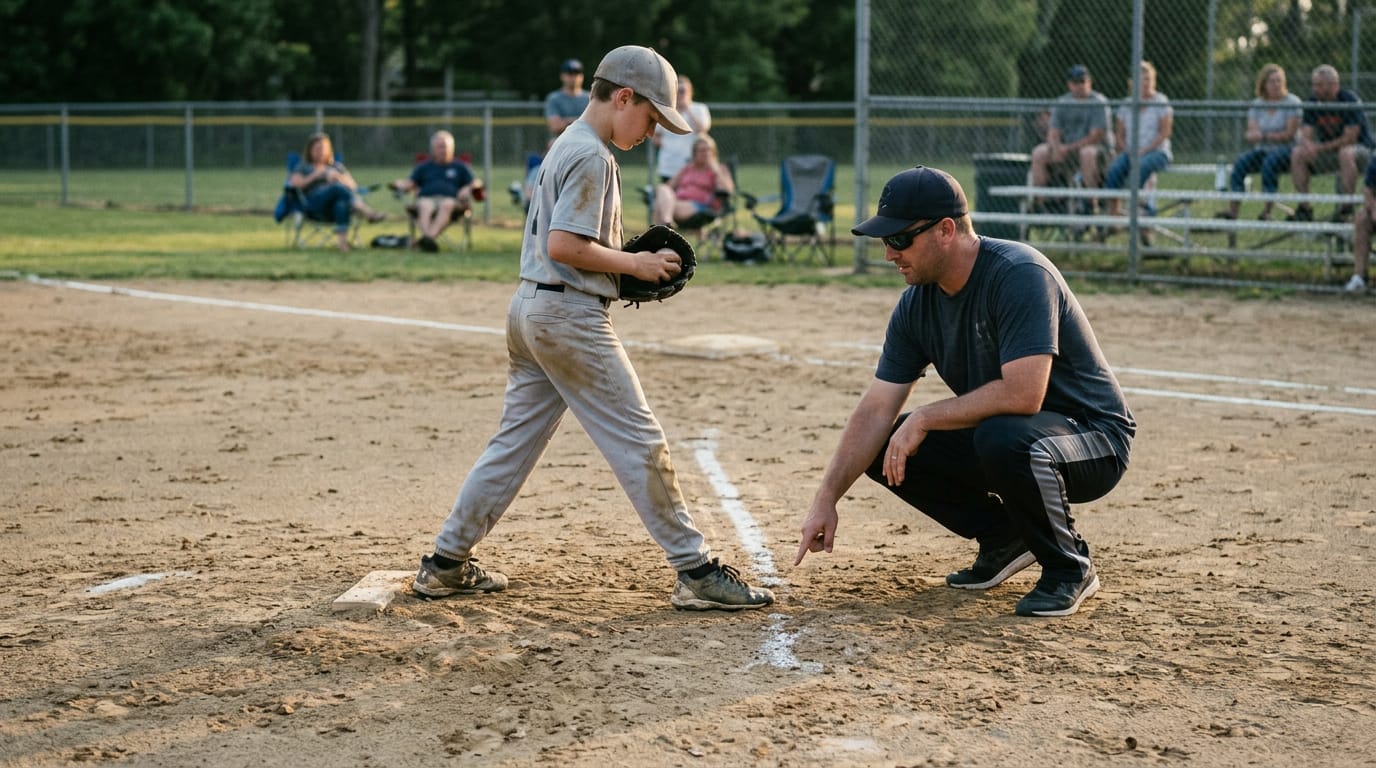
Lefties also get more leeway in how that step is judged. Consider a Little League coach working with a 12-year-old lefty who keeps drifting his step across his body.
Teaching him to point his lead foot at first base before the motion starts gives him a repeatable step, so his pitches stay legal from the first inning on. Small step, big call.
What righties must do to stay legal
A right-handed pitcher faces the third-base side of the diamond instead, so the check shifts to the opposite side of the mound. Righties have three things to get right:
- Facing the third-base side. The body has to be set that way before the motion begins.
- Completing the motion. Once the delivery starts, it has to finish. A pitcher who begins and then stops or changes course can be called for a balk.
- Clear direction. The delivery must be clearly directed toward home plate or a base, so the umpire doesn’t have to guess where the throw is headed.
Think of a rec-league righty who turns toward third, pauses to check a runner mid-windup, then throws to first.
Teaching him to pick one target and commit before he starts keeps the motion continuous, and the umpire has nothing to call. Same rulebook, different angle.
How Umpires Judge and Enforce the Call
A balk call comes down to one umpire reading a fast, moving pitcher in real time. Here’s where judgment comes in and how umpires keep their calls clear.
Why umpires can see it differently
Umpire discretion varies. The same move can be called one way on a Saturday and another way the next weekend.
Think of a parent whose son gets a call one game and a pass the next: the move didn’t change, but the read did, so it helps you know that going in.
Disputes and arguments often start because everyone at the field sees the move from a different spot.
The key question is what counts as a genuine step: did the foot really move toward the base, or did it only seem to? A shuffle or half-motion can look like a step from the stands, which is why these calls get debated.
Lefty and righty pitchers can also get different reads. Their bodies face the bases from opposite sides, so the same step can look different from the umpire’s position.
Umpires know it well but may overthink
Umpires know the balk rule well, and that knowledge is a real strength. It can also tip into overanalysis, where an umpire focused on every possible violation digs into a move that looked routine to everyone else.
The rulebook urges strict enforcement, so an umpire has less room to let a close move slide, even when it looks harmless. Consider a youth coach who drills a full, deliberate step into a pitcher every practice.
When a close call comes, the pitcher isn’t caught off guard, and the team can reset quickly.
When a balk is called, the signal is meant to be clear, so the runners, the batter and both dugouts know right away what happened. The cleaner the step, the easier the call.
How the 2023 Changes Limit Step-offs
The 2023 rules put a firm cap on how often a pitcher can step off the pitching rubber (the slab on the mound) or attempt a pickoff. Here’s how that limit works and how the pitch clock (the timer that keeps the pace of play moving) fits in.
Only two step-offs before a balk
A disengagement is either a step-off or a pickoff attempt, and Major League Baseball’s inside look at how the new rules will work confirms that the pitcher is allotted two of them “without penalty.”
It’s less about whether a pitcher steps off and more about how many times it happens. Two is the limit. The third is a balk.
Here’s how the count works:
- Two disengagements are free. Step-offs and pickoff attempts both count toward the limit.
- The third is a balk. The exception: a third disengagement that retires a runner isn’t a balk.
- The count resets when a runner advances. The tally starts fresh.
Consider a travel-team coach keeping a tally on her scorecard. When her pitcher steps off twice with a runner on first, she signals the pitcher to stay set before a third move gets called.
When the runner advances, she starts the tally over, and that small habit keeps the pitcher from a mistake that’s easy to avoid.

How the pitch clock changed things
The disengagement limit is tied to the pitch clock, so it applies only when the clock is in use. Pitchers got an adjustment period to adapt.
If you’re coaching or parenting one, expect a learning curve, since counting step-offs while watching the timer takes practice.
Before the first pitch, confirm the clock is running, because that decides whether the limit applies at all. Check that first. Then count.
How the Balk Changed over the Years
The balk rule dates to 1898, and it hasn’t stayed frozen since. Here’s how its wording and enforcement have shifted, and why a move you saw go unflagged one season can draw a flag the next.
Rule changes since 1898
According to MLB’s glossary, the specific balk rules were first introduced in 1898 to keep pitchers from intentionally deceiving baserunners. The 1988 ‘discernible’ wording was a trial rather than a permanent rule, and it reverted in 1989.
In 2013, MLB changed the rule to prohibit a pitcher from faking a throw to third base while still standing on the rubber (the slab on the mound).
Sports Illustrated reported that the change was approved at the owners’ meetings, citing Tyler Kepner of the New York Times.
Balk calls spiked alongside stolen bases
Balk calls held steady until 1960, then climbed in step with stolen bases. The count peaked in 1988 at 924 balks.
The Dugout News notes that enforcement has surged at times when umpires were told to call the rule strictly. Think of a youth league pitcher whose coach hears that umpires are calling it tight this season.
Working on a clean, full stop before the first game means a flagged move doesn’t swing a close game.
Memorable balks and record holders
Steve Carlton’s 90 balks mark him as one of the record holders. According to The Athletic, Giants pitcher Stu Miller was called for a balk at the 1961 All-Star Game, when a gust of wind at blustery Candlestick Park made him sway on the mound.
Some balks end the game itself. One illegal move in the final inning can decide the winner. Know the rule cold.
How the 2023 Giants Racked up Balks
A balk is an illegal pitching motion that lets baserunners advance, and the 2023 Giants committed plenty of them. The useful question isn’t just how many balks they had, but who committed them and what the new rules changed around them.
Who balked most for the Giants
The Giants committed 12 balks, the most in the National League. Two pitchers stand out:
- Alex Cobb was charged with five.
- Camilo Doval added three.
Pitch clock violations were another source of trouble, since the timer changed how pitchers work with runners on base.
What the new rules did to games
Those rule changes came with a learning curve. Players needed an adjustment period to get comfortable with the new timing, and balks were one visible sign of that.
Consider a Little League coach who watches a Giants broadcast to see how the timer plays out. His takeaway for his pitchers is simple: stay ready, keep the rhythm, and avoid the move that hands a runner a free base. Muscle memory doesn’t reset overnight.
With pitchers working under the clock, runners had more reason to test the defense, and basepath action picked up.
The 2023 rule changes were associated with shorter games. According to AP News, citing MLB figures, the average nine-inning game lasted 2:40 in 2023, down from 3:04 in 2022.
At its heart, the balk comes down to one idea: a pitcher can keep runners honest, but can’t use an illegal move to fool them. That’s why the rule matters at every level of the game.
Whether you’re a league player, coach, or parent, knowing how the rules change by level helps you read the game with confidence and set realistic expectations for the kids you’re watching.
Know the rule, and the next balk call will make sense from the dugout, the bleachers, or the mound.
References
- A Giant spotlight: San Francisco to host 2028 MLB All-Star Game — nytimes.com (2026)
- Average Time of Nine-Inning Games — apnews.com (2025)
- Baseball Balk Rules Explained | MLB 2026 — sportrules.org (2026)
- Balk & Disengagement Violation (2023 rule change) | Glossary — mlb.com
- What Is a Balk? The Balk Rule Explained Simply — thedugoutnews.com (2026)
- PENALTY FOR A BALK — baseballrulesacademy.com
- An inside look at how the new rules will work — mlb.com
- MLB rules to call fake-to-third, throw-to-first pickoff move a balk — si.com
Questions
What is the rarest pitch in baseball?
There is no official ranking of pitches by rarity, but the eephus pitch is among the rarest. It is an unusually slow, high-arcing pitch used mainly as a surprise.
Why can't pitchers wear white sleeves?
Rules vary by league, but white sleeves may be restricted because they can blend with the ball and make it harder for the batter to see the pitch. Check the rules for your league to confirm what uniform colors are allowed.
Why do catchers ask for new balls?
Catchers ask for a new ball when the current one is dirty, scuffed, or otherwise hard to see or handle. A clean ball helps players track its flight and keeps its condition consistent.
What does balk mean in baseball?
A balk is an illegal move by the pitcher that deceives a baserunner, and it can be called only when at least one runner is on base. In the usual result, the ball is dead and each runner advances one base.
Sources
- Baseball Balk Rules Explained | MLB 2026 | Sport Rules, sportrules.org,
- PENALTY FOR A BALK - Baseball Rules Academy, baseballrulesacademy.com
- An inside look at how the new rules will work, mlb.com
- Balk & Disengagement Violation (2023 rule change) | Glossary | MLB.com, mlb.com
- MLB rules to call fake-to-third, throw-to-first pickoff move a balk, si.com
- What Is a Balk? The Balk Rule Explained Simply - The Dugout News, thedugoutnews.com,
- A Giant spotlight: San Francisco to host 2028 MLB All-Star Game - The Athletic, nytimes.com,
- Average Time of Nine-Inning Games | AP News, apnews.com,
Find your level
The Counter