What Is a Handicap in Golf and How It Works
What is a handicap in golf? See how the number evens out a match, how it’s calculated, and where your score stands among golfers on the course.


Ever tried a friendly round against someone who’s been golfing since childhood? It’s rarely fun for either of you, which is exactly what a handicap solves.
It’s a single number that estimates your playing ability, so players of very different skill levels can compete on equal terms.
Think of it like a weight class in boxing: it matches you with opponents who make the contest worth playing.
Here, we’ll break down what the number means, how it’s calculated, and how to use it on the course, with clear examples and benchmarks along the way.
What Is a Handicap in Golf
A raw score only tells part of the story, so here’s how we turn yours into a number you can compare with anyone’s.
Your skill as a single number
A handicap is a numerical measure of your ability. It’s based on your previous scores, so it reflects how you usually play, not how you played on one lucky afternoon.
It’s measured relative to par, the number of strokes a hole or course should take a skilled player.
Golf is scored by counting every stroke across the holes and comparing that total to par: finish above par and you’re over, finish below and you’re under. A scratch golfer sits at zero.
Why handicaps keep games fair
Consider a dad who plays Saturday mornings with three friends, one of whom has golfed for decades, while he’s only been at it a couple of seasons.
A handicap adjusts for that gap, so every shot still matters and the match stays close. That’s a level playing field.
A handicap is less about beating your friends and more about competing on fair terms. It also works as a benchmark of progress: watch the number drop over a season and you have proof your game is improving. And it decides eligibility for competitions.
How low and high handicaps can go
According to a golf glossary from Golflounge, golf handicap systems set maximum handicap values, and elite players may carry a plus handicap rather than a number above scratch.
A player better than scratch has one in the World Handicap System, which puts their number below zero.
Older guides describe different handicap ranges for men and women. That’s an older view, so check current rules before you assume a limit.
Who really needs a handicap
Beginners often play without one, which is fine for casual rounds. You’ll usually need one for competitions, though. Think of a weekend player who’s been golfing for a single season and wants to enter her club’s Saturday event.
Before a handicap is established, she has to post a minimum number of scores. Once she does, she can tee it up with a number that counts.
Pro events aren’t handicapped, so pros compete on raw scores alone. Start posting your rounds early so you’re not waiting on the sidelines.
How Your Handicap Gets Calculated
Your handicap isn’t a guess. It’s a formula that takes your recent rounds, adjusts each one for course difficulty, and averages your best results.
Averaging your best recent scores
Your handicap index is built from your best recent rounds, not your typical ones. The standard method uses the best 8 of your last 20 scores, while older formulas used the lowest 10. Fewer than 20 scores?
A sliding scale decides how many count, so newer golfers still get a number.
Think of Dana, a weekend golfer whose strong summer pulls her index down, so her handicap matches the player she is now when she enters a club event.
Your index rises and falls with your scoring, and it reflects what you can shoot, not what you usually shoot. That’s why it typically sits below your average score.
Turning each round into a differential
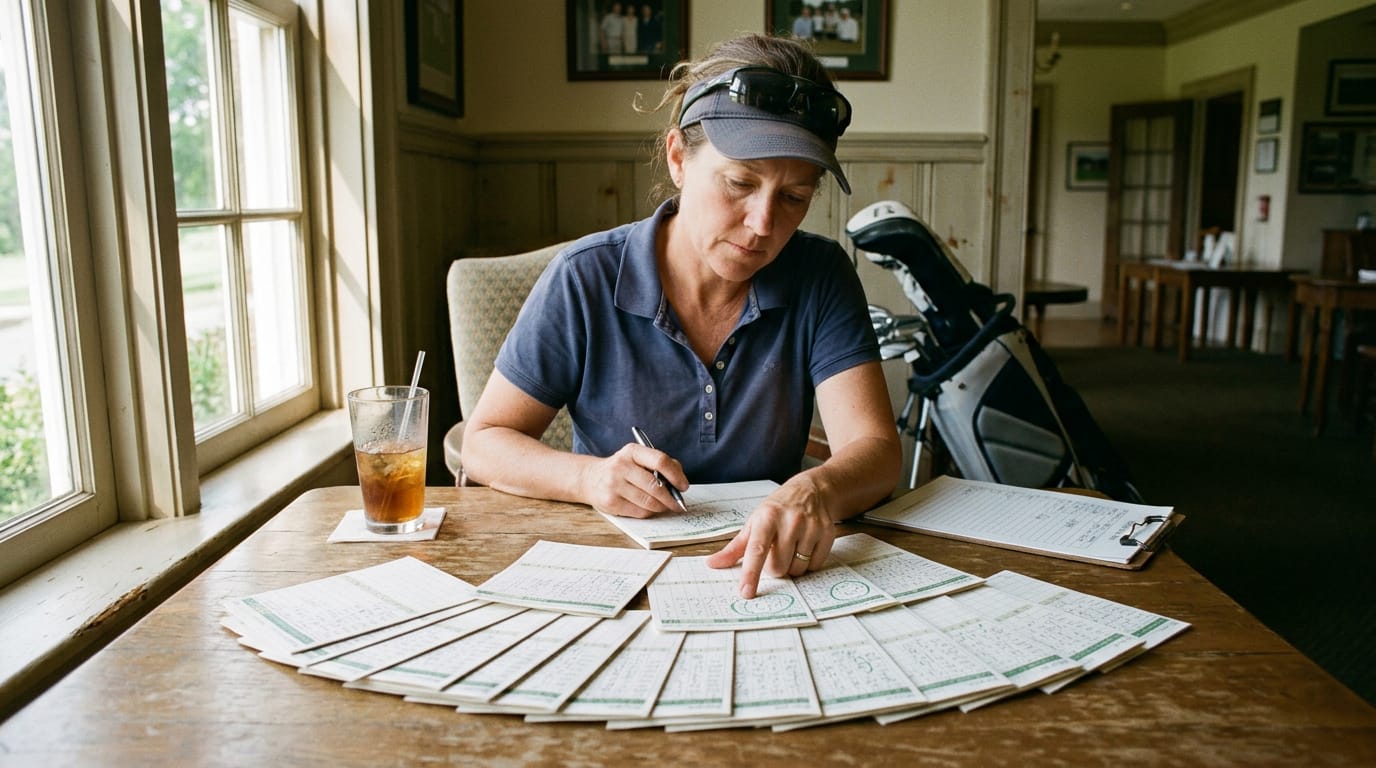
Each round becomes a differential, a single number that makes scores from different courses comparable:
- Subtract the course rating from your adjusted score (your score after any caps, covered below).
- Multiply by 113.
- Divide by the course’s slope rating.
Say you post a 95 on a course rated 71.5 with a slope of 125. That’s 23.5, then 2,655.5, then a differential of 21.2.
What’s your handicap if you shoot a 100? On a course rated 72.0 with a slope of 113, your differential is 28.0, since 113 divided by 113 is 1. One round is only a rough estimate of about 28, not a final index.
Unusual weather can also shift the result through a playing conditions adjustment, covered below.
Reading course and slope ratings
Each set of tees has two numbers, found on the scorecard. The course rating is the expected score for a scratch golfer (someone who plays to a handicap of zero) under normal conditions.
The slope rating measures how much harder the course plays for higher-handicap players, with 113 as the standard.
Here’s the payoff: a higher slope means a tougher course, and the formula credits you for it. Shoot the same score on a higher-slope course and your differential drops.
Ways scores get capped and adjusted
Equitable stroke control caps the score you can post on any single hole, based on your course handicap, so one blow-up hole can’t swamp your round. Once your index climbs, a soft cap slows the rise, while a hard cap sets a firm ceiling.
The playing conditions adjustment corrects days when wind or setup made scoring far easier or harder than the rating suggests, so those days don’t unfairly move your number.
Getting a handicap and keeping it current
Getting started takes a few steps:
- Join a club or local golf organization. They can issue your index and keep it current.
- Post every round. Unposted scores don’t count, so enter them the same day.
- Try online calculators for estimates. They’re handy for a quick read, but they don’t replace an official index.
- Budget for the annual fee. Keeping an official index active usually carries a yearly cost.
- Ask about non-member options. A local golf organization may still issue you an index without a club membership.
Keep posting, and your number will keep up with your game.
Using Your Handicap on the Course
Knowing your number is one thing. Applying it on the course is what makes the round fair.
Your index versus your course handicap
Your handicap index travels with you, so it applies at any course you play. Your course handicap converts that index to the layout you’re playing that day.
The index stays put, but the course handicap shifts, so the number that counts is the one for this course. Same golfer, different number.
Your playing handicap adjusts the course handicap for the format: singles, four-ball or a team match. Your home club keeps your official record, so post your scores there and ask the handicap administrator if anything looks off.
Think of a club player heading to a tougher course than her home track. Her index hasn’t changed, but her course handicap has, and that’s the number to trust on the scorecard.
Figuring net score and where strokes go
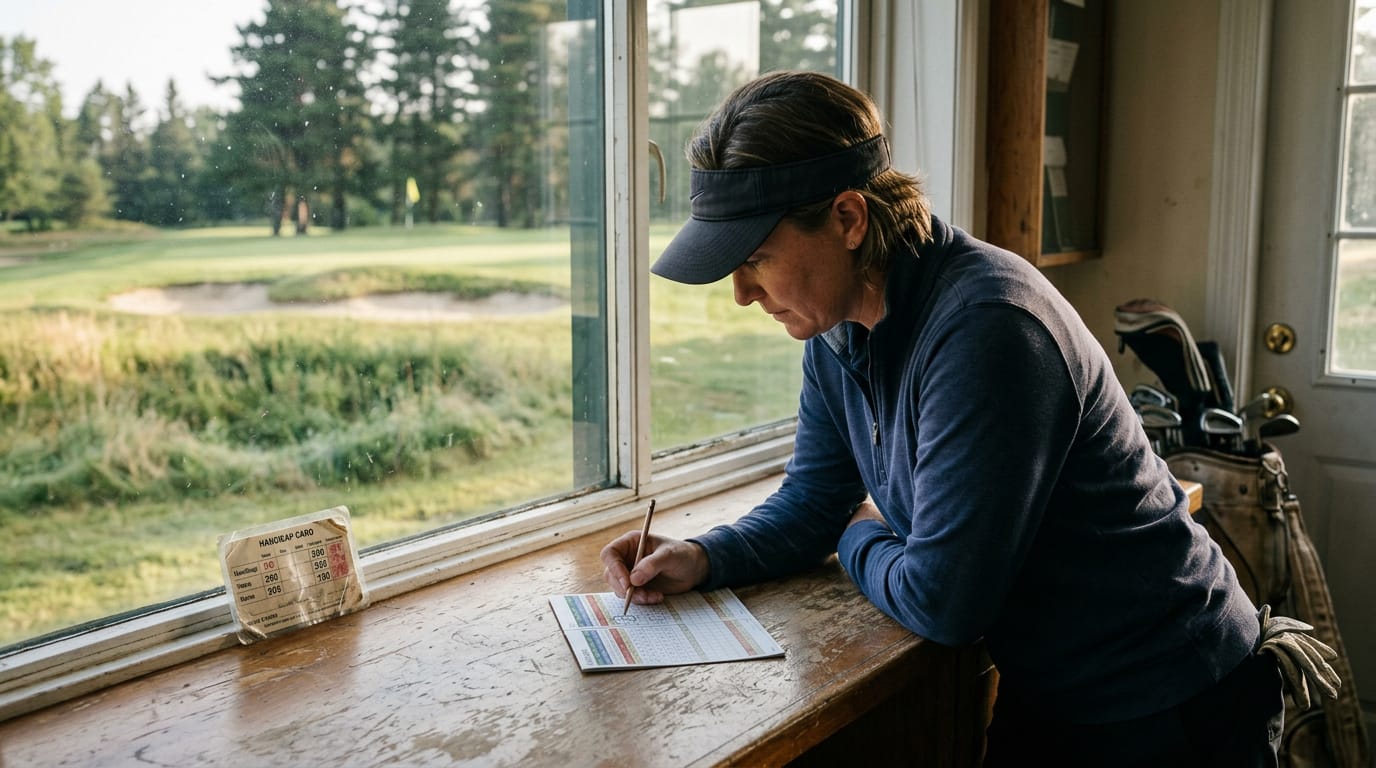
Your net score comes down to two numbers:
- Gross score: every stroke you actually took.
- Strokes received: the strokes your handicap earns on the card.
Subtract strokes received from gross to get your net. Strokes go on the hardest holes first, so one stroke on a tough hole can turn a bogey into a net par.
When a lower handicapper plays a higher one, the lower player gives strokes. Think of a single-digit golfer facing a newer opponent on Saturday. The newer golfer gets the cushion on the hardest holes, and the match stays close.
A plus handicap flips that. A player who’s better than scratch gives strokes back to the field instead of receiving them.
In team events, you usually play a percentage of your handicap, and the format sets that percentage. Read the rules before you tee off.
How Most Golfers’ Handicaps Compare
Before you shop, it helps to know where your number sits. It’s less about whether your handicap is good and more about where it falls among other golfers. Most of us are a long way from scratch, the zero handicap. Once you know your number, golf club fitting is worth understanding before you spend on gear.
Typical handicap numbers for men and women
- Average for men. According to the USGA’s 2025 Golf Scorecard, the average male handicap was 14.0.
- Average for women. That same report puts the average female handicap at 28.8.
- Most amateurs far from scratch. The typical golfer sits well away from zero, so a double-digit number is normal company. Nothing’s wrong with that.
So how bad is a 30 handicap? It isn’t unusual, though it’s on the higher side. It sits just above the women’s average and roughly double the men’s.
Think of a weekend player who’s hovered around a 30 for a couple of seasons and wondered if that’s embarrassing. It isn’t, and knowing exactly where she sits makes her next gear decision a lot easier.
What handicap is top 1%? According to Golf Monthly, you’re in the top 1 percent if you’re off scratch or better, which means a handicap at or below zero. That’s a very small club.
Knowing your band also narrows down which clubs are worth a look, so you’re not shopping blind.
Ways to Bring Your Handicap Down
Lowering your handicap rewards steady habits more than heroic rounds. Start with the fixes that pay off fastest.
Play more and practice consistently
Play more often, since more posted rounds give you more to learn from. Keep a routine too: 30 minutes twice a week beats one marathon session. Short and repeatable wins.
Use the range to rehearse one swing change, then test it on the course.
Putting and chipping are where many strokes hide. A dad who chips for 20 minutes after work each Tuesday might see his scores drop by season’s end.
Lessons and smarter course management
A teaching professional can spot a flaw in one lesson, so book one and practice what they give you.
Pair lessons with a club fitting before you chase strokes, since a fitter matches your clubs to how you swing.
A blow-up hole is a bad shot or string of them that balloons your score. Trimming those is among the fastest fixes, so take your bogey (one over par) and move on.
Smart shot selection means playing your strengths: aim for the middle of the green, not the flag.
Fitness helps too, since better flexibility and core strength keep you balanced through the swing.
Knowing the rules is a free way to save strokes. Review the basics before your next round.

Simulators and indoor rounds in winter
A simulator projects a course onto a screen, and a launch monitor tracks your ball flight and club speed.
Simulators are great for practice, but indoor rounds don’t count toward your handicap.
Winter is when they earn their keep. When the course is frozen, a simulator keeps your swing sharp.
Accurate score records matter too. Keep an honest card for every posted round, including the holes you’d rather forget.
The World Handicap System and Its History
The handicap you carry today grew out of centuries of golfers trying to make matches fair.
One global system that replaced national ones
For years, each country ran its own rules, so a number earned in one place didn’t always carry over to another. The World Handicap System changed that. It swapped many national rulebooks for one set of rules, which gives you global consistency.
Think of a weekend player who joins a league in another state. Her handicap works the same way there as it did back home, so the match starts on fair terms.
The system was introduced in 2020, when the USGA (the United States Golf Association) and the R&A (the Royal and Ancient Golf Club of St Andrews) made major changes to the handicap system, according to the Southern California Golf Association.
It’s now used in 119 countries, with governing bodies like England Golf among those putting it into practice.
How handicapping evolved over the centuries
Early on, golfers negotiated strokes before a match to even out the contest. Writings from the 16th century show the idea was already part of the game.
Think of a club golfer lining up against a sharper friend. Without a shared formula, the strokes came down to whatever the two of them could agree on.
That changed in 1911. According to a USGA history of handicapping, the first nationwide format was adopted on October 11, 1911, at Baltusrol Golf Club in Springfield, N.J., and it used the average of three scores.
From there, the method evolved into the course ratings and slope ratings you’ll see today. Slope shows how much tougher a course plays for higher-handicap golfers. Same goal, sharper tools.
Once you know your handicap, it stops being a mystery and becomes a practical tool. It shows you what a fair match looks like, helps you set realistic goals, and reveals whether your game is actually improving.
Keep it current by posting honest scores, and let it guide your choices on the course and in the shop. A fair match makes every round more fun, and your handicap is how you find one.
References
- Revealed: What Handicap Index You Need To Class Yourself As The Top 1% Of Golfers — golfmonthly.com (2025)
- World Handicap System&Reg; — newfrontier.scga.org
- USGA releases 2025 Golf Scorecard for players with handicap indexes — golfweek.usatoday.com (2026)
- History Of Handicapping, Part III: USGA Leads The Way — usga.org (2011)
- Scratch Golfer: Meaning, Handicap 0 and Plus Handicap — golflounge.de
Questions
What is handicap?
A golf handicap is a number that estimates a player’s ability based on recent scores. It helps golfers of different skill levels compete fairly by adjusting their scores with strokes, and it can also track progress.
How is golf scored?
Golf is scored by counting every stroke taken on each hole, then comparing the total with par, the expected number of strokes for the course. A score above par is over par, a score below par is under par, and the lowest total score wins in stroke play. In handicap matches, players can subtract the strokes they receive from their gross scores to calculate net scores.
Sources
- Scratch Golfer: Meaning, Handicap 0 and Plus Handicap, golflounge.de
- World Handicap System&Reg; - Southern California Golf Association (SCGA), newfrontier.scga.org
- History Of Handicapping, Part III: USGA Leads The Way, usga.org,
- USGA releases 2025 Golf Scorecard for players with handicap indexes, golfweek.usatoday.com,
- Revealed: What Handicap Index You Need To Class Yourself As The Top 1% Of Golfers | Golf Monthly, golfmonthly.com,
Find your level
The Counter