How to Choose a Pickleball Paddle for Your Level
Weight, core, face, shape and grip size explained plainly, what to buy when starting, as a regular and when serious, and when a paddle must be approved.

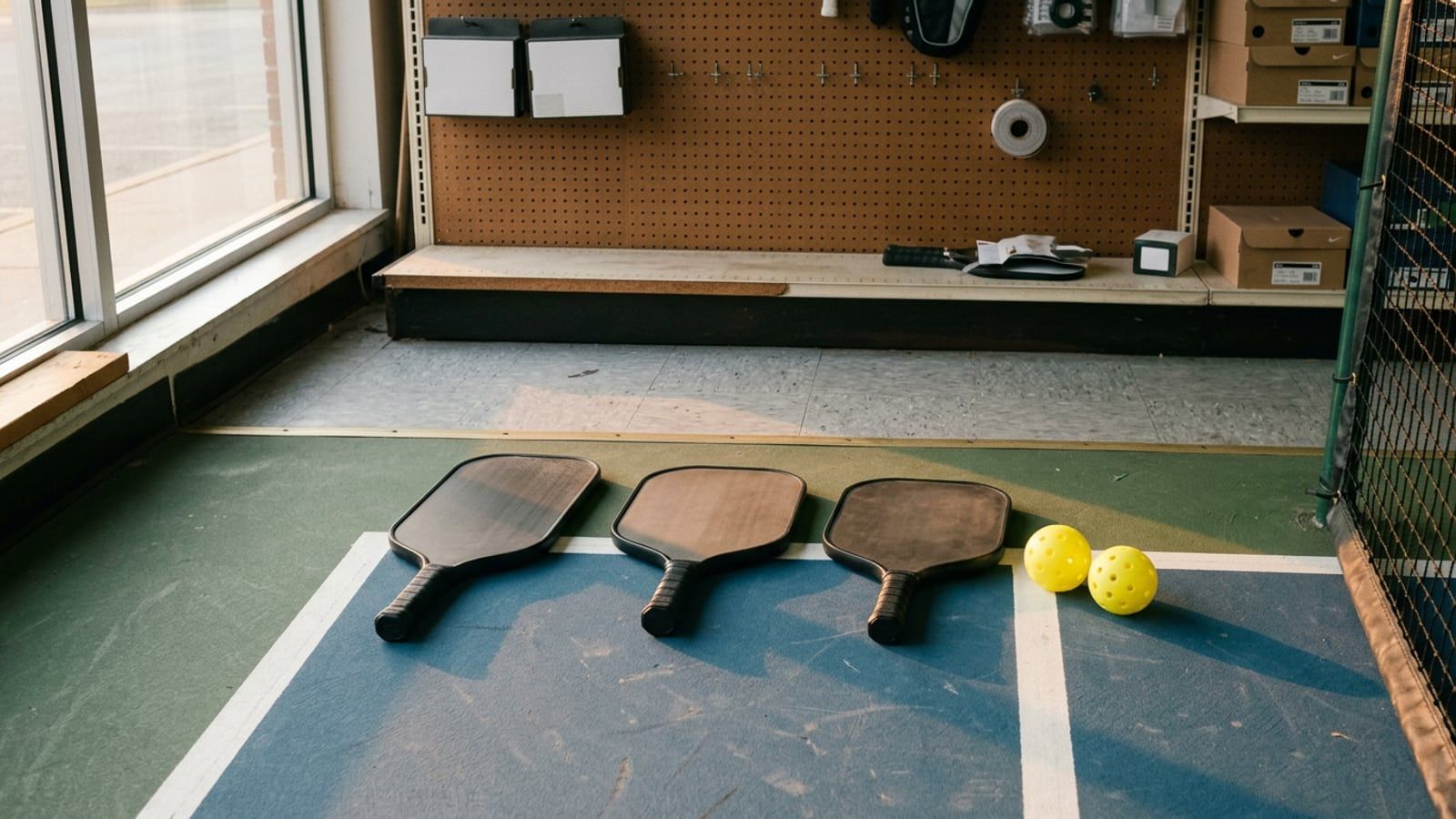
For most players the right first paddle is a midweight one, about 7.3 to 8.2 oz, with a polymer honeycomb core, a standard shape and a grip that fits your hand. A good one costs from about $70 and will see you through a first season and well beyond. The flagship paddles are built for players who already know whether they want more control or more power, and the only way to know that is to play. Five specs decide how a paddle plays: weight, core thickness, face material, shape and grip size. Here is what each one does and what to choose at your level.
Start with how you play
Before you look at a single paddle, answer four questions honestly.
- Your level. New to the game, playing most weeks, or entering tournaments? Buy for the level you play now.
- Your arm. If your elbow or shoulder gets tired or sore after a session, a lighter paddle with a thicker core is the gentler choice. Pain that lasts is one to take to a doctor or physical therapist, not a paddle.
- Doubles or singles. Most recreational play is doubles, with long soft exchanges at the kitchen line where quick hands and control matter. Singles players cover more court and often want more reach and power.
- Touch or power. Do you win points with dinks and drops, or with drives? If you do not know yet, you are in the right place to choose control.
Hold onto the answers; each spec below comes back to them.
Weight: the spec that matters most
Weight changes how a paddle feels more than anything else on the label. Pickleball Central’s guide to paddle weight sorts paddles into three classes:
- Lightweight, under about 7.2 oz: quick to the ball and easy to place, with less power behind it.
- Midweight, about 7.3 to 8.2 oz: enough mass for a deep return, light enough for fast exchanges at the net. Most players, beginners included, belong here.
- Heavyweight, about 8.4 oz and up: more power on drives and serves, slower in hand-to-hand volleys.
There is no weight limit in the rules, so the choice is yours. Two quick tests: if your arm is tired by the third game, the paddle is too heavy; if you are thrown off balance at the end of a swing, it is too heavy as well. Paddle weights are usually given as a range, such as 7.6 to 8.0 oz, because no two come off the line exactly alike. Players who want a little more weight later add lead tape to the edge rather than buying a new paddle.
Core thickness and face material
Nearly every paddle today has a polymer honeycomb core between two face sheets. The thickness of that core and the material of the face decide most of the feel.
| Spec | Option | What it does |
|---|---|---|
| Core thickness | 16mm | Softer, more control and comfort; easier to dink and reset |
| Core thickness | 13 to 14mm | Livelier, more pop on drives; less forgiving on soft shots |
| Face material | Fiberglass | Lively and powerful; common on lower-priced paddles |
| Face material | Graphite | Lighter and crisper, with good feel |
| Face material | Raw carbon fiber | Textured for spin and feel; usually at the top of the range |
Tennis Warehouse Europe’s paddle guide puts cores anywhere from 10 to 20mm and suggests 14 to 16mm if you are unsure. At the counter, the simple version is this: a 16mm core is the easier paddle to learn with, because soft shots win more points at most levels than hard ones.
Leave the face as it came. Sanding or roughening it for extra spin can take it outside the equipment rules, and a worn, smooth face is a reason to replace a paddle, not to refinish it.
Shape: standard, elongated or widebody
USA Pickleball’s rules cap a paddle at 17 inches long, with length and width together no more than 24 inches. Makers share out those 24 inches in three ways:
- Standard: about 16 inches long and 8 wide. A balanced face with a generous sweet spot, and the right first paddle for most players.
- Elongated: longer and narrower. More reach and more leverage on drives and serves, with a smaller sweet spot; favored by singles players.
- Widebody: shorter and wider still, with a large, forgiving face and usually a shorter handle.
If you play doubles and are still learning, a standard shape will forgive more of your off-center hits.
Grip size and handle length
A grip that is too big or too small tires your hand and makes the paddle twist on off-center hits. Grips run from 4 to 5 inches around, and many paddles come with one of about 4.25 inches.
To find yours, Selkirk’s grip-size guide uses a ruler:
- Open your playing hand, fingers together.
- Measure from the middle of the three creases across your palm to the tip of your ring finger.
- The measurement, usually between 4 and 5 inches, is your grip circumference.
Selkirk’s guide also gives a rougher chart by height: 4 inches for players under 5’3”, 4.25 for 5’3” to 5’8” and 4.5 for anyone taller. Note that the finger test used for tennis grips does not carry over to pickleball.
If you fall between two sizes, choose the smaller one. You can build a grip up with an overgrip, but you cannot make a handle thinner.
Handle length matters if you hit a two-handed backhand: look for a handle of about 5 inches or more so both hands fit. Players with a one-handed game can use a shorter handle, which leaves more length for the face.
Tip: borrow before you buy. Most clubs and many courts have players happy to lend a paddle for a game, and a few games with two or three different paddles will teach you more than any spec sheet.
Approved for sanctioned play
For open play, lessons and most casual leagues, any paddle is fine. For a USA Pickleball sanctioned tournament, your paddle has to be on the USA Pickleball approved paddle list, which you can search by brand and model. The list runs to thousands of paddles.
Three things are worth knowing before a tournament:
- Check the exact model. Paddles are approved model by model, so a newer version or a different thickness of a paddle you know may be listed separately.
- Check again before the event. USA Pickleball has added new tests in recent years and can remove a paddle from the list; a decertified paddle still works for recreational play.
- Pro events use their own list. Professional tours run their own approval, separate from USA Pickleball’s, so if you enter an event on a pro tour, ask the organizer which list applies to your division.
Both Selkirk paddles on our Gear page carry USA Pickleball approval.
What to buy at each level
| Level | What to look for | Budget |
|---|---|---|
| Starting | Midweight, polymer core (16mm for control), standard shape, a grip that fits | From about $70 |
| Regular | A paddle chosen for control (16mm) or power (13 to 14mm), demoed first | About $100 to $200 |
| Serious | The model that suits your game, on the approved list, plus a spare of the same paddle | $200 and up |
Starting
You need one paddle, the right balls (outdoor and indoor balls differ) and court shoes with a flat, grippy sole. The two paddles on our Gear page cover the two ways to start:
- For control, and a paddle you will keep: Selkirk’s AMPED Pro Air Epic has a fiberglass face over a 16mm core, weighs 7.8 to 8.2 oz, has a standard 15.75 by 8 inch face and a 5.25-inch handle that fits two hands, and carries a limited lifetime warranty once registered. It lists at $200, and Selkirk had it on sale for $100 when we checked in October 2026. It suits a first season and still suits a good club player.
- On a tight budget: Selkirk’s SLK Latitude Max, $70 at Selkirk as of October 2026, has a graphite face, a 7.6 to 8.0 oz weight, a 4.25-inch grip and USA Pickleball approval. Its 13mm core makes it livelier than a 16mm paddle, so it gives a little less help on soft shots, and its warranty is one year. For a casual player, or anyone not yet sure the game will stick, it is all the paddle you need.
Regular
Once you play every week, you will know whether you are short of control or power, and that tells you which way to go. This is the time to demo two or three paddles, including a thinner 13 or 14mm core if you want more pop on your drives. If you started on a budget paddle and your dinks keep popping up too high, a 16mm paddle like the AMPED Epic is the usual move up. Add an overgrip and a bag.
Serious
Serious players choose by feel, usually after demoing several paddles, and many move to a textured carbon face for spin. Keep a second paddle of the same model, so a cracked edge guard does not end your tournament, and check both on the approved list before you enter.
At any level, the paddles we would hand you are on the Gear page, and the racket sports list on The Counter covers the shoes, balls and bags around them. If you play tennis as well, our guide to choosing a tennis racket works through the same questions for a racket, and the rest of our Racket Sports section covers padel, badminton and squash.
Questions
What weight pickleball paddle is best for a beginner?
A midweight paddle, roughly 7.3 to 8.2 oz in Pickleball Central’s weight classes, suits most new players: enough mass for a deep return, light enough for quick hands at the net. If your arm tires by the third game, go lighter. Leave heavy paddles until you know your swing.
Is a 16mm or a 14mm paddle better?
Neither is better; they feel different. A 16mm core is softer, with more control and a more forgiving feel on soft shots, while a 13 to 14mm core returns the ball with more pop. If you are unsure, start at 16mm; you can find power later more easily than touch.
Do I need a USA Pickleball approved paddle?
Not for open play or most casual leagues, where any paddle is fine. For a USA Pickleball sanctioned tournament, yes: your paddle has to be on USA Pickleball’s approved list. Pro tours run their own approval list, so check with the organizer of any event before you buy for it.
How long does a pickleball paddle last?
There is no fixed lifespan; it depends on how often and how hard you play. Replace a paddle when the face has worn smooth and no longer grips the ball, when a spot on the face sounds or feels dead, or when the edge guard or face starts to separate. Check the warranty too, since terms run from one year to a limited lifetime.
Is an expensive paddle worth it for a beginner?
Usually not. A budget paddle on the approved list, like Selkirk’s $70 SLK Latitude Max, has what a new player needs, and your shots will improve faster than any paddle can improve them. Spend more once you have played long enough to know what feel you want, ideally after a demo.
Sources
- Approved Paddle List, USA Pickleball
- How Do I Find My Pickleball Paddle Grip Size?, Selkirk Sport
- Which Pickleball Paddle Weight Is Right for You?, Pickleball Central
- How to Choose a Pickleball Paddle, Tennis Warehouse Europe
- AMPED Pro Air Epic Pickleball Paddle, Selkirk Sport
- SLK Latitude Pickleball Paddle, Selkirk Sport
Find your level
The Counter