Helmet Size Guide: How to Measure and Check Fit
Helmet size starts with a head measurement: use size charts, check for a level, snug fit, fix common errors, and know when to replace your helmet.


Think about the last hat you bought without trying it on. It either slid over your eyes or pinched behind your ears. A helmet works the same way, with much higher stakes.
The right size sits level, stays put when you shake your head, and feels snug all the way around. Getting there takes a little measuring and some careful checking.
In this post, we’ll cover measuring your head, reading size charts, checking fit, fixing common errors and knowing when to swap, with notes on youth growth, certification and league rules.
Why Helmet Size and Fit Matter
A helmet only protects you if it stays put, so the number on the label is just the starting point. Here’s why we treat fit as the first thing to get right.
What a good fit does for you
A good fit does more than feel comfortable:
- Stays put on impact. A loose helmet shifts when it matters most.
- Avoids pressure points. A helmet that’s too tight digs into the temples, and those pressure points turn into a headache fast.
- Keeps your focus on the game. A helmet that slides or pinches pulls your attention from the ball, puck or trail.
- Brand sizes vary. Sizing isn’t universal, so a medium from one company may not match another’s.
A youth hockey parent buying for a nine-year-old who grew over the summer might grab last year’s size off the rack. It looks fine on the hanger but wobbles every time the kid looks down.
Two minutes with the new one on, chin strap buckled, settles it. Fit beats brand.
Aim for a perfect fit every time
Choose a helmet that fits perfectly, not one that fits close enough. You want it snug, not tight: level on your head, padding that holds without pinching, and straps that keep it put when you shake your head.
Always try before you buy. In a shop, buckle it and move the way you would in play. Shopping online? Check the return policy first, since a helmet that looked right on screen may feel different once it’s on your head.
Think of a weekend cyclist who orders online to save a few dollars. It feels fine at home, but ten minutes into the first ride it’s sliding back and she keeps reaching up to fix it. A quick check while the return window is open would have caught that.

How Do You Measure Your Head?
Your head circumference is the number every helmet chart runs on, so measure it before you compare brands.
Gather these tools before you start
Grab these first:
- A flexible measuring tape, like a soft sewing tape
- String and a ruler as a backup, measuring the string afterward
- A mirror or helper to check the tape stays level
- A pen and paper
- Skip rigid rulers, since they can’t wrap around your head
Position the tape level and snug
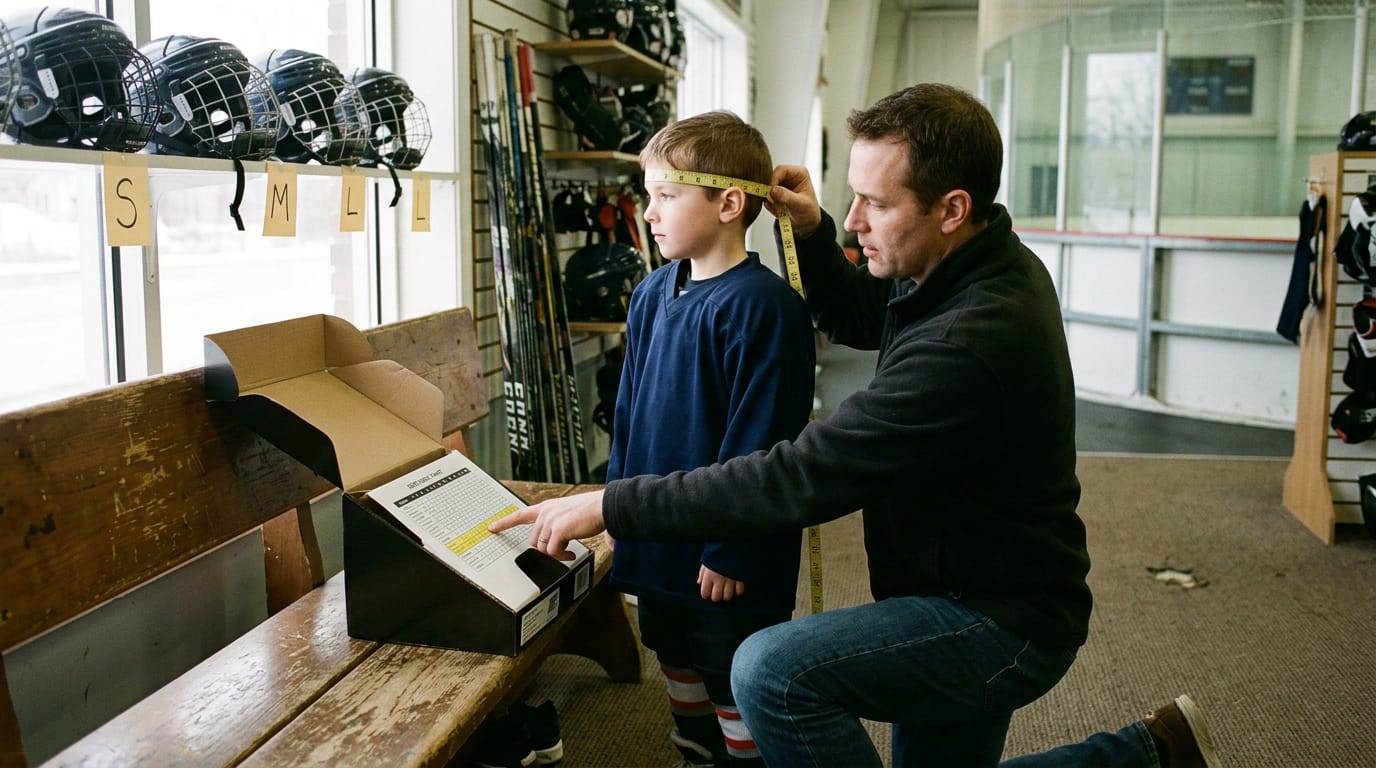
Start with the tape above your eyebrows and ears, then wrap it around the widest part of your head, usually across the back.
Keep it level all the way around. A tape that slopes down the back measures a longer path, so the number comes out too big.
Pull it snug, not tight. It should stay put without pinching at the hairline. Snug is the goal.
Repeat the measurement two or three times and write down the number that repeats.
Think of a parent buying a first lacrosse helmet for a ten-year-old who grew over the winter. Measured in a hurry with the tape slipping, the number comes back small and the helmet pinches by the first practice.
Measured level and snug, twice, it fits all spring.
For a motorcycle helmet, use the same method, then check the number against that brand’s own chart, since sizing doesn’t line up across manufacturers.
Reading Size Charts and Conversions
Size charts turn your measurement into a helmet size, but only if you read them right. Here’s how to decode the common formats.
What size is a 22 inch helmet?
A 22 inch reading is your head circumference, the distance around the widest part of your head. Charts translate that number in a few common ways:
- Letter sizes: S, M and L, each covering a range of head circumference.
- Centimeters or inches: Some charts use centimeters, others inches. A 22 inch head is about 56 centimeters, so a 60 centimeter mark sits above it. Convert before you compare.
- Youth and adult ranges: These run separately, so start with the chart for the person wearing the helmet.
- Hat-size style numbers: Some brands print these beside circumference, so check which system you’re reading.
Use each brand’s own sizing chart
Sizes vary between brands, so a medium from one company can fit like a small from another. Go by the measurement, not the letter on the label, and start with the brand’s own chart for the exact model you’re buying.
Picture a youth hockey parent whose son measures 22 inches. They pick the S/M/L letter from a generic guide, and by the second practice the helmet is rocking on every stop.
The brand’s own chart for that model would have pointed to a better fit. Snug beats guessing.
If you’re shopping Bell, the Bell helmet size chart you need is the one listed for your model, so match your head circumference to that model’s range. Still stuck between two sizes? Contact the brand with your measurement and model name for fit questions.
Ways to Check Your Fit
The size on the label is only a starting point. These checks show whether fit holds before your first practice or ride.
Tests to run while trying it on
- Coverage: Pads touch your head all the way around, with no gaps.
- Stability: Shake your head. If the helmet shifts, it’s too big.
- Pull-off test: With straps open, pull the helmet up and forward. It should resist, not slide off.
- Comfort check: Wear it for ten seconds while you nod and turn. Any pinch means keep looking.
Check the fit with your fingers
- Front edge: A couple of fingers above your eyebrows, not down on your forehead.
- Cheek pads: Touching your cheeks, not pinching.
- Chin strap: Snug enough that only one finger fits underneath.
The 2-2-2 rule is a quick shortcut: two fingers above your eyebrows, a V of strap below each ear, and a chin strap snug enough for one finger.
Match the helmet to your head shape
Heads come as round, oval or intermediate: round heads are about as long as wide, oval heads run longer front to back.
Pressure points matter most. Pressure at your temples or forehead that won’t ease up usually means the wrong size or shape.
Is my bike helmet too small? If it presses at your temples, gives you a headache on a short spin, or won’t sit level, it’s likely too small.
A weekend cyclist whose helmet pinches ten minutes into her first group ride swaps it for one that fits and rides comfortably.
If one shape keeps pinching, look for a shape-specific model built for yours.
Sport changes the details: ski helmets need goggle room, bike helmets should sit level, and hockey or batting helmets must match league rules.
Common Errors and How to Adjust
Most fit problems come from a few predictable mistakes, and you can usually fix them at home.
Avoid these common fitting mistakes
- Guessing size. Measure the head you have today, not the one you had last season. Growing kids can outgrow a helmet fast.
- Ignoring hairstyle. A thick braid, bun or updo changes how the helmet sits, so try it on with your hair the way you’ll wear it.
- Overlooking adjustments. Straps, dials and pads change the fit. Skip them and a helmet that feels fine in the store can feel loose on the field.
- Ponytail ports. Some helmets have a rear opening for a ponytail. If yours does, line the port up with your ponytail so the helmet still sits flat.

Fine-tune with padding and adjusters
Padding inserts are foam pads that fill small gaps between the shell and your head. A parent might buy a size up for a nine-year-old who shot up over the summer, hoping it’ll last the season. Don’t. A helmet that’s too big can shift when it matters most.
Buy the size that fits now and let padding close the small gaps.
Adjustable fit systems are the dials, ratchets and straps that snug the helmet from the inside. Adjust them first, then reach for padding. Once tightened, the helmet should sit level on your brow and stay put when you nod or shake your head.
Snug is the goal. If it still shifts, the size is the problem, not the padding.
Knowing When to Swap Your Helmet
Knowing when to retire a helmet matters as much as buying the right one. Here’s what to watch for and how long a helmet should last.
Signs it’s time for a new one
Some warning signs are obvious, and others only show up when you look closely.
- After any impact. A hard hit or a fall means the helmet has done its job, so it’s time to replace it.
- Deteriorated padding. If the inner padding has broken down or no longer sits snug, the helmet isn’t fitting or protecting the way it should.
- Cracks, dents, and frayed straps. Damage to the shell or straps is a clear reason to retire it.
- Replace every 3 to 5 years. Even a helmet with no visible wear needs to go eventually.
Think of a weekend cyclist who goes down on gravel, scrapes an elbow and rides home with a helmet that looks fine from the outside. It’s less about whether the helmet looks ready and more about whether it’s still protecting you. Swap it out.
As for lifespan, Cycling Weekly points to Consumer Reports, an independent U.S. publication, which advises replacing your helmet every three to five years.
Under the five-year rule, a helmet shouldn’t stay in service past five years, even if it’s never been hit.
The guide Helmets, Heads, and Health for Horse Enthusiasts takes the same line, recommending replacement after a maximum of 5 years or after each major impact.
A well-fitting helmet fades into the background once the whistle blows, and that’s the whole point. When it sits level, stays put and meets your sport’s rules, you can focus on the game instead of adjusting your gear.
Measure carefully, check the fit in person, and recheck it as your kid grows or your league changes its rules.
A helmet that fits right is the one you forget you’re wearing.
References
- Helmets, Heads, and Health for Horse Enthusiasts — digitalcommons.usu.edu (2009)
- How often should you replace your cycling helmet? — cyclingweekly.com (2026)
Questions
What is the lifespan of a helmet?
A helmet should generally be replaced every 3 to 5 years, even if it has no visible damage. Replace it immediately after a major impact, or sooner if its shell, straps, or padding are damaged or worn.
What is the Bell helmet size chart?
Bell helmet sizing varies by model, so use the size chart for the exact Bell helmet you’re considering. Measure your head circumference and match it to that model’s chart rather than relying on a general size label.
What is the 5 year helmet rule?
The five-year helmet rule means replacing a helmet no later than five years after it enters service, even if it has not been in a crash. Replace it sooner after a major impact or if it is damaged or deteriorated.
How do you measure your head for a motorcycle helmet?
Wrap a flexible measuring tape above your eyebrows and ears and around the widest part of the back of your head. Keep it level and snug without pulling tight, then measure two or three times and use the number that repeats.
How to fit a motorcycle helmet?
A motorcycle helmet should sit level and feel snug all the way around, without pinching or pressure points. With the chin strap fastened, shake your head to check that it stays put, and confirm the helmet resists sliding off when you pull it up and forward.
What size is a 22 inch helmet?
A 22-inch head circumference is about 56 centimeters. The corresponding helmet size depends on the brand and model, so check the manufacturer’s chart using that measurement.
What size helmet for a 60cm head?
A 60-centimeter head may fall around a large or extra-large size, but sizing varies by brand and model. Check the specific helmet’s chart and try it on to confirm it sits level and snug without pinching.
Is my bike helmet too small?
Your bike helmet may be too small if it presses painfully at your temples, causes a headache after a short ride, or will not sit level. It should feel snug without pinching; try a different size or head shape if pressure persists.
Sources
- How often should you replace your cycling helmet? | Cycling Weekly, cyclingweekly.com,
- Helmets, Heads, and Health for Horse Enthusiasts, digitalcommons.usu.edu,
Find your level
The Counter