Golf Swing Speed Training: A Complete Guide
Golf swing speed training builds power through better mechanics, overspeed drills, and fitness, with practical ways to measure gains and choose speed aids.

Think of the last time a friend with a smooth, unhurried swing out-drove you off the first tee. It probably felt unfair, but speed isn’t only a gift you’re born with. It’s a skill you can build, one practice session at a time.
Here’s the short answer: faster swings come from sound mechanics, targeted drills, fitness work that supports your rotation, and gear that matches your current level.
This guide covers each piece, from overspeed training and strength work to measuring gains, then shows which speed aids are worth your money and how they should fit.
Why Golf Swing Speed Training Matters
Swing speed is a direct lever for distance, and it’s more trainable than most golfers think.
How do you add 20 yards to your drive?
Some golfers may add as much as 20 yards to a drive through swing-speed training. The engine is club head speed: every extra mile per hour adds yards. A study of collegiate golfers measured 10 to 15 extra yards from higher club head speed.
Drive for Dough, research on professional tour golfers, found that greater driving distance can leave you with shorter approach shots. This isn’t just for pros.
A weekend golfer hitting long irons into par 4s can trade one for a wedge, a real route to lower scores.
What actually builds your swing speed
Speed comes from connected parts:
- Technique and sequencing. It’s less about muscling the club and more about sequencing your body in order. Colorado AvidGolfer notes that as you improve at a drill, your swing speed should rise and your drives should get longer.
- Fitness and mobility. Strength and flexibility let you turn fully and load the club.
- Equipment and fitting. A club that suits your swing lets you use the speed you build.
- Wrist mechanics. Your wrists set the club face angle, and timing the release beats forcing it.
- Hand path length. Your hand path, the route your hands take into impact, should be one you can repeat.
How golf fitness went mainstream
The Tiger era pushed golf fitness into the mainstream, and gym work became routine. It also helps prevent injury, since a strong, mobile body handles a hard swing better. Home-based programs need only a few simple tools and bodyweight moves.
It’s less about having a gym and more about training consistently.
Get the Basic Mechanics Right First
Before chasing more speed, make sure your basics aren’t working against you.
Keeping your grip and wrists neutral
A neutral grip lets the club release on its own. Hold it in your fingers, not your palms, with a relaxed hold rather than a tense one.
Watch your wrists:
- Keep your lead wrist flat or slightly bowed through impact.
- Avoid a cupped wrist, which steals speed and makes the face hard to square.
Take a weekend golfer whose lead wrist cups at the top, leaving the face open at impact. Flattening it gives her a cleaner strike and more speed.
Letting your legs and core lead
Let your legs and core lead the downswing, not your arms. Keep your arms connected to your chest so they ride along with the turn. Avoid the chicken wing, where your lead elbow flies out at the top and drains power.
Picture a dad whose arms do all the work while his hips barely turn. Once he turns his hips first, the ball starts flying straighter. Your arms are passengers.
Setting up with balance and alignment
Here’s what to check:
- Spread your weight evenly between both feet for balanced footing.
- Create a hip hinge by tilting forward from your hips, keeping your spine straight.
- Set a slightly wider stance than your shoulders for more power.
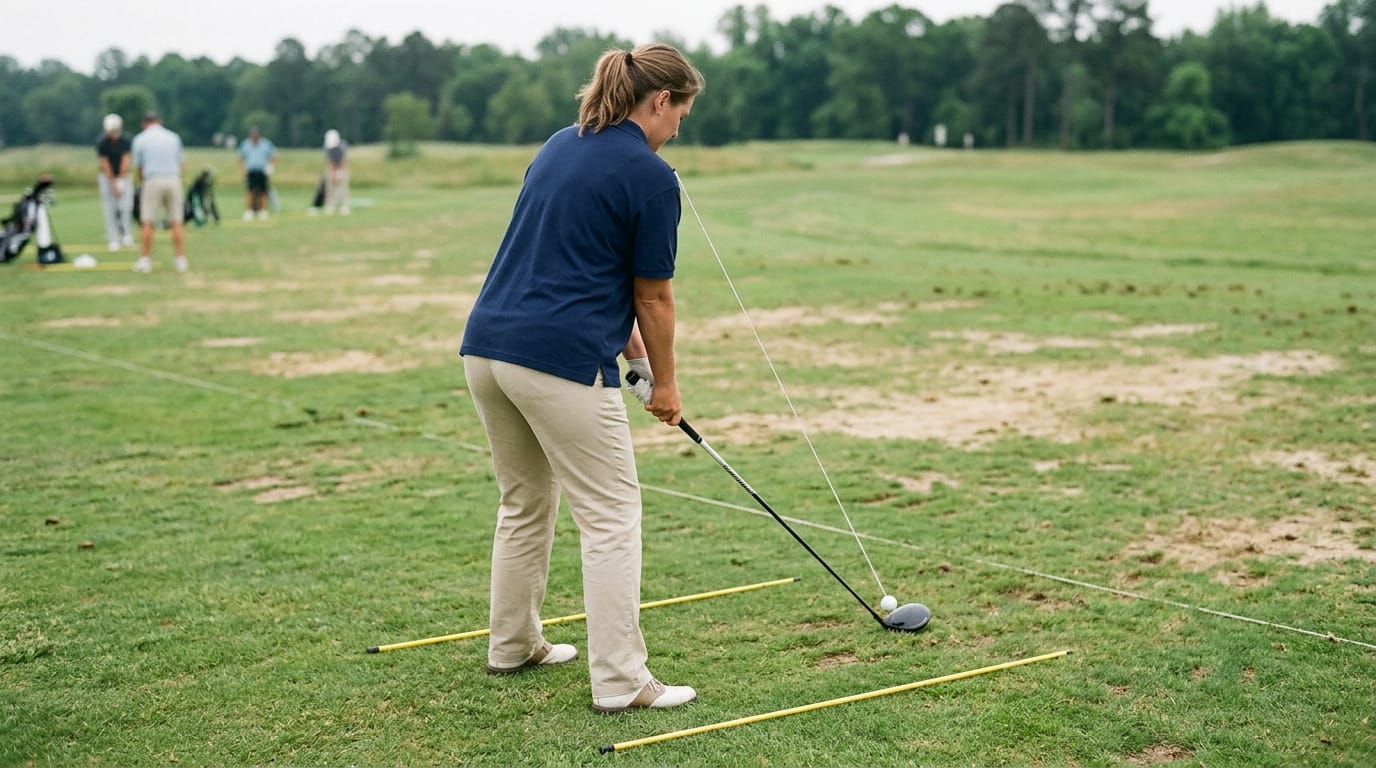
- Lay alignment sticks along your target line and toes to check that your feet, hips, and shoulders are square.
Your swing plane is the tilted path your club travels around your body. What should a driver swing plane be? Ideally, it matches the angle your shaft sits at address, so the club returns to the ball on the same line it started on.
How Overspeed Training Works
Overspeed training means swinging lighter tools faster than your driver allows, so your body learns to move quicker. The goal is to swing faster, not harder.
Does a swing trainer really work?
A six-week comparison of university golfers describes a swing trainer as a club or shaft with changeable attachments, swung as fast as you can. Lighter models drive overspeed; heavier ones add coordinative overload, a challenge to your timing and control.
Neuromuscular conditioning is the real payoff: training your nerves and muscles to fire quickly and in sync. Pros and amateurs both use these tools.
So, does a swing trainer work? It can, as long as you stick with it.
A systematic review by Joyce et al. (2022, Journal of Sports Sciences) found amateur golfers on 8–12 week resistance training programs increased club head speed by 4–7% on average, consistent with 10–17 extra yards off the tee. Consistency wins.
Working with weighted and adjustable clubs
Many trainers let you change the attachment at the bottom, so one adjustable weight club covers light, medium, and heavy swings. Work through them in order:
- Light: overspeed, swung as fast as you can
- Medium: the middle step
- Heavy: coordinative overload
Resistance bands are another option: they add load without touching the club.
Weekly schedule and when gains appear
Aim for three sessions a week, each 10–20 minutes. Think of a weekend golfer who wants a few more yards off the tee. She works through a light trainer three evenings a week and steps up through progressive levels over several weeks.
Gains can show up in 8–12 weeks. Overspeed work isn’t for everyone, though: if you have an injury or ongoing shoulder, elbow, or back pain, hold off on fast swings until a doctor or physical therapist clears you.
Drills That Build Swing Speed
Speed comes less from effort and more from sequencing, the order your body parts speed up. Here’s how each link in that chain builds speed.
Overspeed swings and quick stops
Consider a weekend golfer who wants more distance off the tee without buying a new driver. These drills build that speed on the range. The aim is speed you can control, not speed at any cost. Control wins.
- Speed stick swings. Swing a speed stick, a training club built for fast swings, and keep the motion smooth.
- Pull-down and stop. Bring the club down quickly, then halt it at a set point, like the moment of contact.
- Hit hard, stop quick. Swing firmly, then finish in a controlled stop instead of letting the club whip around.
- Short sets with rest. Keep sets brief with full rest between, so your speed doesn’t turn sloppy.
Drills that start from the ground up
Your legs and hips should start the move before your arms do.
- Step-and-swing drill. Step toward the target as you start down, letting your lower body lead.
- Explosive hip rotation. Turn your hips fast through the downswing, clearing ahead of your upper body.
- Ground-up sequencing. Feel the motion travel from your feet, through your hips, and out to the club.
- Resistance band sequencing. Swing against a band, keeping the order: legs, hips, then arms.
Drills for a clean wrist release
Here the goal is a clean release, not a forced one.
- Flatter lead wrist at top. At the top, keep your lead hand (the top hand on your grip) flatter, not bent.
- Forearms kissing release. Work toward the feeling of your forearms meeting through the hitting area.
- Motorcycle drill. Mimic twisting a motorcycle throttle, rolling your forearms smoothly through the release.
- Avoid casting and flipping. Casting releases your wrists too early, and flipping rolls your hands at the ball. Both cost you speed.

Staying loose while building tempo
Tight muscles slow the club down, so this work trades tension for rhythm.
- Alignment rod whoosh. Swing an alignment rod through the hitting area and aim for a smooth, even whoosh.
- Stay relaxed, loose grip. Keep your grip just firm enough to control the club, so your arms move freely.
- Tempo rope timing. Use a tempo rope to set a steady beat, matching your backswing and downswing to the same count.
- Peak speed at impact. Aim for your fastest speed at the ball, not before it.
Foot position for a longer backswing
Your trail foot and hip, the ones farther from the target, set how fully you can turn. This is about turning more, not swinging harder.
- Longer backswing arc. Set up so your trail hip can turn fully, letting the club travel a longer arc on the way back.
- Foot flare. Turn your trail foot slightly outward so your hip has room to rotate.
- Trail foot staggered. Pull your trail foot slightly back so your feet sit staggered, not side by side.
A sample session you can follow
Consider a parent who practices in the backyard after the kids are in bed. This short routine fits that window and still touches every part of the swing.
- Warm-up first. Start with easy swings and a few stretches so your body is ready for fast moves.
- Step-by-step rep counts. Work through the drills in order, doing a few reps of each with rest between, and stop before your swing gets rushed.
- Repeat three times weekly. Run this session three times a week, with rest days in between.
Fitness Programs That Help Your Swing
A faster swing starts with a body that can turn, brace and recover well. Here’s how we’d build that.
What muscles are important for golf?
Your speed comes from more than your arms, since your core, glutes and shoulders do much of the work. Consider a weekend golfer who does a few simple moves three mornings a week and finds she can rotate fully without her lower back complaining.
Try these moves:
- Medicine-ball throws build explosive rotation.
- Rotary planks train your core to control twisting.
- Squats build the leg strength your swing stands on.
Hip and thoracic (upper back) stretching keeps both areas loose enough to turn. The aim is control rather than raw size, because power you can’t direct won’t help on the course.
Follow along with apps and videos
Start with a self-assessment test to see where you stand. Instructor-led videos walk you through each move, while personalized AI programs try to tailor the plan to you.
Check the subscription pricing and whether a trial is offered before you commit, so you can test the app first.
Warm up to protect your joints
Cold muscles aren’t ready for a fast swing. Dynamic stretching uses controlled movement, like easy arm circles and torso turns, instead of holding stretches still. Run a short pre-round warm-up routine before you tee off.
Picture a club player who swings hard on the first tee without warming up and feels his shoulder tighten by the third hole. Joint protection matters too, so ease into full speed. Warm up first. Swing faster later.
Gear and Tech That Help Speed
Gear only helps if it matches the swing you have today. Here’s how to pick aids, measure your gains, and keep your clubs in step. The ball you play matters too, especially while your swing is still developing, so consider golf balls for slower swing speeds.
Choosing the right overspeed training clubs
Overspeed training clubs are built to be swung faster than your regular driver. The main options are the SuperSpeed system, the Orange Whip LightSpeed, the Rypstick, and The Stack.
Check club lengths and weights before you buy, since they change how each one feels.
Pick aids by level and budget. A weekend golfer on a budget gets more from one well-chosen aid used three times a week than from a full set that sits in the trunk. Choose for the golfer you are this season. Start with one.

Measuring your speed and getting feedback
- Radar tracking. It reads your swing speed directly, so you can compare sessions.
- Wearable wrist sensor data. It records motion you can review after practice.
- Audible feedback tools. They give you a sound cue, so your eyes stay on the ball.
- Real-time speed readings. They show each swing’s speed, so you can adjust before the next one.
Consider a dad who plays Saturday mornings and wants to know if his winter work is paying off. Radar numbers from each range session let him compare week to week instead of guessing. Numbers beat hunches.
Aids that sharpen your mechanics
These tools focus on how you swing, not just how hard. Here’s what each one does:
- Grip and wrist trainers set your hands in the same spot every swing.
- The connection band keeps your arms and body working together.
- The impact stick and divot tutor show where your strike lands.
- The tempo rope and FlexClub help you build a smooth rhythm.
Matching your gear to your new speed
Proper loft and shaft flex. Loft, the angle of the clubface, sets how high the ball flies, and shaft flex, or how stiff the shaft is, should match your speed. Faster swings can outgrow your current driver. Shaft length matters too, so golf driver shaft length deserves a closer look.
Match driver to speed. Pick one whose shaft flex suits your new speed, not your old one.
Visit a club fitter. A fitter can measure your swing and check loft and flex, so you’re not guessing off a shelf.
Check shaft flex after speed gains. Think of a golfer who got faster over one winter but still swings the shaft from the year before. Rechecking flex gives them a club that matches their new pace, so it feels right again. Your gear should keep up.
Putting It Together and What’s Next
Speed comes from a plan, not one drill. Here’s how to tie the pieces together.
Build a well-rounded training plan
Layer these four pieces:
- Fix fundamentals first. Solid grip, posture and tempo let extra speed show up on the ball.
- Combine drills and strength. Pair overspeed drills with strength work so the new power has somewhere to go.
- Monitor strike quality. Watch how solidly you contact the ball, not just how fast you swing.
- Stay patient and consistent. Short, regular sessions beat occasional marathons.
Log your swing speed every few weeks. If it flattens out, you’ve hit a plateau. Check strike quality and fundamentals before you swing harder.
Picture a weekend golfer who keeps a training log. When her numbers stall, she returns to grip and tempo instead of piling on reps, and her swing stays loose. Her approach is steady progress rather than quick fixes.
Who uses and designs these programs
Tour winners use programs like these, but a famous name alone doesn’t prove a program suits your level. Some golf swing-speed training programs are designed with input from biomechanics experts, the specialists who study how bodies move.
A research article on resistance training for performance and injury prevention in golf notes that the exercises were “chosen based on the best biomechanical evidence to minimize injury risk.”
Getting more help from a coach
Book a few golf lessons with a coach before you commit to a program, and bring your log so you can review progress together. Don’t try every drill at once. Pick one or two that target your biggest gap and stick with them.
When you’re ready to shop, browse our speed-training collections for aids that match your level.
Faster swings rarely come from one heroic change. They come from clean mechanics, drills you repeat with purpose, strength work that keeps your body ready, and a simple way to track progress so you know what’s actually working.
When it’s time to buy, choose the aid or club that fits the golfer you are today, not the one you hope to become. Fit beats hype, and the right gear helps you turn new speed into straighter, more consistent shots.
References
- Golf Club Head Speed Training: Rotational Power Science — research.poin-t-go.com (2026)
- Drive for dough. PGA Tour Golfers’ tee shot functional accuracy, distance and hole score — pubmed.ncbi.nlm.nih.gov (2013)
- Resistance training for performance and injury prevention in golf — pmc.ncbi.nlm.nih.gov (2006)
- Effects of Flexibility and Balance on Driving Distance and Club Head Speed in Collegiate Golfers — pmc.ncbi.nlm.nih.gov (2017)
- Strength training vs strength + micro-dosed swing speed training: A comparison of 6-week interventions in university male and female golfers | PSCJ — uksca.org.uk (2026)
- Golf Swing Drill To Effortlessly Add Distance — coloradoavidgolfer.com
Questions
How do you increase your golf swing speed?
Increase golf swing speed by improving sequencing, technique, mobility, and strength rather than simply trying to swing harder. Practice controlled overspeed swings and drills that let your legs and hips lead, and build speed gradually with consistent training.
How do you add 20 yards to your drive?
You may add 20 yards by increasing clubhead speed through sound mechanics, overspeed practice, and strength and mobility work. Better strike quality and a driver fitted to your swing speed can also help turn that speed into distance.
How to build a golf swing plane trainer?
To build a simple swing-plane trainer, place two alignment sticks or similar rods in the ground to form a narrow channel along your intended swing path, keeping them clear of your body and club. Make slow practice swings through the channel without hitting the rods, and adjust the rods to match the path you want to rehearse. Avoid using rigid rods close to your body at full speed.
What's the 70/30 rule in golf?
The 70/30 rule in golf is commonly used to describe spending about 70% of practice time on the short game and putting, and 30% on full swings. It is a practice guideline, not an official rule, and the balance can change based on your skill level and goals.
What muscles are important for golf?
The core, glutes, and shoulders are important for golf because they support rotation, stability, and power. The legs also provide a strong base, while hip and upper-back mobility help you turn fully. Strength and control matter more than simply building muscle size.
What should a driver swing plane be?
A driver swing plane should generally match the angle of the shaft at address, allowing the club to return toward the ball on a consistent path. The ideal plane varies with a golfer’s build and swing, so repeatability and solid contact matter more than forcing one exact angle.
Does a swing trainer work?
A swing trainer can help when it is used consistently and with good technique. Overspeed trainers encourage faster movement, while heavier attachments can challenge timing and control; strength and resistance training can also support speed gains.
Sources
- Golf Swing Drill To Effortlessly Add Distance - Colorado AvidGolfer, coloradoavidgolfer.com
- Drive for dough. PGA Tour Golfers' tee shot functional accuracy, distance and hole score - PubMed, pubmed.ncbi.nlm.nih.gov,
- Golf Club Head Speed Training: Rotational Power Science | PoinT GO Research, research.poin-t-go.com,
- Resistance training for performance and injury prevention in golf - PMC, pmc.ncbi.nlm.nih.gov,
- Effects of Flexibility and Balance on Driving Distance and Club Head Speed in Collegiate Golfers, pmc.ncbi.nlm.nih.gov,
- Strength training vs strength + micro-dosed swing speed training: A comparison of 6-week interventions in university male and female golfers | PSCJ | UKSCA, uksca.org.uk,
Find your level
The Counter