Sports Balls by Size: Official Specs Explained
Sports balls by size vary by age and level. Compare official circumference and weight specs to choose the right ball for your player's league before you buy.

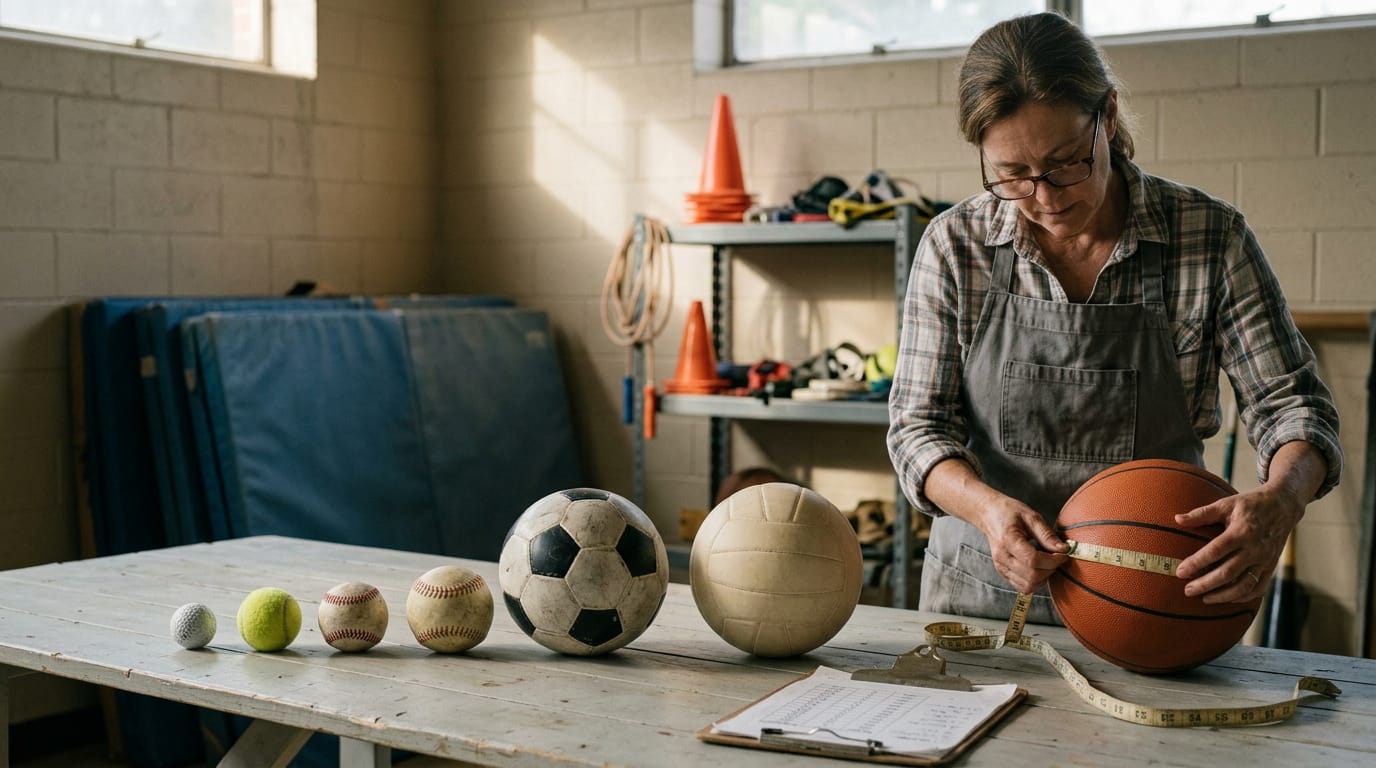
Picture a parent in a sports store holding two soccer balls that look identical, unsure which one fits the older age group. Buying a ball works the same way as buying shoes: the wrong size makes everything harder.
Here, size means diameter and circumference, while weight is how heavy the ball feels in hand, and both shift by sport, age, and level.
In this post, we’ll walk through each sport’s official specs, the age and level variants you’ll see on the shelf, and how to pick the right one for your player’s league. We’ll also cover how to inflate and care for it so it lasts the season.
Sports Balls by Size, Weight, and Circumference
Before you buy, you’ll want three numbers: weight, diameter, and circumference. Where a rulebook sets a figure, we’ve quoted it; where our verified sources don’t, we’ve said so rather than guess.
How major sports balls measure up
The Laws of the Game set the standard for a Size 5 match ball. Think of a parent buying one for a weekend match: check the label for Size 5 and a circumference in the range below, and you’ll know it meets the standard before you pay.
Basketball’s governing rules set the weight of a regulation ball, and a Testbook reference answer gives it as 625g.
For tennis, a study of tennis ball ‘feel’ notes that the International Tennis Federation (ITF) Rules of Tennis set strict limits on mass and diameter, and that a rebound test measures each ball’s coefficient of restitution, or how much energy it gives back.
Cricket and field hockey rules both define the required measurements and weight of match balls, though we don’t have verified figures for field hockey. Here’s the quick-reference comparison:
| Sport | Weight | Circumference |
|---|---|---|
| Soccer, Size 5 match ball | 410g to 450g at kickoff (14 oz to 16 oz) | 68.0cm to 70.0cm (27 in to 28 in) |
| Basketball, regulation | 625g | Not covered here |
The measurements covered in this guide
Specs come down to three measurements:
- weight in grams
- diameter (the distance straight across the middle)
- circumference (the distance around the outside)
They switch between centimeters, inches, and millimeters, and one millimeter is a tenth of a centimeter. Weight is about how a ball feels, while circumference is about how big it is against the rules.
Packaging loves the word ‘official.’ The number is what counts.
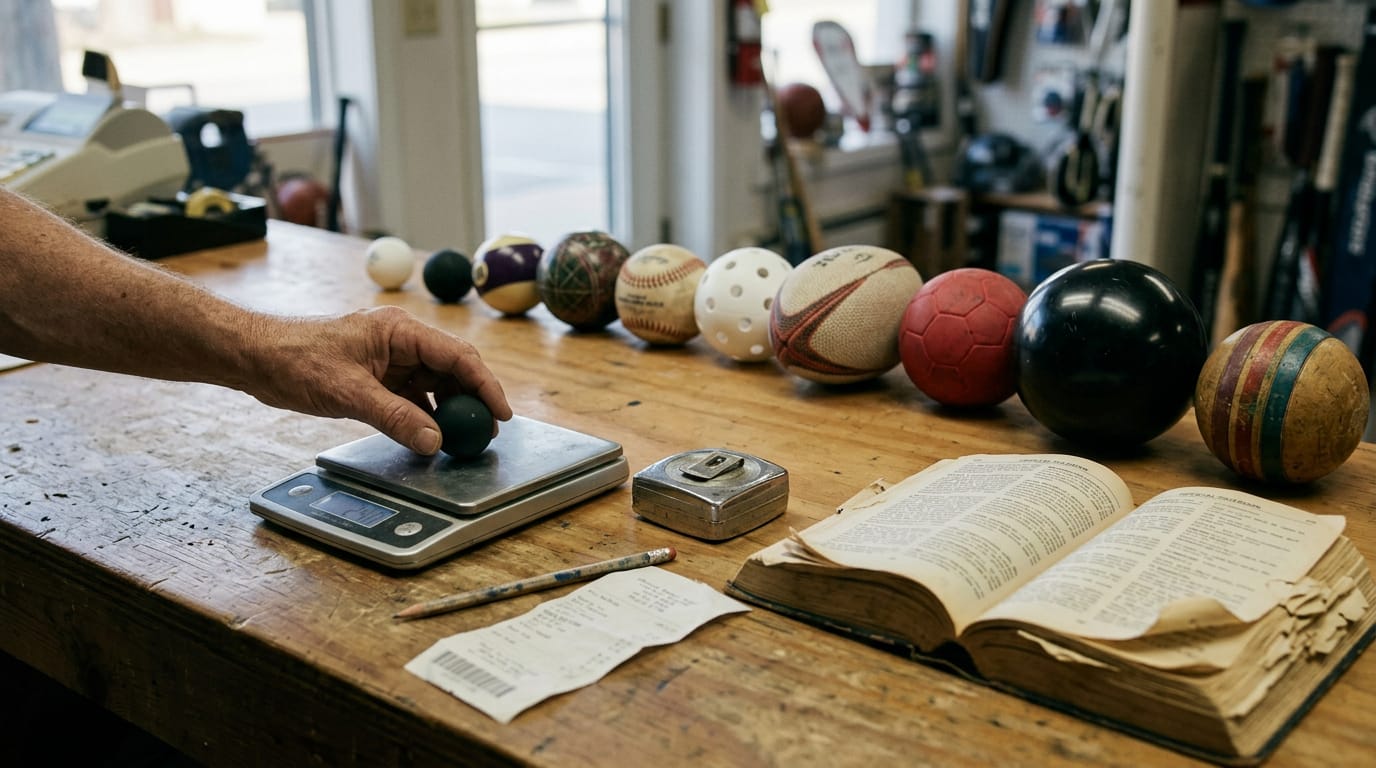
Other sports balls, from squash to bowling
We don’t have verified figures for these balls, so before you buy any of them, check the weight and size against the sport’s official rulebook.
- Squash, ping-pong, racquetball
- Pool, carom billiards, bocce
- Baseball, softball, Wiffle ball
- Rugby, Australian football, jai alai
- Bowling, croquet, handball
How balls differ by gender and level
- Men’s vs women’s cricket balls: Cricket ball specs vary by gender and age, and a study of women’s international cricket notes that those balls are lighter with a smaller circumference.
- Professional match standards: Match balls follow written rules, like the Size 5 football in the table above, so check the spec before you buy.
- Tournament golf ball specs: We don’t have verified figures for golf, so check the event’s rules before you buy.
Official Sizes for Each Age and Level
It’s less about how a ball looks and more about who it’s built for. Here’s how we’d narrow it down: start with an age-to-size chart for youth, then match the ball to your player’s level.
Soccer ball sizes for kids and adults
Soccer balls come in graded sizes. A thesis on the impact behaviour of footballs notes that these come in three sizes, 3, 4 and 5, each tailored to different age groups and levels of play.
Size 4 and Size 5 are the two to compare first, and youth and foam 8.5 inch soccer balls are worth asking about for the youngest players.
Say your nine-year-old is moving from backyard kicks to a rec league. Buy the size that league lists for her age group, not the one that just looks big enough on the rack.
That way she spends practice learning the game instead of chasing a ball she can’t control.
Basketball sizes for men, women, and kids
The men’s regulation size is 29.5 inches. If your player is heading to high school or college ball, look up the official NFHS (National Federation of State High School Associations) and NCAA (National Collegiate Athletic Association) ball before you buy.
Mini and kids’ balls are made for smaller hands, so match the label to your player’s age. Women’s and youth balls are sized separately from the men’s, so don’t assume the 29.5 inch ball fits everyone. Check the label first.
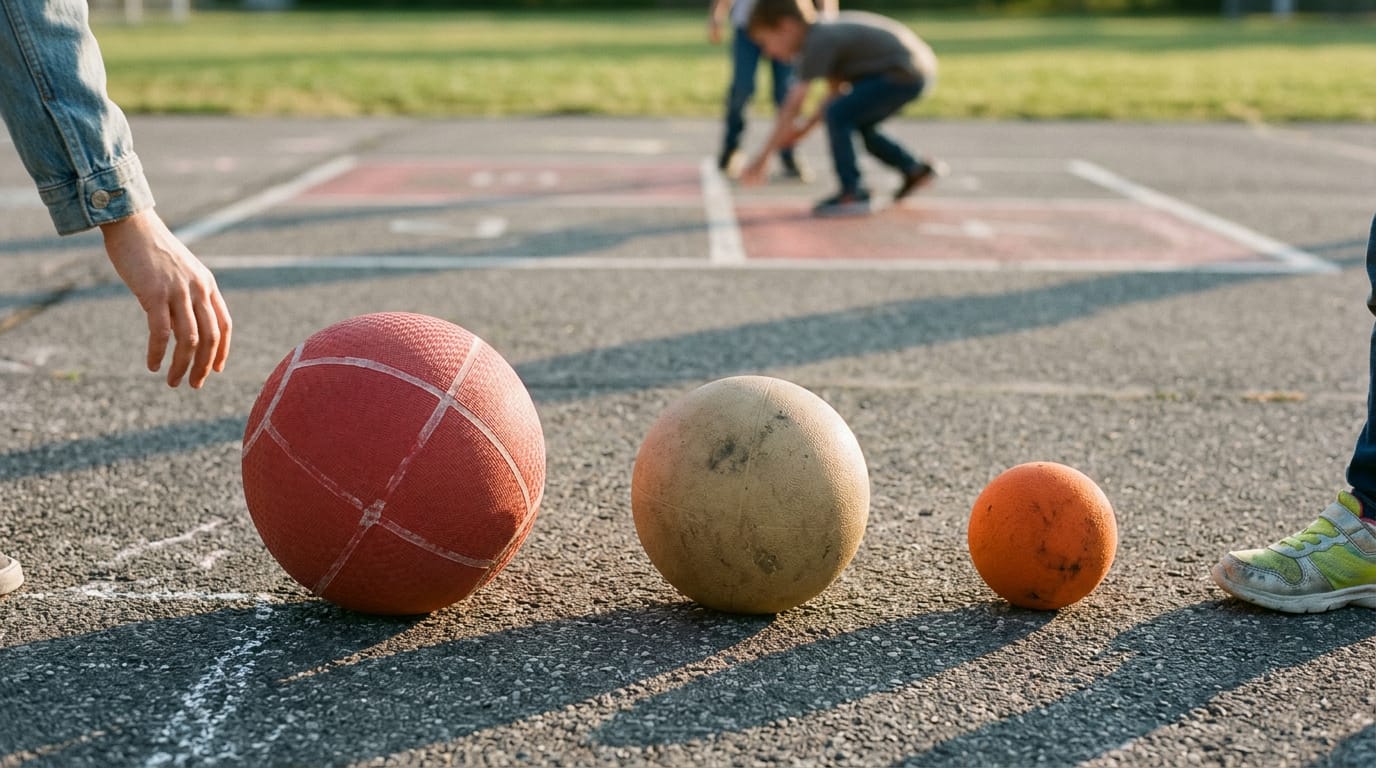
Kickball, dodgeball, and four-square ball sizes
Kickball uses an 8.5 inch ball, and dodgeball uses a 7 inch one. For four-square, a playground ball fits the game, and the 6 inch foam version suits younger kids.
Sizes and weights for other popular sports
- Volleyball: Check whether your league requires an official-size ball before you buy.
- Football: Choose the official size for organized play, or the 9.75 inch foam ball for younger or casual throwing.
- Baseball: The 3.5 inch foam baseball is a soft option for younger players learning to hit.
- Bowling: Pick a bowling ball in the 3-5 lb range that your player can hold steady through a full swing.
- Medicine balls: Weights come in a range, so pick one your player can throw with good form, not the heaviest one on the rack.
Why Exact Ball Specs Matter
A ball that’s slightly off in weight or size can change how an entire game plays out. Before you buy, it helps to know why we care so much about those numbers.
How standard sizes keep play fair
Standard specifications (the required weight, diameter and circumference) mean everyone is playing with the same tool. When every ball in a league matches those numbers, a pass or a bounce means the same thing on every field.
For example, a youth soccer coach entering her team in a tournament across town can have her players train with the game-day ball all season, so nobody’s team is stuck adjusting to an unfamiliar one.
Fairness comes from sameness rather than from superior equipment.
Specs shape how a ball feels in your hands and off your foot, bat or racket. A ball that’s too heavy for a young player’s frame makes accurate throws a chore, while one that’s too light can be hard to control.
When the size matches the player’s age and level, the ball does its job without fighting them. A good ball disappears into the game.
The standard also helps everyone around the game. Players know what to expect before the whistle, officials have a clear reference when a ball’s condition is questioned, and fans can follow the action without wondering whether the ball changed mid-match.
Whether you’re coaching, officiating or cheering from the stands, that shared standard keeps the focus on the play.

Types of Balls to Weigh Before Buying
Settle three things before you match a size chart: material, where it’ll be played, and how you’ll keep it inflated.
Ball materials and which ones last longest
- Composite and synthetic leather: panels that mimic real leather at a friendlier price.
- Rubber and nylon-wound: tough and bouncy, with a firm, consistent feel.
- Foam and vinyl: light and soft, best for younger players.
- Butyl bladder: the inner air chamber that holds pressure, so a good one keeps its bounce.
Which materials last longest depends on the surface. A rec-league coach whose team practices on asphalt every Tuesday is better off with rubber or nylon-wound balls than foam or vinyl, so the set lasts the season. Choose for surface rather than price.
Choose by use and league approval
Start with where you’ll play: indoor and outdoor balls are built for different floors.
Many leagues only accept balls approved by a governing body, such as the NFHS (National Federation of State High School Associations), the NCAA (National Collegiate Athletic Association) or the USVA (United States Volleyball Association).
- Physical education (PE) and gym class: prioritize durability and balls that are safe for younger students.
- Beginner and training balls: built for drills, so they make a smart second purchase.
- Check league rules before buying: a backyard-approved ball may not be legal in games. Check first.
Pumps, covers, and what a set costs
Every ball has a target PSI (pounds per square inch), listed on the packaging. Inflate to that number with a gauge. Don’t go by feel.
- Electric inflators: hit your target PSI without hand-pumping, which helps if you fill a full set often.
- Cage ball covers: protect the large balls rolled around shared school gyms.
- Sets of six: compare the per-ball cost against single purchases to see if you’re saving.
A PE teacher outfitting thirty students gets more floor time from a set of six and an electric inflator than from one hand pump passed around the room.
Once you know the sport, age, and level, choosing a ball gets a lot simpler. Match the size to the player on the field, confirm the weight fits your league’s rules, and inflate it to the pressure the maker recommends.
Keep it clean and dry between sessions, and it’ll hold up all season.
Get those details right and you won’t be stopping practice to hunt for a replacement. The right ball simply fades into the game, and that’s exactly what you want.
References
- Understanding the mechanisms that govern the impact behaviour of a football — doi.org (2024)
- [Solved] What is the weight of a basketball ball_______. — testbook.com (2026)
- Physical Match Demands of Women’s International Cricket — repository.essex.ac.uk (2023)
- Table 1 Equipment and materials used in the study. — preview-www.nature.com
- Determination and analysis of dimensions of ‘feel’ in tennis ball impacts — dspace.lboro.ac.uk (2005)
- Football Laws: All 17 IFAB Laws Explained — lawsofsports.com (2026)
- United States Golf Association — usga.org
Sources
- Football Laws: All 17 IFAB Laws Explained, lawsofsports.com,
- [Solved] What is the weight of a basketball ball_______., testbook.com,
- Determination and analysis of dimensions of 'feel' in tennis ball impacts, dspace.lboro.ac.uk,
- United States Golf Association | List of Conforming Golf Balls, usga.org
- Table 1 Equipment and materials used in the study., preview-www.nature.com
- Physical Match Demands of Women’s International Cricket, repository.essex.ac.uk,
- Understanding the mechanisms that govern the impact behaviour of a football, doi.org,
Find your level
The Counter