Street Legal Golf Carts: Rules, LSVs, and Buying Tips
Street legal golf carts need more than a fairway setup. See what makes one an LSV, which state rules apply, and whether conversion is worth it before you buy.

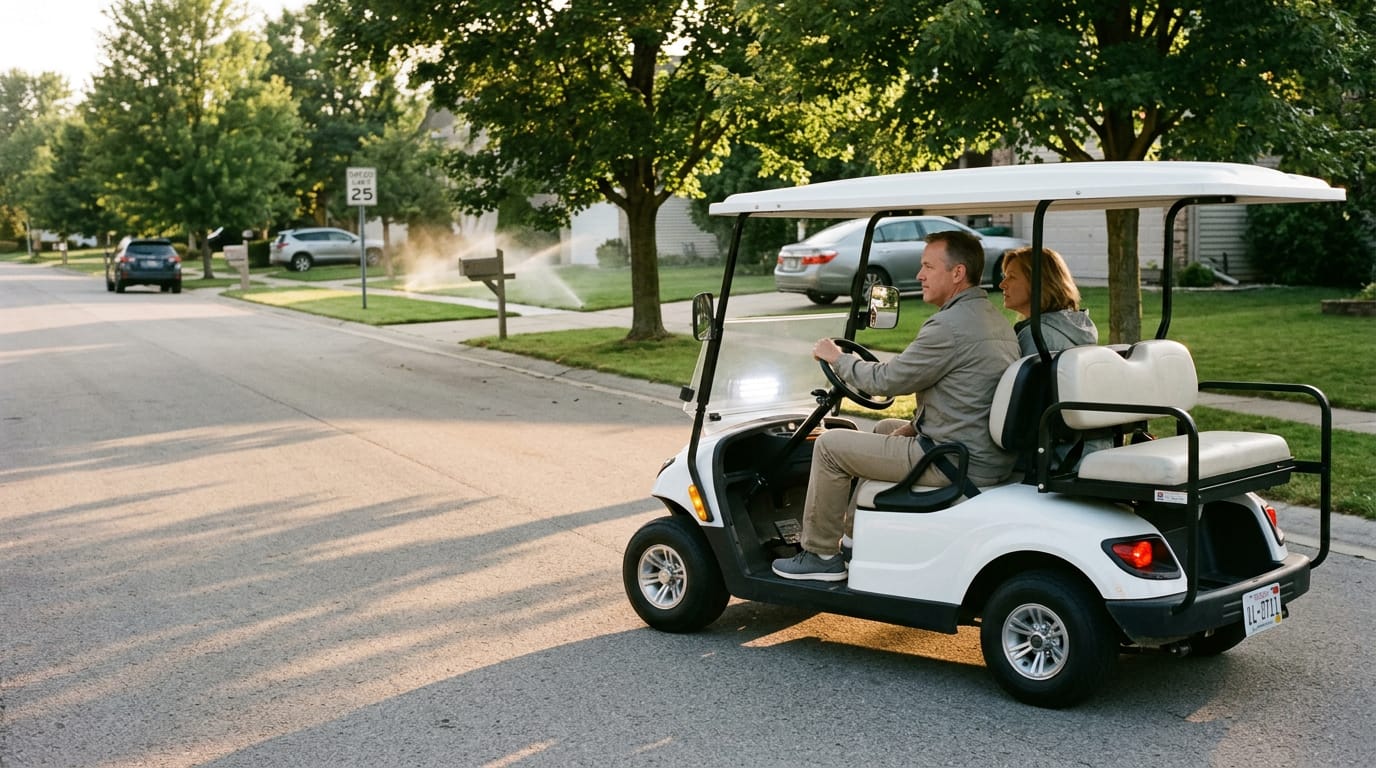
Picture running to the hardware store without leaving the course behind. That’s the appeal of a street-legal golf cart, but a fairway cart isn’t automatically road-ready.
A low-speed vehicle (LSV) is a small, four-wheeled vehicle equipped to meet road rules, and whether you can drive one depends on where you live.
This guide covers what turns a cart into an LSV, how the two differ, what your state allows, and whether converting one yourself makes sense. We’ll also look at brands, prices, running costs, and how to choose the right fit before you buy.
How Street Legal Golf Carts Become LSVs
Your cart doesn’t qualify just because it has a few lights and a windshield. It becomes a low-speed vehicle (LSV) only when it meets the federal definition, carries the required equipment and has the paperwork to prove it.
How federal law defines a low-speed vehicle
Federal rules set the frame. A federal review of Federal Motor Vehicle Safety Standards (FMVSS) defines an LSV as a four-wheeled vehicle with a top speed above 20 mph and no more than 25 mph on a paved level surface.
LegalClarity adds that its gross vehicle weight rating (GVWR) must be under 3,000 pounds.
Two more rules apply:
- FMVSS 500 compliance. The cart must meet FMVSS 500, the standard for low-speed vehicles.
- Manufacturer self-certification. The maker confirms on its own that the cart meets those rules.
Safety equipment your cart must have
Here’s what your cart needs:
- Headlights, tail lights and brake lights
- Turn signals and reflectors
- Mirrors and a compliant windshield
- Seat belts
- A working parking brake
- A vehicle identification number (VIN)
The goal is legal equipment, not flashy accessories. Think of a golfer who drives her cart from the 18th green to the clubhouse. With every item in place, she can enjoy the ride. No second-guessing.
Which papers prove your cart is certified
- Certification label. Look for the label on the cart itself.
- VIN verification. Confirm the VIN matches your paperwork.
- Certificate of origin. This traces the cart back to its maker.
- Title documents. These show who legally owns the cart.
Keep the papers together. Paperwork is your proof.
How Golf Carts Differ from LSVs
Golf carts and low-speed vehicles (LSVs) look alike, but the law treats them differently. Here’s the split, then California’s definition.
Key differences between the two types
Five areas set them apart:
- Purpose and design. A golf cart is built for the course, while an LSV is built for public roads.
- Speed. Both are slow, but each has its own rules, so check before assuming they can share the same streets.
- Federal certification. An LSV is built to meet federal road-safety standards. A standard golf cart generally isn’t.
- Registration and insurance. Road-going vehicles are usually registered and insured like cars. Course carts usually aren’t.
- Public-road access. Where either can drive depends on your state and city, so classification matters more than looks.
Think of a weekend golfer who buys a cart for the course, then wants to run to the clubhouse on a public street. Its classification and your state’s rules decide whether that’s allowed, so check before he rolls out.
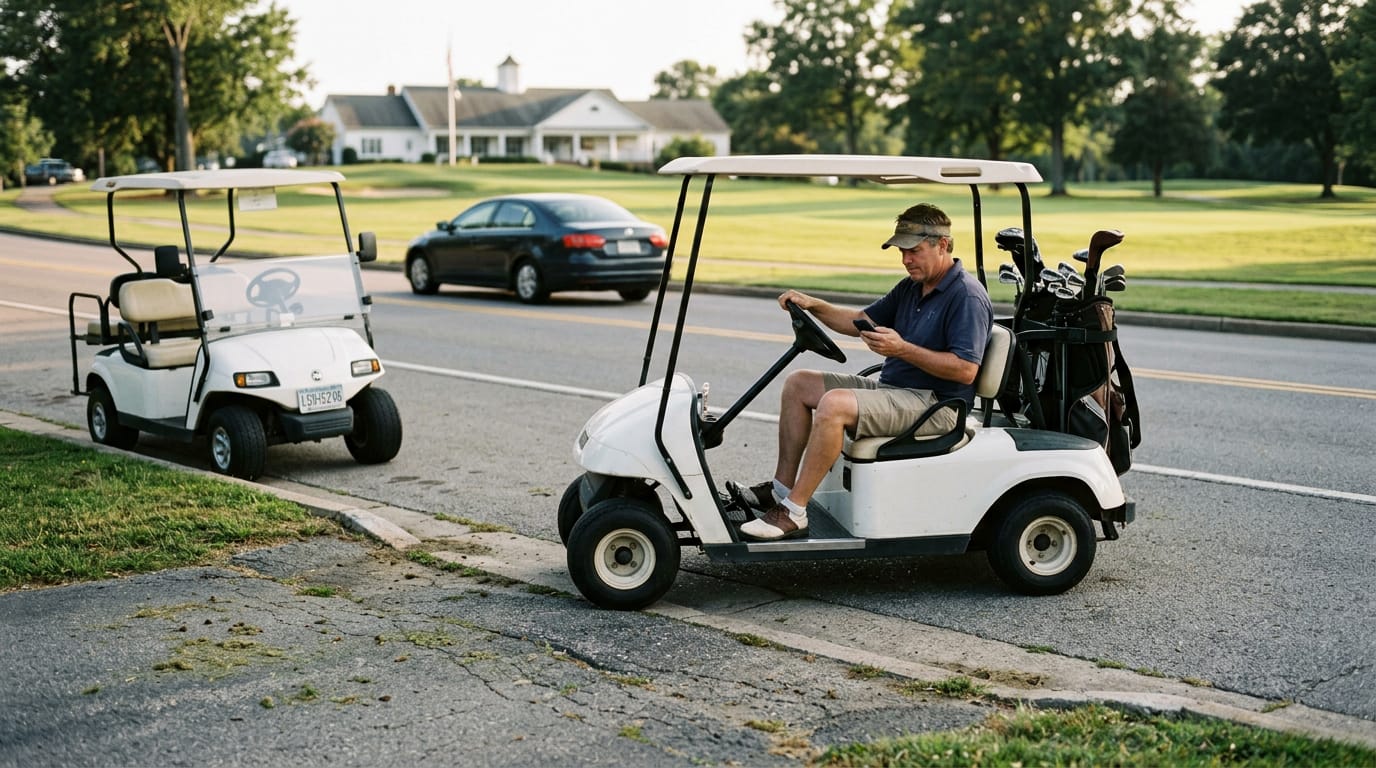
How California defines a standard golf cart
California’s definition has four parts you can check against any cart:
- Speed cap. A forensic engineering analysis of golf course cart accidents quotes the state definition: not more than 25 miles per hour.
- Weight. A state law firm’s guide cites the California Department of Motor Vehicles (DMV): less than 1,300 pounds unladen, meaning empty of passengers and cargo.
- Seating. No more than two persons, including the driver.
- Purpose. Designed to carry golf equipment.
Check a cart against all four, and you’ll know whether it fits.
What States Allow Golf Carts on Roads?
Each state sets its own rules, so which states allow golf carts on the road depends on where you live. The real question is usually which road and what paperwork comes with it.
Where you can drive an LSV
The legal category to know is the low-speed vehicle (LSV). LegalClarity notes that LSVs may generally be operated on roads posted at 35 mph or less, subject to local restrictions. Crossings of faster roads need their own check of state and local rules.
Local governments can further restrict or expand access, so a road that qualifies on paper isn’t always open.
Driving a standard golf cart on roads
Standard carts get a tighter limit. In Amery, The Amery Free Press reports that carts will be allowed on city-jurisdiction streets posted at 25 mph or less.
Some places go further with designated routes.
LegalClarity’s California guide explains that under Vehicle Code Section 21115, a city or county can designate roads adjacent to or providing access to a golf course, and those stretches can’t reach more than one mile from the course.
Local ordinances control the details, including speed limits and crossing zones.
Consider a weekend golfer who wants to ride a cart to the clubhouse for lunch. Before she buys, she checks whether her route stays on a 25 mph street or a designated route, so her ride is planned, not guessed.
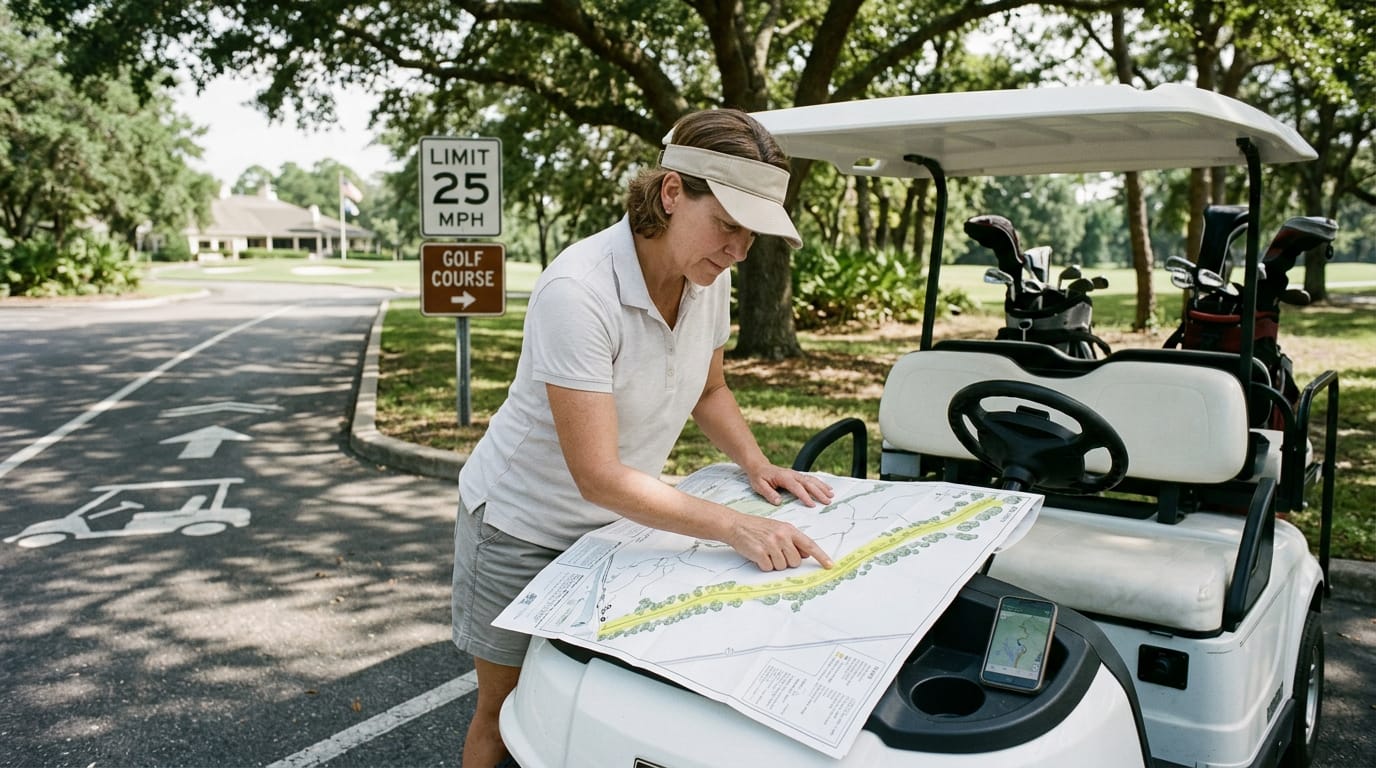
Getting your cart registered and insured
Run through this list first:
- DMV registration. Contact your state’s DMV to learn what registration your cart needs.
- Liability insurance minimums. Ask your insurer which minimums apply.
- Valid driver’s license. Every driver should hold one.
- Check with local authorities. Local rules can still restrict a registered cart, so ask before you plan a route.
A few phone calls now beat a surprise later.
Changing a Cart into an LSV Yourself
Converting a cart into a low-speed vehicle (LSV) yourself sounds like a shortcut, but it’s usually the longer road.
Why DIY upgrades fall short
Here’s where home upgrades usually stumble:
- Accessories don’t create certification. A windshield or a horn won’t make the cart an LSV, however well it’s installed.
- Lights alone aren’t enough. They make the cart visible, not legal.
- A speed increase doesn’t make it an LSV. Faster is still just a golf cart.
- Modified carts get treated as regular vehicles. Ordinary road rules can apply.
Consider a weekend golfer who bolts new headlights onto her gas cart, then drives it to the hardware store across the road from the course. She’s handled the visible part, but the cart still isn’t an LSV.
If you’re asking how fast you can get a gas golf cart to go, the answer that matters on a public road isn’t a top speed. It’s whether the cart is certified as an LSV.
Driving a non-compliant cart on public roads can leave you legally exposed. If something goes wrong, your insurer may question your coverage.
A factory-built LSV is the easier route
A cart built as an LSV at the factory skips the guesswork. The manufacturer designs safety equipment in from day one, not bolted on later. That makes the path to legality simpler.
Picture a parent who wants one cart for family rounds and short neighborhood drives. A factory LSV means Saturday goes to the course, not the garage.
Before you buy, confirm the certification covers that exact unit. The model name on the brochure isn’t enough.
Brands and Models Worth a Look
Several manufacturers build low-speed vehicles (LSVs), the carts that can be registered for public roads. Here’s who’s in the mix and how to narrow the list.
Brands that build street-legal LSVs
- Tomberlin
- Club Car
- ICON EV
- Evolution
- GEM
- Tara
As for which golf cart brand is the most reliable, we don’t have a verified ranking to crown a winner. Instead, ask each dealer how the model you’re eyeing has held up and who handles its warranty repairs.
The Tara LSV lineup
Tara’s LSV lineup gives you three models to compare:
- Roadster 2
- Roadster 2+2
- Explorer 2+2
Compare the seating and cargo room of the two 2+2 models against the base Roadster 2 before you decide. Pull the lithium battery specs for each one too, since the battery is what you’ll live with day to day.
These carts run up to 25 mph, so match that top speed against the limits on the roads you plan to drive.
A brand name alone isn’t proof
A badge tells you who built the cart, not what you’re actually driving home. Consider a weekend golfer who spots a familiar name on a dealer’s lot and assumes every cart in that row is street legal.
Then she checks the spec sheet and finds the one she liked is a standard golf cart, so she keeps looking instead of paying for a cart that can’t go on the road. Check the cart, not the badge.
- Brand isn’t proof. A familiar name doesn’t guarantee the unit in front of you is set up for public roads.
- Verify configuration per vehicle. Ask for the spec sheet on the exact cart and confirm it’s the street-legal setup.
- Mixed golf and LSV lineups. A single brand’s lineup can include standard golf carts alongside LSVs, so one showroom may hold both.
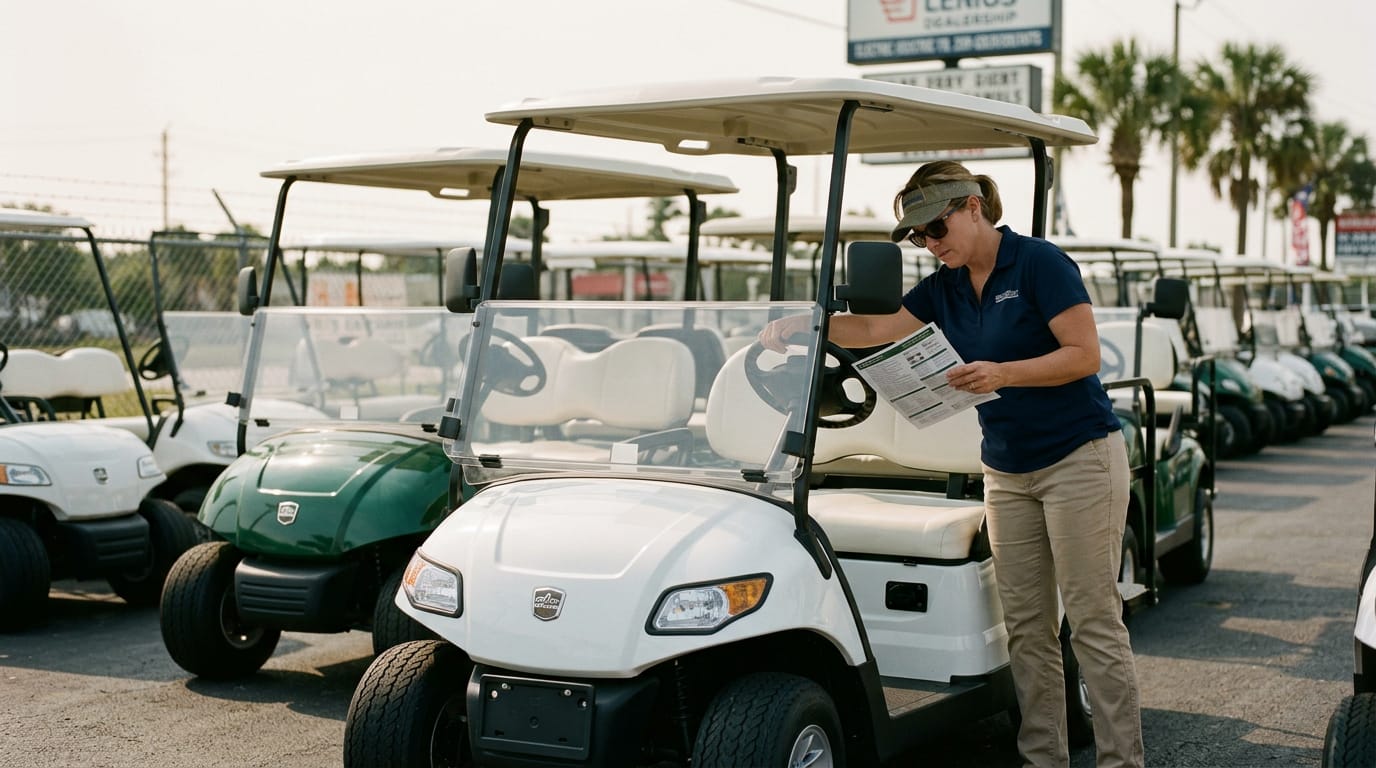
What dealers have in stock near you
Dealers near you may carry new and used carts, in electric and gas versions, so decide which you want before you walk in. You may also spot Evolution, Denago, Swift and Teko on the lot.
Lifted and all-terrain models turn up on some lots too. If your course or neighborhood has rougher paths, they may appeal, but ask whether the street-legal setup still applies to that build.
How to Choose the Right Cart
Before you compare models, confirm the cart can legally run your routes and fits your budget.
Checks to run before buying
- Check intended routes. List every road, since a weekend golfer’s clubhouse street may also be her errand route.
- Verify certification and VIN. Match the certification and the VIN (vehicle identification number) to the paperwork.
- Confirm registration eligibility. Make sure it can be registered where you live.
- Check route speed limits. Match each route’s posted limit to the cart’s top speed.
- Test-drive configuration. Drive the exact setup you’ll buy.
Comparing everyday needs side by side
- Seating and payload. Count riders and gear, since payload (total weight a cart can carry) matters as much as seats.
- Range and charging. Is a gas-powered golf cart better than an electric? Neither wins everywhere, so buy for your routes. Gas means refueling, while electric means managing range (how far one charge goes).
- Hills and terrain. Steep grades ask more of the cart’s power, so test the hills you’ll face.
- Service support. Ask where repairs happen, since a nearby shop keeps downtime short.
- Club storage and bag fit. Measure your bag against the cargo space before you buy.
Financing terms and local delivery
How much is a golf cart worth? A Metairie golf cart dealer advises comparing new and used prices, taking condition into account.
A golf cart financing guide advises budgeting for insurance, maintenance, and repairs. Don’t forget the battery.
- 0% APR financing. APR (annual percentage rate, the yearly cost of borrowing) of 0% means no interest.
- Up to 36 months. Terms can stretch that far, so weigh monthly payments against the total cost.
- Local delivery available. Ask whether the seller can bring it to you.
- Online application. Start it from home before you visit.
Street-legal golf carts open up plenty of errands, but only when the cart, the paperwork, and your state’s rules line up.
Match the cart to how you’ll really use it, and weigh the lowest sticker price against upkeep. A clubhouse run and a daily commute ask very different things of a vehicle.
A well-chosen cart fades into the background, and that’s exactly the point.
References
- Golf Cart Dealer Metairie — doi.org (2026)
- Review of Federal Motor Vehicle Safety Standards (FMVSS) for Automated Vehicles : Identifying Potential Barriers and Challenges for the Certification of Automated Vehicles Using Existing FMVSS — ntlsearch.bts.gov (2016)
- Forensic Engineering Analysis Of Golf Course Cart Club And Ball Accidents — doi.org (2021)
- Low-Speed Vehicle (LSV) Classification: Rules & Requirements — legalclarity.org (2026)
- Low-Speed Vehicles: Legal Definition and Road Access Rules — legalclarity.org (2026)
- Amery to allow golf carts, low-speed vehicles on city streets | News — theameryfreepress.com (2026)
- Golf Cart Rules On City Streets: Staying Safe And Compliant — statelawfirm.com
- How to Make a Golf Cart Street Legal in California — legalclarity.org (2026)
- Golf Cart Financing Flexible Options for Purchasing a Golf Cart — doi.org (2026)
Questions
What is the difference between a LSV and a golf cart?
A golf cart is generally designed for use on a golf course and usually is not federally certified for public roads. An LSV is a four-wheeled vehicle certified to federal safety standards, with a top speed above 20 mph and no more than 25 mph; it also needs required equipment and paperwork. State and local rules determine where either type can be driven.
What is the fastest golf cart I can buy?
Factory-built LSVs are generally limited to 25 mph under the federal definition. Some modified golf carts may go faster, but increasing speed does not make a cart street legal; road use depends on its certification and local rules.
How much is a golf cart worth?
A golf cart’s value depends on whether it is new or used, its condition, age, features, and battery health. Compare prices for similar carts and include likely insurance, maintenance, repair, and battery costs in your budget.
How fast can you get a gas golf cart to go?
There is no single safe or legal speed for a modified gas golf cart; it varies by model and modifications. For public-road use, speed alone is not enough: an LSV must be certified and have a top speed above 20 mph and no more than 25 mph, while a faster modification does not create LSV status.
What states allow golf carts on the road?
Rules vary by state and locality, and some allow standard golf carts only on designated streets or routes. LSVs may generally use roads posted at 35 mph or less, subject to local restrictions; check your state DMV and local authorities for permitted roads, registration, and insurance requirements.
Which golf cart brand is the most reliable?
There is no universally verified ranking for the most reliable golf cart brand. Ask dealers about the specific model’s service history, warranty support, and where repairs are handled, and check the configuration of the exact vehicle you plan to buy.
Do they still make gas golf carts?
Yes. Manufacturers and dealers still offer gas-powered golf carts, alongside electric models. Availability varies by dealer and location.
Is a gas-powered golf cart better than an electric?
Neither gas nor electric is better for every buyer. Gas carts require refueling, while electric carts require charging and planning around their range; compare your routes, terrain, operating costs, and access to service before choosing.
Sources
- Low-Speed Vehicle (LSV) Classification: Rules & Requirements - LegalClarity, legalclarity.org,
- Review of Federal Motor Vehicle Safety Standards (FMVSS) for Automated Vehicles : Identifying Potential Barriers and Challenges for the Certification of, ntlsearch.bts.gov,
- Forensic Engineering Analysis Of Golf Course Cart Club And Ball Accidents, doi.org,
- Golf Cart Rules On City Streets: Staying Safe And Compliant, statelawfirm.com
- Low-Speed Vehicles: Legal Definition and Road Access Rules - LegalClarity, legalclarity.org,
- Amery to allow golf carts, low-speed vehicles on city streets | News | theameryfreepress.com, theameryfreepress.com,
- How to Make a Golf Cart Street Legal in California - LegalClarity, legalclarity.org,
- Golf Cart Dealer Metairie – Quality Golf Carts, Parts & Service, doi.org,
- Golf Cart Financing Flexible Options for Purchasing a Golf Cart, doi.org,
Find your level
The Counter