Do You Wear Shoes for Pilates? It Depends on Your Class
Do you wear shoes for Pilates? Mat classes are often barefoot, while reformer studios may require grip socks, so know what to pack before class.
Showing up to Pilates in running shoes is like wearing a parka to the beach: sometimes it’s just the wrong gear. The good news is that the answer is simpler than the shoe aisle makes it look.
The short version: it depends on your class. Many mat classes are done barefoot, many studio and reformer classes ask for grip socks, and some people prefer dedicated Pilates shoes for extra support.
Here’s how to match your footwear to your class, what to pack, and what to expect once you’re on the mat.
Do You Wear Shoes for Pilates?
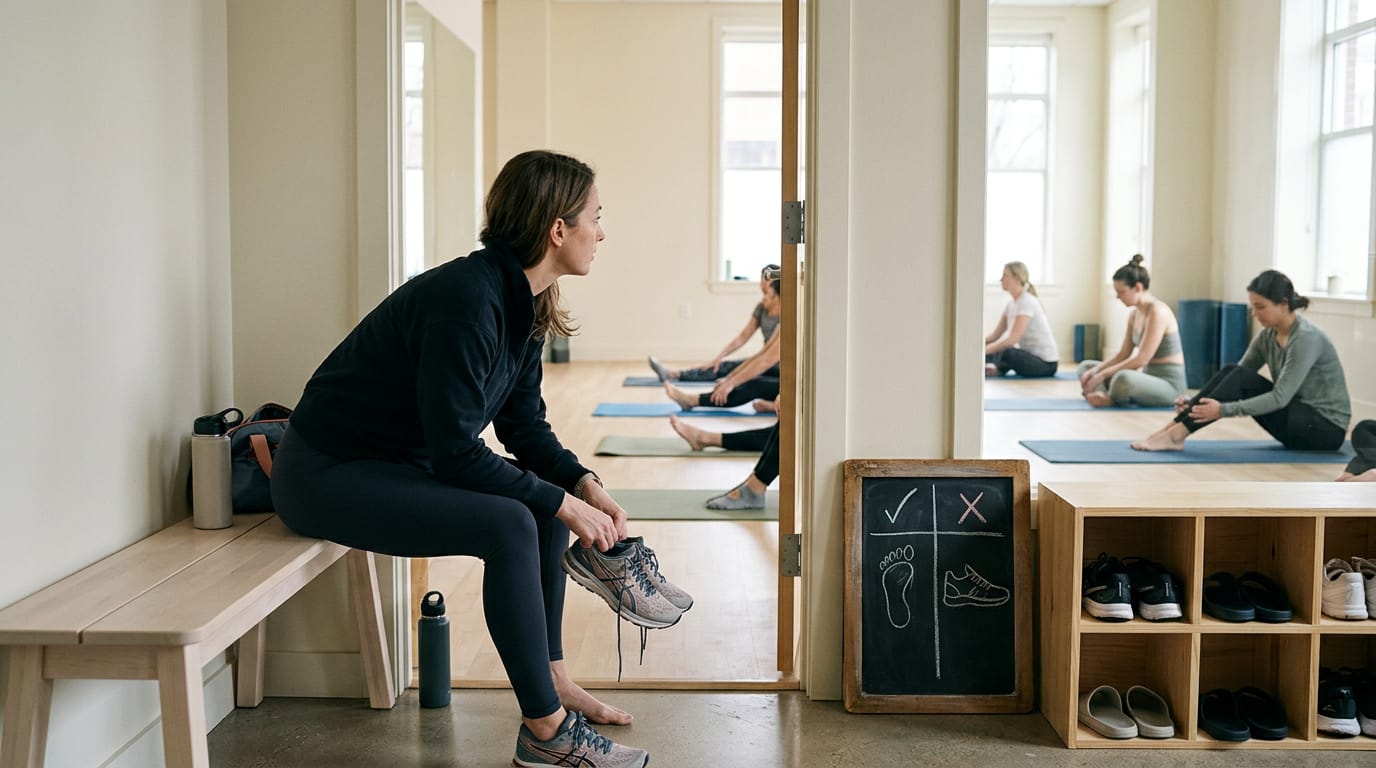
Short answer: usually not your sneakers. For most people, grip socks are the best footwear for Pilates, with bare feet on the mat and grippy shoes as a backup.
Why street shoes and sneakers stay off
Regular shoes drag outside dirt onto a floor where people work barefoot or in socks. Sneakers add a thick sole that dulls the feel of the equipment.
Running shoes deserve their own warning: they’re built for forward motion, not steady balance, so leave them in the gym bag. Studios expect bare feet or footwear made for the studio.
Can I go barefoot to reformer Pilates?
Yes, with one caveat: it depends on the machine. On the mat, bare feet are about feel; on the reformer, they’re about grip. Your instructor can see how your feet line up on the mat, and you’ll get direct floor feedback.
On the reformer, the carriage slides under you, so bare feet can slip on the footbar. Cold floors and shared equipment raise hygiene concerns, so ask your studio first.
Why grip socks beat regular socks
Grip socks have rubberized dots on the sole that keep your feet from sliding on the footbar and carriage. Regular socks are slippery, and a slipping foot throws off the whole movement.
They’re the gold standard for reformer work, and some studios require them, so check before your first class. Bring backup socks, since a worn pair loses its grip.
Think of a weekend golfer who takes reformer classes to loosen his hips. He slides off the footbar in regular socks, then grabs a pair of grip socks the next week and finishes class steady.
Grippy shoes if you’d rather not
If you’d rather not wear socks, grippy shoes are the other option. They offer full-sole traction. Open-sole styles leave more of your foot exposed, while closed-sole styles cover it fully. Most people stick with socks.
Sole thickness affects floor feel: thin soles keep you close to the floor, while thick ones dull that feedback.
If you have bunions (bony bumps at the base of the big toe), plantar fasciitis (heel pain from irritated tissue along the sole) or a recent injury, check with your doctor or physical therapist before choosing a sole, and tell your instructor so they can adjust your footwork.
How to choose grip socks that last
Look for these features when you shop:
- Anti-skid technology. Grip should sit where your foot presses down, so it holds on the footbar and carriage.
- Ample foot coverage. Grip across more of the foot keeps you steady in more positions.
- Odor-eliminating tech. Helps when the same pair goes through class after class.
- Durability and wash cycles. Check that the grip survives repeated washes, since faded dots stop working.
- Sizing. Look for a snug fit with no sliding inside the sock.
Cheap store socks tend to disappoint because grip and fit fade fast, and you’ll end up sliding anyway. A snug, well-built pair is the smarter buy. Steady feet make the whole hour easier.
Clothes That Work Best in Class
As a beginner, you don’t need a special outfit, just clothes you can move in freely. Here’s the real test: can your instructor see your body, and can you roll and stretch without fidgeting?
Choose fitted clothes that show alignment
Instructors correct form by watching how your hips, spine and shoulders line up, so alignment is what they need to see. Picture a parent at her first class in a loose tee and baggy shorts.
The instructor can’t tell where her pelvis sits, so the cues stay vague. Choose clothes that reveal your lines rather than hide them.
- Fitted, not skin-tight. Snug enough to show your shape, loose enough to move freely.
- Nothing baggy. Extra fabric bunches during rolls and bridges and hides your alignment.
Fit beats fashion.
Pants and shorts that stay put
High-waisted leggings are a dependable pick because they stay put through leg circles and roll-downs. Bulky seams and zippers dig in when you lie on the mat, so choose flat seams and no hardware.
Pants that slide during floor work turn a core session into a tug-of-war.
Opinions split on shorts for reformer classes. Some people love the airflow, while others prefer leggings to keep skin off the moving carriage and straps. Ask your studio what it prefers first.
Picking a top and supportive bra
A fitted tank or tee keeps your shoulders and arms visible for alignment checks. Skip hoodies and drawstrings, which can swing into your face during inversions or tangle as you move.
- Supportive bra, no underwire. Wire-free support holds you snugly without digging in when you lie back.
- Moisture-wicking, breathable fabrics. They pull sweat away so you stay comfortable instead of clammy.
- Light layers for warmth. If you get chilly at the start, bring one you can shed once you warm up.
Comfort beats trend.
Pack These Before You Head Out
Packing takes a few minutes, and a good bag saves you from scrambling in the lobby. Here’s what we’d bring and how to walk into your first class ready.
Gear to bring along
Think of a weekend runner trying Pilates for the first time between long runs, who wants to spend the hour working her core instead of digging through her bag for a hair tie. The goal isn’t to pack more. It’s to pack smart.
- Water bottle. Fill it before you leave home so you can sip between exercises.
- Small towel. Handy for sweaty hands or a damp forehead between sets.
- Hair ties. Pull long hair back so it stays out of your face when you’re rolling through your spine.
- Mat. Check whether the studio expects you to bring your own, and ask if you’re not sure.
- Extra layers. Studio temperatures vary, so pack a light layer you can add or shed.
- Gym bag. Keep everything in one bag, with a separate pouch for anything damp.
Tips for your very first class
- Arrive 10 to 15 minutes early. That gives you time to check in, find a spot, and set up your mat without rushing.
- Tell the instructor you’re new. They can show you the basics, suggest modifications, and check your setup. A quick heads-up goes a long way.
- Keep an open mind. Feeling awkward is normal, and everyone in the room was once the new person unsure where to put their feet. Show up anyway.
What to Expect Once You’re in Class
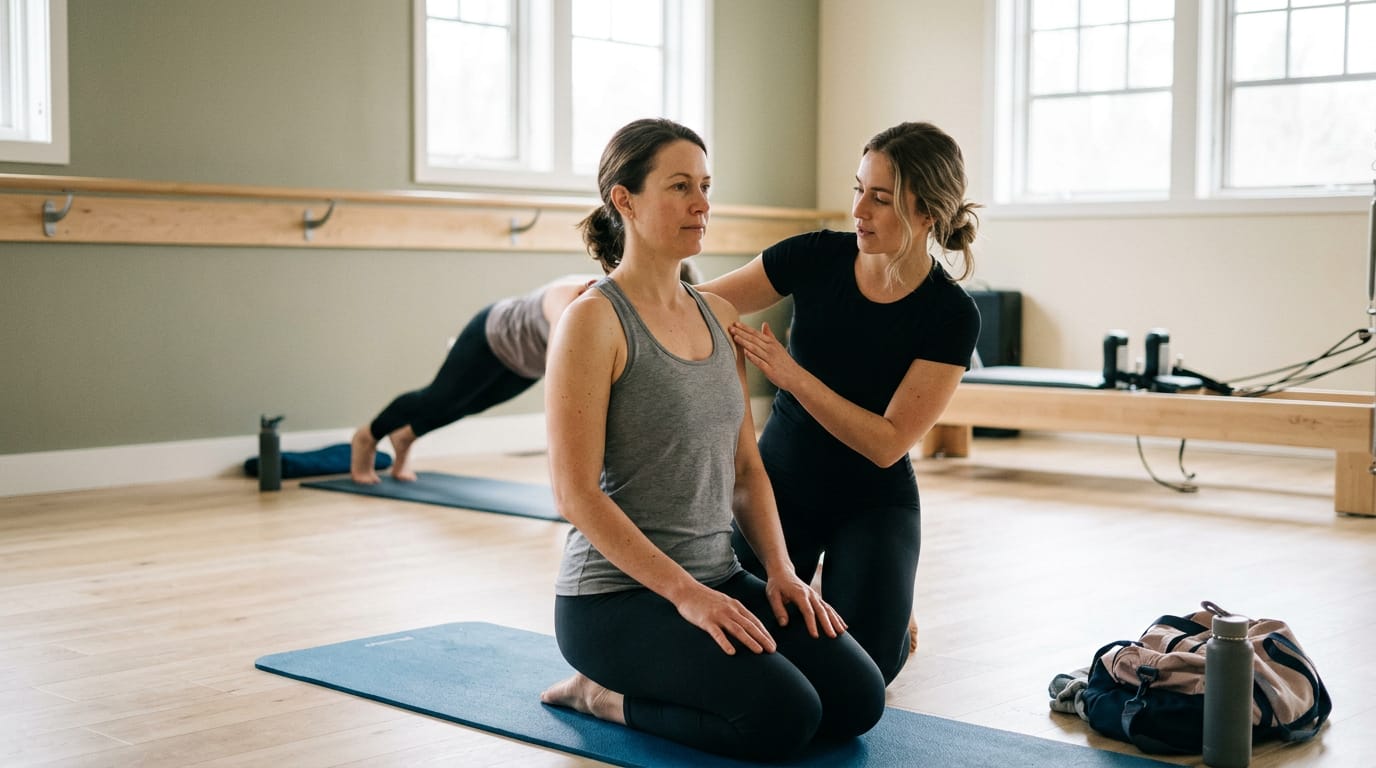
Once you step into the studio, the class format decides how much your footwear matters. Here’s what you’ll see on the studio floor and how often we’d suggest showing up.
Common class styles you’ll find
You’ll most likely run into three formats, and each one asks something different of your body:
- Barre class. Small, controlled movements paired with strength work, often done while holding a ballet-style barre for balance.
- Mat Pilates. Floor-based work where your own body weight provides the resistance.
- Reformer Pilates. Movements on a sliding carriage, with springs and straps providing the resistance.
Instructors often offer modifications, easier or harder versions of a move, so the class works for your level. Think of a weekend soccer parent who joins a mat class to build core control for longer sprints.
On day one, her instructor shows her an easier version of a move so she can keep good form. As she gets stronger, she moves up to the harder option without straining.
It’s less about how hard you push and more about how well you control each move. Start easy.
How often to go and how long
A practical starting point is two or three sessions a week. That’s enough to build a routine without crowding out the rest of your schedule. Each class runs 45 to 60 minutes, so block out time for changing and settling in before the first movement.
Show up consistently, and the work adds up.
Pilates Roots and Why Form Counts
Before you pick out a pair of shoes, it helps to know what Pilates asks of your body. The method rewards how you move as much as how hard you work, and that focus shapes everything from footwear to how you approach class.
Why control and form prevent injury
Pilates is built on control. Each movement is slow and deliberate, and you’re asked to keep your core, the muscles around your midsection, engaged while your joints stay lined up.
The goal is quality rather than quantity, so a few controlled reps beat a rushed set.
Proper form matters because it keeps you from getting hurt. A feasibility study on a mat-based Pilates program for community-dwelling seniors points out that proper body positioning and pacing are what keep people from straining their muscles.
Form isn’t a nice-to-have. It’s the part you can’t skip.
The method also has older roots. Its influences go back to earlier movement traditions, and that emphasis on precise, controlled work still runs through today’s classes.
Think of a weekend runner who adds Pilates to balance out her long runs. In her first few classes she moves slowly, keeps her pelvis steady and pays attention to her breathing.
Over time she learns to tell a good stretch from a strain, so she backs off early instead of sidelining herself for a month.
Whether you go barefoot, pull on grip socks, or choose Pilates shoes, the right pick depends on your class and how your feet feel while you move. Look for a snug fit without pinching, and a grip that keeps you steady on the equipment.
Good footwear disappears once class starts, and that’s exactly the point. Set your feet up right, and you can give your full attention to your breath, your alignment and the next movement.
References
- Feasibility of a mat‐based Pilates program for community dwelling seniors to improve balance and core strength — pmc.ncbi.nlm.nih.gov (2025)
Questions
What type of footwear is best for Pilates?
Grip socks are the best choice for most Pilates classes, especially reformer classes, because their rubberized soles help prevent slipping on the footbar and carriage. Mat classes are often done barefoot, but check your studio’s footwear rules before you go.
What to wear to Pilates as a beginner?
Wear comfortable, fitted clothes that let you move freely and allow the instructor to see your alignment. High-waisted leggings and a fitted tank or tee are dependable options; bring grip socks for reformer class, plus water and a small towel.
Can I go barefoot to reformer Pilates?
Yes, you can go barefoot to reformer Pilates, but bare feet may slip on the footbar or carriage. Ask your studio first, since some require grip socks; regular socks can also be slippery, so grip socks are usually the steadier option.
Sources
Find your level
The Counter