Badminton Court Size: Singles, Doubles and Backyard Setups
Badminton court size depends on singles or doubles. Get dimensions in metres and feet, net height, line rules, and the extra space needed around the court.

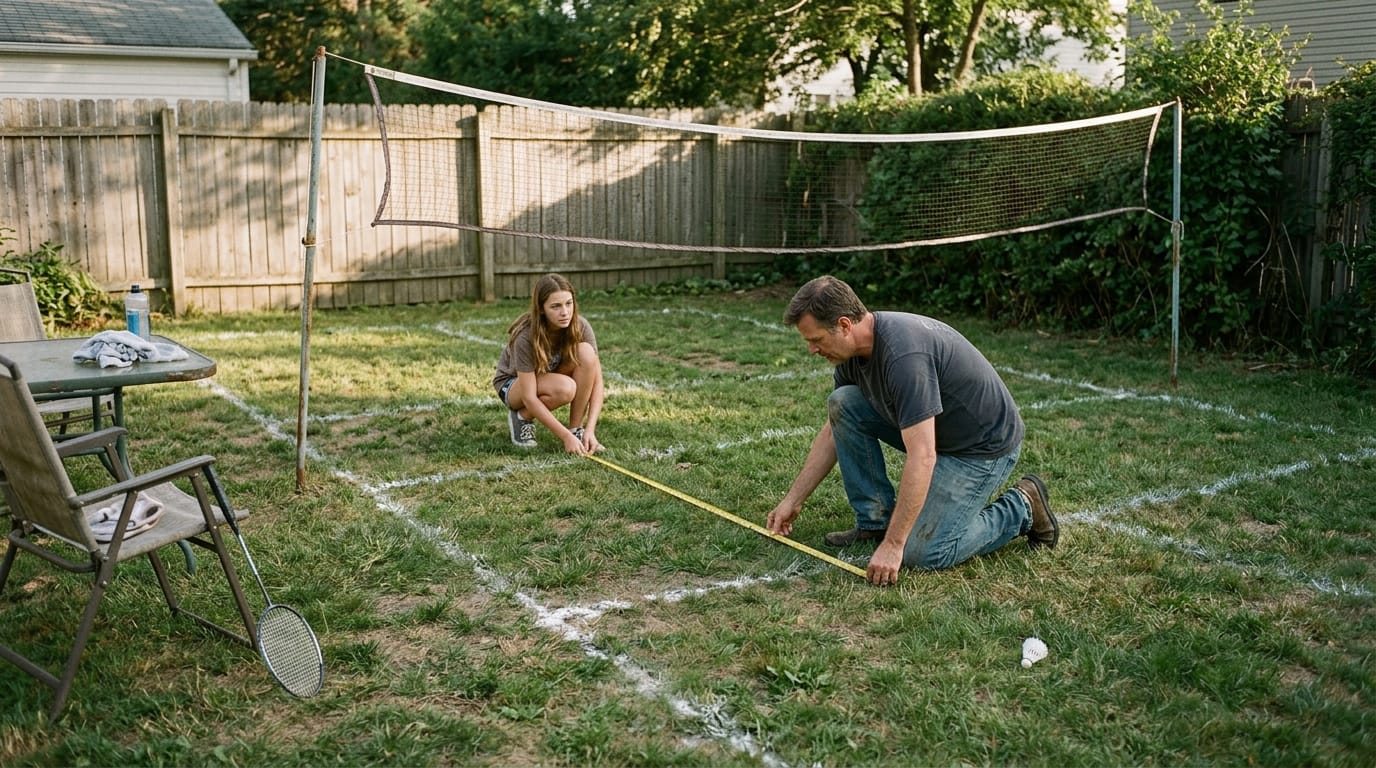
Ever tried to mark out a badminton court in the backyard and realized nobody agrees on where the lines go? You’re not alone. Measuring a court works like measuring a room before you buy a couch: get the space wrong and nothing else fits right.
Here’s the short answer: the official size depends on singles or doubles, and your backyard may match neither. This guide covers dimensions in metres and feet, net height, line rules, run-off space, and outdoor variants, plus gear and surface tips.
Official Court Size for Badminton
Before you mark out lines, you need the official numbers. Only the width changes between singles and doubles.
Is a badminton court 20 feet by 44 feet?
Essentially, yes. According to Sport Rules, a standard court is 13.4 m long, with a width of 6.1 m for doubles and 5.18 m for singles. That’s roughly 20 by 44 feet for doubles.
- Doubles: 13.40 m x 6.10 m
- Singles: 13.40 m x 5.18 m
Both sets of lines share one court: the singles sidelines sit inside the doubles sidelines. The outdoor AirBadminton variant, played on sand, uses a doubles court of 16 m x 6 m.
In or out? A shuttle touching a boundary line counts as in, since every line is part of the area it defines. Anything landing beyond the line is out.
Think of a parent marking out a backyard court for her teenager. Measuring that 20 by 44 feet footprint first keeps every line where the rules expect it, so nobody argues over a close call.
How high the badminton net sits
The net is tallest at the posts. BadmintonAlpha gives 1.55 m (5 feet 1 inch) there, while VICTOR Badminton puts the centre at 1.524 m, so the net dips in the middle.
On AirBadminton sand courts, the net is lower still at 1.45 m at the centre. A lowered net like that cuts down on errors and extends rallies.
Service lines and the front dead zone
According to Sport Rules, the short service line sits 1.98 m from the net on each side. On AirBadminton, a 2 m dead zone sits at the front, and players can’t hit inside it. That discourages net play.
Doubles uses a long service line that differs from the singles one.
Room Needed Around the Court
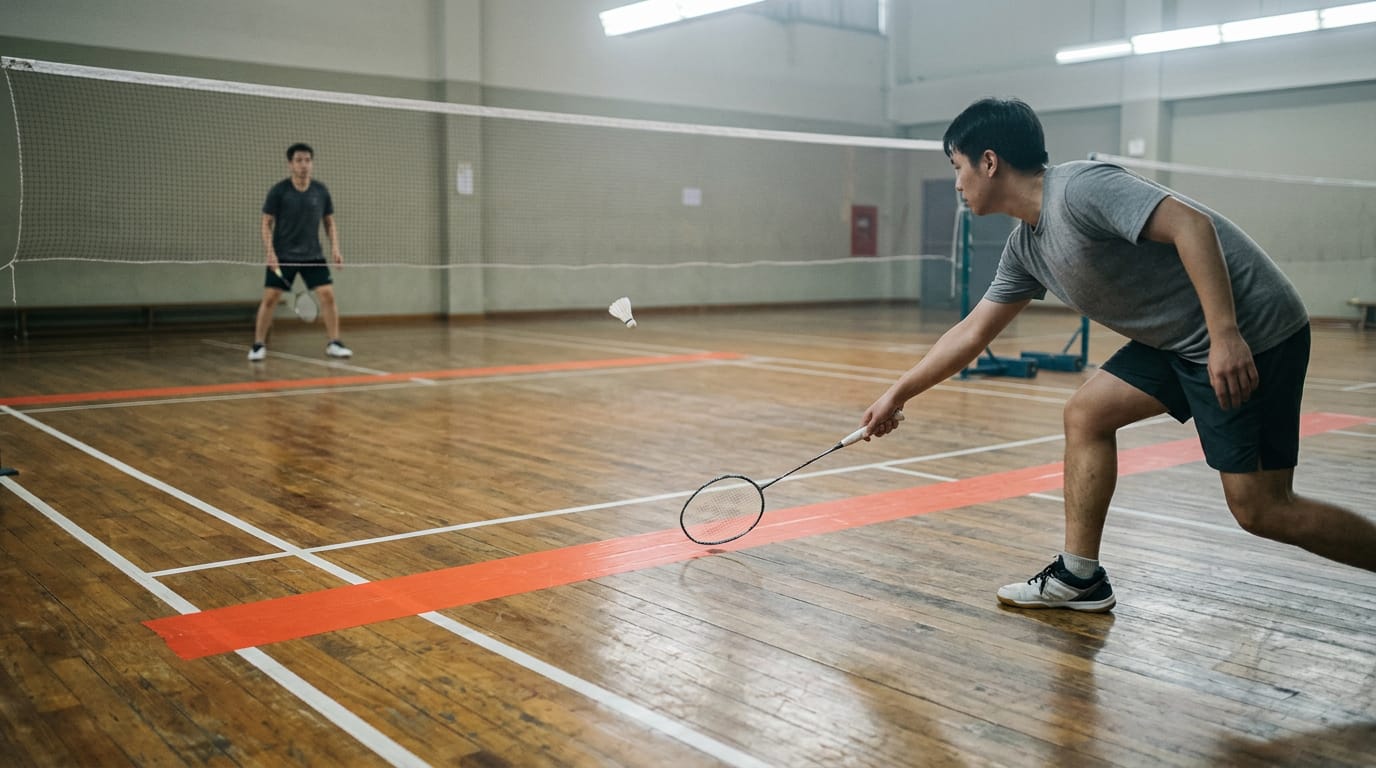
Before you chalk a single line, measure the space around it. Players need room to lunge, recover, and chase down a smash without hitting a wall, and that room adds up faster than most people expect.
Clearance needed at sides and ends
The clearance is the free space beyond each boundary line. The Badminton World Federation (BWF) recommends 1.8m at the sides and 2.4m at the ends. Here’s how that compares with a garden court and tournament play:
| Setup | Sides | Ends |
|---|---|---|
| BWF recommended | 1.8m | 2.4m |
| Garden court | about 1m | 1.5m |
| Tournament | 2.4m | 3m |
Aim for a total comfort footprint of about 9.7m x 18.2m. That’s comfortable room, not minimum room, and it’s the number to plan around.
Consider a dad who wants a court in his back garden for weekend games with his daughter. He measures the lawn, finds roughly 1m at the sides and 1.5m at the ends, and realises that’s enough for friendly rallies.
Rather than planning for tournament-sized room he’ll never use, he buys a portable net set made for gardens.
If you’re marking out the court yourself, measure these clearances before any tape goes down. A court that doesn’t fit the room is hard to fix once the lines are set.
Ceiling height needed for indoor play
Sides and ends aren’t the only limits indoors. According to Sport Rules, BWF competition requires up to 9m of clear height above the court. Look up before you commit to an indoor space.
Outdoors, there’s no height constraint, and that’s a real edge over indoor halls. You never have to work around a low roof, so the clearances you measured become your main limit.
Choosing a Surface That Drains Well
Your surface matters as much as your racket. A court that’s slippery, rough or waterlogged can undo your best shots, so here’s what to look for underfoot.
What a good playing surface feels like
A good badminton surface is hard but true: the ball bounces predictably and your feet stay planted. A little cushioning helps your knees and ankles over a long session. Grass is unplayable, and bare concrete is too hard on your joints.
You’re after grip that lets you stop and turn, not a sole that sticks, because a stuck foot is what twists a knee.
Match your shoes to the surface too. Think of a weekend player who wears indoor court shoes onto an outdoor court on a Saturday morning. Her soles skid on the first rally, and she spends the match watching her feet instead of the shuttle.
A pair matched to the court lets her move freely and focus on her shots.
Keeping outdoor water off the court
A court that holds water can stay unusable for hours after the rain stops, so drainage matters as much as grip outdoors. A surface that drains beats one that just looks smooth in the dry.
One practical option is modular tile laid over a prepared base. Water drains through the tiles rather than pooling on top, so the court is ready to play sooner after a shower.
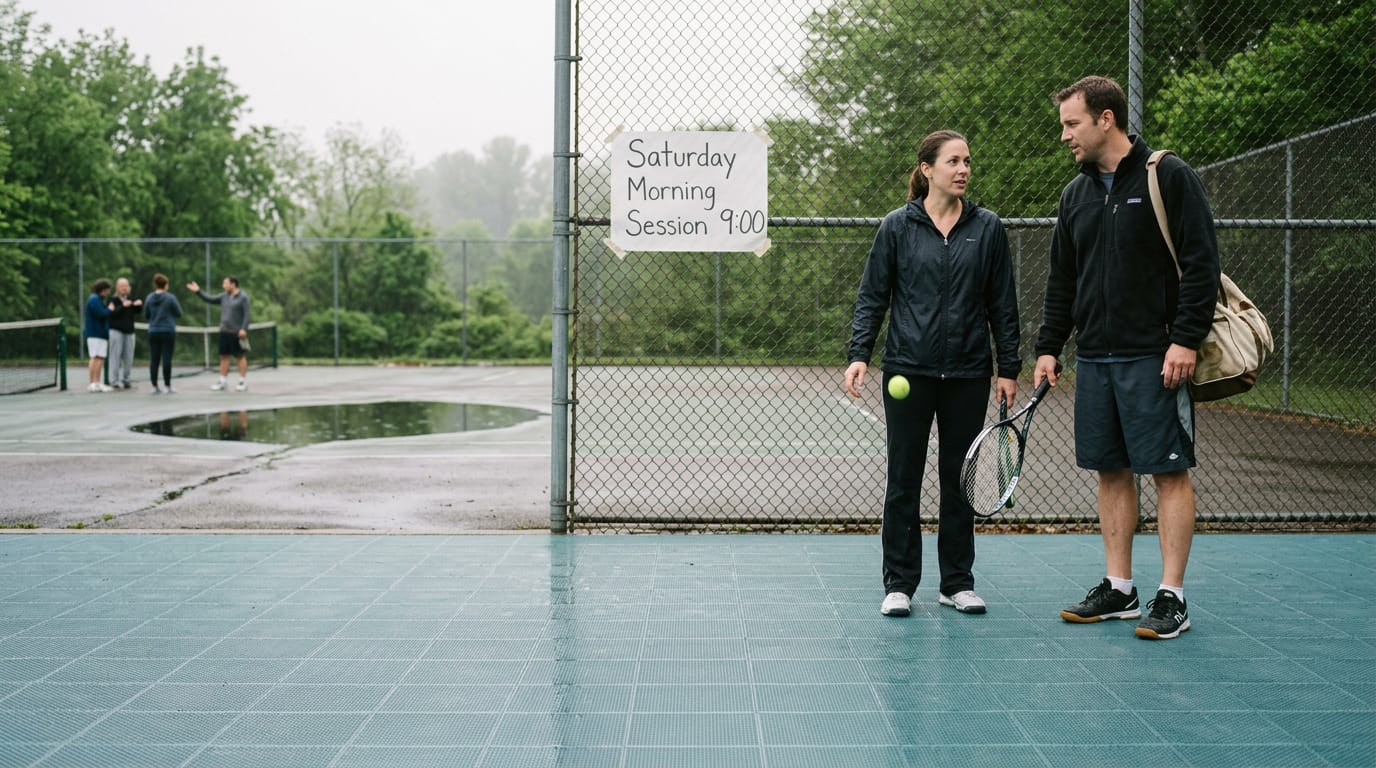
Consider a club running a Saturday morning session on an outdoor court. After one overnight storm, the surface stays puddled into the afternoon and the group cancels.
A court built to drain would have been ready for the first serve, and nobody loses their booked hour.
Playing Outdoors When the Wind Picks Up
Wind changes the game fast. Here’s how it affects the shuttle and how to site your court so skill, not gusts, decides the match.
How wind moves the shuttlecock
According to a study of shuttlecock velocity decay, a shuttlecock weighs about 5 g and is elongated, so it runs into strong drag, the air resistance that slows it and keeps it stable in flight.
Even a light breeze curves the path, and a stiff gust can turn a skilful rally into a lottery. Think of a club player who spent all winter sharpening her drop shot, only to watch it drift wide on a gusty Sunday.
It’s less about how you hit and more about where the breeze takes the shuttle.
Outdoors, plastic shuttles hold their line better than feathers. A study of a new synthetic shuttlecock reported straighter flight trajectories for the synthetic design.
Where and how to place your court
Look for a spot in the lee of a building or solid boundary, the sheltered side away from the wind. Then run the long axis across the prevailing wind, the direction the breeze usually comes from, so shots aren’t fighting a headwind or tailwind.
No solid wall? A hedge is more effective than an open fence, which lets gusts pass straight through.
Consider a parent who sets up a backyard court beside the garage, runs it across the prevailing wind, and gets the kids rallying all afternoon instead of chasing shuttles across the lawn.
Plan for shelter rather than hope. A sheltered court keeps the game about your skill, not the weather.
Sharing One Court with Other Sports
If your floor has to do double duty, the badminton court can share it with other games. Here’s what that takes and what to plan for.
Setting up badminton and pickleball together
Good news: both courts are identical. Each measures 13.40m x 6.10m, so one slab carries both sports, and the combination court is the result.
Consider a weekend player who splits Saturdays between a badminton match and a pickleball game on the same surface. The lines and floor stay put, so only the net has to change.
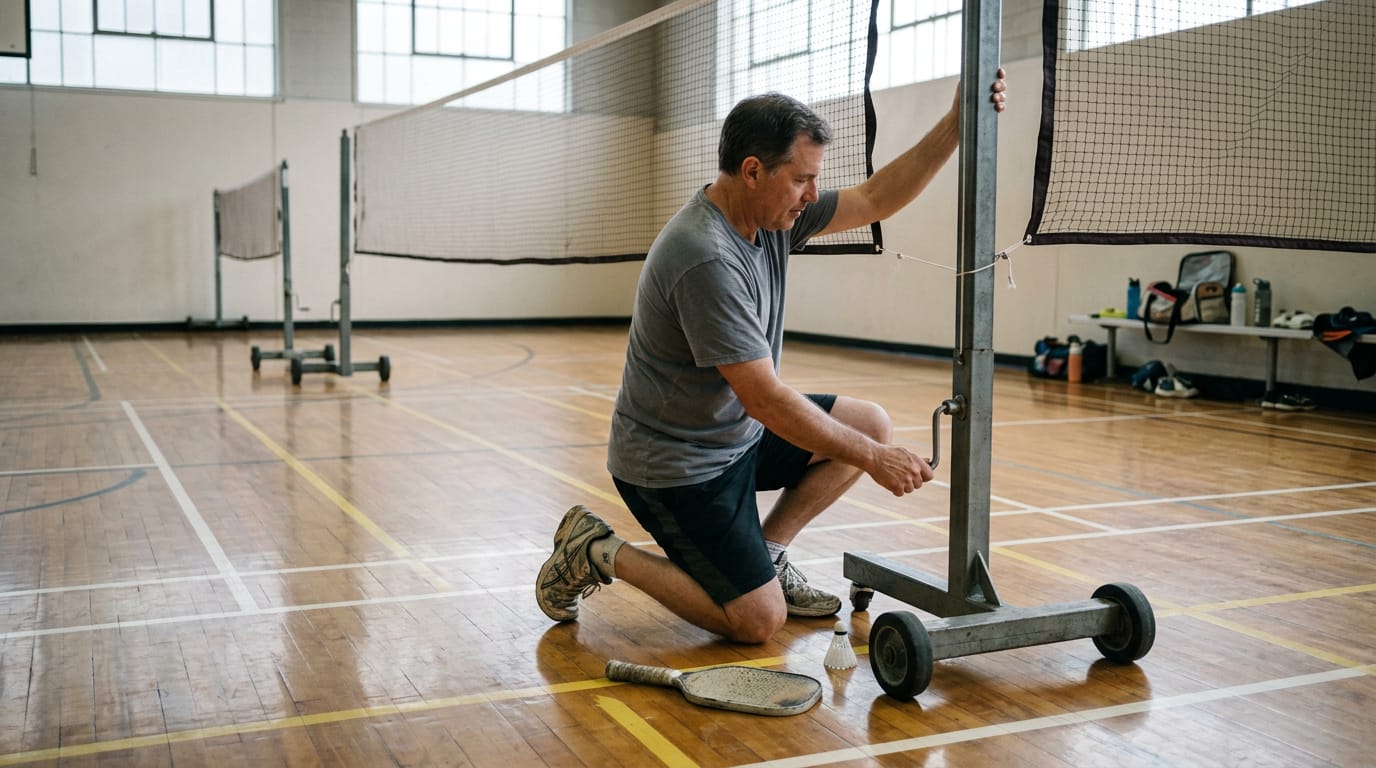
Here’s where the setup matters. A pickleball net sits at 36in, while a badminton net sits at 1.524m, so you’ll need adjustable or second net posts. The court stays put; the net is what moves. Get the posts right first.
Adding more sports to the same court
A third set of lines adds junior tennis, so the same surface can host three games. Think of a parent whose kid plays junior tennis on Tuesdays while the family’s badminton group uses the floor on Thursdays.
One court with lines for each sport covers both without a second surface.
Pickleball is unaffected by wind, which is a relief if your court sits outdoors. A combination court is always playable. Whichever sport shows up, the floor is ready. One surface, many games.
How AirBadminton Changes the Court
AirBadminton uses a longer court and a few built-in changes. Here’s what’s different and what it means on court.
What makes the AirBadminton court different
The most obvious change is length. An AirBadminton court measures 16 metres (about 52 feet), compared with 13.4 metres (about 44 feet) for an indoor court. That extra room gives every rally more space to develop.
The court also has a dead zone, which compensates for how the AirShuttle behaves.
AirBadminton courts can be set up on:
- grass
- hard surfaces
- sand
The posts can sit up to 1 metre (about 3 feet) outside the sidelines, which helps when you’re fitting a court into a yard or a park.
Think of a parent setting up a court in the backyard for the kids. With the posts pushed wider, they get room to move without the court feeling cramped.
Gameplay changes with the AirShuttle
The dead zone shapes your strategy. It rewards strokes away from the net rather than at it, so you’ll want to think about where the shuttle goes, not just how hard you hit it.
Sand courts also get a lowered net, a simple tweak meant to keep rallies going. Longer rallies are the goal.
Because the court is longer, the shuttle stays in play longer. Consider a club player used to indoor courts stepping onto an AirBadminton court for the first time. She’ll notice the rallies run longer, so she’ll want to pace herself from the start.
The format also supports doubles and triples, so you can play with a partner or a bigger group of friends.
Once you know where the lines go, the rest of the setup gets a lot easier. Measure the court correctly, leave room for run-off, and pick a surface and gear that fit the space you’re actually using.
Good setup disappears once the rallies start. Players stop thinking about the boundaries and focus on the shuttle, which is exactly the point of getting the measurements right in the first place.
References
- Shuttlecock velocity decay after smash and slice shots in badminton — iopscience.iop.org (2026)
- Impact of a new synthetic shuttlecock on badminton performance and player perception — doi.org (2025)
- RETRACTED ARTICLE: A smart position optimization scheme for badminton doubles based on human–computer interactive training in wireless sensor networks | Journal on Wireless Communications and Networking — link.springer.com (2020)
- Badminton Court Dimensions and Boundary Lines — sportrules.org (2026)
- BADMINTON RULES (1):COURT AND COURT EQUIPMENT | VICTOR Badminton — test1.victor-europe.com (2025)
- BadmintonAlpha — badmintonalpha.co.uk
- How To Play Air Badminton????? — badmintoncafe.com
- Ceiling and Venue Obstructions | Badminton — sportrules.org (2026)
Questions
What is the little ball called in badminton?
The little ball used in badminton is called a shuttlecock, or simply a shuttle. It is also sometimes called a birdie.
How tall is a badminton court?
A badminton court has no fixed height. For indoor competition, up to 9 metres of clear space above the court may be required; the net is 1.55 metres high at the posts and 1.524 metres at the centre.
Is 5'7" good for badminton?
Yes. A height of 5'7" is perfectly suitable for badminton; players of many heights can play and succeed. Footwork, timing, technique, and fitness matter more than height alone.
What does 1u, 2U, 3U, 4u mean in badminton?
The U ratings indicate a racket’s weight class: 1U is the heaviest and 4U is lighter, with higher numbers generally meaning lighter rackets. Typical ranges are about 95–99 g for 1U, 90–94 g for 2U, 85–89 g for 3U, and 80–84 g for 4U, excluding strings and grip.
Is badminton 15 or 21 points?
Badminton is usually played to 21 points per game using rally scoring, where a point is awarded on every rally. A match is generally best of three games; 15-point games belonged to older scoring rules.
Is a pickleball court the same size as badminton?
A pickleball court and a doubles badminton court have the same overall dimensions: 20 by 44 feet. Their line markings and net heights differ, so a shared court needs clearly distinguishable lines and an appropriate net.
Is a badminton court 20 feet by 44 feet?
Yes. A standard doubles badminton court is about 20 feet by 44 feet; the exact dimensions are 20 by 44 feet (6.10 by 13.40 metres). A singles court uses the same length but is narrower.
Is ball badminton a sport?
Yes. Ball badminton is a sport, traditionally played in India with a yellow wool ball and wooden rackets. It is distinct from badminton, which uses a feather or synthetic shuttlecock.
Sources
- RETRACTED ARTICLE: A smart position optimization scheme for badminton doubles based on human–computer interactive training in wireless sensor networks |, link.springer.com,
- Badminton Court Dimensions and Boundary Lines | Sport Rules, sportrules.org,
- BadmintonAlpha - Badminton Court Dimensions, badmintonalpha.co.uk
- BADMINTON RULES (1):COURT AND COURT EQUIPMENT | VICTOR Badminton | Europe, test1.victor-europe.com,
- How To Play Air Badminton????? - Badmintoncafe, badmintoncafe.com
- Ceiling and Venue Obstructions | Badminton | Sport Rules, sportrules.org,
- Shuttlecock velocity decay after smash and slice shots in badminton - IOPscience, iopscience.iop.org,
- Impact of a new synthetic shuttlecock on badminton performance and player perception, doi.org,
Find your level
The Counter