Platform Tennis Explained: Rules, Gear, and Strategy
Platform tennis uses a screened court and solid paddles, so tennis gear won’t fit. Compare rules, choose balls and shoes, and find leagues to play.

Think about the first time you bought running shoes. The pair that fits your stride gets you through a full season, while the one that looks good on the rack often doesn’t. Buying platform tennis gear works the same way.
Platform tennis is a racket sport closely related to tennis, but the court, the rules and the equipment are different enough that you can’t just grab your old tennis racket and head out.
In this guide, we’ll cover what the sport is and how it differs from tennis, then walk through the paddles, balls and shoes that suit your level.
Platform Tennis Basics and Winter Play
If you’ve played tennis, platform tennis will feel familiar, but it’s built for the cold months. Here’s how we’ll break it down.
Sport basics and where it started
Platform tennis is a racquet sport for winter play and a distinct brand of tennis. Most tennis rules still apply, so the basics feel familiar. It’s tennis in spirit, but built for winter in practice.
According to the Platform Tennis Museum and Hall of Fame, the sport was invented in Scarsdale, New York, in the fall of 1928, when neighbors Jimmy Cogswell and Fess Blanchard went looking for an outdoor winter sport close to home.
How the court handles cold and snow
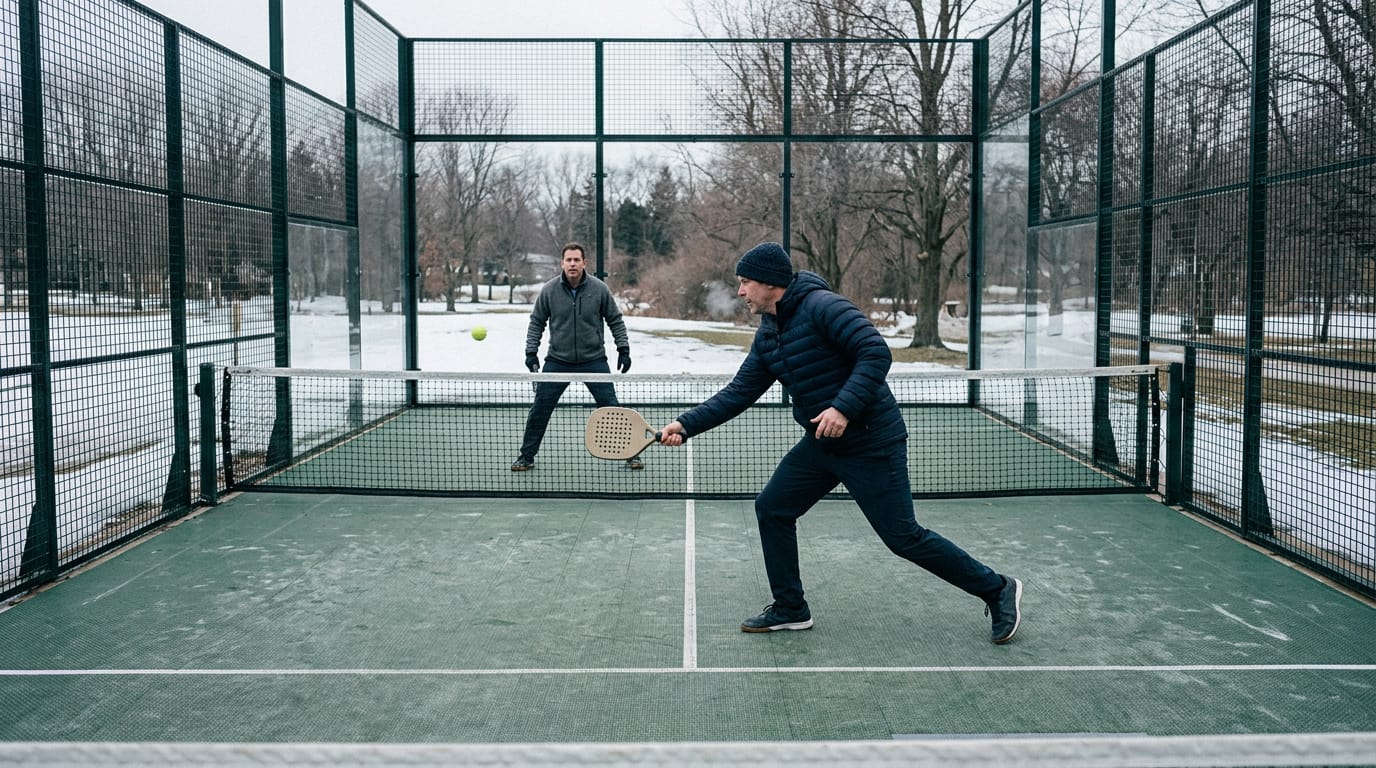
Winter is the whole point. According to the Lubbock racquets record, the raised platform lets snow pass through its wood planks, which helps clear it from the playing surface.
Several features make the court work in winter:
- Small court. It’s easy to clear.
- Propane heaters. They sit under the surface to add warmth.
- Floodlights. They make night play possible.
More and more players are picking it up each year. Think of a weekend player in a snowy January who wants a Saturday match. The snow falls through the planks, and the floodlights let the game run after work. Snow doesn’t have to end the match.
The debate over paddle or platform
Some players say paddle tennis instead of platform tennis, and that’s part of an ongoing name debate. Expect to hear both.
Is paddle tennis different from pickleball? Yes. Pickleball is its own sport, so don’t assume they’re the same game.
How the Rules and Court Differ
If you already play tennis, the court will look familiar at first glance, but a few rules split the two games apart. Here’s where they diverge.
Court size and the screen walls
A platform tennis court measures 44 feet by 20 feet. A tennis court measures 78 feet by 36 feet, and a racquet club in Lubbock, Texas describes its singles court as 78 feet long and 27 feet wide.
The most visible difference is the screen walls. A platform court is surrounded by screens rather than open space, and the reason is practical.
According to the sport’s own overview, players got tired of pulling balls out of snow banks, so they put up chicken wire fencing.
One serve, no lets, net clips count
Platform tennis allows only one serve. Miss it and the point is over, which is why the serve is often called the great equalizer. Think of a weekend tennis player who’s used to a second serve to fall back on.
On a platform court, a reliable first serve matters more than a big one.
There are no service lets, so a serve that clips the net is live. If it still lands in the court, play goes on with no replay.
Playing the ball off the screens
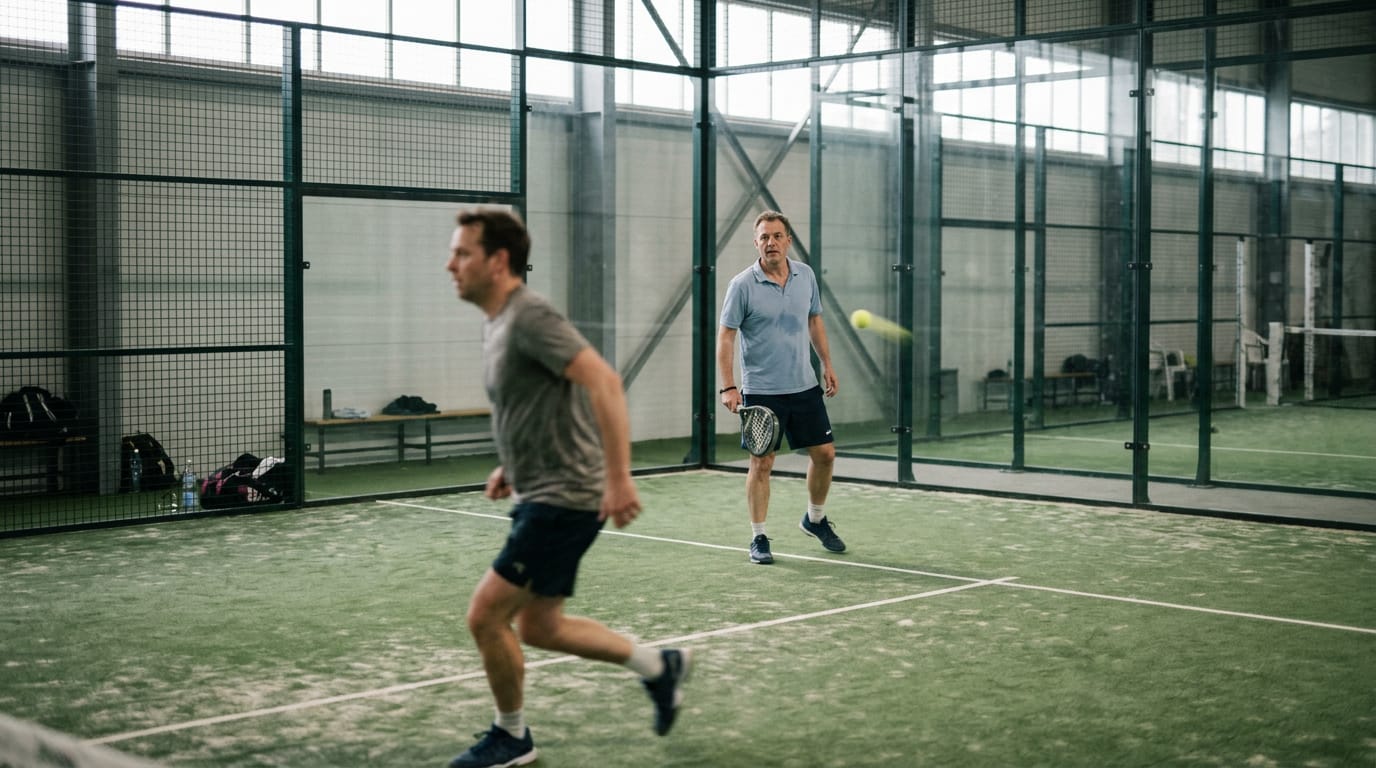
Here the screens are part of the game, not the edge of it. The ball can hit a screen after it bounces, and you’re still allowed to return it as long as you play it before its second bounce.
This is the biggest difference from tennis, and it’ll take a while to get used to.
For example, a first-timer might hit a clean return, watch it carom off the back screen, and freeze, not realizing the ball is still in play. Keep your feet moving until the ball is actually out of play, and you’ll handle those rebounds far better.
Where to find the official rules
The full rulebook lives on the league’s website, so check the rules page before your first match. Read the scoring and tiebreak documents too, since they spell out exactly how games and tiebreaks are counted.
Balls and Paddles You’ll Need
Your ball and paddle shape every rally, so know what to look for before you check out.
How the ball compares to tennis
A platform tennis ball is the same size as a tennis ball, but heavier: over 2.5 ounces versus about 2 ounces. It’s solid rubber, not hollow, and it’s covered in felt.
A customs ruling on imported platform tennis balls describes that construction: a solid rubber core under a smooth flock coating.
Match your ball to the temperature you’ll play in, especially in winter. Think of a weekend player bundling up for a cold-morning match: warm gloves she can still grip the paddle with, layers she can shed between games, and the right ball for the day.
She stays loose instead of shivering through the second set.
Paddle size, material and buying tips
Paddles are usually 18 inches long, and they’re made from composite materials. According to a Platform Tennis Hall of Fame document, graphite, carbon fiber and titanium have made paddles lighter, stronger and easier to play with since 1995.
Some composites are finished to mimic the look of wood, but the materials underneath are modern.
Choose by level: newer players should favor control, while more experienced players can weigh feel and power more carefully.
Demo paddles before you buy. Swing several in the shop or on a court if they allow it, and skip any that tire your arm after a few minutes. Fit beats brand.
For shoes, wear court shoes with good grip and side support, since you’ll be stopping and pivoting quickly. Running shoes built for straight-line miles are a poor match for that.
Winning Strategy and Shot Technique
Platform tennis rewards patience more than power, and that’s the first thing to unlearn if you’re coming from tennis. Here’s how the strategy shifts, plus the shots worth practicing first.
How the strategy differs from tennis
Great tennis players don’t always transfer. Strong tennis skills help, but the habit of going for the big shot can backfire when the walls keep the rally going longer than you expect.
Winners are rare. Most points end on an error, so the game is less about hitting winners and more about avoiding mistakes. Your job is to keep the ball in play until your opponent cracks first.
- Minimize your own mistakes. Keep the ball deep and low, and don’t rush a shot you don’t need to take.
- Force opponent errors. Make your opponents hit from the back of the court or off the wall, and let them be the one taking the risk.
Tips and pro lessons for better shots
Once the strategy clicks, these resources help you practice the shots that support it:
- Tip of the week videos. Short clips give you one idea at a time, so you can try it in your next session instead of fixing everything at once.
- Backhand roller lesson. A focused lesson breaks one shot into steps you can drill on your own before you try it in a match.
- Push overhead strategy. When a ball comes over your head, pushing it deep and under control keeps the rally alive instead of swinging hard and handing your opponent an easy ball.
- Pro-led instruction. A pro can see your grip and footwork and correct them in real time, something a video can’t do.
Consider a weekend player who watches the backhand roller lesson on Tuesday, drills it during warm-ups on Saturday, and is still keeping rallies alive in the third set. Pick one shot at a time.
Joining Leagues and Tracking Ratings
Joining a league is the fastest way to get up to speed with players at your level.
How local leagues are organized
Local leagues have a few main parts, and details vary by club, so confirm them with your organizer.
- Divisions group teams by night and time, so you can pick one that fits your schedule.
- Standings track team points across the season.
- Weekly schedule tells you when and where to show up.
- Box and casual play offer a looser way to get on court.
- Tournaments are the bigger events on the calendar.
Consider a weekend player who joins the division that meets on her free night. She knows when to show up and builds a regular partner group without juggling her calendar. Leagues are about showing up as much as winning. Missing a scheduled match can even decide the result, which is what a walkover in tennis covers.
How PTI ratings and ladders work
The Platform Tennis Index (PTI) is used to rate players. According to the PTI explainer on the Platform Tennis website, it was developed by volunteers with the American Platform Tennis Association (APTA) to gauge skill level from match data.
Your number follows your results, not your potential. Every match counts.
The PTI algorithm changed in 2024, so check the ratings page before comparing numbers from before that update.
The King of the Hill ladder is a separate ranking you can follow alongside your PTI.
Beat the Pros and other club events
Beat the Pros is a challenge that lets you test your game against stronger players. Think of a parent who plays on weekends and wants a clear read on her level. Signing up gives her a benchmark, and one tough match teaches more than a dozen easy ones.
Add other club events to your next event list so they don’t slip past you.
Forms, scores and absence guidance
- Recording scores keeps standings accurate and feeds the match data behind your PTI, so report every result.
- Absence guidance tells you what to do if you can’t make a match, so your team can plan ahead.
- Locations and directory help you find courts near you before you pick a league.
- Forms hold the sign-up and reporting paperwork, so have them handy when you register.
Watching the APTA Tour and Nationals
Want to see the best players without leaving home? Here’s where to watch the American Platform Tennis Association (APTA) tour, how to follow scores live, and who won the latest national titles.
Where to watch matches live online
Picture a weekend player studying how top teams handle tough rallies, then trying it in Saturday’s game. Coverage has grown in a few clear ways:
- More courts and earlier rounds. You’ll find more courts streamed and earlier rounds too, so you can catch matches before the final.
- More commentary. Broadcasts add commentary, so the action makes more sense.
- More stats and info. Expect more on screen, so you can see how a point was won, not just who won it.
- APTA Network on YouTube. The APTA Network on YouTube lets you watch from your phone or TV.
Grab your phone and you’re courtside.

Following scores and stats live
Can’t watch the whole match? Checking the live scoring site over lunch tells a club player how the pair they’re cheering for is doing.
- Court Director stats and scores. Stats and scores come through Court Director, so you can check in without waiting.
- APTA investment in scoring. The APTA has invested in scoring, a sign the tour takes live numbers seriously.
- Live scoring site. It puts results in one place, so you know where a match stands, not just how it ended.
Latest national champions and results
- 2026 Men’s National Champions. According to the APTA’s congratulations post, Alvi Regalado and Jose Salazar took the title in a 3-hour, three-set match over Guillermo Nunez and Marc Powers, 6-7, 6-3, 6-4.
- First Nationals experiences. Heading to your first Nationals? Watching the results shows the level you’ll face before you step on court.
- Young teaching pros on tour. Keep an eye on the young teaching pros on tour, and watch how they play, not just who wins.
The People and Honors Behind the Sport
Platform tennis is shaped as much by its people as by its courts. Here’s who the sport honors, which players are worth following, and where we’d send you for the official news.
Hall of Fame inductees and tributes
The Platform Tennis Hall of Fame has a new inductee for its Class of 2027: Stephen Mitchell. The APTA’s announcement of his election was made on behalf of its Hall of Fame Nominating Committee, so it’s the best place to read the official wording.
Every inductee helped shape the game before you ever picked up a paddle, so the Hall is also a way to look back. Recognition counts.
For the latest Masters Nationals winners, start with the APTA’s own announcements.
Meet the players on tour
Following the tour is less about memorizing names and more about recognizing them when they come up at your club. Profiles of tour players give you the background, and the regular spotlight series means there’s always a new name to learn.
Think of a club player who reads a tour profile one week, then hears that same name at the Saturday mixer. Now she has something real to talk about, and that’s the payoff.
Board thanks and sponsor presence
The APTA also thanks retiring board members, a small but meaningful way to show that leadership changes are noticed. Sponsors have a presence in this material too, so you can see who’s backing the sport as you read.
Official posts from the APTA’s account are the most direct source for all of it, and they live at platformtennis.org.
Platform tennis rewards players who understand the sport, from the court and rules to the gear that matches their level.
Whether you’re a parent outfitting a kid for a new season, a weekend player buying your first paddle, or a serious amateur checking whether this year’s model is actually better, the principle is the same: buy for the player you are today.
Get the gear right, and the only thing you’ll think about is the next point.
References
- A raquet club for Lubbock, Texas — hdl.handle.net (1978)
- Customs Ruling NY N065027 - The tariff classification of platform tennis balls from Taiwan — customsmobile.com
- Lubbock racquets — hdl.handle.net (1982)
- Congratulations to the 2026 APTA Men’s National Champions — platformtennis.org (2026)
- Congratulations to Stephen Mitchell—Class of 2027 Platform Tennis Hall of Fame — platformtennis.org
- What is Platform Tennis — old.platformtennis.org
- Manufacturing Your Equipment What You Should Know Ke lipps Alivu then Play — platformtennishalloffame.org
- Platform Tennis Index — platformtennis.org
- History of the Game — platformtennishalloffame.org
Questions
Where was platform tennis invented?
Platform tennis was invented in Scarsdale, New York, in the fall of 1928. Neighbors Jimmy Cogswell and Fess Blanchard created it as an outdoor winter sport.
What shoes do you wear for platform tennis?
Wear court shoes with good grip and lateral support for quick stops, pivots, and changes of direction. Running shoes are less suitable because they are designed mainly for straight-line movement.
Is paddle tennis different than pickleball?
Yes. Paddle tennis and pickleball are separate sports, with different equipment, courts, and rules, even though their names and paddle-style play can sound similar.
Is it illegal to play pickleball on a tennis court?
No. Pickleball can be played on a tennis court, usually with temporary lines and a portable net or adjusted tennis net. Players should check the facility's rules and use a court designated for pickleball when required.
Sources
- Lubbock racquets, hdl.handle.net,
- What is Platform Tennis, old.platformtennis.org
- A raquet club for Lubbock, Texas, hdl.handle.net,
- Customs Ruling NY N065027 - The tariff classification of platform tennis balls from Taiwan, customsmobile.com
- Manufacturing Your Equipment What You Should Know Ke lipps Alivu then Play, platformtennishalloffame.org
- Platform Tennis Index – Platform Tennis, platformtennis.org
- Congratulations to the 2026 APTA Men’s National Champions – Platform Tennis, platformtennis.org,
- Congratulations to Stephen Mitchell—Class of 2027 Platform Tennis Hall of Fame – Platform Tennis, platformtennis.org
- History of the Game | Platform Tennis Museum and Hall of Fame, platformtennishalloffame.org
Find your level
The Counter